
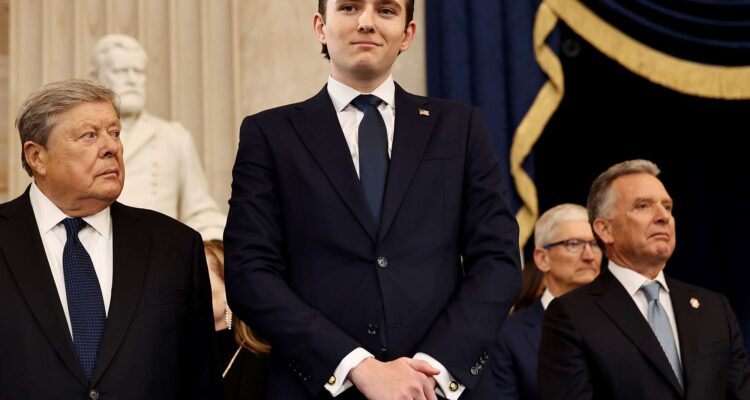
Iran offers $10 million bounty for assassination of Trump’s son

Iranian state television airs threat against Barron Trump while offering $10 million reward.

By World Israel News Staff

Iranian state television has broadcast a threatening segment focused on President Donald Trump’s son Barron, depicting purported efforts to track his movements and penetrate his security while referring to a $10 million reward for reaching him.

The roughly three-minute segment marks an escalation in increasingly explicit Iranian threats against Trump and members of his immediate family, coming less than a month after another regime-linked video targeted first lady Melania Trump and ended with a direct warning to her son.

The latest broadcast features images of 20-year-old Barron Trump alongside dramatized scenes of surveillance and online tracking.

Graphics shown during the segment purport to map people and locations associated with the president’s son and suggest efforts to identify vulnerabilities in the Secret Service protection surrounding him.

The report also refers to a $10 million reward and, near its conclusion, claims that “many would be willing” to accept the money.

There is no publicly available evidence that Iranian operatives have successfully penetrated Barron Trump’s security or obtained the type of sensitive information implied by the broadcast.

In late July, Iran’s Tasnim News Agency, an outlet closely connected to the Islamic Revolutionary Guard Corps, released a separate video centered on Melania Trump.

  WATCH: What a former IRGC soldier thinks about the faltering regime in Iran

That video examined the first lady’s movements in New York, stores she reportedly frequents and aspects of her security arrangements.

It suggested that individuals close to her could be recruited or bribed and encouraged so-called “freedom fighters” to target her.

The video concluded with an explicit warning.

“This is just the beginning; Barron Trump, wait for us!”

The US Secret Service said at the time that it was examining the threat.

“The Secret Service is aware of the video and investigates anything that can be perceived as a threat toward our protectees,” agency spokesman Nate Herring said, while declining to discuss protective intelligence measures.

Tasnim is not merely a private Iranian media organization with sympathetic views toward the government. The US Treasury sanctioned the agency in 2023, saying it had been founded by two IRGC commanders and remained under the Revolutionary Guards’ influence.

According to the Treasury Department, Tasnim has assisted the Iranian government and security forces in identifying dissidents and protesters and has acted on behalf of the IRGC.

The latest threat comes amid an already extensive history of Iranian threats and alleged assassination plots targeting Trump and other senior American officials, particularly those Tehran holds responsible for the January 2020 US strike that killed Quds Force commander Qasem Soleimani.

  WATCH: How Iran’s shadow oil fleet evades sanctions to fund terrorism

In November 2024, the US Justice Department charged an alleged Iranian government asset, Farhad Shakeri, in connection with multiple murder-for-hire schemes and said the IRGC had tasked him with developing a plan to assassinate Trump.

Then-Attorney General Merrick Garland said the case demonstrated Iran’s efforts to conduct assassination operations abroad, including against the incoming president.

The charges, Garland said, involved an Iranian regime asset directed to advance assassination plots “including President-elect Donald Trump.”

According to the criminal complaint, an IRGC official instructed Shakeri in October 2024 to produce a plan to kill Trump within seven days. Shakeri told investigators that Iranian officials had indicated money would not be an obstacle to carrying out the attack.

US authorities have documented other alleged Iranian plots as well.

In 2022, the Justice Department charged IRGC member Shahram Poursafi with attempting to arrange the assassination of former national security adviser John Bolton, allegedly as retaliation for Soleimani’s killing.

Prosecutors said Poursafi offered $300,000 for Bolton to be murdered in the Washington area.

The threats have taken on a more public character during the current US-Iran conflict.

Anti-American rallies in Iran have featured calls for Trump’s death, while threatening images of the president and members of his family have appeared on public displays.

  US military seeking ‘unconventional ways’ to punish Iran – report

Iranian hardliners have repeatedly demanded retaliation against American officials following the deaths of senior Iranian political and military leaders in US-Israeli strikes.

Trump has responded to previous assassination threats with warnings that any Iranian attempt against him would trigger overwhelming US retaliation.

Israel conquered the Golan Heights in the Six-Day War, annexing the area by law in 1981. UN Security Council resolution 497, passed only days later, rejected the annexation as “null and void.”

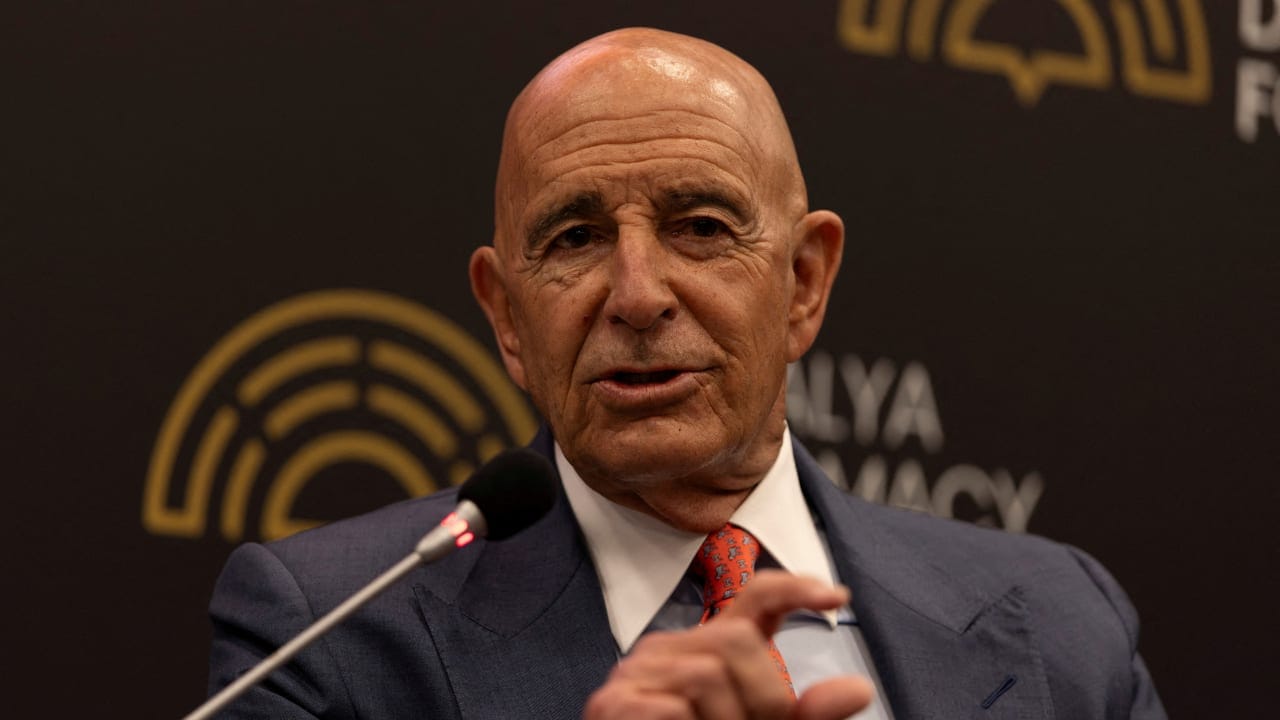
US Special Envoy for Syria and Ambassador to Turkey Tom Barrack speaks during a session at Antalya Diplomacy Forum in Antalya, Turkey, April 17, 2026.
(photo credit: REUTERS/UMIT BEKTAS/FILE PHOTO)
The US ambassador to Turkey and special envoy to Syria and Iraq, Tom Barrack appeared to reverse his previous comments on the status of the Golan Heights in recent days, backing the US recognition of the area as Israeli territory in a statement to the Associated Press on Sunday.

“United States policy on the Golan was set by President Trump in 2019 and is unchanged,” he said, contradicting his claim in an interview with Mario Nawfal on Friday where he stated that Israel occupies the Golan Heights.

“They still occupy the Golan against the UN resolutions, against all of the international order, which has said the Golan is Syria’s,” Barrack said then, despite the US having recognized the area as Israeli for almost a decade.

The interview took place against the backdrop of Israel’s strike on the Abu al-Duhur military airfield in Idlib last week. Israel claimed that Turkish troops were ready to deploy at the base, a claim that Turkey denied.

yrian negotiations primarily on Israeli withdrawal from areas besides Golan

Israel conquered the Golan Heights in the Six-Day War, annexing the area by law in 1981. UN Security Council resolution 497, passed only days later, rejected the annexation as “null and void.”

VIEW OF snow on Mount Hermon in Syria, as seen from the northern Golan Heights, in Jan.
VIEW OF snow on Mount Hermon in Syria, as seen from the northern Golan Heights, in Jan. (credit: FLASH90)

In 2019, Trump recognized the Golan Heights as Israeli, as a part of pro-Israel moves including the recognition of Jerusalem as Israel’s capital and moving the US embassy there.

Syria never rescinded its claim to the Golan Heights, and after Ahmed al-Sharaa took power in December of 2024, the question the area’s status entered the spotlight once again.

During negotiations between Israel and Syrian officials in Jordan on Sunday, the Syrian delegation asked to separate negotiations over the Golan Heights, appearing to prioritize the matter of Israel’s withdrawal from areas captured after December 2024.

Barrack said strike on Syria may have been political

Barrack condemned Israel’s strikes on the Idlib airbase, calling them “serious and worrisome.”

In Friday’s interview, Barrack suggested that Israel may have intended to provoke a faceoff with Turkey through its strike. Barrack also said the strike could have had political motives, with Israeli elections scheduled for October.

Following the attack, Barrack said the US would work to establish a deconfliction mechanism between Israel, Turkey, and Syria, insisting that increased communication would be necessary to prevent violence.

“Syria has demonstrated itself to be a responsible and stable sovereign neighbor, and a carefully structured de-escalation arrangement would contribute significantly to greater calm and predictability across the region,” Barrack told The Jerusalem Post.

Amichai Stein and Reuters contributed to this report.


The Midnight Dispatch


The invitation has not yet been officially confirmed by Iran’s Foreign Ministry or by any of the three countries that are parties to the agreement.

Turkish President Tayyip Erdogan, Saudi Crown Prince Mohammed bin Salman, and Pakistan's Prime Minister Shehbaz Sharif pose after signing a joint defence agreement in Mecca, Saudi Arabia, August 7, 2026.
Turkish President Tayyip Erdogan, Saudi Crown Prince Mohammed bin Salman, and Pakistan’s Prime Minister Shehbaz Sharif pose after signing a joint defence agreement in Mecca, Saudi Arabia, August 7, 2026.
(photo credit: Saudi Press Agency/Handout via REUTERS)
Iran has been invited to join the Mecca Agreement for Mutual Defense, the new security alliance established by Saudi Arabia, Turkey and Pakistan earlier this month, Al Mayadeen reported on Saturday, citing a senior Iranian official.

The invitation has not yet been officially confirmed by Iran’s Foreign Ministry or by any of the three countries that are parties to the agreement.

Mehdi Rahimi, head of the Iranian parliament’s Khaneh Mellat news agency, told the channel that “Iran has received an invitation to join the Mecca Agreement, and the matter is under review.”

Rahimi added that countries in the region “are moving toward seeking a regional security umbrella,” and claimed that this represented “a victory for Iran, because it has been calling for this for a long time.”

The Mecca Agreement was signed on August 7 by Saudi Crown Prince Mohammed bin Salman, Turkish President Recep Tayyip Erdogan and Pakistani Prime Minister Shehbaz Sharif.
Turkish President Tayyip Erdogan meets Saudi Crown Prince Mohammed bin Salman, ahead of the expected signing of a defence deal between Saudi Arabia, Pakistan and Turkey, in Mecca, Saudi Arabia, August 7, 2026.
Turkish President Tayyip Erdogan meets Saudi Crown Prince Mohammed bin Salman, ahead of the expected signing of a defence deal between Saudi Arabia, Pakistan and Turkey, in Mecca, Saudi Arabia, August 7, 2026. (credit: Murat Cetinmuhurdar/Turkish Presidential Press Office/Handout via REUTERS)

The agreement establishes a principle of mutual defense under which an attack on any one of the three countries would be considered an attack on all of them. Turkish Foreign Minister Hakan Fidan compared the mechanism to Article 5 of the NATO treaty, but stressed that the agreement was not directed against Iran or any specific country.

The member states have already begun developing mechanisms for diplomatic and military coordination, including meetings among foreign and defense ministers and military commanders, joint exercises, and cooperation between their defense industries.

Alliance could expand to include more countries

Turkey has said the alliance could expand to include additional countries. Egypt has been publicly mentioned as a possible candidate for membership.
Iran has so far responded to the agreement with cautious approval. Iranian Foreign Ministry spokesman Esmaeil Baghaei said on August 10 that Tehran had “no reason for concern” over the establishment of the alliance.

According to Baghaei, the move reflects growing recognition among countries in the region of the need to build regional security mechanisms.

If the claim that Iran was invited is officially confirmed, Iranian membership would significantly alter the character of the alliance, which was established by three countries with close security ties to the West, and would turn it into a substantially broader regional framework.