Iran is “looking for a good, stable and strong agreement, but if the other party talks about plan B, we also have plan B,” Iranian Foreign Minister Abdollahian said.
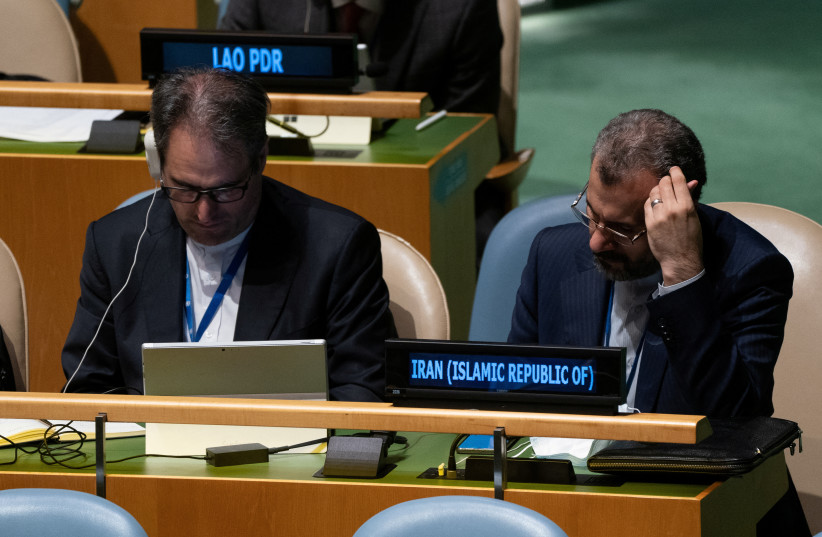
 Delegates from Iran attend the Nuclear Non-Proliferation Treaty review conference in New York City, New York, US, August 1, 2022. (photo credit: REUTERS/DAVID 'DEE' DELGADO)
Delegates from Iran attend the Nuclear Non-Proliferation Treaty review conference in New York City, New York, US, August 1, 2022.
(photo credit: REUTERS/DAVID ‘DEE’ DELGADO)

Iran made a counter-offer to the European Union’s “final” draft to renew the 2015 nuclear deal, just at Brussels’s deadline to do so at midnight on Monday.

Iran’s response, as one diplomatic source put it, was a “yes, but,” rather than keeping with the EU’s “take it or leave it” formulation. Tehran essentially responded to the EU’s deadline by trying to extend it and continue negotiations, the source said.

The Islamic Republic called for greater guarantees that US sanctions would be lifted and would not disrupt economic activity.

In addition, they did not mention its demand for the International Atomic Energy Agency to cancel its investigations into traces of nuclear material found at undeclared sites in Iran. The EU draft states that if Iran gives credible responses as to the origin of those traces by the time the nuclear deal is meant to be implemented, then it will not oppose the probe’s closure.

Iran did not reject or accept that offer in its response, according to diplomatic sources.
US Special Envoy to Iran Rob Malley seemed to allow for the compromise in the EU draft, saying in an interview on Friday that the probes “will be closed when Iran provides the technically credible answers that the IAEA has requested of them…but not before.”

Mohammad Marandi, a spokesperson for Iran’s nuclear-negotiating team, told Al Jazeera Arabic that they are “not far from an agreement.”

“Iran has expressed its concerns in its response, but…remaining issues are not very difficult to resolve”

Mohammad Marandi

“Iran has expressed its concerns in its response, but…remaining issues are not very difficult to resolve,” Marandi said. “Those concerns are founded upon past US and EU violations. I can’t say there will be a deal, but we’re closer than we’ve been before.”

US State Department spokesman Ned Price said Monday, before midnight, that the US will provide its views on the EU’s final draft privately and directly to the bloc’s High Representative Josep Borrell, who is the coordinator of the Iran nuclear talks.

Iranian Foreign Minister Hossein Amir Abdollahian warned earlier in the day that Iran is “looking for a good, stable and strong agreement, but if the other party talks about plan B, we also have plan B.”

Abdollahian told Iranian journalists Tehran has “shown relative flexibility on two issues,” likely referring to demands for the US to remove the Islamic Revolutionary Guard Corps from its list of Foreign Terrorist Organizations and for the International Atomic Energy Agency to drop investigations into undeclared nuclear sites, which held up the negotiations for over five months. The US declined both demands, and the E3 – Britain, France and Germany – would not agree to the second.

Iran is “waiting for the flexibility of the American side in the third issue, which is guarantees,” Abdollahian said. He later added, in that vein, that the nuclear deal “has flaws like any other document, but the main flaw is that in the verification field, our commitments are fully investigated, but regarding the cancellation of sanctions, verification of the other party’s commitments is not very common.”

Comments made by Iranian Foreign Ministry spokesman Nasser Kanaani that though there was progress in recent nuclear talks in Vienna, the draft that the EU has called final “did not completely reach Iran’s legal demands.”

“Whether… this round of talks can [come] near an agreement depends on the other side, particularly the US, meeting Iran’s rightful demands,” he said.

Consultations were taking place at the highest levels in Tehran, Kanaani added.

The lead-up to the nuclear text

The 2015 Joint Comprehensive Plan of Action lifted sanctions on Iran in exchange for limitations on its nuclear program. These limitations would expire over time, ending in 2030, with restrictions on the manufacture of advanced centrifuges expiring next year. The Trump administration left the deal in 2018, opting for more sanctions instead, and the Biden administration began negotiating a return to the JCPOA early last year.

The EU, which coordinates the indirect talks between Iran and the US, said a draft it tabled earlier this month was final and that recent negotiations in Vienna were meant to deal with its technical aspects.

Reuters contributed to this report.


Iranian Foreign Minister Hossein Amirabdollahian said on Monday that his country would submit its final conclusion regarding the conditions for the revival of the 2015 nuclear deal on Monday night. In comments on Monday, Amirabdollahian said Iran was going to send its final conclusion about the JCPOA talks to the European coordinator in written form at midnight tonight. The foreign minister reiterated that if the US respects Iran’s red lines and guarantees that Iran will fully enjoy the economic benefits of the deal, the deal would be achievable.

State Department spokesperson Ned Price said on Monday that the US and its negotiating partners remain focused on the dangers of Iran’s nuclear weapons program. He told reporters that President Biden “has provided clear instructions to the team. We will not allow Iran to acquire a nuclear weapon. We continue to believe that diplomacy is by far the best, the most effective means by which to constrain, verifiably and permanently, Iran’s nuclear program.”

According to Ynet, Israel is afraid of last-minute American concessions, and has already made it clear to Washington that “We will not be bound by this agreement.”

Senior officials in Israel say that if Iran returns to the agreement, Israel would not be committed to it and would do everything in its power to sabotage the Iranian nuclear program and “make life miserable for them.”

Monday was the deadline for Iran to issue its response to a European Union proposal to revive the 2015 nuclear deal, which was signed by the U.S., Iran, Britain, France, Germany, Russia, and China after former President Trump had pulled out of that agreement in 2018.

As to Iran’s demands, before it rejoins the talks, Price said “The only way to achieve a mutual return to compliance with the [Joint Comprehensive Plan of Action] is for Iran to drop further unacceptable demands that go beyond the scope of the JCPOA.”

Those demands have to do with Iran’s insistence on limiting the International Atomic Energy Agency investigation into undeclared nuclear material in the country, for the US to take the Islamic Revolutionary Guard Corps off the terrorist list, and for the US and the EU to lift economic sanctions on the IRGC.

In the meantime, Israel is following with vigilance and concern the advanced contacts between Iran and the international powers towards a possible agreement to return to the nuclear agreement. Israel fears last-minute American concessions that would allow Iran to return to the agreement.

A dialogue has been taking place in recent days between the Americans and Israel, in which Israel is trying to prevent concessions and insists that the US would not renege on its commitments to Israel not to give in to the Iranians. The head of the National Security Council, Dr. Eyal Hulata, held talks on this issue with his American counterpart, Jake Sullivan.

The Israeli side is particularly afraid of an American concession regarding the “open cases,” those IAEA investigations that Iran wants to close. Israeli officials have been expressing behind closed doors their disappointment at the American conduct, feeling that the Americans “sedated Israel” and tricked it into thinking that there would be no return to the agreement.

Officials in Israel said that the Americans asked Israel “not to surprise them,” to which the Israelis replied: “Yes, we will surprise you. We are not committed to this agreement and think that returning to it is bad, and we will act against the Iranian nuclear program.”

Israel is concerned that the minute the Americans drop their objections to Iran’s additional demands, both countries would sign the deal immediately.


Syrian officer tells Reuters Iranian base and nearby air defense system hit in Tartus; Hezbollah posts near Damascus also struck, sources tell news agency

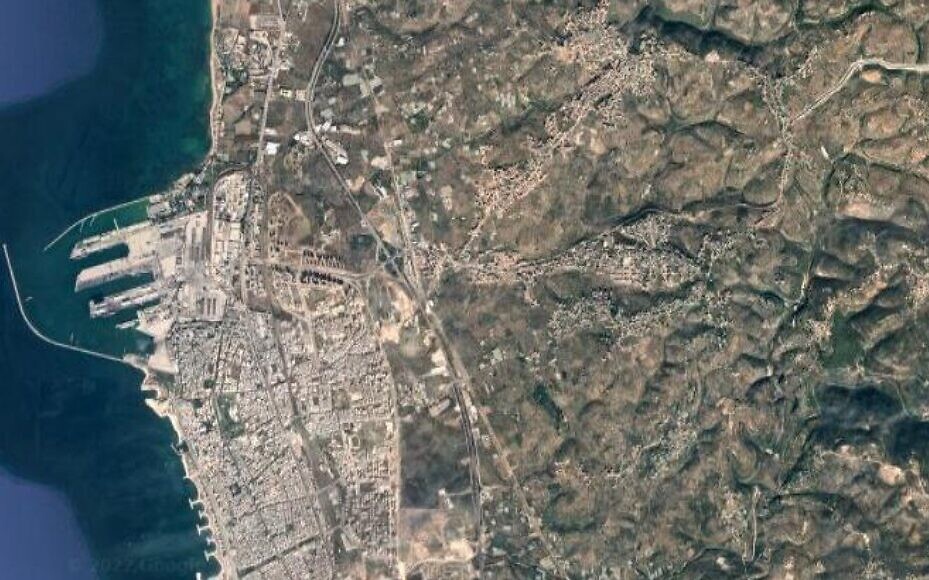
Illustrative: A satellite photo of the Syrian port city of Tartus (Google maps)

Illustrative: A satellite photo of the Syrian port city of Tartus (Google maps)

Israeli airstrikes near Russia’s main navy base in the coastal Syrian city of Tartus on Sunday night targeted Iranian sites, an unidentified Syrian officer told the Reuters news agency on Monday.

The state-run SANA broadcaster had earlier said Israeli jets launched missiles from over neighboring Lebanon, targeting sites in Tartus and on the outskirts of the capital Damascus, killing three soldiers and wounding three others.

The Syrian army officer told Reuters on condition of anonymity that an Iranian base near the village of Abu Afsa, south of Tartus, was targeted alongside a nearby air defense system and radar station.

Footage circulating on social media apparently showed a burning site in the Tartus area. SANA confirmed a fire had erupted at a site that was targeted.

The port city is home to Russia’s only Mediterranean base, where its warships are docked. The coastal city of Latakia, some 70 kilometers north of Tartus, houses a Russian airbase.

Two Syrian military defectors familiar with the region told the agency that the strikes near Damascus hit outposts manned by the Lebanese Hezbollah terror group.

File: A Russian navy missile ship ‘Veliky Ustyug’ sails off from the Russian naval facility in Tartus, Syria, on patrol in eastern Mediterranean, September 26, 2019. (AP Photo/Alexander Zemlianichenko)

Israel does not acknowledge specific strikes in the enemy state, and had no comment on Sunday’s reports.

It has carried out hundreds of airstrikes in Syria in the last decade, mostly to stymie attempts by Iranian forces to transfer weapons to Iran-backed Hezbollah, or establish a foothold on Israel’s northern frontier.

A fire is seen burning near the coastal city of Tartus following a reported Israeli airstrike, August 14, 2022. (Social media)

Israeli strikes have continued in Syrian airspace, which is largely controlled by Russia, even as ties with Moscow have deteriorated in recent months.

Israel has found itself at odds with Russia, as the Jewish state increasingly supports Ukraine against Russia’s invasion, while still seeking to maintain freedom of movement in Syria’s skies.