As Israel prepares for potential conflict over offshore gas extraction, experts say Nasrallah’s threats are mostly an effort to stay relevant, but they also keep him dangerous

By beating war drums and ramping up military provocations, Lebanon’s Hezbollah terror group has been doing everything to indicate it is ready to wage war with Israel over offshore gas extraction near a disputed maritime border between the countries.
Israel, meanwhile, has become increasingly concerned by the ever-escalating rhetoric of the Iranian-backed group’s leader, Hassan Nasrallah, and has been preparing for potential conflict.
But some experts believe Nasrallah’s bluster and threats will not translate into significant action. Rather, they signify Hezbollah’s effort to regain popularity back home as Lebanon faces a major financial and social crisis, as well as to stay relevant as a threat to Israel.
Israel and Lebanon, which do not have diplomatic relations, have been engaged in indirect talks mediated by the US over the rights to the Karish gas field and to demarcate a contested maritime border between the two countries.
US Energy Envoy Amos Hochstein has recently been visiting the region to get Lebanon to come down from its claim to a massive maritime zone that includes Karish, which Israel seeks to develop as it tries to position itself as a natural gas supplier to Europe.
Lebanon’s financial situation, which has been spiraling out of control since 2019, has been branded by the World Bank as one of the world’s worst economic crises since the 1850s. Meanwhile, the country faces major political chaos, exacerbated by the deadly 2020 Beirut port explosion.

Nasrallah recently escalated his rhetoric after Israel moved a natural gas extraction vessel into the Karish field with the issue yet unresolved. And in its boldest move yet, Hezbollah sent four unarmed drones toward the offshore platform several weeks ago, all of which were intercepted by the Israel Defense Forces.
As recently as Monday evening, Nasrallah said all Israeli land and sea targets were within the range of his group’s missiles.
Nasrallah statements such as “We will reach Karish and everything beyond Karish and everything beyond that,” as well as “War is much more honorable than the situation Lebanon is heading to now — collapse and starvation,” have prompted Israel to ramp up defenses for the floating rig.

It has also issued numerous stern warnings to Hezbollah, both via statements by top officials and through diplomatic and military channels. On Tuesday, the Walla news site, citing an unnamed defense source, said the IDF has held a series of maritime drills over the past month simulating defense against missile attacks on Israeli assets at sea.
And in June, the IDF held a major military exercise in Cyprus simulating a ground offensive deep inside Lebanon in a potential war against Hezbollah — another possible message to the group.
Aside from warning signals and a bolstering of defenses, Israel has taken no immediate offensive action. Jerusalem has consistently sought to avoid a major conflict with the Iran-backed group, which is considered to be the most significant adversary along its borders, with an estimated arsenal of nearly 150,000 rockets and missiles that can reach anywhere in Israel.

At the same time, the thinking in Lebanon is likely very similar.
Matthew Levitt, the director of The Washington Institute’s program on counterterrorism and intelligence and an expert on Lebanon, said the political and economic collapse in Lebanon has contributed to there being “far less of an appetite among just about all Lebanese for any type of renewed hostilities that would make the situation still worse.”
“On the one hand, I think [Hezbollah] want to scratch their resistance itch, they want to demonstrate to their base and to Israel that they’re still here and not to be trifled with,” Levitt told The Times of Israel in a phone call.
“But I also worry that as the situation in Lebanon continues to either be bad or deteriorate still further, I worry that Hezbollah believes — whether it’s true or not — that if things get to a point that they’re so bad, the disincentive against renewed hostilities dissipates.
“Do things get so bad that Hezbollah figures, ‘We can do something to get Israel to retaliate and then start blaming Israel for the economic situation and political situation?’” he said.

David Daoud, a Lebanon expert at the Atlantic Council said Hezbollah realizes Lebanon cannot afford a war as “there would be no recovery, and they would be compounding the people’s misery with a war that people don’t want, and that might affect their popularity.”
“Right now they’re trying to maintain this ‘responsible posture’ but while not conceding entirely,” Daoud said.
He said Hezbollah “cannot look to be doing nothing” as Israel begins to extract gas from Karish, and as it holds indirect negotiations over the maritime border.
“Because of that they have to up the rhetoric and carry out ‘theatricalities,’” he argued.
Levitt explained that Hezbollah wants to remind both Israel and Lebanon that it is a key player on the border due to the “detour” the terror group took throughout the 2010s.
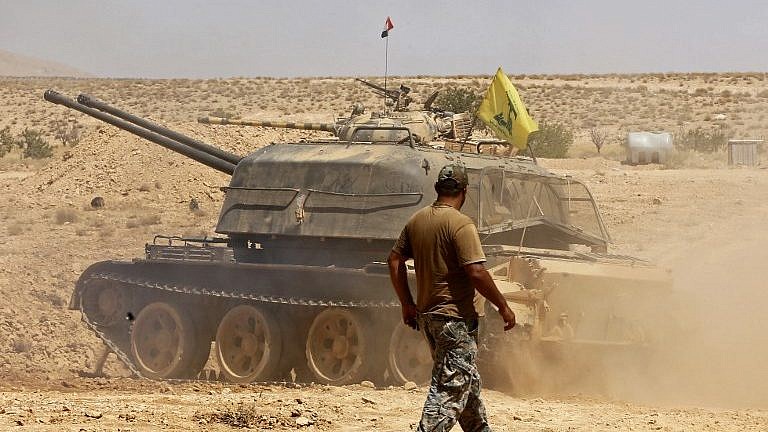
“Hezbollah had this detour away from its ‘resistance’ against Israel and toward defending Iranian interests and the Assad regime and its own supply lines in Syria,” he said, referring to Hezbollah’s massive participation in the Syrian civil war.
Amid that involvement, analysts like Levitt believed the group would not want to fight Israel, to avoid waging wars on two fronts.
But in recent years, Hezbollah has managed to significantly lighten its footprint in Syria, Levitt said, as “things have stabilized for the Assad regime and Iran and its militias, as [Tehran] has recruited more Syrian elements into their alliance.”
Levitt said that with Hezbollah bringing its focus back to Lebanon, it was “only a matter of time before Nasrallah started making threatening comments about how wonderful his rockets are, and how far they can reach, and doing things that are intended to kind of poke a bit, but not so far as to start a conflict.”
That included sending four unarmed drones toward the Karish gas field on two separate occasions on June 29 and July 2.

“I think that they want to demonstrate that they’re there and still have their principles as they see them, and want to do things that they can portray as being in the interest of all Lebanese,” Levitt said. (Some of Lebanon’s leaders, however, have slammed Hezbollah for actions they believe are of the exact opposite nature.)
Daoud said Hezbollah leaders, in their recent actions and rhetoric, appeared to be “flexing their muscles while in reality doing nothing, to satisfy their base more than anything.” But the group “doesn’t want to look like the spoilsport and do something that would mess up the negotiations unnecessarily, and then everyone turns [on] them including their own base.”
Still, Daoud warned it was “not entirely out of the [realm of] possibility” that Hezbollah could take more aggressive armed action.
Levitt similarly said that “things can get out of hand pretty quick, and when you’re dealing with perception and misperceptions in international relations, people make mistakes,” mentioning that Nasrallah admitted the 2006 abduction of two Israeli soldiers on the border, which sparked the Second Lebanon War, had been a mistake.
“There are no guarantees here,” he stressed.