The Iranian Naval Threat Expands

JULY 10, 2022 5:51 PM
The Iranian Naval Threat Expands

by Michael Segall / JNS.org

OPINION

Iranian military commanders and other members of the armed forces pray on the Iranian-made warship Makran during an exercise in the Gulf of Oman, January 13, 2021. Picture taken January 13, 2021. Iranian Army/WANA (West Asia News Agency)/Handout via REUTERS

JNS.org – At the Annual Economist Government Roundtable in Greece on July 5, 2022, Israeli Defense Minister Benny Gantz disclosed, “Iran is methodically basing itself in the Red Sea, with warships patrolling the southern region.” He added, “The presence of Iran’s military forces in the Red Sea in recent months is the most significant in a decade. It directly threatens trade, energy and the global economy.”

A short time earlier, a website that opposes the Iran-supported Houthi rebels in Yemen reported that, on June 28, 2022, Somali security forces in Bandar Beyla on the Arabian Sea captured two weapons-laden boats that the Houthis, with help from Iran’s Islamic Revolutionary Guard Corps (IRGC), were trying to deliver to the Somali terror organization Harakat al-Shabaab al-Mujahideen, Al-Qaeda’s affiliate in East Africa, more commonly known as “al-Shabaab.”

The report said that the boats, which had Somali and Yemeni crews, belonged to Ahmad Matan, a Somali smuggler behind an October 2017 truck bombing that killed more than 500 people. The smuggling is reportedly conducted from Somalia to Yemen and vice versa.

In November 2021, the organization Global Initiative against Transnational Organized Crime reported that weapons deliveries from Iran to the Houthis had found their way to Somalia. Some navigation systems on arms-smuggling ships intercepted by the US Navy showed exit points from the port of Jask in Iran — where the IRGC navy (IRGCN) and the Iranian navy (IRIN) operate — and the port of Mukalla in Yemen, which is used for Yemeni and Somali smuggling.

In May 2021, the US warship USS Monterey confiscated a massive weapons shipment whose source was apparently Iran. On July 7, 2022, the UK revealed that on January 28 and February 25, 2022, Royal Navy ship HMS Montrose’s Royal Marines seized Iranian weapons from speedboats being operated by smugglers in international waters south of Iran.

In recent years, the IRGCN, which has conducted most of Iran’s naval activity in the Persian Gulf region, has spread to the Arabian Sea, the Red Sea and the Mediterranean. In the Arabian Sea and Red Sea region, this presence is mainly clandestine. Civilian vessels are used to collect intelligence and deliver arms to the Houthis. In some of its operational activities, the IRGCN — granted priority for equipment, manpower and training — was aided by the IRIN.

The Iranian presence in the Arabian Sea and the Red Sea hides behind slogans of the international war on piracy. However, it is also used for Iranian operational activity and arms smuggling to the Houthis in Yemen, Somalia and Palestinian terror organizations in Gaza and Lebanon. As part of Iran’s aggressive drone strategy, converted ships used by the IRGC navy and the Iranian navy serve as launch platforms for drones, fast-boats and explosive-laden naval suicide boats (GPS-guided and unmanned) that can strike targets in the Mediterranean, including Israeli gas rigs.

These Iranian naval capabilities are well-suited to Iran’s asymmetric-warfare doctrine. Some are now in use against Saudi strategic infrastructure, including attacks on oil facilities at sea and on land, on Saudi ships operating off the Saudi coast and for Iranian retaliatory attacks against foreign assets in the region.

Moreover, Iran is smuggling arms to the Horn of Africa to step up its involvement in the region, particularly in Somalia, which is not only a destination for arms smuggling but also a transit station for moving arms up the Red Sea towards the Mediterranean.

Iran’s naval activity in the region has been hit by hard times, including mysterious attacks on Iranian ships and the confiscation of weapons on ships and boats originating in Iran. Yet Iran will continue its seaborne activity in the region, upgrade its drone-launching capabilities from maritime platforms and deliver arms to its allies in the area, Palestinian terror organizations and Hezbollah.

With ongoing air strikes against its proxies in Gaza, Yemen, Lebanon, Syria and Iraq, Iran attaches great importance to surface-to-air weapons. Accordingly, it will continue to upgrade its proxies’ capabilities in this regard with 358 SAMs and MANPADS and other air defense capabilities through smuggling via air, land and sea.

An increased Iranian naval presence — including IRGC forces tasked with logistical assistance and terror — intensifies the threat to international commercial and shipping lanes. It augments Iran’s ability to attack ships, such as the strike on the MT Mercer Street cargo ship off the coast of Oman in July 2021. The US Central Command stated that the drone that hit the ship and killed two crew members was manufactured in Iran.

The improvement in Iran’s naval warfare, aerial and sea drones, fast-boats and missile capabilities from maritime platforms all give Iran the ability to operate against targets at sea in asymmetric warfare and to develop a possible response against Israel in retaliation to ongoing attacks on Iranian security assets and nuclear targets.

IDF Lt.-Col. (ret.) Michael (Mickey) Segall, an expert on strategic issues with a focus on Iran, terrorism and the Middle East, is a senior analyst at the Jerusalem Center for Public Affairs and at Acumen Risk Advisors.

This article was originally published by the Jerusalem Center for Public Affairs.
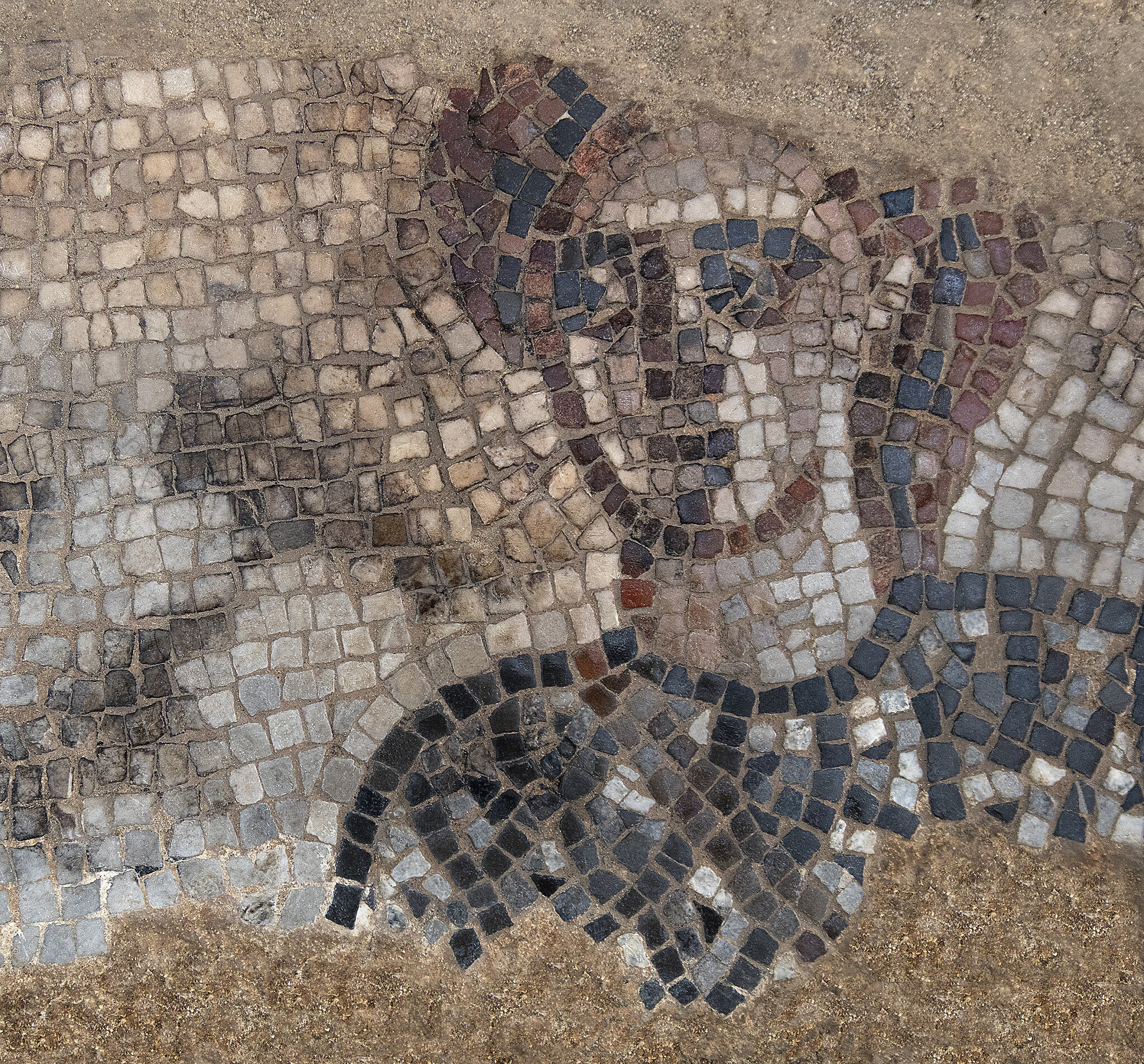

Mosaic uncovered by archeologists digging at the Huqoq site depicts Book of Judges story featuring the two heroines defeating the Canaanite commander Sisera


The Israelite commander Barak depicted in the Huqoq synagogue mosaic. (Jim Haberman)

The Israelite commander Barak depicted in the Huqoq synagogue mosaic. (Jim Haberman)

Archeologists working at a dig in the Galilean town of Huqoq have uncovered the earliest known depictions of the biblical heroines Deborah and Yael, in mosaics that are thought to be nearly 1,600 years old.

The find, announced by the University of North Carolina-Chapel Hill’s Prof. Jodi Magness on Tuesday, joins a growing collection of ancient mosaics discovered over the past decade at the site of a former synagogue in the Lower Galilee.

Magness, a professor of religious studies at the university, has overseen a team of students and archeologists excavating the area for more than 10 years. Excavations at the site restarted earlier this year after they were halted for close to three years due to the COVID-19 pandemic.

The mosaics depict the biblical story in the Book of Judges when the prophetess Deborah told the Israelite military leader Barak to mobilize the troops of Naftali and Zevulun to fight against Canaan, whose forces were led by Sisera. Barak said he would only go to battle if Deborah joined him, and Deborah in turn prophesied that a woman would defeat Sisera’s army. Sisera, fleeing flooding, sought refuge in the tent of Yael, who drove a tent peg through his head, killing him.

“This is the first depiction of this episode and the first time we’ve seen a depiction of the biblical heroines Deborah and Yael in ancient Jewish art,” Magness said in a statement from the university. “Looking at the book of Joshua, chapter 19, we can see how the story might have had special resonance for the Jewish community at Huqoq, as it is described as taking place in the same geographical region — the territory of the tribes of Naftali and Zevulun.”

According to the university, the three-part mosaic shows Deborah looking at Barak in the first portion; Sisera seated in the middle section, of which only a small portion is preserved; and Sisera lying dead on the ground after Yael killed him in the bottom section. UNC-Chapel Hill only released photos showing Barak depicted in the mosaic; it is unclear how well preserved the images of the two women are.

Mosaic depicting a fox eating grapes in the ancient synagogue at Huqoq in the Lower Galilee. (Jim Haberman)

The team working at the ancient synagogue, which was built in the late fourth-early fifth century CE, also uncovered a mosaic depicting vases holding sprouting vines with four animals eating clusters of grapes: a hare, a fox, a leopard and a wild boar.

All of the newest mosaics have been removed from the site for conservation, the university said.

The latest discovery joins a long line of ancient mosaic depictions uncovered at the Huqoq synagogue site. In 2019, before the project was frozen due to COVID, archeologists uncovered mosaics of the earliest known artistic rendering of the little-known Exodus story of Elim, and a partially preserved depiction of the Book of Daniel’s grotesque four beasts, which signal the end of time.

In 2018, the mosaics unearthed at the late Roman-era synagogue included images of the biblical story of the Israelite spies in Canaan. A year earlier, the earliest known mosaic of Jonah and the whale was uncovered, and in 2016, mosaic floors showing the iconic scenes of Noah’s Ark and the parting of the Red Sea were revealed.

UNC-Chapel Hill participants on the Huqoq dig, including Prof. Jodi Magness (back row, second from left). (Jim Haberman)

Previous Huqoq excavations have led Magness to revise previously held conceptions of the practice of Judaism in the Byzantine era.

“The mosaics decorating the floor of the Huqoq synagogue revolutionize our understanding of Judaism in this period,” said Magness in a 2018 press release. “Ancient Jewish art is often thought to be aniconic, or lacking images. But these mosaics, colorful and filled with figured scenes, attest to a rich visual culture as well as to the dynamism and diversity of Judaism in the Late Roman and Byzantine periods.”

In 2011, the relatively untouched and well-preserved Byzantine synagogue was discovered under the rubble of the modern Arab village of Yakuk that stood at the site until intentionally torched in 1948. Magness and her team began work there in 2012, and returned each summer until the COVID pandemic forced them to cancel for 2020 and 2021.

Amanda Borschel-Dan contributed to this report.


Iran enriches to 20% with new centrifuges at fortified site

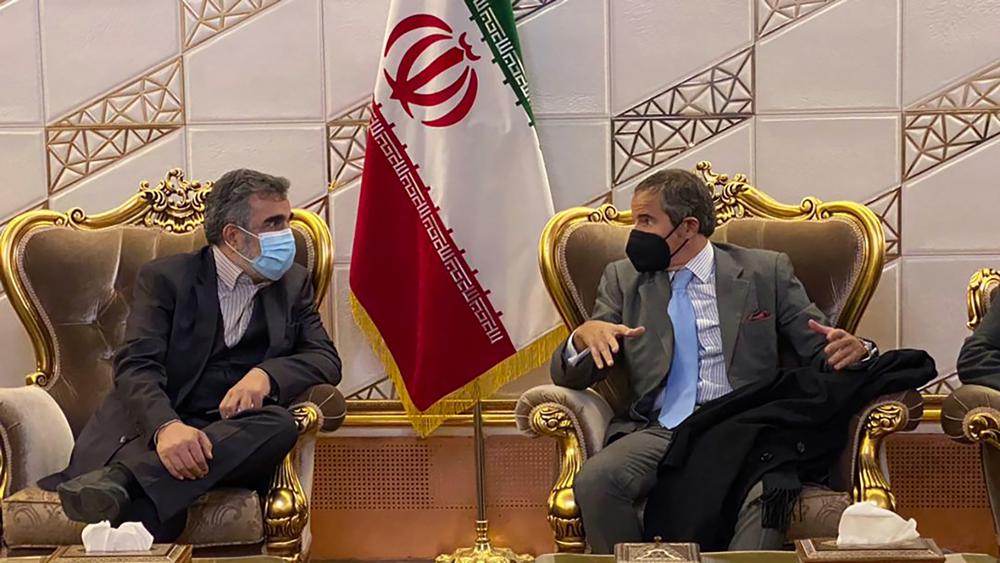
FILE - Director General of International Atomic Energy Agency, IAEA, Rafael Mariano Grossi, right, speaks with deputy head of the Atomic Energy Organization of Iran Behrouz Kamalvandi at Imam Khomeini Airport, in Tehran, Iran, Nov. 22, 2021. Iran announced Sunday, July 10, 2022, that it has begun enriching uranium up to 20% using sophisticated centrifuges at its underground Fordo nuclear plant, state TV reported, an escalation that comes amid a standoff with the West over its tattered atomic deal. Kamalvandi said uranium enriched to 20% was collected for the first time from advanced IR-6 centrifuges on Saturday. (Atomic Energy Organization of Iran via AP, File)

TEHRAN, Iran (AP) — Iran announced Sunday that it has begun enriching uranium up to 20% using sophisticated centrifuges at its underground Fordo nuclear plant, state TV reported, an escalation that comes amid a standoff with the West over its tattered atomic deal.

That Tehran is enriching uranium up to 20% purity — a technical step from weapons-grade levels of 90% — with a new set of its most advanced centrifuges at a facility deep inside a mountain deals yet another blow to the already slim chances of reviving the accord.

Behrouz Kamalvandi, a spokesman for Iran’s Atomic Energy Organization, said uranium enriched to 20% was collected for the first time from advanced IR-6 centrifuges on Saturday. He said Iran had informed the U.N. nuclear watchdog about the development two weeks ago.

Centrifuges are used to spin enriched uranium into higher levels of purity. Tehran’s 2015 nuclear agreement with world powers had called for Fordo to become a research-and-development facility and restricted centrifuges there to non-nuclear uses.

Iran had previously told the IAEA that it was preparing to enrich uranium through a new cascade of 166 advanced IR-6 centrifuges at its underground Fordo facility. But it hadn’t revealed the level at which the cascade would be enriching.

The International Atomic Energy Agency, the U.N.’s nuclear watchdog, told The Associated Press that it had verified on Saturday that Iran was using a set-up that allowed it to more swiftly and easily switch between enrichment levels.

In a report to member states, Director General Rafael Grossi described a system of “modified sub-headers,” which he said allowed Iran to inject gas enriched up to 5% purity into a cascade of 166 IR-6 centrifuges for the purpose of producing uranium enriched up to 20% purity.

Iran did not comment on the latest IAEA finding.

Nuclear talks have been at a standstill for months. The U.S. special envoy for Iran, Robert Malley, described the latest round of negotiations in Qatar as “more than a little bit of a wasted occasion.”

The IAEA reported last month that Iran has 43 kilograms of uranium enriched to 60% purity — a short step to 90%. Nonproliferation experts warn that’s enough fissile material for one nuclear weapon if Iran chose to pursue it.

However, Iran still would need to design a bomb and a delivery system for it, likely a monthslong project.

Iran insists its program is for peaceful purposes, though U.N. experts and Western intelligence agencies say Iran had an organized military nuclear program through 2003.

Tehran’s escalating nuclear work has raised alarm with transparency rapidly diminishing. Last month Iran shut off more than two dozen IAEA monitoring cameras from various nuclear-related sites across the country.

Former President Donald Trump abandoned the nuclear deal in 2018 and re-imposed crushing sanctions on Tehran, setting off a series of tense incidents across the wider Mideast. Iran responded by massively increasing its nuclear work, growing its stockpile of highly enriched uranium and spinning advanced centrifuges banned by the accord.

Iran’s adversary Israel has long opposed the nuclear accord, saying it delayed rather ended Iran’s nuclear progress and arguing that sanctions relief empowered Tehran’s proxy militias across the region.

On Sunday, Israeli Prime Minister Yair Lapid called on the U.N. to re-impose multilateral sanctions on Iran — a bid that was met with stiff opposition when pushed by the Trump administration.

“The response of the international community must be decisive: to return to the U.N. Security Council and activate the sanctions mechanism at full force,” Lapid, who is serving as caretaker leader, told his Cabinet. “Israel, for its part, maintains full freedom to act, diplomatically and operationally, in this fight against Iran’s nuclear program.”

___

Associated Press writers Isabel DeBre in Dubai, United Arab Emirates, and Tia Goldenberg in Jerusalem, contributed to this report.