Iran and its proxies are worried about the idea of an Israeli-Arab military alliance built along NATO lines.

By Khaled Abu Toameh, Gatestone Institute 

Iran and its terrorist proxies have intensified their efforts to sabotage US President Joe Biden’s upcoming visit to the Middle East, which is scheduled to take place in mid-July.

The effort to sabotage the visit comes amid reports that Biden will try to advance Israel-Saudi relations and broker a military alliance between Israel and a number of Arab countries to confront the threats and terror by Iran and its proxies.

According to the reports, Biden is planning to form a regional conference in Jeddah, Saudi Arabia. The coalition will include the US, Israel, and some Arab countries, including Gulf states, Egypt, Jordan, and Iraq. “The new alliance is intended to contain Iran and, in the first stage, will be based on an air defense system against Iranian missiles and attack drones and cyber security measures,” said Prof. Eytan Gilboa, an expert on US-Israel relations.

The mullahs in Tehran and their proxies, such as the Palestinian Hamas group and the Lebanese Hezbollah militia, appear especially worried about the idea of establishing an Israeli-Arab military alliance built along NATO lines.

They also appear worried that some Arab countries, including Saudi Arabia, may be moving towards normalizing their relations with Israel.

As part of the efforts to thwart normalization between the Arab countries and Israel, Hamas leader Ismail Haniyeh travelled to Beirut last week for talks with Hezbollah Secretary-General Hassan Nasrallah.

Haniyeh’s visit to Beirut has outraged many Lebanese and Arabs, who expressed concern that the Hamas-Hezbollah alliance would further destabilize Lebanon and bring it closer to a military confrontation with Israel.

According to Hamas, Haniyeh and Nasrallah “reviewed the political developments in the region and their repercussions on the Palestinian cause, as well as the dangers of the normalization [between Israel and Arab countries].”

Haniyeh and Nasrallah emphasized the need to “develop the program and axis of resistance as the strategic option for restoring the [Palestinian] national rights,” Hamas added.

When Hamas and Hezbollah talk about “develop[ing] the program and axis of resistance,” they are referring to terrorist attacks against Israel. The two terrorist groups have tens of thousands of rockets and missiles that are ready to be fired towards Israel at any moment from the Gaza Strip and Lebanon.

Ali Barakeh, a senior Hamas official, said that Haniyeh’s visit to Lebanon aims at “consulting and coordinating” with Hezbollah about the situation in the region “in light of the talk about forming an Arab-American alliance to confront the axis of resistance.”

Barakeh added, “It’s natural for the Palestinian resistance to consult with the Lebanese resistance in order to confront the American-Zionist policy that it hostile to our nation and the Palestinian cause.”

Referring to the idea of a military build-up against Iran in the region, Haniyeh warned that “what is happening in the region is very dangerous and has gone beyond normalization between Arab countries and Israel.”

In a speech before the Arab-Islamic National Conference in Beirut on June 25, the Hamas leader said, “Normalization [with Israel] is a crime because it harms Palestine and the Arabs; this is an attempt to integrate the Zionist entity into alliances in the region. This scheme targets the resistance in Palestine and Lebanon. The Palestinian people need strategic depth and the unity of the Arab and Islamic nation.”

It is clear that Haniyeh and Nasrallah are seeking to use Lebanon as a launching pad not only to attack Israel, but also as a base for intimidating Saudi Arabia and other Arabs into avoiding alliances with Israel against Iran.

Some Lebanese have expressed outrage that their president, Michel Aoun, received the Hamas leader in the presidential palace in Beirut.

Charles G. Hage, a Lebanese citizen, wrote, “At a time when we are looking for ways out so that the Lebanese do not go hungry, can someone tell us how Lebanon benefits from a public meeting between President Michel Aoun and the head of Hamas’ political bureau, Ismail Haniyeh? Hamas is accused of terrorism and banned in the various countries that Lebanon requests help from. Is Lebanon required to become a new Gaza?”

Haniyeh’s visit to Lebanon, according to Lebanese journalist Sawsan Mhanna, coincided with a visit by Saudi Crown Prince Mohammed bin Salman to Egypt and Jordan.

Mhanna wrote, “At a time when Egypt and Jordan received Saudi Crown Prince Mohammed bin Salman, and at a time when Egypt and Saudi Arabia signed 14 agreements worth $7.7 billion, Beirut receives Hamas leader Ismail Haniyeh. What if Crown Prince Mohammed bin Salman’s plane had landed in Beirut? What if Beirut were free?”

Iran and its proxies were cooperating to prevent the establishment of an anti-Iranian military alliance in the Middle East, wrote Emirati journalist Mohamed Taqi. “After the accelerated Arab moves to establish a Middle East alliance, the terrorist Ismail Haniyeh went to meet with the terrorist Hassan Nasrallah… The puppets of Iran are always against any Arab national and security project.”

It was high time that the US take note that there is no difference between Iran’s various terrorist proxies, noted Iranian-American investigative journalist Lisa Daftari. “When will the Biden admin learn that Hezbollah, Hamas, Al-Qaeda, ISIS, and Iran’s regime are all the same?” Daftari asked.

“Iran occupied Lebanon through its powerful arm, Hezbollah, which took control of Lebanon by the force of Iranian weapons,” remarked Lebanese political commentator Huda al-Husseini.

“This occupation was justified by the absurd claim that these weapons aim to impose a balance of terror with the Israeli enemy and prevent its attacks, when in fact its use was purely internal to terrorize and kill,” Husseini said.

Al-Husseini pointed out that Iran tightened its control over Lebanon after the US war in Iraq in 2003 by getting rid of Lebanese Prime Minister Rafik Hariri, who was subsequently slain.

“Hezbollah, which is a faction of the Iranian Revolutionary Guards, took control of state institutions… Iran penetrated Syria after the outbreak of the revolution against the regime in 2011 and Bashar Assad resorted to the Iranian Revolutionary Guards to defend what remained of his regime. Tehran gave orders to Hezbollah to get involved, commit the most horrific massacres, terrorize opponents, and restore the [Syrian] army’s control. This made the Syrian regime in the grip of Tehran. Iran completed its expansion plans through its weapons to Hamas in Gaza and the Houthis in Yemen,” Husseini said.

In a move reflecting growing concern over Iran’s meddling in the internal affairs of Lebanon, several Lebanese politicians and political and religious leaders urged the international community to confront Hezbollah.

They demanded that Hezbollah hand over its weapons to the Lebanese Army and reminded the international community that the terrorist militia was behind the assassination of Rafik Hariri. They also requested that the Lebanese Army be deployed along the border with Israel to prevent another war.

Earlier, the same group of Lebanese warned that Nasrallah should not be responsible for making decisions on war and peace on behalf of his masters in Iran. The group also called for ending the Iranian “occupation” of Lebanon.

The Arabs are evidently aware of the dangers that Iran and its terrorist proxies pose to Lebanon and other countries, especially the Gulf states. They also seem anxious about Iran’s increased efforts to meddle in the internal affairs of the Arab countries as part of the mullahs’ scheme to expand their influence throughout the Middle East.

The meeting between Hamas and Hezbollah leaders in Lebanon should set off alarm bells in Washington: the meeting shows that Iran is taking advantage of the perceived weakness of the Biden administration in failing to confront the mullahs’ covetous schemes in the region.

Without question, this meeting took place on instructions from Tehran ahead of Biden’s visit to Saudi Arabia and Israel. It only remains to be seen whether the Biden administration’s policy of appeasement toward the mullahs enables the Iranians and their proxies to redouble their efforts to spread their expansion, terrorism and bloodshed throughout the Middle East.


Iran moves to foil Israeli-Arab ties, sabotage Biden’s visit to Mideast


Hezbollah, Hamas and other Iranian-backed groups have increased their drone threats over the last years.

Drones are often used, both by smugglers and security forces. (photo credit: IDF SPOKESMAN’S UNIT)
Drones are often used, both by smugglers and security forces.
(photo credit: IDF SPOKESMAN’S UNIT)

Israel’s downing of three drones on Saturday illustrates the growing nexus of Iran-Hezbollah threats in the region and specifically the Lebanese terrorist organization’s escalating attempts to target gas platforms off the coast of Israel.

Over the last several years Iran has rapidly expanded its drone program and encouraged its proxies in the region to develop their own drone technology. These drones are often kamikaze drones, meaning they have a warhead and are designed to fly into their target.  The drone threat against Israel has emerged slowly, in stages, over the last several years. Hezbollah has been using drones for many years, but they are increasingly more sophisticated and the threat is growing.

Back in 2014 the Center for the Study of the Drone at Bard College detailed some of the past history of these threats.

The article by Dan Gettinger and Arthur Holland Michel noted that “much of Hamas and Hezbollah’s unmanned technology derives from or originated in Iran, which has maintained an active military drone program since the Iran-Iraq War.”

It notes that back in 2004 an “Iranian-made drone operated by Hezbollah managed to fly in Israeli airspace for five minutes before it crashed into the Mediterranean sea. The 2.9-meter-long UAV was not picked up on Israeli radars.

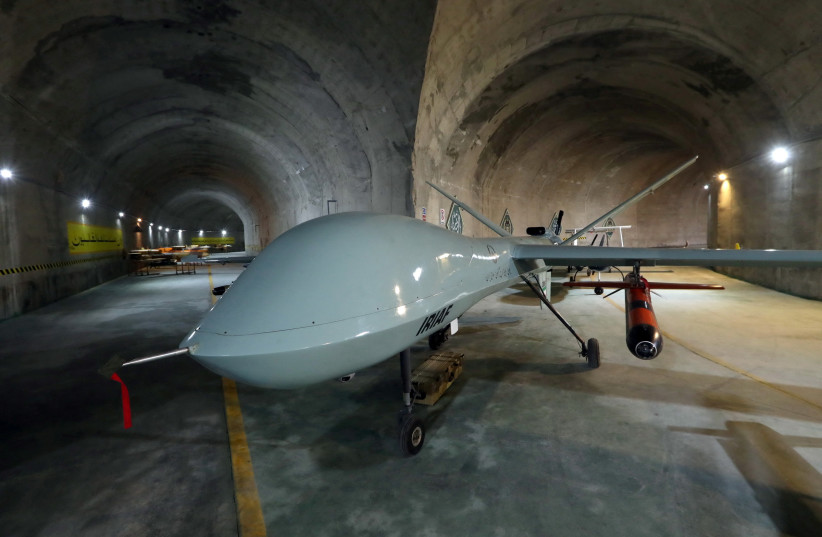
 A drone is seen at an underground site at an undisclosed location in Iran, in this handout image obtained on May 28, 2022. (credit: IRANIAN ARMY/WANA/REUTERS)A drone is seen at an underground site at an undisclosed location in Iran, in this handout image obtained on May 28, 2022. (credit: IRANIAN ARMY/WANA/REUTERS)

The incident prompted the Knesset to convene a hearing with the IDF Chief of Staff Moshe Ya’alon.

The report also noted that in “April 2005, a Misrad-1 UAV reportedly entered Israeli airspace, conducting an 18-mile (30 km.) reconnaissance flight over cities in the Galilee region.” During the 2006 war Hezbollah launched more drones. These included a drone packed with explosives that targeted a ship. One of the drones even had 30kg. of explosives, according to reports.

Drone capabilities in the Middle East

Hezbollah, Hamas and other Iranian-backed groups have increased their drone threats over the last years. This included incidents in 2010, 2012 and 2014. The 2012 incident was particularly important because reports at the time said Tehran had attempted to spy on Israel’s Dimona facility using a drone.

The overall picture that emerges is that by 2018 Hezbollah and Iran, along with the Iranian-backed Houthis in Yemen, Iranian-backed militias in Syria and a large number of militias linked to Iran in Iraq, all had drone capabilities.

The UAVs shot down on Saturday appear to be of several different types. It is unclear if they carried explosives and how they were controlled. They do not appear to have been linked together to act as a kind of drone swarm.

In 2019 Iran used drones and cruise missiles to attack Saudi Arabia’s Abqaiq facility. Iran also operationalized Kataib Hezbollah in Iraq to target Saudi Arabia using drones.

Iran moved drone technology to the Houthis in Yemen who have launched  numerous drone attacks against Saudi Arabia over the years. In January the threat grew to include attacks on the UAE.

The Alma Research and Education Center said in December 2021 that “in the special report we published on December 21, we stated that we estimate that today Hezbollah has approximately 2,000 Unmanned Aerial Vehicles (UAVs). Over the past 15 years, there has been a huge increase in the number of Hezbollah’s UAVs.”

Iran has increasingly used its militias in Iraq and Syria to target both the Kurdistan autonomous region in Iraq using drones, and has used drones against US forces in Iraq and Syria.

In October 2021 Iran also used drones in Syria to target the Tanf garrison where US forces are present in southern Syria. Last July Iran used drones to target a commercial ship in the Gulf of Oman, killing two sailors on the bridge of the Mercer Street tanker.

This illustrates the growing regional threat of the drones, which has expanded rapidly.

In February 2018 Iran lifted the veil on the drone threat by using a drone flown from T-4 base into Israeli airspace. It was shot down near Beit Shean. In August 2019 Iran sent Hezbollah “killer drone” operatives to a safe house in southern Syria to target Israel. Israel struck the operatives.

In March 2021 Israel used F-35s to down Iranian drone threats over Syria. Then Iran used a drone flown from Iraq in May 2021. That drone entered Israeli airspace near Beit Shean and was shot down.

Defense Minister Benny Gantz has warned of the growing threat. In September 2021 Gantz noted that Iran was training drone operators at its Kashan base and he mentioned “terror operatives from Yemen, Iraq, Syria and Lebanon [trained] in flying Iranian-made UAVs (unmanned aerial vehicles).”

Last November Gantz revealed Iranian drone bases in Chabahar and on Qeshm Island. In February Iran flew drones from Iran over Iraq to target Israel. They were shot down by the US-led coalition.

On February 17 Israel said it downed a drone flown by Hezbollah. Hezbollah claimed in February that one of its drones flew into Israeli airspace for half an hour. Israel activated Iron Dome and scrambled jets at the time.

In March foreign reports, including by Al-Mayadeen, said Israel had destroyed hundreds of drones in Iran. On May 17 the IDF said it had downed another drone belonging to Hezbollah.

On June 9, Hezbollah leader Hassan Nasrallah threatened Israel’s gas platforms off the coast. “The immediate objective should be to prevent the enemy from extracting oil and gas from the Karish gas field,” Nasrallah said. Hezbollah wants to stop a potential maritime agreement, backed by the US, between Israel and Lebanon. Syria also blamed Israel for an airstrike on Saturday in Tartus.

The downing of the drone illustrates Israel’s abilities in detecting drones and also Israel’s investment over the years in technology to down drones. These include the use of warplanes, and Barak surface-to-air missiles, and equipping Israel’s latest corvette ships with the best systems to detect and stop drone and missile threats.

Israel has increased the abilities of Iron Dome to stop these types of threats as well. In addition Israel continues to carry out the campaign between the wars to prevent Iranian entrenchment in Syria. However, the overall context is that Iran is increasing the range of its drones which are proliferating all over the region.

Last year it is believed Iran moved Shahed 136 drones to Yemen. These may have a range that enables them to strike at Eilat.

In addition, Iran increased its investment in Iraqi-based militias such as Kataib Hezbollah to increase their drone and missile threats.

Israel is increasing its work with US Central Command and Navcent, as well as with new partners in the Gulf to discuss air defense priorities and drone threats.

The drone threat on July 2 therefore is part of the much wider Iranian threat; and ties into the importance of Israel’s work with the US, UAE, Bahrain and other countries in the region to prevent destabilization.

The US is increasingly concerned about Iranian drone threats. Members of Congress have also worked on the Deterring Enemy Forces and Enabling National Defenses (DEFEND) Act and the Stop Iranian Drones Act. All of this is important in the context of Hezbollah’s recent escalation.


Energean working in the Karish oil field, offshore Israel, in 2020. (Screen capture/YouTube)

Energean working in the Karish oil field, offshore Israel, in 2020. (Screen capture/YouTube)

The Israel Defenses Forces announces that it successfully intercepted three drones flown by the Lebanese Hezbollah terror group, heading for the Karish gas field in Israel’s territorial waters.

One of the aircraft was downed by an F16 fighter jet, and the other two by Barak missiles launched from the Saar 5 Class Corvette INS Eilat, the military says.

The IDF says the UAVs were “identified at an early stage and monitored throughout their flight by air control units” and “intercepted at the most appropriate operational point.”

A preliminary investigation shows that the drones did not pose a real threat at any point during their flight, the military says.

Israel says the drilling platform is in part of its UN-recognized exclusive economic zone, but Beirut insists it is in a disputed area.

Lebanon and Israel — which have no diplomatic relations and consider each other enemy states — have been holding indirect talks brokered by the US for close to two years to resolve a maritime border dispute.


Conversation