
Iran launches rocket into space as nuclear talks to resume

U.S. criticizes launch as “unhelpful and destabilizing.”

By Associated Press

Iranian state television said Sunday that Tehran had launched a solid-fueled rocket into space, drawing a rebuke from Washington ahead of the expected resumption of stalled talks over Tehran’s tattered nuclear deal with world powers.

It’s unclear when or where the rocket was launched, but the announcement came after satellite photos showed preparations at Imam Khomeini Spaceport in Iran’s rural Semnan province, the site of Iran’s frequent failed attempts to put a satellite into orbit.

State-run media aired dramatic footage of the blastoff against the backdrop of heightened tensions over Tehran’s nuclear program, which is racing ahead under decreasing international oversight.

Iran had previously acknowledged that it planned more tests for the satellite-carrying rocket, which it first launched in February of last year.

Ahmad Hosseini, spokesman for Iran’s Defense Ministry, said Zuljanah, a 25.5 meter-long rocket, was capable of carrying a satellite of 220 kilograms (485 pounds) that would ultimately gather data in low-earth orbit and promote Iran’s space industry.

The White House said it was aware of Iran’s announcement and criticized the move as “unhelpful and destabilizing.”

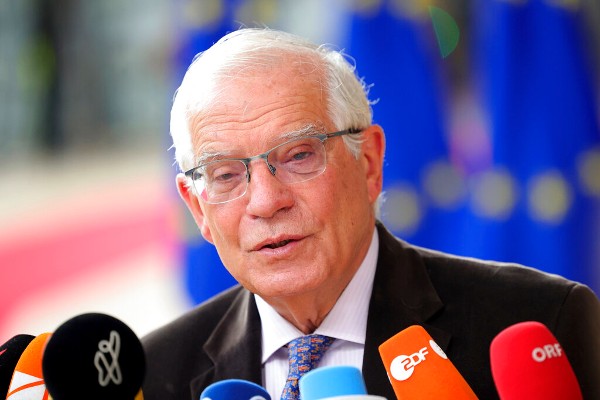
The launch comes just a day after the European Union’s foreign policy chief, Josep Borrell, traveled to Tehran in a push to resuscitate negotiations over Iran’s nuclear program that have stalemated for months. A few significant sticking points remain, including Tehran’s demand that Washington lift terrorism sanctions on its paramilitary Revolutionary Guard.

Borrell said on Saturday that talks over the nuclear deal would resume in an unnamed Persian Gulf country in the coming days, with Iranian media reporting that Qatar would likely host the negotiations.

Former President Donald Trump withdrew the U.S. from the nuclear deal in 2018 and reimposed crushing sanctions on Iran. Tehran responded by greatly ramping up its nuclear work and now enriches uranium closer than ever to weapons-grade levels.

In a further escalation that limits the international community’s view into its nuclear program, Iran removed over two dozen International Atomic Energy Agency cameras from its nuclear sites this month. The agency’s director called the move a “fatal blow” to the tattered nuclear deal.

Tehran’s rocket launches have raised alarm in Washington amid the unraveling of the nuclear deal. The U.S. warns the launches defy a United Nations Security Council resolution calling on Iran to steer clear of any activity related to ballistic missiles capable of delivering nuclear weapons.

The White House on Sunday said it was committed to using sanctions and other measures to prevent further advances in Iran’s ballistic missile program.

The U.S. intelligence community’s 2022 threat assessment, published in March, claims such a satellite launch vehicle “shortens the timeline” to an intercontinental ballistic missile for Iran as it uses “similar technologies.”

Iran, which long has said it does not seek nuclear weapons, maintains its satellite launches and rocket tests do not have a military component.

Even as Iran’s government has sharpened its focus on space, sending several short-lived satellites into orbit and in 2013 launching a monkey into space, the program has seen recent troubles. There have been five failed launches in a row for the Simorgh program, a type of satellite-carrying rocket. A fire at the Imam Khomeini Spaceport in February 2019 also killed three researchers.

The launch pad used in the preparations for the launch of the Zuljanah rocket remains scarred from an explosion in August 2019 that even drew the attention of then-President Trump. He later tweeted what appeared to be a classified surveillance image of the launch failure. Satellite images from February suggested a failed Zuljanah launch earlier this year, though Iran did not acknowledge it.

Meanwhile, Iran’s paramilitary Revolutionary Guard in April 2020 revealed its own secret space program by successfully launching a satellite into orbit. The Guard operates its own military infrastructure parallel to Iran’s regular armed forces.



Thousands of records detailing requests to the Vatican made by Jews who were being persecuted by the Nazis were made available online to the public, the Vatican announced last Thursday. Allowing access to the documentation titled “Ebrei” (“Jews”), which has been available to researchers since March 2020, was made “at the request of the Holy Father,” who ordered universal access aimed “to preserve the petitions for help from Jewish people all over Europe, received by (Pope Pius XII) during the Nazi-Fascist persecutions.”

The letters, written by Jewish people across Europe begging Pope Pius XII and other Roman Catholic officials for help, total 170 volumes, equivalent to nearly 40,000 digital files, containing some 2,700 individual appeals, the Vatican said.

While the Vatican made no such direct link publicly, the decision to make the documents available online closely follows the controversy over a new book by historian David I. Kertzer, titled, “The Pope at War,” in which Kertzer suggested that Pope Pius remained silent out of fear of the Nazis and that the Vatican prioritized saving Jewish converts to Catholicism from persecution.

Proving Kertzer’s point, the archive contains a letter written on July 29, 1941, by a parish priest seeking help for a German Jew who was trying to emigrate to Brazil. The priest asks: “Is it true that the Holy See — with a passport visa — is able to help Jews get to places where they can find hospitality?” The Vatican’s response, one week later, is: “You can respond that only Jews who converted before 1935 receive a visa.”

The archives contain many requests from Jewish converts to Catholicism asking the Vatican for proof of their conversion. Others are asking the Vatican to help prove they were Arian, such as the 1940 appeal from an anonymous man from the city of Turin who wanted to marry a Catholic woman.

In an article for the Vatican newspaper, the Vatican foreign minister Archbishop Paul R. Gallagher highlighted the case of Werner Barasch, a German Jewish convert to Catholicism who was imprisoned in a concentration camp in Miranda de Ebro, Spain. Barasch wrote a letter in 1942 to an Italian friend and asked that Pope Pius secure his release with the authorities in Madrid so he could travel to the United States and be reunited with his mother. According to Gallagher, the archive revealed that “he was released from the Miranda camp the year after his appeal in a letter to the pope, and that in 1945, he was finally able to join his mother in the United States.”

Kertzer responded, saying that putting the files online was “part of a continued attempt of the Vatican to present a certain kind of narrative of its role” under Pious XII. “I am sure one can find some cases where Jews were helped, but most of these cases where they offered any help were Catholics who were being considered Jews by the Nazis, which of course the Vatican was very opposed to,” he added, noting that “many Jews thought that their only hope of escaping being murdered was to convert, and so thousands of Jews did,” and that the files “have very little information on what if anything was done for them, much less whether it did any good.”


EU and Iran agree to resume nuclear talks in Vienna

Nuclear talks in Vienna poised to resume this week, fueling major concerns in Israeli security establishment.

By World Israel News Staff

Negotiations in Vienna aimed at restoring the 2015 Iran nuclear deal are set to resume this week, after Tehran and the European Union agreed to reboot talks.

On Saturday, Iranian Foreign Minister Hossein Amirabdollahian held a joint press conference in Tehran with Josep Borrell, High Representative of the European Union for Foreign Affairs and Security Policy.

At the press conference the two announced that talks between the EU and Iran will restart this week.

“The coming days means the coming days, I mean quickly, immediately,” Borell said, The Associated Press reported, urging the Biden administration to join the rebooted talks.

“Negotiations must resume, and this is a decision that must be made in Tehran and Washington.”

However, White House National Security Council spokesperson John Kirby declined to comment on the negotiations’ status.

“But there’s nothing changed about our position that a nuclear deal is the best way to prevent Iran from achieving nuclear weapons status,” Kirby said. “We want to get them back into compliance.”

The talks in Vienna collapsed in March, with Iran quickly moving to curtail international surveillance of its nuclear program and to bolster its uranium enrichment operations.

In early June, Iran deactivated several surveillance devices used by United Nations inspectors to monitor Iran’s uranium enrich operations, drawing condemnation from the International Atomic Energy Agency.

The Israeli government praised the IAEA earlier this month for its censure of Iran, but Israel’s security establishment now fears the renewed talks in Vienna could lead to a new agreement which could pose a serious threat to the Jewish state.

“If it will be signed, the current deal would be very bad for Israel,” a senior Israeli security official told Israel’s Channel 12.

“It would be limited to two and a half years, and it will allow Iran to develop its economy, thus giving it the ability to significantly grow its military capabilities across the Middle East.

Israel fears that the Biden administration is likely to sign onto the new nuclear agreement in November, following the midterm elections.

President Joe Biden’s meetings with Israeli and Saudi leaders during his Middle East trip next month are expected to focus heavily on the resumption of talks in Vienna.

Israel’s primary concern with the emerging nuclear deal is that it will give Iran less than a year of breakout time. Unconfirmed reports indicate the agreement will set the amount of time Tehran needs to produce the amount of highly enriched uranium needed for a nuclear bomb to four to six months.

While uranium needs to be only 3.67 percent pure to generate nuclear power, Iran has enriched its uranium stockpile to 60%, a degree of purity that no country without an atomic weapon has pursued. A nuclear bomb requires uranium to be enriched to 90% purity.

Israel also fears that a premature lifting of sanctions will enable Tehran to boost its support for its terror proxies across the Middle East.

The controversial Joint Comprehensive Plan of Action (JCPOA) of 2015 promised Iran economic incentives in exchange for limits on its nuclear program. Former president Donald Trump withdrew the U.S. from the agreement in 2018. Negotiating a return to the nuclear agreement is a key foreign policy goal of U.S. President Joe Biden.

Israel, Saudi Arabia and the Gulf states, oppose an American return to the JCPOA agreement.
