
Jerusalem has cited coordination with Moscow over Syria as a reason for not taking a more active role in helping Ukraine.
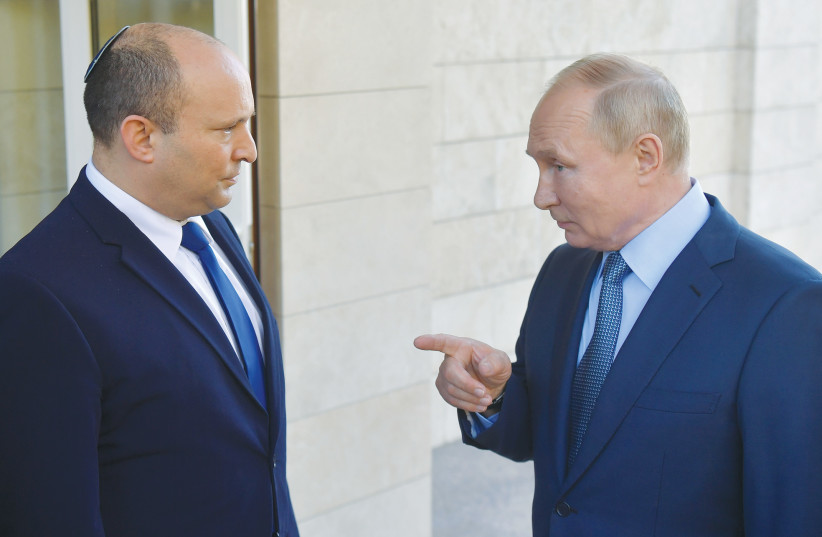
RUSSIAN PRESIDENT Vladimir Putin meets with Prime Minister Naftali Bennett in Sochi last month. (photo credit: Evgeny Biyatov/Sputnik-Kremlin via Reuters)
RUSSIAN PRESIDENT Vladimir Putin meets with Prime Minister Naftali Bennett in Sochi last month.
(photo credit: Evgeny Biyatov/Sputnik-Kremlin via Reuters)

Russia has repeatedly lashed out at Israel in recent days, while Israel’s position on the Ukraine conflict has remained unchanged, despite being predicated on a good relationship between Jerusalem and Moscow.

The latest Russian move against Israel is to circulate a draft UN Security Council resolution condemning the bombing of the international airport in Damascus, which Russia has blamed on Israel.

The attack violates Syria’s sovereignty and undermines stability, Russia said in the draft, adding that the perpetrators must take responsibility, KAN News reported. The strike on the airport makes it much harder to send humanitarian aid to Syria, the draft said.

The resolution is highly unlikely to get the UNSC’s approval because the US, UK and France can veto it.

But it is one in a series of angry reactions from Moscow since the strike in Damascus on June 10, after which satellite images showed significant damage to the airport’s military and civilian runways, rendering them inoperable.
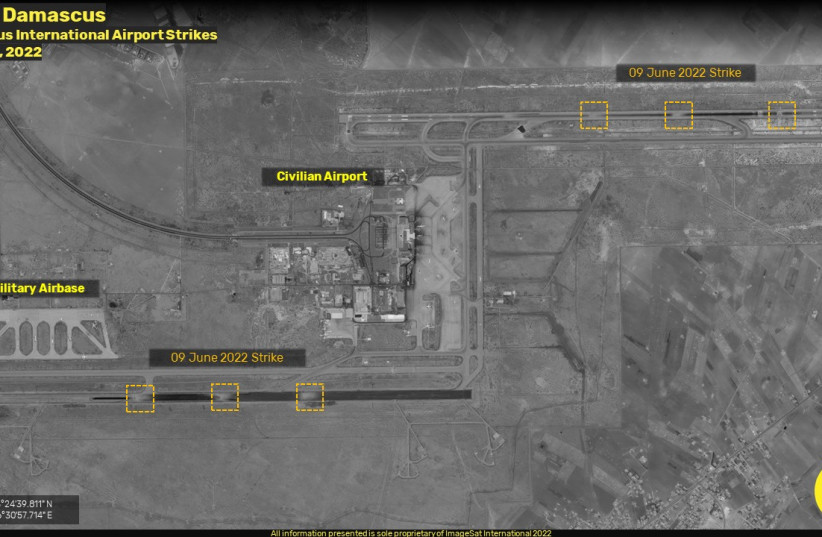
 Significant damage to runways at Damascus International Airport after alleged Israeli strikes targeted the site (credit: IMAGESAT INTERNATIONAL)Significant damage to runways at Damascus International Airport after alleged Israeli strikes targeted the site (credit: IMAGESAT INTERNATIONAL)

Russian Foreign Ministry spokeswoman Maria Zakharova condemned the airstrikes soon after, saying such actions put civilian airlines and civilians in danger.

Days later, Moscow formally reprimanded Ambassador to Russia Alex Ben-Zvi, and Deputy Foreign Minister Mikhail Bogdanov said he was not convinced by Israel’s explanations for the attack.

The series of events takes place as Israel has been reluctant to provide military aid to Ukraine following Russia’s invasion in late March.

Invasion of Ukraine

Israel voted to condemn Russia’s invasion of Ukraine at the UN in all votes in which it could participate, and Foreign Minister Yair Lapid has repeatedly spoken out against the war and accused Russia of war crimes. But Prime Minister Naftali Bennett has been quieter and has focused on expressing sadness at the loss of life. Meanwhile, Israel sent several planes loads of humanitarian aid and built a field hospital.

Once a wave of terrorism hit Israel in late March and April, Ukraine mostly fell off of the national agenda. Nevertheless, the Defense Ministry delivered protective gear to Ukraine and sent senior representatives to US-led meetings on supporting the country at war.

Jerusalem has cited coordination with Moscow over Syria, where the Russian Army has a major presence, as a reason for not taking a more active role in helping Ukraine, even though Kyiv has asked for aid.

Israel conducts strikes on Iranian targets and weapons convoys in Syria, and it has a deconfliction mechanism to avoid a confrontation with Russia.

As recently as last week, Bennett and his office have said a good relationship between Israel and Russia has helped maintain an effective channel of communication between the West and Russian President Vladimir Putin that should not be jeopardized. A source close to Bennett cited the opening of a humanitarian corridor to evacuate Ukrainians from Mariupol’s Azovstal iron and steel works in May as a positive result of Bennett’s continued contact with Putin.

At the time, a Kremlin statement said Bennett and Putin had discussed the humanitarian corridor, but a Ukrainian diplomatic source did not share the assessment that Israel played a major role.

In addition, when asked about the Bennett-Putin channel, an American diplomatic source last week was dismissive of the claim that it is helpful, adding that Putin has manipulated all of his Western interlocutors who attempted to stay in contact with him since he invaded Ukraine.

MEANWHILE, THERE have been heightened diplomatic tensions between Jerusalem and Moscow since the invasion of Ukraine, even as Israel has said it is trying to maintain the relationship.

Hours before the invasion, and while Israel was still totally silent on Ukraine, Russia took issue with Israeli sovereignty over the Golan Heights in a UNSC meeting. Though Russia recognized western Jerusalem as the capital of Israel in 2017, its ambassador to the UN appeared to roll that back in his remarks, expressing opposition to “Tel Aviv’s announced plans for expanding settlement activity in the occupied Golan Heights.”

In April, when Defense Minister Benny Gantz said Israel would send helmets and flak jackets to Ukraine, Russian Ambassador to Israel Anatoly Viktorov told Russian state TV his country would “respond accordingly.”

Putin also demanded in a letter to Bennett that Israel grant his country control of a church in Jerusalem, as the previous government promised. An Israeli court stopped the transfer in March.

The following month, Russian Foreign Minister Sergey Lavrov said Ukrainian President Volodymyr Zelensky commands “Nazi forces” and that “Adolf Hitler also had Jewish blood.”

Bennett and Lapid condemned the remarks, while the Foreign Ministry in Moscow doubled down. Days later, Bennett said Putin had apologized for the comments, but the Russian readout only said they discussed the Holocaust.

Viktorov participated in a Knesset meeting on May 10 marking Victory Day, celebrating the end of World War II, and walked out after lawmakers called Russia’s invasion of Ukraine a “slap in the face for our grandparents who fought the Nazis,” among other criticisms. Viktorov had prior engagements, and his departure was not related to the speeches, the Russian Embassy said at the time.

There have also been reports of Russian dissatisfaction at Israel moving in on the European energy market, following sanctions on Moscow. Israel, Egypt and the EU signed an agreement last week for the Europeans to import gas from the Eastern Mediterranean in the coming years.

At the same time, Western countries are not putting pressure on Israel to do more for Ukraine.

During her visit to Israel last week, European Commission President Ursula von der Leyen said Jerusalem was “help[ing] Ukraine with tons of humanitarian aid and a field hospital, and you have welcomed tens of thousands of Ukrainian refugees to your land.”

Washington understands the challenges Israel faces with Russia on its northern border, the American source said. The US is satisfied that Israel has responded positively to its requests regarding Ukraine, he also said, which echoes statements by US Secretary of State Antony Blinken during his visit to Israel in March. Blinken thanked Lapid for his strong repudiation of Russian aggression against Ukraine and the Israeli promise that Israel would not be used as a back door for sanctions violations.”

Blinken also said he was “thankful [for the] Israeli government’s efforts to provide humanitarian aid, including over 200 tons of medicine, food and other supplies… and the field hospital.”

Israel’s relatively quiet support for Ukraine does not seem to have jeopardized the deconfliction mechanism in Syria at this point – Bogdanov mentioned it as a way for Israel to clarify its position in his statement last week – but it is clearly putting a strain on the relations. Yet with Israel’s major Western allies apparently satisfied with Jerusalem’s position, it will likely stay the same, even as Russia tries to condemn Israel at the UN.



Israelis, Get Out of Turkey Right Now!

by Ruthie Blum / JNS.org

OPINION

People shop at the Spice Market also known as the Egyptian Bazaar in Istanbul, Turkey on December 16, 2021. Photo: Reuters/Dilara Senkaya

For well over a week, the Israeli government has been urging Israelis in Turkey to return home as soon as possible. It has also admonished those unable or unwilling to cut short their holidays not to frequent shops, restaurants or tourist attractions and, if possible, not to leave their rooms at all.

The warning stems from an immediate and concrete threat from Iran. According to accounts in some media outlets last week, a group of Israelis enjoying themselves in Istanbul received a phone call from security services ordering them not to return to their hotel, as Iranian terrorists were lying in wait. These travelers were picked up and promptly put on a plane without their belongings.

A far more specific report emerged on Saturday night, with an anonymous defense official revealing that Iran’s mission to murder Israelis in Istanbul was ongoing and in full swing. While praising the close cooperation with Ankara authorities that enabled the thwarting of a number of imminent attacks, he announced that the Iranian cells operating in the area know exactly which hotels have Israelis guests and how to recognize them.

His revelation followed a meeting on Friday afternoon between Mossad chief David Barnea and National Security Council head Eyal Haluta, after which they issued similarly warnings: Israelis in Turkey should refrain from posting on social media and riding in taxis, and should lock their hotel-room doors and refuse to open them for anyone, including chambermaids.

It turns out that Iran has not only dispatched terrorists whose sole goal is to target Israelis, but has recruited Turkish citizens to assist in the endeavor. Nothing like leaning on locals to help identify Jewish-state denizens in their midst.

So far so bad. Worse is the response of the unwitting targets. Happy to be on what is, for many, their first trip abroad since the beginning of the pandemic, a good portion of the thousands of Israelis—2,000 out of 5,000 who went there earlier this month—aren’t in the mood to leave.

The defense official, who added that remaining in Istanbul is tantamount to “tempting fate,” declared that even complacent Israelis would flee Turkey like bats out of hell if they were aware of the whole picture. One brush stroke is that some Israeli tourists were minutes away from death and didn’t realize it.

Sadly, this glimpse into what is going on isn’t sufficient cause for a full Israeli exodus from Turkey, which is a favored destination for its sites and relatively inexpensive fare.

This is not just because the Israelis staying there are having fun. Nor is it due solely to their concern about the money that they’ve already spent on flights and rental cars, or sums that they stand to lose by doing an about-face.

No, it’s both simpler and more complicated than that. In the first place, Israelis live with terror warnings and actual attacks on a daily basis. Secondly, pooh-poohing danger—rhetorically, at least—is a cultural attribute, as is refusing to be a freier, a patsy.

The hesitation about being seen to follow directives when others are flaunting them is one element of this funny form of bravado. But being in the literal crosshairs of Iranian killers is not the least bit amusing. And it’s clear that this is an order that must be obeyed for everyone’s sake.

It is tricky enough for Israeli and Turkish security forces to track down the would-be assassins without also having to run around begging hundreds of potential victims to evacuate. Another truism is that in the event of tragedy striking, the very people who dismissed the demand that they fly to safety will expect the Israeli government to rescue them.

It is, as well, the height of irony that many of the same Israelis cowered in the face of the coronavirus. Apparently, it’s easier for the powers-that-be in Jerusalem to instill health anxiety in the public than fear of slaughter at the hands of the Islamic Revolutionary Guard Corps.

Israel believes that IRGC Intelligence Organization head Hossein Taeb is behind the foiled attacks and those still in the works. The assessment is that the ongoing mission was launched to avenge the death of Col.  Hassan Sayyad Khodaei, deputy commander of the IRGC’s secret Quds Force Unit 840, which plans and executes terrorist attacks against Israeli and Western targets beyond Iran’s borders.

Khodaei was one of a number of IRGC members—two of them aerospace engineers in charge of developing weapons for Hezbollah in Lebanon—assassinated in recent weeks. While reiterating what his colleagues have been stressing to the sitting ducks in Istanbul, Israeli Defense Minister Benny Gantz said that any attack on Israeli citizens in Turkey would be responded to “decisively.”

Tehran isn’t listening or doesn’t care. The Israelis in its sights ought to bear that in mind. Let’s hope it’s not too late for them to make it to the tarmac unscathed.

Ruthie Blum is an Israel-based journalist and author of “To Hell in a Handbasket: Carter, Obama, and the ‘Arab Spring.’ ”


Iranian Ballistic Missile Site Hit By Drone Attack: Report

The Shahid Hemmat facility “is considered one of the most important military industrial complexes in Iran.”

By David Hellerman, World Israel News

An Iranian ballistic missile facility was hit in a drone strike, sparking a massive explosion on Friday night, according to an Arab media report.

The Kuwaiti tabloid Al Qabas reported on Sunday that the blast took place at the Shahid Hemmat base in western Tehran. The base is an Islamic Revolutionary Guards Corp research and development site which, according to the paper, “is considered one of the most important military industrial complexes in Iran.”

A source quoted by the paper claimed that the drones that struck the base were apparently launched from roughly 10 km (6.2 miles) away from the IRGC complex. Iranian officials believe that the drones used had been smuggled into the country in pieces and assembled within Iran.

Iran has not yet confirmed the incident.

Iranian Defense Minister Brig. Gen. Amir Hatami visited the Shahid Hemmat facility to assess the damage.

Al Qabas further reported that while the Iranian Air Force was placed on high alert, one of its F-14s crashed at the Isfahan Air Base in central the center of the country. The crash was attributed to engine failure and the pilot and co-pilot safely ejected.

An explosion and fire broke out under mysterious circumstances at the same base in October 2021.

Israel is widely believed to  be responsible for a series of attacks on workers in Iran’s military and nuclear programs.

Tensions between Jerusalem and Tehran soared as Israel warned is citizens in Turkey to leave following “concrete” threats by Iran to kill or kidnap Israelis. Channel 12 reported on Saturday that Israeli and Turkish intelligence foiled at least one attack during the weekend and several others in recent days.

Over the past several weeks, two workers in the IRGC Aerospace Force were killed and a senior Quds Force officer was assassinated in broad daylight outside his home in Tehran.

Israel accused the IRGC of smuggling missile components on civilian flights landing in Damascus, prompting an air strike on Damascus International Airport widely attributed to Israel. Israel’s Kan News reported that the smuggled components were intended to convert conventional missiles into precision weapons.