Iran suspects Israel killed two Iranian scientists several weeks ago by poisoning their food, a Monday report said, as tensions flare between Tehran and Jerusalem amid Iranian progress on its rogue nuclear program and a series of mysterious deaths in Iran.
The scientists, Ayoob Entezari and Kamran Aghamolaei, died in separate incidents under murky circumstances that Iran suspects were targeted killings, The New York Times reported, citing an Iranian official and two other sources connected to the government.
The details of the mens’ work, the circumstances of their deaths and their ties to the government remain unclear. Both scientists were young and healthy before their deaths, which occurred on different days, hundreds of miles apart.
Entezari, 35, became sick after attending a dinner party in the city of Yazd and died on May 31. Authorities were searching for the host of the party, who has vanished, the report said.
Iran International, an opposition outlet based in the UK, previously reported that an acquaintance had intentionally poisoned Entezari, and that the man who hosted the dinner party fled the country.
Get The Times of Israel’s Daily Editionby email and never miss our top stories
By signing up, you agree to the
terms
Entezari was reportedly employed at a research and development center in Yazd, where he was said to have worked on developing missiles and drones.
The area’s governor sent his family a letter calling him a “martyr,” indicating that he had been killed by an enemy or while serving the country, and a picture reportedly showed local officials paying a condolence visit to his home. The province later said the use of the term was a mistake.
Authorities denied that Entezari was an aerospace engineer and that he had a prominent job, but photos and videos showed him meeting with Iran’s former president Hassan Rouhani in 2019. His university also said he was an aerospace engineer, the New York Times report said.
Aghamolaei’s background is even more sketchy. After a business trip in the city of Tabriz, the 31-year-old geologist went to Tehran, then became sick with severe nausea and diarrhea. His organs failed and he died on June 2, the report said, citing information from one of his friends.

Kamran Aghamolaei (Courtesy)
Tehran’s Tarbiat Modares University, where he was a doctoral student, put out a statement saying he had died of a heart attack. There have been no other official statements.
Hebrew media and some Persian news outlets based outside Iran said Aghamolaei worked at the Natanz nuclear facility, which his friends denied, The New York Times reported.
The alleged killings came amid a string of mysterious deaths in Iran in recent weeks and climbing tensions between Israel and Iran. The Islamic Republic has further breached nuclear agreements, threatened Israel and reportedly targeted Israeli civilians in Turkey, while Israel has issued warnings about Iran’s nuclear program and reportedly bombed Iran-linked targets in Syria.
On May 22, two gunmen on a motorcycle shot and killed Islamic Revolutionary Guard Corps Col. Hassan Sayyad Khodaei in Tehran. He reportedly was involved in killings and abductions outside of Iran, including attempts to target Israelis. There has been no claim of responsibility for the attack, and Iranian officials have blamed Israel.
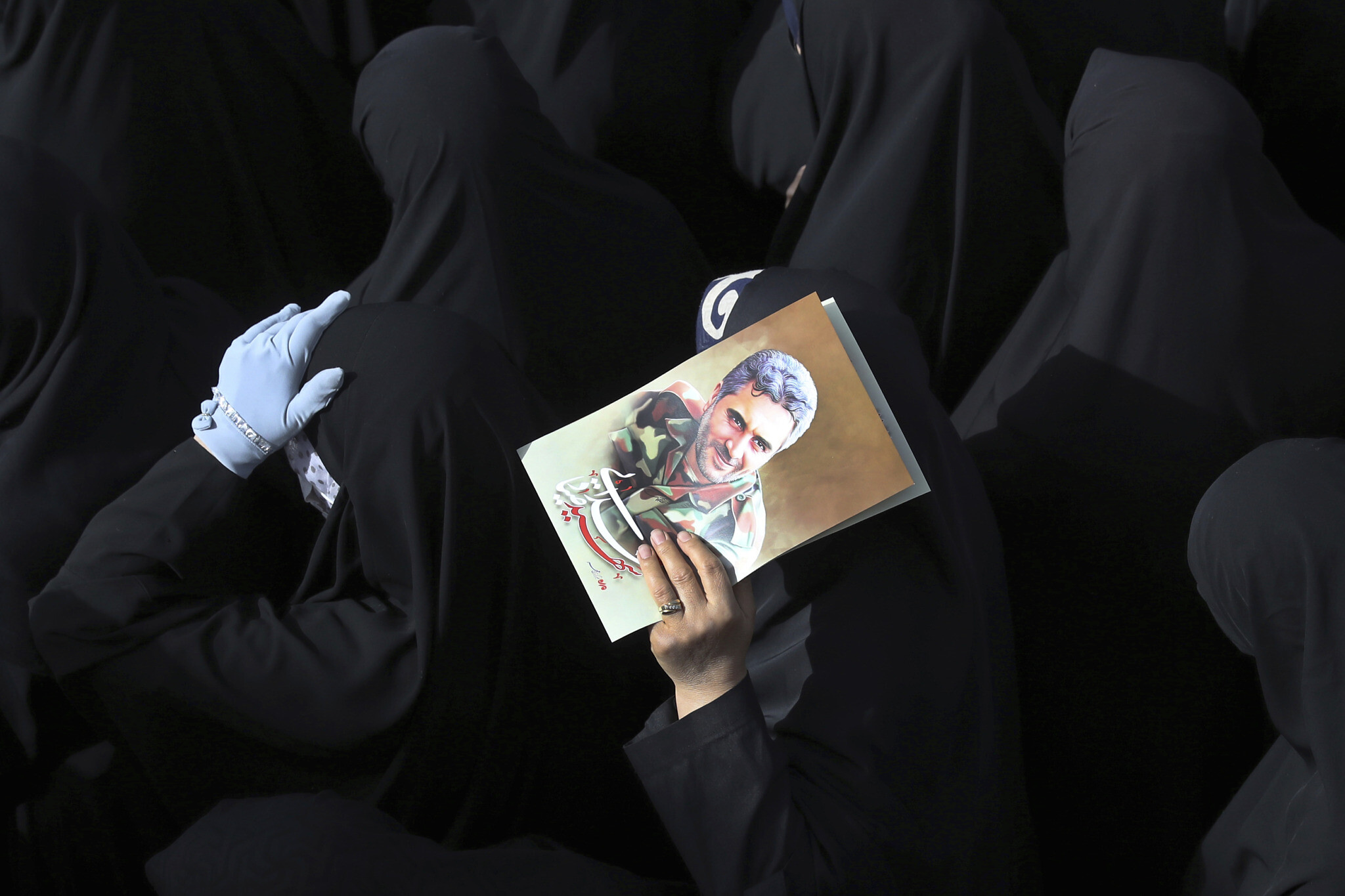
Mourners attend the funeral ceremony of Iran’s Revolutionary Guard Col. Hassan Sayyad Khodaei, shown in the poster, who was killed on Sunday, in Tehran, Iran, May 24, 2022. (Vahid Salemi/AP)
The 50-year-old Khodaei remains a shadowy figure and Iran has yet to offer biographic detail beyond saying that he also was a member of the elite Quds Force, which is tasked with carrying out operations abroad. The IRGC has described him as “defender of the shrine” — a reference to Iranians who support militias fighting the extremist Islamic State group in Syria and Iraq. Thousands attended his funeral in Tehran and hard-line President Ebrahim Raisi visited his family.
Earlier this month, another colonel in the Quds Force died, reportedly in an accident at his home, either a fall from a roof or a balcony. Iran International, which is linked to Iran’s regional adversary Saudi Arabia, claimed Col. Ali Esmailzadeh was killed over suspicions he provided information to Iran’s enemies that was used in the assassination of Khodaei days earlier.
Late last month, an engineer was killed and another employee injured in Iran’s Parchin military complex under unclear circumstances.
Iranian media reported on Monday that two members of the paramilitary Revolutionary Guard’s aerospace division died as “martyrs” in Iran in separate incidents over the weekend.
Amid the killings, Israel has in recent weeks warned its citizens against traveling to Turkey amid a series of reports about Iranian terror attempts in the country.
Israel’s Channel 13 reported Monday that several Israelis visiting the Turkish city of Istanbul were whisked out of the country last week by Israeli security officials, who were acting on intelligence showing that the visitors were at immediate risk from Iranian assassins.
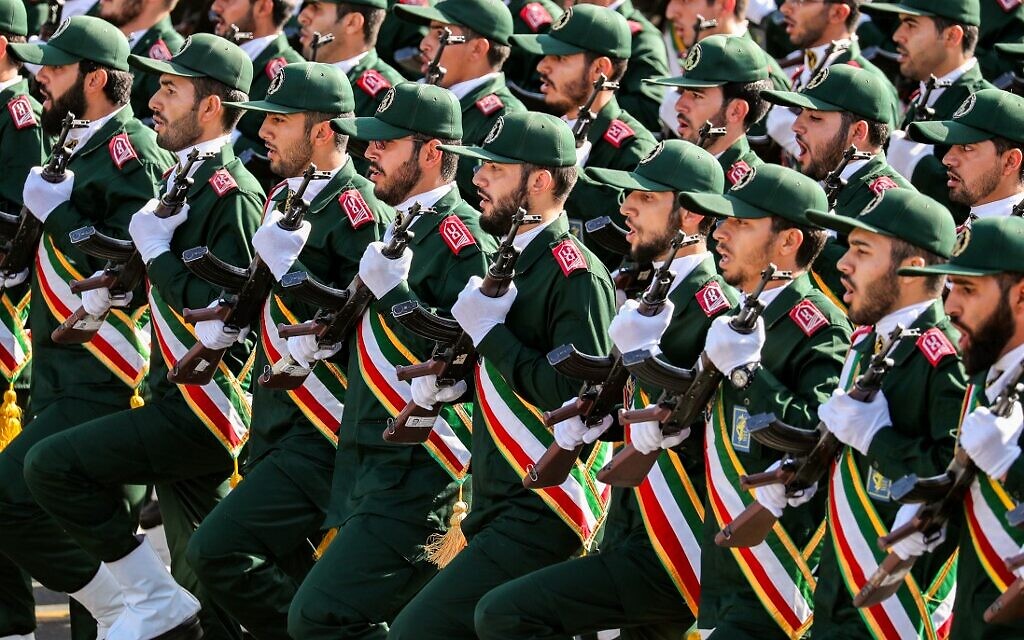
Members of Iran’s Islamic Revolutionary Guard Corps (IRGC) march during the annual military parade marking the anniversary of the outbreak of the devastating 1980-1988 war with Saddam Hussein’s Iraq, in the capital Tehran, on September 22, 2018. (Stringer/AFP)
Israel’s National Security Council on Monday raised the warning for Istanbul to level 4, the highest, meaning Israelis are explicitly told not to visit an area and to leave if they are already there. Foreign Minister Yair Lapid called on Israelis in Turkey to return immediately and for citizens to cancel travel plans to the country. Other reports have said that Turkish security forces have acted against Iranian agents in the country.
The security incidents have come as Iran’s nuclear deal with world powers remains stalled and continues to deteriorate.
The UN nuclear watchdog formally censured Iran over its nuclear program last week, hours after the Islamic Republic said it disconnected some of the International Atomic Energy Agency’s cameras monitoring its nuclear sites, cutting off monitoring of its progress. The agency’s chief, Rafael Grossi, warned that the move could deal a “fatal blow” to negotiations to revive the 2015 nuclear accord, stalled since March.
Iran followed this up on Thursday by announcing that it has begun injecting gas into newly installed advanced uranium enrichment centrifuges.
Iran said Monday that all measures it has taken to roll back its commitments under the 2015 nuclear deal with world powers are “reversible” if a new agreement is finalized.
Prime Minister Naftali Bennett warned in an interview published Saturday that Tehran was drawing “dangerously close” to producing nuclear weapons, and called on the global community to join Israel and ramp up pressure against Iran’s nuclear program and ambitions.



