
“The West is concerned that the NPT…will fail and a domino effect will begin as countries withdraw from the treaty.”
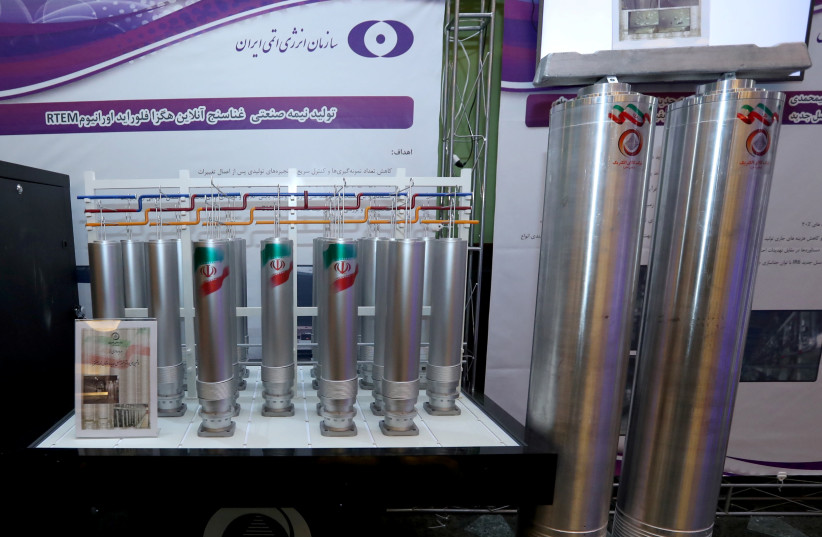
 A number of new generation Iranian centrifuges are seen on display during Iran's National Nuclear Energy Day in Tehran, Iran April 10, 2021 (photo credit: IRANIAN PRESIDENCY OFFICE/WANA (WEST ASIA NEWS AGENCY)/HANDOUT VIA REUTERS)
A number of new generation Iranian centrifuges are seen on display during Iran’s National Nuclear Energy Day in Tehran, Iran April 10, 2021
(photo credit: IRANIAN PRESIDENCY OFFICE/WANA (WEST ASIA NEWS AGENCY)/HANDOUT VIA REUTERS)

Iran should withdraw from the Treaty on the Non-Proliferation of Nuclear Weapons (NPT), an article on the front page of the Iranian Kayhan newspaper, affiliated with Iranian Supreme Leader Ali Khamenei, urged on Tuesday.

The article cited the stalling of talks on a return to the JCPOA nuclear talks, a wave of pressure on Iran, the continued reluctance of the US to lift sanctions, and recent reports by the International Atomic Energy Agency (IAEA) against Iran as a reason for Iran to withdraw from the NPT, calling such a move the “minimum solution for [Iran’s] diplomatic apparatus.”

“Withdrawal from the NPT as high-pressure leverage could be a strong response to the US and European approach to the Islamic Republic of Iran’s nuclear activities,” read the Kayhan article. “The West is concerned that the NPT – a treaty whose general spirit is to contain non-nuclear-weapon states – will fail and a domino effect will begin as countries withdraw from the treaty.”

The article added that withdrawal from the non-proliferation treaty “has more benefits than membership,” and that Iran could withdraw from the NPT by activating Article 10 of the treaty, which allows a party to leave if it determines that “extraordinary events, related to the subject matter of this Treaty, have jeopardized the supreme interests of its country.”

If it decides to withdraw, Iran would have to give notice to the other parties to the NPT, as well as to the United Nations Security Council, three months in advance.
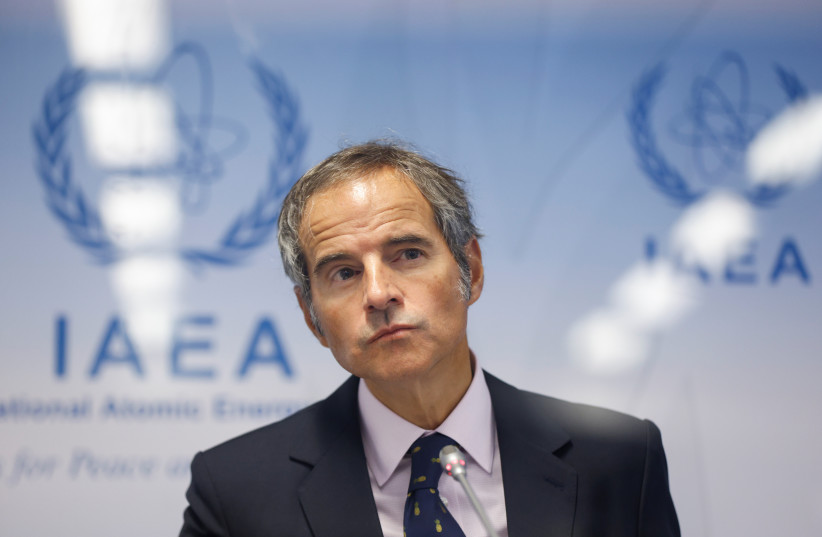
 INTERNATIONAL ATOMIC Energy Agency director-general Rafael Grossi at an IAEA Board of Governors meeting in Vienna, September 13. (credit: Leonhard Foeger/Reuters)INTERNATIONAL ATOMIC Energy Agency director-general Rafael Grossi at an IAEA Board of Governors meeting in Vienna, September 13. (credit: Leonhard Foeger/Reuters)

The Kayhan article complained that the IAEA had become “a political tool for the United States and Europe with false reports and coordination with the criminal Zionist regime.”

Hossein Shariatmadari, the managing editor of Kayhan, claimed to the Iranian Fars News Agency on Monday that the West’s dispute with Iran is not about the Islamic Republic’s alleged moves towards a nuclear weapon.

Shariatmadari complained that the former Iranian government led by then president Hassan Rouhani opposed proposals to withdraw from the NPT, saying that “unfortunately [the proposal] was abandoned very soon.”

The Kayhan editor pointed out that Israel is not a member of the NPT, claiming that Israel was provided with nuclear weapons by the US, France and Britain, although Israel denies owning any nuclear weapons.

“The IAEA is silent about all the countries that have officially and openly violated the provisions of the NPT, and has focused all its efforts on Iran, which it knows does not seek to develop nuclear weapons, and under the pretext of inspections, it obtains the latest military information and details of our country’s scientists and provides it to the enemies of Iran with pictures for sabotage in nuclear and military facilities and assassination of our country’s scientists!” said Shariatmadari to Fars.

“All the evidence suggests that the nuclear challenge is just an excuse, and the only way forward for us to get that excuse out of the hands of the enemy is to use Article 10 of the NPT and withdraw from the treaty,” added the Kayhan editor.

Support growing in Iran for anti-nuke fatwa to be revoked

A fatwa (Islamic religious decree) listed on Khamenei’s official English-language website states that “the Islamic Republic of Iran considers the use of nuclear, chemical and similar weapons as a great and unforgivable sin. We proposed the idea of ‘Middle East free of nuclear weapons’ and we are committed to it. This does not mean forgoing our right to peaceful use of nuclear power and production of nuclear fuel.”

Former Iranian diplomat Amir Mousavi told Al-Mayadeen TV on Monday that there is a growing call in Iran for Khamenei to reconsider his fatwa against the use of nuclear weapons, warning that the fatwa may be seen as a “weakness” and may be a “basis” for assassinations and other attacks against Iran.

Last year, Mousavi stated that “A fatwa is not permanent, according to the Ja’afari Shi’ite jurisprudence. A fatwa is issued in accordance with developing circumstances. Therefore, I believe that if the Americans and Zionists act in a dangerous manner, the fatwa might be changed,” according to MEMRI.

Despite Khamenei’s fatwa, in April former Iranian MP Ali Motahari stated “from the very beginning” Iran had begun nuclear activity with the goal to “build a bomb and strengthen the deterrent forces.” Motahari added that Iran “could not maintain the secrecy of this issue, and the secret reports were revealed by a group of hypocrites,” seemingly leading to the plan being abandoned.

“If we, like Pakistan, could secretly make and test bombs, it would be very deterrent,” Motahari stated. “When we started something, we should have seen it to the end.”

Motahari has commented in the past that Tehran can still make a nuclear bomb, despite Khamenei’s fatwa against such weapons, because the fatwa only forbids the use of a bomb, not the creation of one.

Draft resolution against Iran submitted to IAEA board

The United States, Britain, Germany and France have submitted to the UN nuclear watchdog’s board a draft resolution criticizing Iran for not fully answering the watchdog’s questions on uranium traces at undeclared sites, a move that is likely to anger Iran.

Several diplomats said the resolution was likely to pass easily despite warnings by Iran of retaliation and consequences that could further undermine already stalled talks on rescuing the 2015 Iran nuclear deal. Iran’s ally Russia opposes such a resolution.

IAEA Director-General Rafael Grossi stated on Monday that Iran is going to cross the uranium enrichment threshold needed to create a nuclear bomb, stressing that this “cannot be avoided.” Grossi has lamented in recent weeks that Iran has failed to provide credible explanations about the IAEA’s findings at three undeclared locations in the country, including traces of nuclear material.


Iran Has Enough Fissile Material for 3 Nuclear Warheads


Iran has enough fissile material to produce three nuclear warheads, an Israeli official said Monday, according to a report published by Israel Hayom.

The news came as the United Nations International Atomic Energy Agency’s Board of Governors began a week-long conference in Vienna to decide whether or not to issue a resolution against Iran. If that takes place, it would be the first such move in two and a half years.

IAEA Director Rafael Grossi told the Board of Governors on Monday there was no longer any possibility of stopping Iran from crossing the nuclear threshold.

“Having a significant quantity [of highly-enriched uranium] does not mean having a bomb, but … this idea of crossing the line, it’s going to happen,” Grossi said.

Iran International has reported that the United States, the United Kingdom, France and Germany have already been discussing a resolution against Iran. China and Russia, however, are warning such a move could upset the talks aimed at resurrecting the moribund JCPOA nuclear deal signed in 2015 between Iran and world powers.

Those talks have been limping along off and on in Vienna for more than a year. Officials involved in the negotiations have been largely pessimistic about the prospect of a successful conclusion.

Iran, on the other hand, is losing no time in its drive to increase its stockpile of highly-enriched uranium and creep closer to achieving an atomic weapon.

Last weekend Grossi paid a swift visit to Jerusalem, where he met with Israeli Prime Minister Naftali Bennett to discuss Iran’s nuclear efforts.

Grossi did not announce the visit — which lasted less than a day — prior to his arrival, nor did he offer any statement following the meeting.

According to the Israeli prime minister’s office, Bennett expressed Israel’s “deep concern” regarding Iran’s continued progress toward achieving nuclear weapons while deceiving the international community by using false information and lies.

Bennett emphasized the “urgent need” to mobilize the international community to take action against Iran, “using all means” in order to prevent the mullahs from achieving nuclear weapons.

Iran has repeatedly threatened to annihilate the Jewish State.

Speaking to reporters this week, the Israeli official said information about Iran’s galloping progress in uranium enrichment is found in one of the two reports presented by Grossi to the IAEA Board of Governors.

“The report examined the original nuclear agreement. It shows a disturbing trend of uranium enrichment in large quantities, at high levels of 60 percent and 20 percent percent, and in large quantities.

“The total enriched material is defined as 3-SQ, which means a quantity sufficient for three nuclear bombs,” the Israeli official said.

Uranium enriched to 60 percent purity has only one short step to go before reaching the 90 percent level needed for production of an atomic bomb.

Thus far, Iran has not taken that step — as far as anyone knows. But Iran has not responded to questions posed by the IAEA, and as the Israeli official said, “It can’t do it without blatantly lying and without being caught.”

If, as expected, the IAEA moves ahead with its resolution, it could result in censure of the Islamic Republic by the UN Security Council — but that is by no means guaranteed. Iran might even do an about-face and agree to the nuclear deal being discussed in Vienna.

But that’s very unlikely.

Bennett stressed to Grossi the importance of the IAEA Board of Governors delivering a “clear and unequivocal message” to Iran in its upcoming decision this week.

But the prime minister also made it clear that while Israel prefers diplomacy in order to deny Iran the possibility of developing nuclear weapons, it reserves the right to self-defense and to action against Iran in order to block its nuclear program should the international community not succeed in the relevant time frame.


Jerusalem stands to benefit as Washington repairs ties with ‘pariah’ Riyadh and defuses criticism at home; young Saudis reportedly more inclined to favor normalization

Saudi Crown Prince Mohammed bin Salman speaks during the Gulf Cooperation Council (GCC) Summit in Riyadh, Saudi Arabia, December 14, 2021. (Bandar Aljaloud/Saudi Royal Palace via AP)

Saudi Arabia is engaging in talks with Israel on economic ties and “security arrangements,” as it adjusts to shifting attitudes in the Middle East, where the Jewish state is not longer universally seen as an undisputed enemy, the Wall Street Journal reported Monday.

The kingdom has identified growing support among young Saudis for establishing ties and is moving toward advancing cooperation, according to the report.

Israel and Saudi Arabia do not have official diplomatic relations, but covert ties have warmed in recent years, as the Saudi crown prince, Mohammed bin Salman, has increasingly been seeing Israel as a strategic partner in the fight against Iranian influence in the region.

Officials in Israel and Saudi Arabia now say it is not a matter of if, but rather when, the two countries publicly improve their relations, the report said.

Sources familiar with the developments told the newspaper that the Biden administration is helping to broker an agreement for commercial planes from Israel to have expanded access to Saudi airspace, while the Saudis are looking to gain control of two strategic Red Sea islands.

Currently, only flights between Tel Aviv and the United Arab Emirates, which normalized ties with Israel in 2020, fly over Saudi Arabia, passing over the northern tip. But Israel has not yet received such access for flights to India, Thailand, and China, which, as a result, are significantly longer than they need to be.

There is also benefit for Washington as it seeks to repair its ties with Riyadh. US President Joe Biden vowed during his election campaign to make Saudi Arabia a “pariah” over the killing of journalist Jamal Khashoggi, which US intelligence concluded was ordered by Prince Mohammed. An improvement of ties with Israel could temper criticism of Biden over a potential meeting with the prince.

The US is seeking a Biden visit to Israel and Saudi Arabia in a trip that could push forward interests for all three countries.

US President Joe Biden listens as he meets virtually with infant formula manufacturers from the South Court Auditorium on the White House complex in Washington, June 1, 2022. (Susan Walsh/AP)

Saudi Prince Khalid bin Salman, brother of Prince Mohammed, recently visited Washington, where he told people in private that polling showed a change among Saudis under 30 in favor of diplomatic relations with Israel, people briefed on the talks were cited in the report as saying.

Riyadh has repeatedly said that its official position is that it will only normalize ties with Israel after the establishment of a Palestinian state.

Yet Saudi officials explained to the Wall Street Journal that support for the Palestinians is no longer a foregone conclusion, with many younger people disillusioned with the Palestinian Authority. In addition, there is Saudi resentment at Iran’s backing of the Hamas terror group that controls the Gaza Strip.

“If Hamas builds a relationship with Iran to protect themselves, then why don’t we have a relationship with Israel against Iran to protect ourselves?” one Saudi official said in the report.

People involved in the efforts noted that official diplomatic relations could still be years away, but the ongoing secret developments could speed up the process of establishing ties as both countries see Iran as a common threat.

The most likely first development, according to Israeli and Saudi officials, is an agreement for planes to fly over Israel and Saudi Arabia as part of security talks that would include the fate of the two Red Sea islands, Tiran and Sanafir. The existence of the negotiations about the islands was first reported by Axios.

This photo taken on January 14, 2014, through the window of an airplane, shows the Red Sea’s Tiran (foreground) and the Sanafir (background) islands in the Strait of Tiran between Egypt’s Sinai Peninsula and Saudi Arabia. (Stringer/AFP)

A Saudi takeover of security control of the strategic islands requires Israeli approval, under the terms of the Israel-Egypt peace deal. There is an international force on the islands, between the Gulf of Aqaba and the Red Sea. Sources familiar with the developments say that all three countries are considering a proposal for the international force to leave and Saudi forces to take over instead, an arrangement that would also indicate improvements in ties between Israel and Riyadh.

The kingdom refrained from signing onto the Washington-brokered Abraham Accords in 2020 as the US and Israel had hoped, but is believed to have given the go-ahead to Bahrain, where it retains decisive influence, to join the normalization agreement with Israel alongside the United Arab Emirates, Morocco, and Sudan.

In late 2020, then-prime minister Benjamin Netanyahu and then-Mossad chief Yossi Cohen, alongside other Israeli officials and then-US secretary of state Mike Pompeo, were said to have visited Saudi Arabia to meet with the crown prince, in the first known high-level meeting between an Israeli and a Saudi leader.

In addition, Israeli businessmen have been permitted to travel to Saudi Arabia to develop economic ties, people familiar with the visits said. Saudi Arabia’s major sovereign-wealth fund has already approved, for the first time, for Jared Kushner to invest money in Israeli companies. The fund has invested $2 billion with Kushner’s Affinity Partners.
