Israel says the field in question is within its exclusive economic zone, not in disputed waters.

Lebanese President Michel Aoun speaks at the Ministry of Foreign Affairs as Lebanese expats vote in Lebanon's parliamentary election, in Beirut, Lebanon May 8, 2022. (photo credit: DALATI NOHRA/HANDOUT VIA REUTERS)
Lebanese President Michel Aoun speaks at the Ministry of Foreign Affairs as Lebanese expats vote in Lebanon’s parliamentary election, in Beirut, Lebanon May 8, 2022.
(photo credit: DALATI NOHRA/HANDOUT VIA REUTERS)

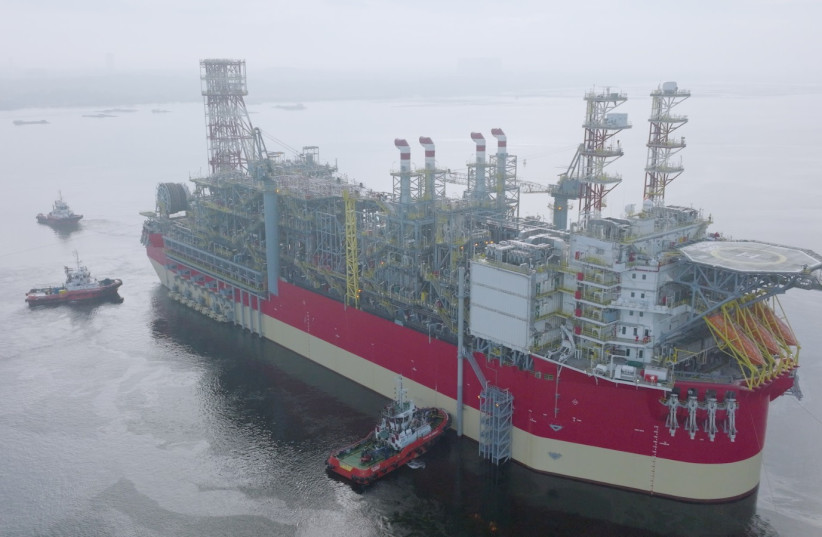
Lebanon warned Israel on Sunday against any “aggressive action” in disputed waters where both states hope to develop offshore energy, after a ship arrived off the coast to produce gas for Israel.

President Michel Aoun said any activity in the disputed area would amount to an act of aggression and a provocation, after the arrival of the natural gas storage and production ship operated by London-based Energean.

Israel says the field in question is within its exclusive economic zone, not in disputed waters.

But in a statement, the Lebanese presidency said Aoun discussed with caretaker Prime Minister Najib Mikati the vessel’s entry “into the disputed maritime area with Israel, and asked the Army Command to provide him with accurate and official data to build upon the matter.”

Aoun said negotiations to delineate the southern maritime border continued and “any action or activity in the disputed area represents a provocation and an aggressive action.”

any action or activity in the disputed area represents a provocation and an aggressive action

President Michel Aoun

There was no immediate response from the Israeli government to Aoun’s statement. Israeli Energy Minister Karine Elaharrar welcomed the vessel’s arrival and said she hoped it would be brought online quickly.

“We will continue to work to diversify the energy market and maintain stability and reliability,” she said.

“EXTREMELY DANGEROUS”

Energean said its floating production storage and offloading vessel arrived on Sunday at the Karish field, about 80 km (50 miles) west of the city of Haifa, in Israel’s exclusive economic zone. The company said it planned to bring it online in the third quarter.

Mikati said Israel was “encroaching on Lebanon’s maritime wealth, and imposing a fait accompli in a disputed area,” calling this “extremely dangerous.”

The United States began mediating indirect talks between the sides in 2000 to settle a long-running dispute that has obstructed energy exploration in the eastern Mediterranean.

Lebanon is home to the heavily armed, Iran-backed Hezbollah group, which has fought numerous wars with Israel.

Hezbollah has previously warned Israel against drilling for oil and gas in the disputed area until the issue is resolved, and said the group would take action if it did so.

Lebanon says its border cuts into the sea at an angle farther south and Israel’s claim runs farther north, creating a triangle of disputed waters.

Last year, Beirut expanded its claim by around 1,400 square km (540 square miles), enlarging the area disputed with Israel.

Lebanon has yet to respond to an undisclosed proposal a U.S. envoy made early this year to revive the stalled talks.

Senior Lebanese security official Major General Abbas Ibrahim said in an interview published last week following his trip to Washington that Beirut’s response would open the door for a return to those talks and that the United States was keen to “turn the page” on an issue that could blow up.


Energean floating gas production rig docks in Israeli waters

The newfound energy source could incentivize competition in the Israeli energy economy, reducing energy prices and energy related services.

Floating gas production rig, Energean Power (photo credit: ENERGEAN)
Floating gas production rig, Energean Power
(photo credit: ENERGEAN)

Energean’s floating gas production rig, Energean Power, has arrived in Israel, mooring near the Shark gas reservoir, about 80 km off the coast of Haifa.

Energean, which holds the gas production licenses from the “Shark(Karish)” and “Crocodile(Tanin)” reservoirs, announced the arrival on Saturday.

Energean will immediately begin anchoring and connecting the rig to the gas wells and piping networks and begin the initial run of various systems.

The company estimates that commissioning operations will last about 3-4 months until the first gas flow is achieved, which is expected in the third quarter of 2022.

“I am pleased to confirm that Energean Power, the floating rig of Energean, arrived safely in Israel this morning. This is a very significant milestone for the first gas extraction from the Shark Reservoir, expected in the third quarter of this year,” Matthews Riggs, CEO of Energean said.

This is a very significant milestone for the first gas extraction from the Shark Reservoir

CEO of Energean, Matthews Riggs

“Our flagship project will provide energy security to Israel and the region. This milestone joins Energian’s recent discoveries in the Olympus region, which will form a significant basis for the company’s continued growth and the development of the local and regional energy economy,” he added.

The newfound energy source could incentivize competition in the Israeli energy economy, reducing energy prices and energy-related services, as well as ensuring an additional source of gas supply for Israel’s energy independence.

Lebanese response

Lebanon, on the other hand, was not thrilled about the new rig mooring in Israel’s exclusive economic zone, claiming it is settled in waters disputed between Israel and Lebanon.

President Michel Aoun said any activity in the disputed area would amount to an act of aggression and a provocation, after the arrival of the natural gas storage and production ship operated by London-based Energean.

Israel says the field in question is within its exclusive economic zone, not in disputed waters.

But in a statement, the Lebanese presidency said Aoun discussed with caretaker Prime Minister Najib Mikati the vessel’s entry “into the disputed maritime area with Israel, and asked the Army Command to provide him with accurate and official data to build upon the matter.”

Aoun said negotiations to delineate the southern maritime border continued and “any action or activity in the disputed area represents a provocation and an aggressive action.”

any action or activity in the disputed area represents a provocation and an aggressive action

President Mechel Aoun

Energean’s FPSO facility

An FPSO facility is a vessel used by the gas and oil industry, for the production and processing of natural gas from marine reservoirs. Floating rig technology, which is not fixed to the seabed, has a number of significant advantages, thanks to an efficient, economical, greener and safer production capability.

FPSOs are preferred in frontier offshore regions as they are easy to install, and do not require a local pipeline infrastructure to export oil. FPSOs can be a conversion of an oil tanker or can be a vessel built specially for the application, like Energean Power.

Used in offshore production since the 1970s, FPSOs have been historically utilized in the North Sea, offshore Brazil, Asia Pacific, the Mediterranean Sea and offshore West Africa.

Energean Power was towed by two tugs from the shipyard where it was built in Singapore, all the way to Israel. The voyage, which lasted about 8900 km(5532 miles), lasted 35 days during which it passed through 6 seas, and towards the end it crossed the Suez Canal, entering the economic waters of Israel over the weekend. The rig continued its journey until it arrived At 5:00 a.m. to its location near the reservoir in Israeli waters near Haifa.


Failure to pass the bill by the end of June could bring civilian life in the settlements to a grinding halt.

 Jewish settlers look on during a march near Hebron in the West Bank, June 21, 2021 (photo credit: REUTERS/MUSSA QAWASMA)
Jewish settlers look on during a march near Hebron in the West Bank, June 21, 2021
(photo credit: REUTERS/MUSSA QAWASMA)

The fate of Prime Minister Naftali Bennett’s governing coalition may hang in the balance on Monday over a directive giving Israel legal jurisdiction over settlers living in the West Bank, which has been approved every five years since 1967.

Right-wing members of the opposition have pledged to vote against the bill as part of a push to bring down Bennett’s government.

Yesha Council head David Elhayani, of the coalition’s New Hope Party, has warned that failure to pass the bill will create “absolute chaos” for Israelis living in Judea and Samaria.

If the first reading of the bill is not passed on Monday, it could still be passed the following Monday. Failure to pass it by the end of June could bring civilian life in the settlements to a grinding halt.

Israeli police would not be able to operate in Area C of the West Bank, where all the settlements are located and which is under Israeli military and civilian rule.

 NAFTALI BENNETT and Mansour Abbas in the Knesset. Is a partnership like this lost for good?  (credit: Emmanuel Dunand/AFP via Getty Images)NAFTALI BENNETT and Mansour Abbas in the Knesset. Is a partnership like this lost for good? (credit: Emmanuel Dunand/AFP via Getty Images)

The more than 450,000 Israelis who live there would be stripped of rights that allow them to operate as if they live within the borders of sovereign Israel. This could include access to state health insurance, the ability to be drafted into the army and the renewal of driver’s licenses.

As of Sunday night it was not clear that the bill had support even within the coalition. Ra’am (United Arab List) and rebel MKs Ghaida Rinawie Zoabi and Idit Silman may end up deciding how to vote at the last minute, which will make it very hard to know if there is a majority to pass the bill.

Ra’am leaders met on Sunday night to consider how to vote. Party leader Mansour Abbas is in favor of it and is trying to persuade other MKs in Ra’am and Rinawie Zoabi to vote for it in order to keep the coalition together.

Justice Minister Gideon Sa’ar has warned of political consequences if the bill is not passed. Sa’ar told confidants in the coalition that his threat would not apply if the bill is blocked by Silman.

One possibility is to purposely bring the bill to a vote as a no-confidence motion and then have Silman declared a defector if she votes against it. Silman told confidants that she was not deterred by such threats and could not be declared a defector for one vote against the coalition.

If Silman would be declared a defector, she could not run for the next Knesset on the slate of either Likud or the Religious Zionist Party.

Bennett’s associates said they would bring the bill to a vote repeatedly until it passes. Unlike other bills, it would not have to wait six months to be brought to a vote again if it is defeated in the Knesset plenum.

But Elhayani said that the impact of the bill is so great, that no one should be playing politics with it.

If this law fails there will be lawyers who can’t register to practice, young adults that can’t enter the army and people who arrive at the hospital that can’t receive treatment, said Elhayani, who is also the head of the Jordan Valley Regional Council.

“Every day there will be a new story of someone who was harmed,” he said, adding that “the impact is so dramatic that I can’t understand why people are playing politics with this.”

the impact is so dramatic that I can’t understand why people are playing politics with this

David Elhayani

More than 70% of those living in Judea and Samaria voted for parties that now want to abandon them by voting against this directive, Elhayani said.

“It’s a slap in the face to those voters.”