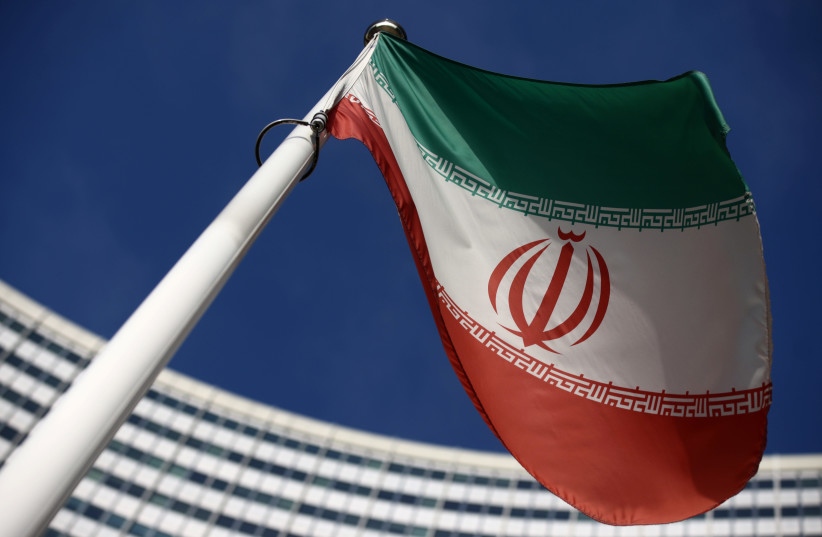
New York Times reports that Tehran views deadly incident as an attack, noting it fits pattern of alleged past Israeli strikes in Iran and Lebanon


2004 satellite image of the military complex at Parchin, Iran. (AP/DigitalGlobe-Institute for Science and International Security)

2004 satellite image of the military complex at Parchin, Iran. (AP/DigitalGlobe-Institute for Science and International Security)

A deadly explosion at Iran’s Parchin military complex on Wednesday was caused by quadcopter suicide drones, in an attack that fits a pattern of previous strikes that have been attributed to Israel, The New York Times reported Friday.

The report cited three Iranian sources along with a US official, who confirmed drones hit the site, but declined to say who was behind the attack. It said the drones exploded into a building being used for research on Iran’s drone development.

The blast killed a young engineer at the site and injured one other person.

The report noted that the strike fits a pattern of previous attacks that have been attributed to Israel, including previous strikes against Iran’s drone program.

Iranian sources told the Times that the drone attack was launched from inside Iran, not far from the Parchin military base — which the Islamic Republic uses to develop missile, nuclear and drone technology — noting that quadcopter drones have a short flight range, and Parchin is a long way from Iran’s borders.

While Iranian officials initially used the word “accident” to describe the explosion, the Defense Ministry in a later statement called it an “incident” and labeled the casualty a “martyr,” suggesting that Tehran is convinced it was an attack by a foreign entity.

On Thursday, Islamic Revolutionary Guard Corps commander Hossein Salami said that the killing “will be responded to… Our enemies should wait,” without naming who they were.

This would not be the first time that a drone attack was launched from within Iran’s borders by operatives said to have been recruited by Israel.
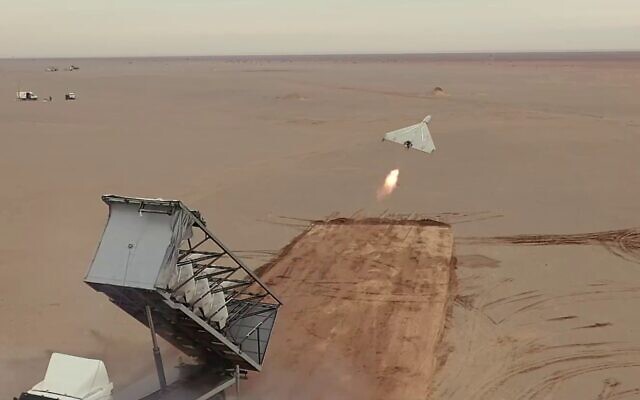
An Iranian Shahed-136 drone is launched during a military exercise in Iran, December 2021. (Screen capture/Twitter)

Israel did not comment on the Wednesday incident, but it mirrored others that have taken place recently in Iran and Lebanon where Jerusalem has sought to target Tehran’s production and transfer of drone technology to proxies across the Middle East.

Last February, a reported Israeli UAV attack caused major damage to Iran’s drone fleet near the city of Kermanshah, prompting Iran to fire missiles at a site in Iraq that it claims was an Israeli intelligence base.

Last June, an alleged Israeli drone struck a facility in the city of Karaj that is used to assemble centrifuges for uranium enrichment at the Natanz and Fordow. The site is called the Iran Centrifuge Technology Company, or TESA.

A senior Israeli military official told the New York Times that the country has invested significant resources to detect and destroy such weapons, which pose a particular threat given that they can evade the IDF’s antimissile systems such as Iron Dome.

Iranian drones were used in attacks against Israel, Saudi Arabia, the UAE, Yemen and even a US base in Syria, intelligence officials told the Times.

Wednesday’s strike came days after gunmen took out an officer in Iran’s Islamic Revolutionary Guard Corps in the middle of Tehran.

Israel has told US officials that it was behind the assassination and that it killed Col. Hassan Sayyad Khodaei in an effort to warn Tehran against the continued operation of an alleged covert unit he helped lead, an intelligence official told the Times.
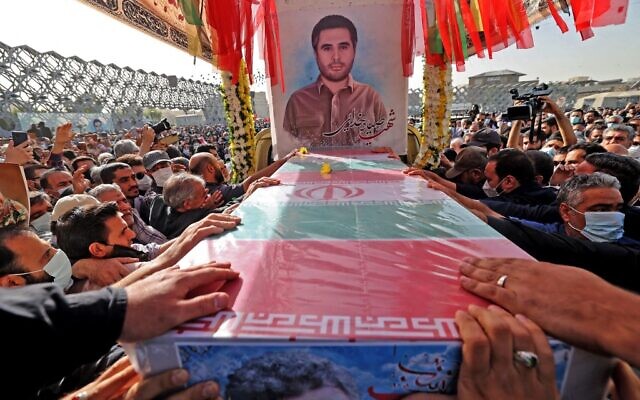
Mourners gather around the coffin of Iran’s Revolutionary Guards colonel Sayyad Khodaei during a funeral procession at Imam Hussein square in the capital Tehran, on May 24, 2022. (Atta Kenare/AFP)

Parchin, located south of Tehran, has been tied to Iran’s missile production work and nuclear research. It has been the site of a number of mysterious blasts in the past, which some have suggested were engineered by Iran’s foes.

The complex is alleged to have hosted past testing of conventional explosives that could be used to detonate a nuclear warhead, something Iran has repeatedly denied.

The site came under renewed scrutiny by the International Atomic Energy Agency in 2015 when Tehran reached a landmark deal with major powers under which it agreed to curb its nuclear activities under UN supervision in return for the lifting of international sanctions.

Iran had previously denied the IAEA access to Parchin, insisting it was a military site unrelated to any nuclear activities, but the agency’s then-chief, the late Yukiya Amano, paid a visit to the site.

Iran’s nuclear program has been the target of a campaign of sabotage, cyberattacks and assassinations of key scientists that it has blamed on Israel.

Other explosions and fires occurred in Parchin in 2014 and 2007.


Israelis traveling to the Gulf states, Azerbaijan and Turkey are urged to be cautious.

By David Hellerman, World Israel News

Israeli officials are concerned Iran will attack Israeli or Jewish interests abroad in revenge for the assassination of a senior paramilitary officer in Tehran on Sunday.

Channel 12 News reported that Israel will likely issue advisories about traveling to countries which border Iran, including the Persian Gulf states and possibly Turkey.

The report stressed that there are no intelligence warnings of specific attacks.

Rather, Israelis visiting the United Arab Emirates, Bahrain, Azerbaijan, and Turkey are advised to be cautious.

The heightened concern follows the assassination of Col. Hassan Sayyad Khodaei of the Islamic Revolutionary Guards Corps (IRGC) on Sunday. He was shot and killed in his car outside his home by unknown assassins on a motorcycle in broad daylight.

Reports indicated that Khodaei was the deputy commander of the IRGC’s Unit 840, which is said to be responsible for abductions and assassinations around the world. In recent years, Iranian plots against Israelis have been thwarted in Cyprus, the United Arab Emirates, Ethiopia, Kenya and Columbia.

Other sources told the Times that Khodaei was a key figure in providing Hezbollan and Iranian proxies in Syria with advanced drone technology and tactical advice.

The New York Times — citing an unidentified intelligence official of unspecified nationality — reported on Wednesday that Israel notified Washington it was responsible for the hit. Israel blames the U.S. for the leak, saying it endangers Israeli lives and increases Tehran’s motivation for revenge.


Iran’s foreign minister said that Iran is not trying to create a nuclear weapon but that Israel is lying to the world about it.

 Iran's and US' flags are seen printed on paper in this illustration taken January 27, 2022.  (photo credit: REUTERS/DADO RUVIC/ILLUSTRATION)
Iran’s and US’ flags are seen printed on paper in this illustration taken January 27, 2022.
(photo credit: REUTERS/DADO RUVIC/ILLUSTRATION)

The Zionist control of United States policy has prevented the revival of the nuclear deal, Iran Foreign Minister Hossein Amir-Abdollahian said on Thursday, and warned other options were on the table.

“We have intelligence that the Zionist regime has taken the foreign policy of the US hostage,” Amir-Abdollahian charged during a public interview he gave Fareed Zakaria of CNN at the World Economic Forum in Davos. “If the American side will decide realistically, then the deal is at hand.” Amir-Abdollahian added that this is why Israel had come up with false stories about his country.

He blamed Israel for over-dramatizing the US decision, leaked to Politico this week, to keep Iran’s Islamic Revolutionary Guard Corps on its Foreign Terror Organizations list.

The story was publicly confirmed by Prime Minister Naftali Bennett, who said US President Joe Biden had informed him of the decision last month.

Israel has made it seem as if retaining the IRGC on that list is significant for the future of the Iran talks, but this is not so, Amir-Abdollahian explained.

The Iranian flag waves in front of the International Atomic Energy Agency (IAEA) headquarters, before the beginning of a board of governors meeting, amid the coronavirus disease (COVID-19) outbreak in Vienna, Austria, March 1, 2021. (credit: REUTERS/LISI NIESNER)The Iranian flag waves in front of the International Atomic Energy Agency (IAEA) headquarters, before the beginning of a board of governors meeting, amid the coronavirus disease (COVID-19) outbreak in Vienna, Austria, March 1, 2021. (credit: REUTERS/LISI NIESNER)

“The FTO thing is just one level of our talks between us and the Americans, indirectly,” he said. “There are still remaining issues which are also important. Unfortunately, the Israeli side made it [the FTO issue] public, magnified it, and now this issue is being portrayed as the main hurdle.”

The Iranian foreign minister also blamed Israel for the story that ran this week in the Wall Street Journal, saying that access to International Atomic Energy Agency documents helped Tehran conceal work on its past nuclear program.

These IAEA documents were part of the cache of 100,000 documents connected to Iran’s former nuclear program that Israel was able to spirit out of Tehran in 2018, and has since shared with the US intelligence community.

“The Zionists are spreading a lot of lies.”

Irans Foreign Minister Hossein Amir-Abdollahian

Amir-Abdollahian spoke with Zakaria amid great skepticism that the 2015 Iran deal, known as the Joint Comprehensive Plan of Action, can be revived.

The deal was designed to constrain Iran’s nuclear program to ensure that it did not develop nuclear weapons. It was signed in 2015 between Tehran and the six world powers: the US, Russia, China, France, Great Britain and Germany.

The Trump administration quit the deal in 2018 and reimposed crippling sanctions on Iran. Biden has sought unsuccessfully to revive the deal.

US sanctions

Iran wants the US to lift the sanctions prior to an agreement, while the Biden administration wants an agreement before rescinding sanctions.

The British envoy to the Vienna-based Iran talks, Stephanie Al-Qaq, said that if “we reach the point at which the deal is hollowed out, then it would no longer be worth returning to.”

US special envoy for Iran Rob Malley told the Senate Foreign Relations Committee that prospects for reaching a deal were “tenuous at best.”

The envoys are concerned that given Iran’s advancements in its nuclear program, a deal, once reached, might no longer be relevant.

Amir-Abdollahian said that private messages Iran indirectly receives from Malley and Biden are different from their public statements, which could be political in nature.

If Biden’s intentions are genuine, the foreign minister said, he should “show them on the ground.”The window for diplomacy was still open as long as sanctions were lifted and the Iranian public was convinced that it would receive economic relief, he explained.

“Give us economic guarantees and remove the elements of the maximum pressure policy of Trump,” he said. “These are the most important issues to us that we have to focus on.”

Amir-Abdollahian claimed that Iran is “serious about reaching a strong and good and lasting deal. Our nuclear program is strong and totally peaceful. We are keeping the window of diplomacy open,” and if the US has a realistic approach, “we will get to the point where we will make a deal. The United States has to make a decision. If the Zionist lobby distances itself from the national interest of the US, just a little, Mr. Biden can reach a good deal. If it doesn’t happen, here in Iran for the last 40 years we have withstood these pressures and we have other options on the table as well.”

Amir-Abdollahian also claimed that the accusation that his country had possessed a program devoted to the development of nuclear weapons was false.

Iranians are “not after developing a nuclear bomb, but the Zionist regime is repeating this lie,” he said.