
Israel, Syria, Russia and the Shifting Middle East Sands

by Eyal Zisser / Israel Hayom / JNS.org

OPINION

Smoke rises after Syrian state media reported an Israeli missile attack in a container storage area, at Syrian port of Latakia, Syria, in this handout picture released by SANA on December 28, 2021. SANA/Handout via REUTERS

JNS.org – Earlier this month, a Russian air-defense battery stationed in Syria fired missiles at Israeli jets that had attacked a Syrian factory manufacturing weapons earmarked for Hezbollah.

The missile fire, the first incident of its kind since Russian military forces arrived in Syria seven years ago, was meant to show that, despite the war in Ukraine, Moscow is determined to maintain — no matter the cost — its foothold in Syria. Israeli officials, however, tended to interpret the missile fire as a warning signal and a message, whereby Russia could punish Israel for its position on the war in Ukraine by restricting and perhaps even negating Israel’s freedom of action in Syrian airspace.

As of now, this was an isolated incident and we can only hope it remains one, yet it raises doubts and even concerns. It also takes us back 55 years to the final weeks of May 1967 to the countdown before the Six-Day War — a war that no one expected and no one wanted.

Then too, Israel acted in Syria to foil the Syrians’ efforts to divert water from the Jordan River and against attacks carried out by Fatah terrorists, who the Syrians encouraged along Israel’s northern border. It’s possible the escalation along that border sparked concerns in Moscow that Israel was about to attack Syria, but it also seemed Russia wanted to exploit the events by pouring oil on the fire, create an atmosphere of war and thus ensure the fealty of their Arab allies and bolster Moscow’s regional standing.


As a result, the Russians warned the Arabs that Israel was set to attack Syria, while all of Israel’s denials fell on deaf ears. In doing so, the Russians initiated a snowball effect that led to the war’s eruption. In the wake of the Russian warning, then-Egyptian President Gamal Abdel Nasser deployed his forces to the Sinai Peninsula, closed the Straits of Tiran to Israeli ships and expelled all United Nations forces from the Gaza Strip.

The Arab world rallied for war against Israel, while Israelis were gripped by a sense of siege and strangulation. The war became inevitable. It seems the Russians were surprised by the cascade of events, lost control over them and were humiliated by the total defeat of the Arab armies, which they had armed and trained. In response, they severed ties with Israel as punishment for its victory.

The IRGC blamed the killing on “global arrogance,” typically code for the United States and Israel.

By Associated Press

A senior member of Iran’s powerful Revolutionary Guard was killed outside his home in Tehran on Sunday by unidentified gunmen on a motorbike, state TV reported.

Although the Guard gave only scant detail about the attack that occurred in broad daylight in the heart of Iran’s capital, the group blamed the killing on “global arrogance,” typically code for the United States and Israel.

That accusation, as well as the style of the brazen killing, raised the possibility of a link with other motorbike slayings previously attributed to Israel in Iran, such as those targeting the country’s nuclear scientists. There was no immediate claim of responsibility for the attack.

The two assailants shot Col. Hassan Sayyad Khodaei five times in his unarmored Iranian-made Kia Pride, state media said, right off a highly secure street home to Iran’s parliament.

Reports identified Khodaei only as a “defender of the shrine,” a reference to Iranians who fight against the extremist Islamic State group in Syria and Iraq within the Guard’s elite Quds force that oversees foreign operations.

Little information was publicly available about Khodaei, as Quds officers tend to be shadowy figures carrying out secretive military missions supporting Hezbollah, the Lebanese militant group, and other militias in Syria, Iraq and elsewhere.

The Tehran prosecutor arrived at the crime scene within hours of the killing to investigate and demanded police urgently arrest the perpetrators. The probe’s speed suggested Khodaei’s prominence in the murky structure of the Guard’s overseas operations.

Those operations have come under repeated Israeli air attack in Syria. An Israeli strike near the Syrian capital of Damascus killed two Guard members in March, prompting Iran to retaliate by firing a missile barrage into northern Iraq.

Security forces were pursuing the suspected assailants, state TV reported, without offering further details or giving a motive for the killing.

Around the same time, state-run media said the Revolutionary Guard’s security forces had uncovered and arrested members of an Israeli intelligence network operating in the country, without elaborating on whether they had any connection to Khodaei’s slaying.


Assailants on a motorcycle shot and killed the Quds Force member in front of his home in the Iranian capital.

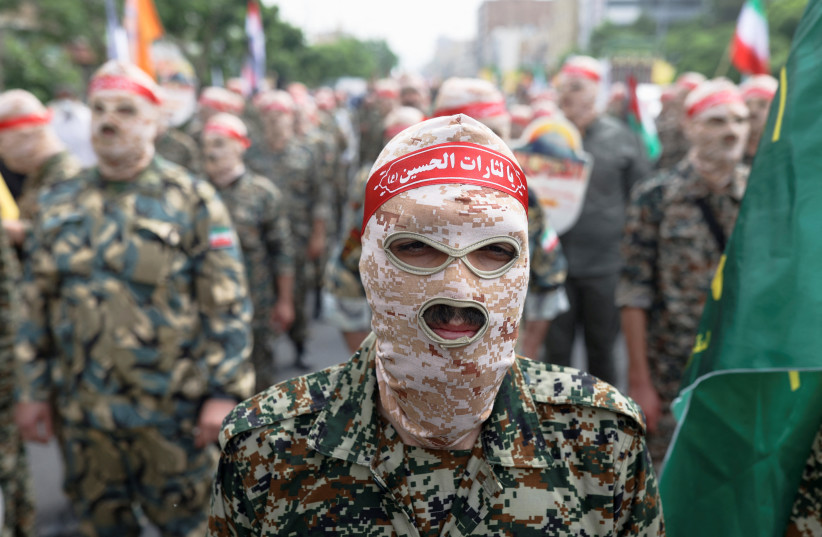
 Members of a special IRGC force attend a rally marking the annual Quds Day, or Jerusalem Day, on the last Friday of the holy month of Ramadan in Tehran, Iran April 29, 2022. (photo credit: MAJID ASGARIPOUR/WANA (WEST ASIA NEWS AGENCY) VIA REUTERS)
Members of a special IRGC force attend a rally marking the annual Quds Day, or Jerusalem Day, on the last Friday of the holy month of Ramadan in Tehran, Iran April 29, 2022.
(photo credit: MAJID ASGARIPOUR/WANA (WEST ASIA NEWS AGENCY) VIA REUTERS)

A member of the Islamic Revolutionary Guards Corps’ Quds Force involved in planning attacks on Jews and Israelis worldwide, Colonel Hassan Sayad Khodayari, was assassinated in Tehran on Sunday afternoon, the IRGC announced.

Khodayari operated in Syria, according to the IRGC statement. Photos reportedly from the scene showed Khodayari dead in a vehicle after he was shot.

Assailants on a motorcycle shot and killed the Quds Force member in front of his home on Mojahedin Eslam Street in the Iranian capital, according to Iranian reports. Iranian authorities are searching for the assailants.

The IRGC called the assassination a “criminal terrorist act of the counter-revolution and elements related to global arrogance (a term often used to refer to the US and Israel).”

Shortly after the assassination, in a seemingly unrelated incident, the IRGC claimed that it had arrested a “network of thugs” associated with the Mossad without providing further details.

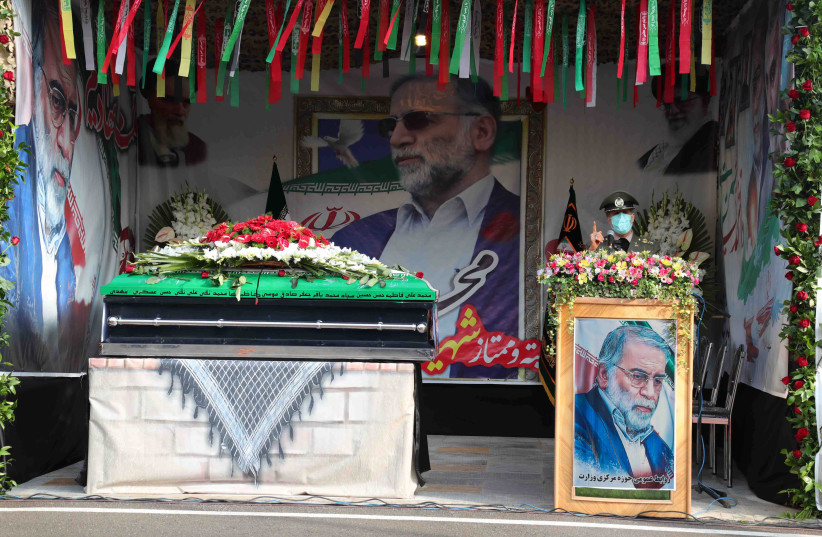
 Iranian Defense Minister Amir Hatami, speaks during a funeral ceremony of Iranian nuclear scientist Mohsen Fakhrizadeh, in Tehran, Iran November 30, 2020.  (credit: IRANIAN DEFENSE MINISTRY/WANA/HANDOUT/VIA REUTERS)Iranian Defense Minister Amir Hatami, speaks during a funeral ceremony of Iranian nuclear scientist Mohsen Fakhrizadeh, in Tehran, Iran November 30, 2020. (credit: IRANIAN DEFENSE MINISTRY/WANA/HANDOUT/VIA REUTERS)

In November 2020, Iran’s chief military nuclear scientist Mohsen Fakhrizadeh was assassinated in Tehran in an attack Iranian officials blamed on Israel.
