The exercise will take place within Israel’s month-long drill, dubbed “Chariots of Fire.”
By Batya Jerenberg, World Israel News
The American air force will join an Israeli drill in two weeks that will practice hitting Iran, Channel 13 reported Tuesday evening.
U.S. jets that will conduct air-to-air refueling of a number of Israeli war planes, simulating an airstrike on the Islamic Republic. CENTCOM commander General Eric Corella already landed Tuesday to lead the coordination effort between the air forces, the report said.
While the air force practices hitting Israel’s enemy far away, ground forces will concurrently engage in multi-front “battles” in order to sharpen the IDF’s abilities to contend with many threats at once. This includes dealing with even worse violence from the Arab-Israeli sector than that which occurred in mixed cities during last May’s Operation Guardian of the Walls against Hamas terrorists in the Gaza Strip.
The joint drill can only be seen as a warning to the Islamic Republic at a time when the chances of the U.S. signing back onto the nuclear accord with Iran seem to be fading. Iran has time and again threatened to attack Israel and, according to Defense Minister Benny Gantz, it will soon have enough enriched uranium to construct a nuclear weapon.
Iran also threatens Israel more immediately by continuing to build up the missile forces of its terror proxies on Israel’s borders. It also has Islamic Republican Guard Corps units stationed in Syria, which Israel hits regularly in an effort to derail further Iranian entrenchment so close to home.
The training run will take place within an intense, month-long drill that began last week, dubbed “Chariots of Fire.” Encompassing all Israeli forces simultaneously, it is simulating combat scenarios on air, sea, land and in cyberspace and is Israel’s largest military exercise ever.
Thousands of regular and reserve troops are taking part, with the aim, said Prime Minister Naftali Bennett, of “upgrad[ing] our capabilities in preparing for the real thing.”
A new World Monuments Fund project in conjunction with the US embassy in Baghdad aims to repair Iraqi cultural heritage as part of the Future of Babylon project
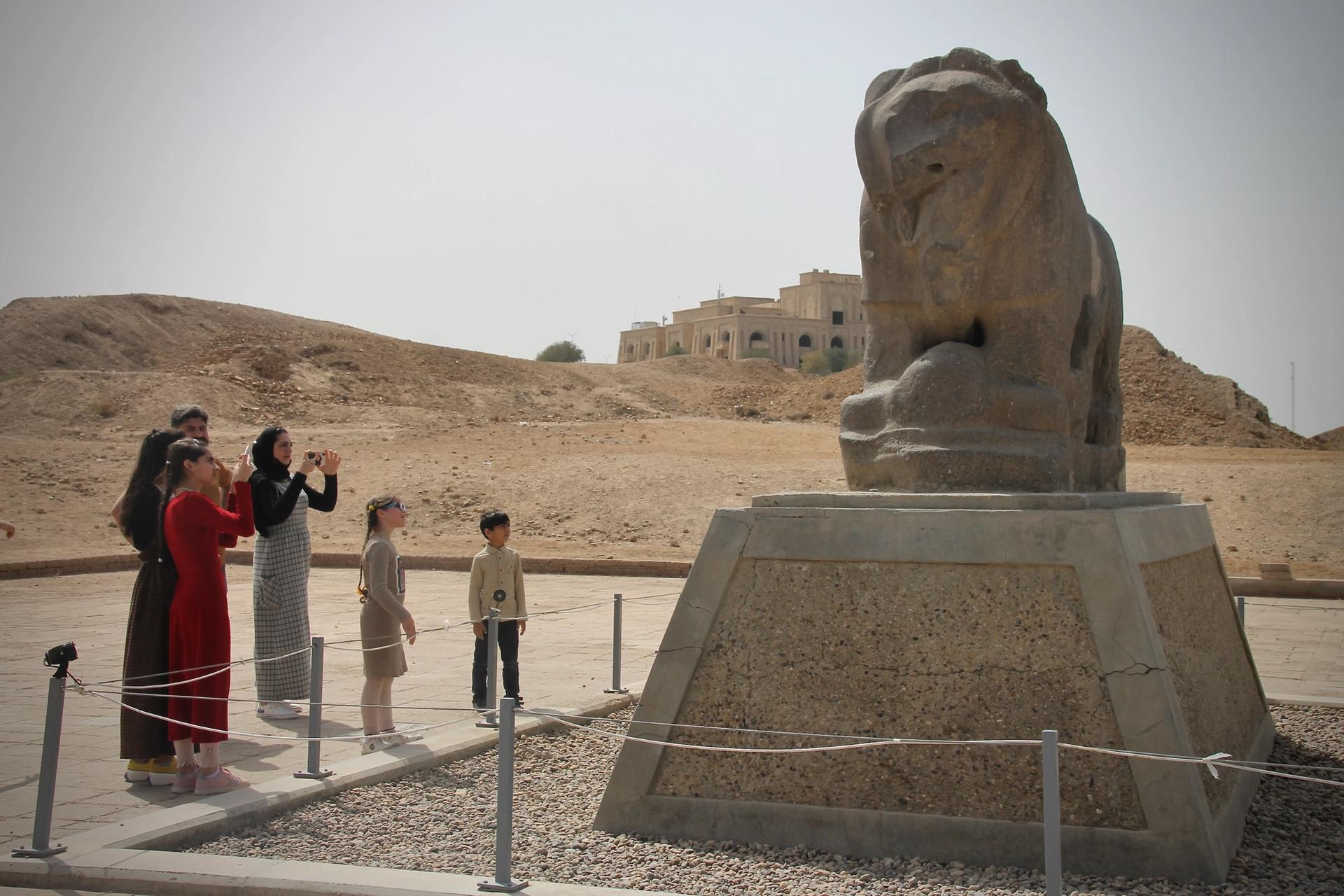
The World Monuments Fund assisted in the conservation of the famous Lion of BabylonPhoto: Hadani Ditmars
A new World Monuments Fund (WMF) project in Babylon, funded as part of a $3m donation by the US embassy in Baghdad first bestowed in 2018, aims to repair and restore the famed Ishtar Gate by this summer.
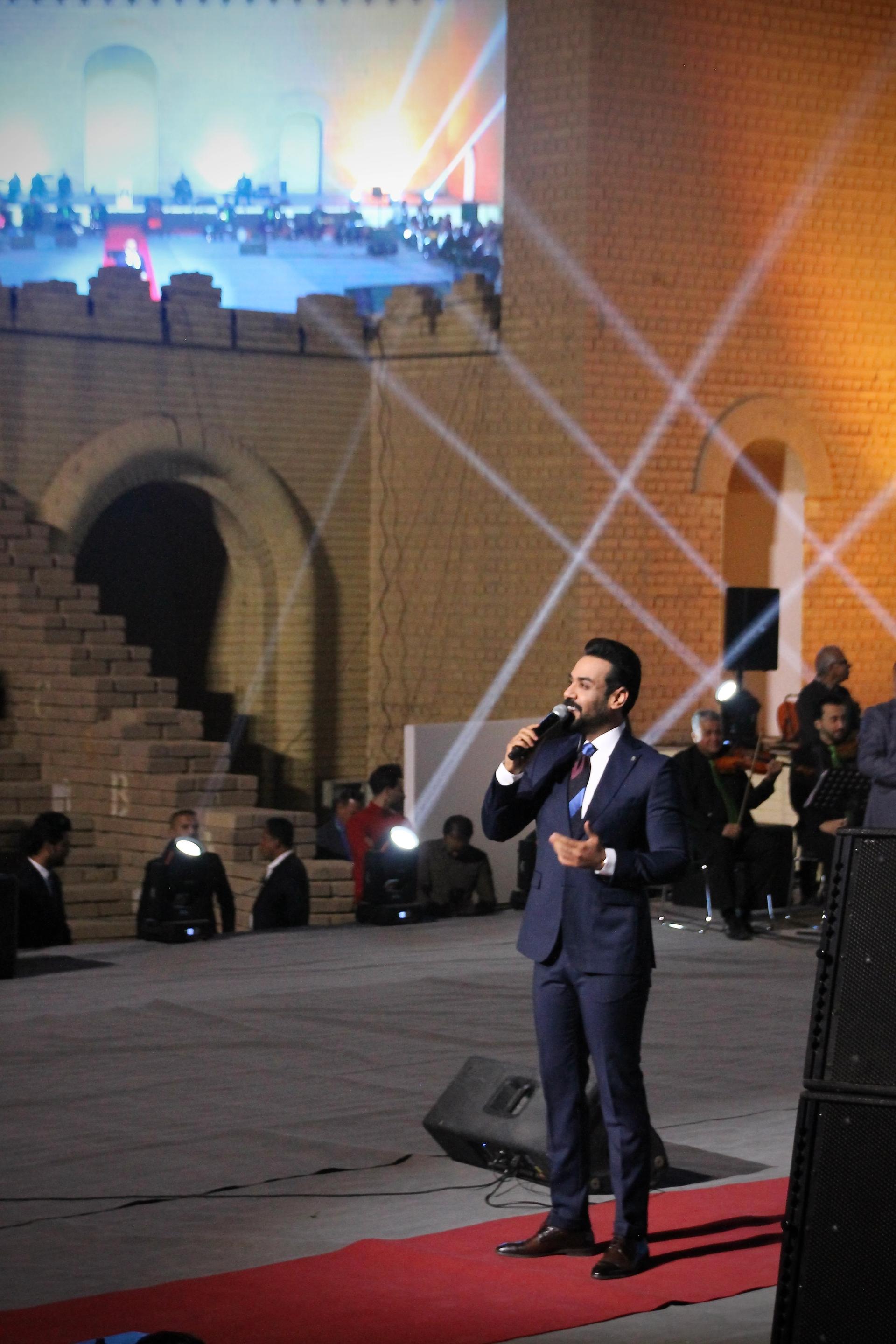
As soaring melodies from a concert at the amphitheatre built by Saddam Hussein in the 1980s, on the ruins of a third-century BC foundation, drifted over from the newly revived Babylon festival, the WMF programme director Jeff Allen toldThe Art Newspaper: “The project will help usher in new tourism initiatives designed to enhance the visitor experience and help the local economy. It will also train and employ local Iraqis in heritage conservation techniques.”
The Babylon festival was revived last year and the 2022 edition is taking place this month and features the famous Iraqi singer Ali JasimPhoto: Hadani Ditmars
The new initiative is part of the WMF’s 15-year commitment to conservation efforts as part of its Future of Babylon project, initiated in 2008. Collaborating with the Iraqi State Board of Antiquities and Heritage (SBAH) until 2015, the WMF performed extensive surveys and documentation and developed conservation plans. The organisation also assisted with a Unesco World Heritage nomination for Babylon that culminated in its inscription in July 2019 and helped with the conservation and stabilisation of the Lion of Babylon. The projects at the Ishtar Gate and Ninmakh Temple, launched in 2016 and 2019 respectively, will be the beneficiaries of the US embassy funding.
Babylon was once the pet project of Saddam Hussein, who envisioned himself as a neo-Nebuchadnezzar, and often referred to a Quranic passage linking the ruler of the Babylonian Empire to the liberation of Palestine. To his credit, his budget for upkeep was much higher than the one currently managed by the Iraqi government, but his labour of love and self-aggrandisement—he had stones inscribed with his name as in other ancient sites—also involved much heavy-handed reconstruction in the 1980s and 90s, often using cement bricks and other inappropriate building materials.
Hussein’s interventions, neglect resulting from 12 years of draconian UN sanctions that bankrupted the country, and subsequent damage by military vehicles in the wake of the 2003 invasion all contributed to Babylon’s demise.
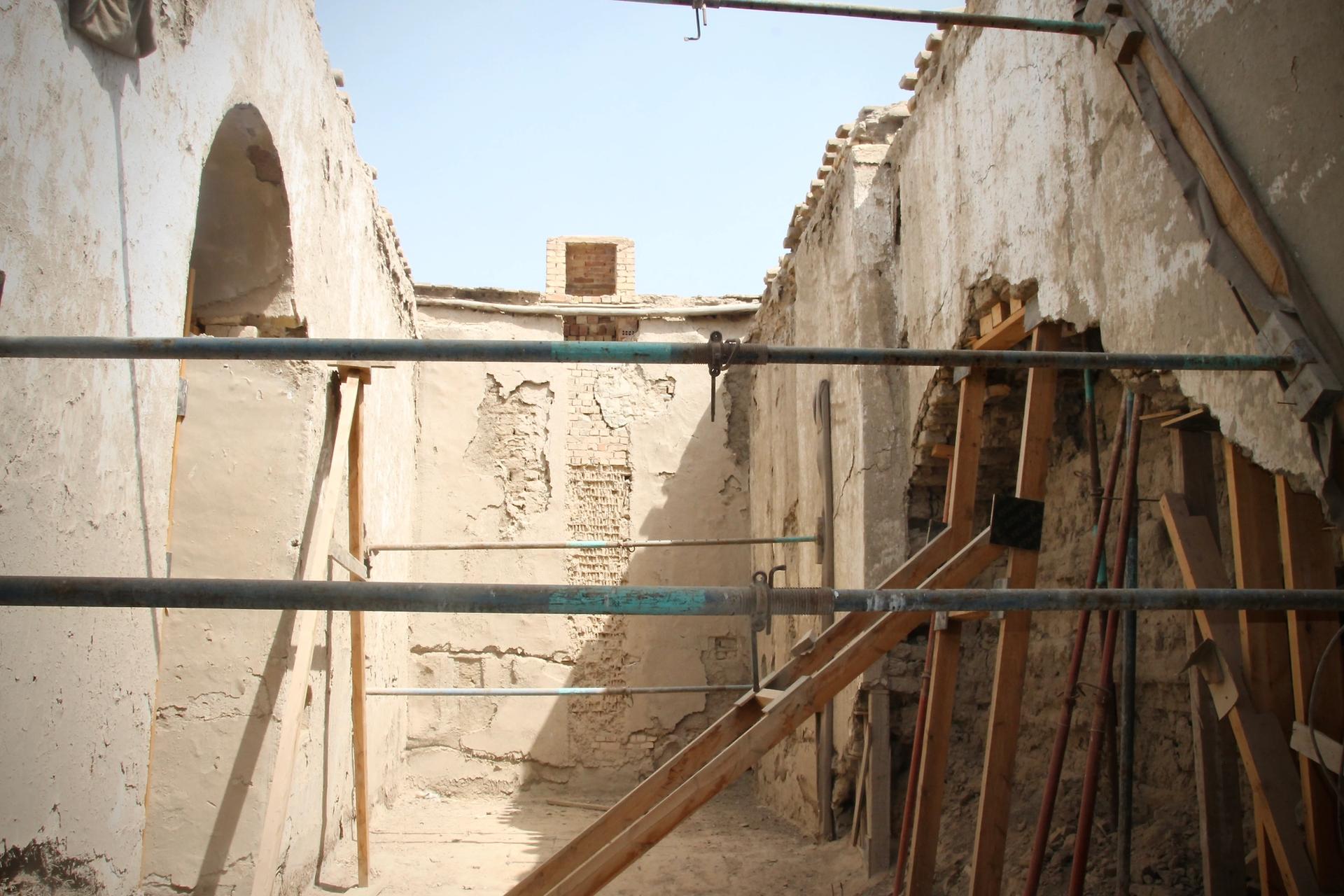
Ninmakh Temple at Babylon is undergoing urgent repairsPhoto: Hadani Ditmars
Construction, too, has taken a toll over the years. In 1927, the British ran a railway line through the site, and in the 1980s Hussein built a highway through part of it, along with a palace for himself, complete with a helipad. There are still three existing but non-functioning oil pipelines, two of which were built in the 1970s and 80s and the third of which is more recent—work on it was blocked after the SBAH filed a lawsuit in 2012.
But today, with renewed internal and foreign tourism and funding from the US embassy and other international donors, Babylon is coming back to life. Its still-eerie, grandiose Hussein-era palaces and guesthouses are filled with international artists invited for the Babylon festival, and thousands of Iraqis flock here every month for parties, weddings and musical boat rides along the Euphrates river.
The current WMF work at the Ishtar Gate—the eighth and most elaborate gate to the inner city of Babylon, whose north facade was reconstructed and displayed in the Pergamon Museum in Berlin in 1930—is addressing issues around changing groundwater levels and its impact on masonry humidity.
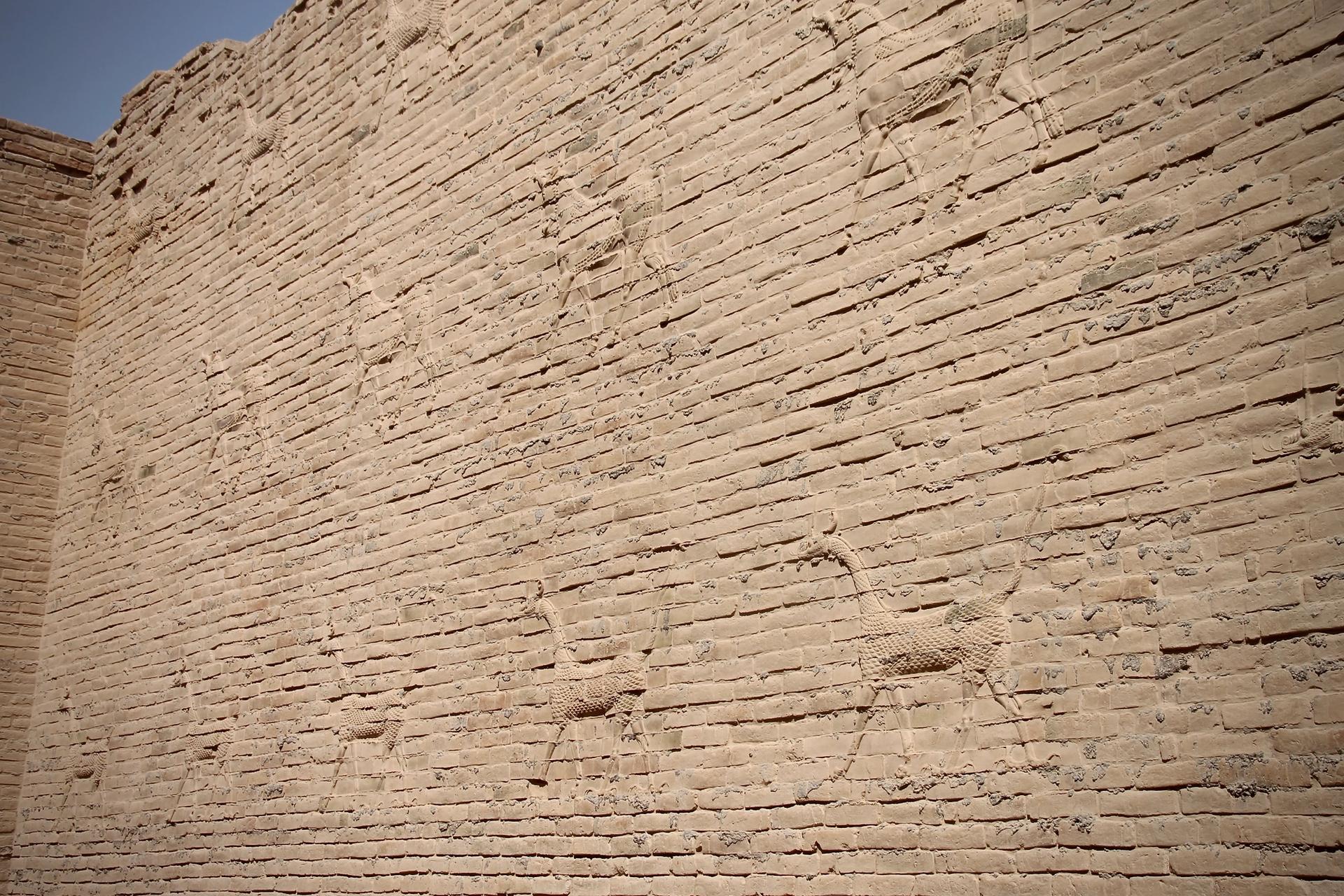
The north façade of the Ishtar Gate, similar to the one pictured here in Babylon, was smuggled out of Iraq and is now housed in the Pergamon Museum in BerlinPhoto: Hadani Ditmars
According to the SBAH archaeologist Ammar Altaee, although Hussein-era interventions did use some mud and straw-baked bricks, which allowed for proper drainage, the concrete bricks they used that absorb but can’t expel moisture have caused significant damage. Current plans, detailed in conceptual drawings, will address drainage issues with façades of metal netting and local stones. The delicate repair job unfolds brick by brick, with layers from interventions in 1958, when King Faisal was in power, joining Hussein-era concrete and mud bricks, being replaced where possible by newly made baked and fired mud bricks, produced in local workshops in nearby Borsippa. The production of the new bricks, sized and coloured to match the original Babylonian ones (the Hussein-era ones were too small and not the right shade) is simultaneously reviving traditional masonry and training new practitioners.
Brick reliefs of bulls and dragons, referencing Marduk the supreme god of Babylon and facing incoming visitors to protect the city from evils, look on as repairs to a dangerous staircase make the area a safer experience for tourists.
Meanwhile at the temple of Ninmakh—the Sumerian goddess said to have created man from a mixture of mud and the blood of a murdered god—urgent repairs are underway to secure damaged walls before the next winter rains cause them to collapse. The mud-brick walls were weakened by a Hussein-era concrete roof that they could not support, which collapsed in 1999, and a second mud roof that replaced it, which was damaged by post-invasion military occupation.
Gazing out at an ancient well that local legend says is the abode of the mischievous angels Harut and Marut—hung there for eternity by God for teaching magic to mortals—the WMF project manager Osama Hisham notes: “This is only one of many temples that need urgent repair.”
Author:RhondaPublished:May 17, 2022
PM’s directive comes amid growing calls for the IDF to use attack helicopters and air-to-surface missiles against terror suspects in the West Bank.
Israeli soldiers secure the scene after a Palestinian assailant attempted to stab Israeli soldiers, near the Hawara checkpoint, outside the West Bank city of Nablus, May 17, 2022.
(photo credit: NASSER ISHTAYEH/FLASH90)
Israel will use “all kinds of weapons” to target terrorists who aim to harm Israeli citizens or soldiers, Prime Minister Naftali Bennett said on Tuesday.
The prime minister’s directive comes amid growing calls for IDF to use attack helicopters and air-to-surface missiles against Palestinian terror suspects in West Bank. Last week, Noam Raz, a veteran of the counterterror unit Yamam, was shot and killed during an IDF operation in the Palestinian city of Jenin.
Speaking after a visit to the Efraim Regional Brigade in the West Bank with IDF Chief of Staff Lt.-Gen. Aviv Kohavi, Bennett said that he instructed them to use all means necessary to bring calm and security to Israel.
“The directive is clear: to hit terrorists wherever they are, with all types of weapons,” the prime minister said. “We give our full support to the IDF and Israel Police to attack any terrorist – in Jerusalem, Judea and Samaria and anywhere else in the country. Whoever raises a hand against an Israeli citizen or an IDF soldier – his blood is on his head.”
AN ISRAELI Apache helicopter fires a missile towards the Gaza Strip in July 2014 (credit: BAZ RATNER/REUTERS)Early Tuesday, IDF soldiers shot a Palestinian near the Hawara checkpoint outside Nablus after he attempted to stab troops in the area.
Video from the scene of the attempted attack shows a person running toward soldiers with a knife in his hand before being shot. No Israeli soldiers were injured in the incident.
“We are happy that this incident ended without any civilians getting hurt,” said St.-Sgt.-Maj. R. who shot at the terrorist.
IDF soldiers, the Shin Bet (Israel Security Agency) and Border Police arrested 18 Palestinians throughout the West Bank early Tuesday morning, including in Qarawat Bani Hassan, Hable, Halhul, ad-Dhahiriya, Dheisha, Nablus and Kalkilya, as part of Operation Break the Wave.
In Ras Atiya, the IDF seized an M-16 and arrested a suspect. As soldiers worked to arrest suspects in Far’a, shots were fired in the area. No soldiers were injured.
Later on Tuesday morning, clashes were reported in Al Aroub near Hebron as Israeli forces entered the town.