With Israel’s national security adviser in Washington to meet his counterpart, Israeli officials have reportedly said the chances of world powers signing a new nuclear deal with Iran are greatly diminished.
According to reports in the Israel Hayom newspaper and the Kan public broadcaster on Tuesday, US administration officials are closer than ever to admitting defeat on US President Joe Biden’s stated goal to return to the 2015 deal.
Talks in Vienna between Iran and world powers have been stalled for six weeks, reportedly over Iran’s demand that Washington delist its Islamic Revolutionary Guard Corps from a US terror list.
“The possibility that the parties will sign an agreement in the foreseeable future is dwindling at an exponential rate,” an official told Israel Hayom. A source cited by Kan suggested that the White House “is much more willing these days, then it was in the past” to admit the talks are likely to fail.
According to an Axios report on Monday, the Biden administration “has recently started discussing a scenario” in which the deal won’t be revived.
Last week, a senior Israeli diplomatic official claimed that Biden administration officials notified their European counterparts that Washington does not plan on delisting Iran’s Islamic Revolutionary Guard Corps.
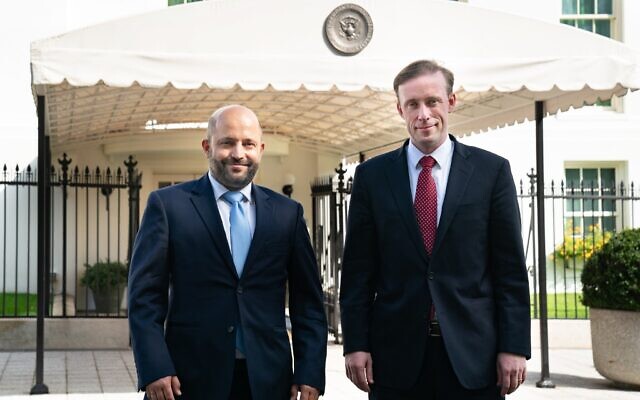
National Security Council chairman Eyal Hulata (L) and US National Security Adviser Jake Sullivan in front of the White House on October 5, 2021. (Jake Sullivan/Twitter)
National Security Adviser Eyal Hulata met with his US counterpart Jake Sullivan on Monday in Washington, a day after Biden told Prime Minister Naftali Bennett that he would visit Israel in the coming months.
According to the US readout of the meeting, Sullivan told Hulata that “the United States is attuned to Israel’s concerns about threats to its security, including first and foremost from Iran and Iranian-backed proxies.”
During his conversation with Biden on Sunday, Bennett said that “I am sure that President Biden, who is a true friend of Israel and cares about its security, will not remove the Revolutionary Guards from the [State Department’s] list of [Foreign] Terrorist Organizations,” per the Israeli readout.
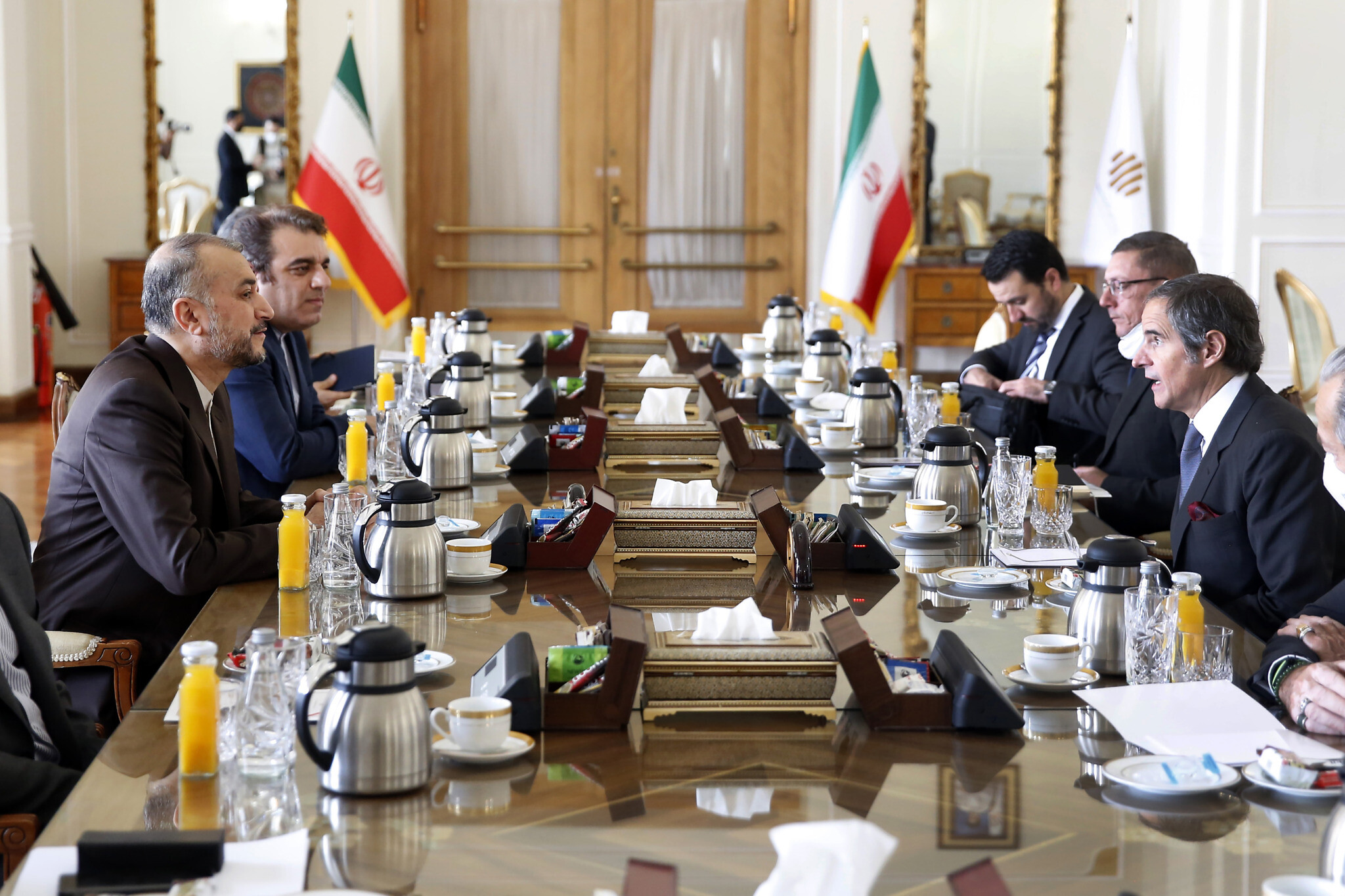
On Monday, Iran called for a new meeting “as soon as possible” in the Vienna negotiations it has been holding with Britain, China, France, Germany and Russia directly, and the United States indirectly.
“It is appropriate that a face-to-face meeting is held as soon as possible,” foreign ministry spokesman Saeed Khatibzadeh told his weekly press conference. “It is not yet decided where and when to have this meeting and at what level it should be held, but it is on the agenda.”
The 2015 deal gave Iran sanctions relief in exchange for curbs meant to guarantee that Tehran could not develop a nuclear weapon, something it has always denied wanting to do.
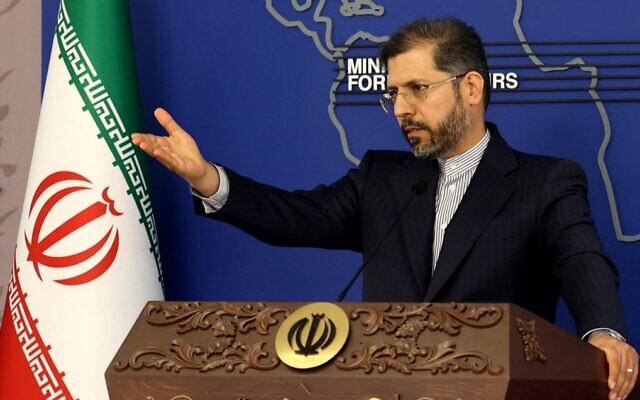
Iran’s Foreign Ministry spokesman Saeed Khatibzadeh speaks to the media during a press conference in Tehran, on April 25, 2022. (Atta Kenare/AFP)
The United States unilaterally withdrew from the accord in 2018 under then-president Donald Trump and reimposed biting economic sanctions, prompting Iran to begin rolling back its own commitments.
Iran and the US, adversaries for decades, have been exchanging views through the European coordinator of the Vienna talks, Enrique Mora.
Khatibzadeh said Iran and the European Union agreed that “prolonging the pause in the negotiations is not in anyone’s interest.” He added that the talks “have not stopped and are continuing through the coordinator of the Vienna negotiations.”
The Vienna talks, which started a year ago, aim to return the United States to the nuclear deal, including through the lifting of sanctions on Iran, and to ensure Tehran’s full compliance with its commitments.
“It is clear that if the US had given the right answers to the remaining issues… everyone would have been in Vienna by now,” said Khatibzadeh.
US State Department spokesman Ned Price said last week that “if Iran wants sanctions-lifting that goes beyond the JCPOA, they’ll need to address concerns of ours that go beyond the JCPOA.”