
Should they support the first Jewish candidate for president? Or rather vote for the moderate Emmanuel Macron?
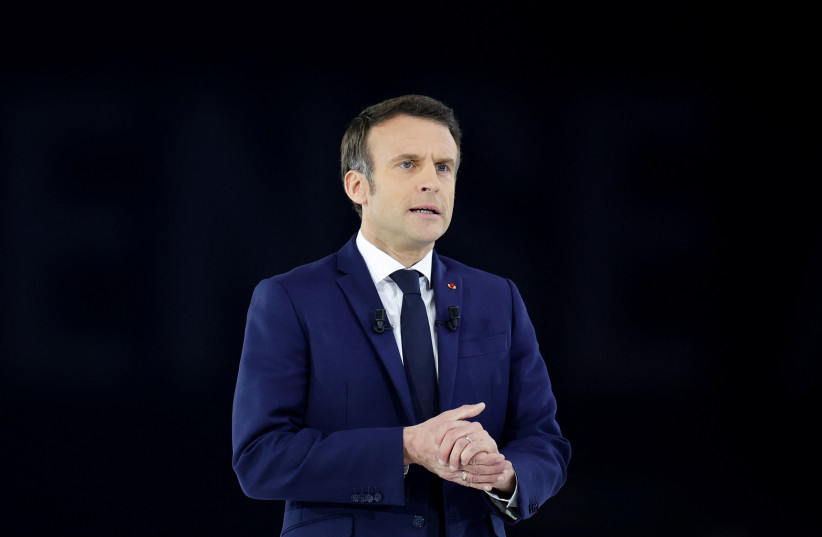
French President Emmanuel Macron, candidate for his re-election in the 2022 French presidential election, attends a political campaign rally at Paris La Defense Arena in Nanterre, France, April 2, 2022. (photo credit: REUTERS/SARAH MEYSSONNIER)
French President Emmanuel Macron, candidate for his re-election in the 2022 French presidential election, attends a political campaign rally at Paris La Defense Arena in Nanterre, France, April 2, 2022.
(photo credit: REUTERS/SARAH MEYSSONNIER)

While there have been many Jewish prime ministers in France, there was only one Jewish president, Alexandre Millerand, who was baptized, and whose mother converted to Catholicism. Millerand was president from 1920 to 1924, but since then, a Jew has not led the republic.

France now has a Jewish presidential candidate, the extreme right-wing Eric Zemmour, who gained momentum early in the race but is no longer considered a realistic candidate, and not likely to make it to the second round of voting. President Emmanuel Macron is in the lead, and holds a comfortable advantage over rivals in the first round of voting, according to Reuters polling.

Other surveys show Macron would win a second-round runoff against any of his rivals, albeit by a narrower margin than his 2017 victory.

Far-right candidate Marine Le Pen has consistently polled in second place. Hard-left contender Jean-Luc Mélenchon has climbed to the third spot, with Zemmour and conservative challenger Valérie Pécresse a few percentage points behind.

Close to half a million Jews in France will face a difficult decision in Sunday’s presidential election: should they support the Jewish candidate for president, or vote for the moderate Macron?

 ERIC ZEMMOUR, leader of the French far-right party “Reconquete!” who is running in this year’s French presidential election, is seen at a campaign rally in Lille, northern France earlier this month. (credit: PASCAL ROSSIGNOL/REUTERS)ERIC ZEMMOUR, leader of the French far-right party “Reconquete!” who is running in this year’s French presidential election, is seen at a campaign rally in Lille, northern France earlier this month. (credit: PASCAL ROSSIGNOL/REUTERS)In conversations this week with members of France’s Jewish community, many said that leaders of their communities are extremely cautious in what they say, and very nervous about the outcome of the election. There are no polls that show who the Jews will vote for, but much attention has been paid to Israel and how French Jews in Israel will vote. Many French Jews in Israel are supporting the extreme-right Jewish candidate, largely because he has recently spoken up against antisemitism.

Some estimates predict that 20%-30% of French-Israeli Jews will cast their absentee ballots for Zemmour, even though he has almost no chance of moving to the second round of voting.

Others indicate that a majority of the French-Israeli Jewish community will vote for Macron.

Heads of the French Jewish community spoke to rabbis in Israel recently and briefed them on the situation. They begged the rabbis to tell their congregants not to vote for Zemmour, saying that could create a negative and even violent reaction toward Jews in France.

On Monday, Zemmour tweeted about the case of Jeremy Cohen, a young French Jew who was killed by a tram. He asked why Cohen’s death wasn’t considered an antisemitic attack even though a video showed a gang trying to beat him up just seconds before he was killed.

“These images are chilling,” Zemmour tweeted. “The death of yet another of our children and the deafening silence on the facts revolt me. Did he die to escape scum? Did he die because he was a Jew? Why is this case hushed up?”

The tweet bolstered Jewish support for Zemmour, who has been losing substantial support lately, according to recent polls published in France.

On the other hand, heads of the French Jewish community have criticized Zemmour and called him antisemitic, among them French Chief Rabbi Haim Korsia.

Francis Kalifat, head of the CRIF umbrella group of French-Jewish communities, wrote in an op-ed regarding Zemmout, “He’s not a useful idiot – he’s a useful Jew and the new leader of Holocaust denial in our country.”

Ariel Kandel, director-general of Qualita, an organization promoting immigration to Israel from France, said on Thursday that “those who immigrated to Israel are mostly right-wing and Jews who suffered from antisemitism when living in France. Therefore, many of them will vote for Zemmour. Many French Jews wanted to vote for right-wing parties but couldn’t bring themselves to vote for Le Pen due to her views and family history, which were very problematic for the Jewish community.”

Kandel thinks the story of this election, specifically regarding the Jewish community, is that “there is a chance that someone from the Le Pen family can be elected president – something that wasn’t realistic just a few months ago. Those who don’t want to vote for Macron or for the far-right may abstain in the second round. When there is less turnout, it is always good for extremists.

“The fact that the Jewish candidate – Zemmour – became more extreme than Le Pen made her more acceptable. It is Zemmour’s fault that Le Pen has a slight chance of becoming president. Le Pen won’t be able to be elected without the help of Zemmour, and I think he will also declare that he supports her. To see a Jew stand on stage with someone with the last name Le Pen, asking his supporters to vote for her, sounds like a crazy Netflix series.”

Kandel said that in his opinion, “Zemmour is an assimilated Jew who is not antisemitic but promotes something problematic. It’s a very scary situation for French Jews.”

If Le Pen is elected, he said, there is a chance of a surge in immigration from France to Israel.

“Many Jews have talked about a situation for years that if Le Pen is elected, they will immigrate to Israel,” said Kandel. “There is no reason we won’t be able to reach 10,000 Jews making aliyah if she is elected.”

“The European energy market is facing a substantial shortage following the Russia crisis,” Elharrar said. “Israel sees an opportunity and will take full advantage of it.”

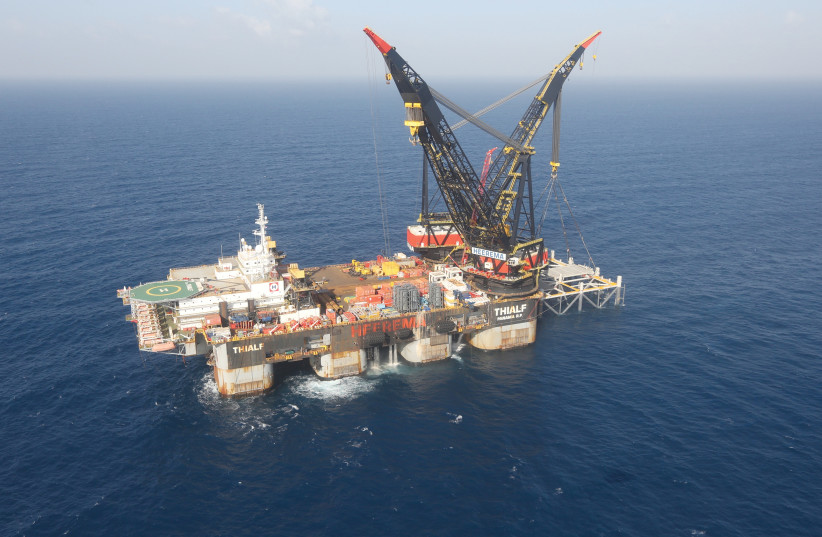
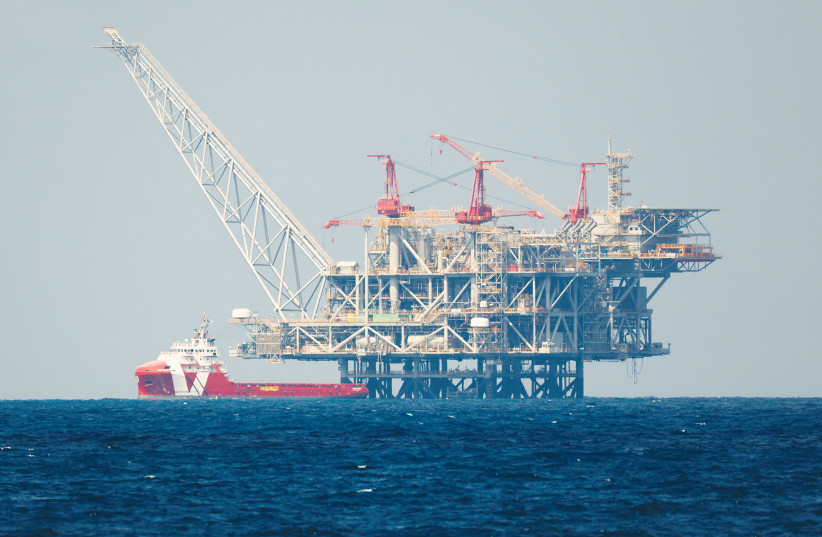
ISRAEL’S GAS fields include some of the largest discovered anywhere in the world since 2010, including the Leviathan natural gas field, off the coast of Haifa. (photo credit: ALBATROSS)
ISRAEL’S GAS fields include some of the largest discovered anywhere in the world since 2010, including the Leviathan natural gas field, off the coast of Haifa.
(photo credit: ALBATROSS)

Israel is preparing to step into the gap in Europe’s energy market left by sanctions on Russian natural gas as soon as this summer, Energy Minister Karin Elharrar said on Thursday.

“The European energy market is facing a substantial shortage following the Russia crisis,” Elharrar said. “Israel sees an opportunity, and will take full advantage of it.”

Russia provides Europe with about 40% of its natural gas consumption per year, more than 150 billion cubic meters (BCM). Israel cannot totally take Russia’s place, but eastern Mediterranean states can provide about 20 BCM annually, most of which would come from Israel. The US promised Europe 15-20 BCM of liquefied natural gas (LNG) following the Russia sanctions, and Qatar is expected to export 20-30 BCM to Europe.

“We’re not a replacement for Russian gas, but we have a good amount that we can export,” a senior diplomatic source said this week, commenting that the energy issue comes up as “a huge issue for everyone” in most conversations between top Israeli officials and foreign counterparts.

“The question is what is the quickest and most cost-efficient method, and what is most beneficial to all those involved,” said the source.

 THE PRODUCTION platform of the Leviathan natural gas field in the Mediterranean Sea, off the coast of Haifa: The realization of the commercial potential of the field is in the hands of the companies.  (credit: AMIR COHEN/REUTERS)THE PRODUCTION platform of the Leviathan natural gas field in the Mediterranean Sea, off the coast of Haifa: The realization of the commercial potential of the field is in the hands of the companies. (credit: AMIR COHEN/REUTERS)Elharrar and the EU Commissioner for Energy Kadri Simson established a working group on energy, which Egypt will be joining as well.

The working plan, based on an agreement between Elharrar and her Egyptian counterpart that has yet to be finalized, is for Israeli natural gas to go through Egypt’s plant for liquefaction and then exported to Europe.

An Egyptian diplomatic source confirmed that there are “ongoing talks in light of requests from the European side to see how we can work together in the field of gas to be able to export more to the EU. It is an ongoing discussion that has not been finalized for Israel to export more to Egypt and then Egypt export more to the EU.”

Natural gas cooperation came up in Foreign Minister Yair Lapid’s meeting with Egyptian Foreign Minister Sameh Shoukry last week, at the Negev Summit.

Energy is an “important topic not only between Egypt and Israel but for the broader region,” the Egyptian source said.

The increased exports in cooperation with Egypt will only begin once production begins in the Karish-Tanin field, which Elharrar said will likely be in September.

“We are prepared to examine other options, like producing LNG in Israel and other pipelines,” Elharrar said. “I am meeting with other companies to hear their offers and our options, which we can use to build agreements with other countries.”

One of those options is the long-discussed EastMed Pipeline, from Israel through Cyprus and Greece. The countries have signed agreements to advance the pipeline, but have had trouble getting investments into a project that has been estimated to cost $6 billion.

Foreign Minister Yair Lapid discussed the matter with his Greek and Cypriot counterparts in Athens this week, and Elharrar plans to meet with the countries’ energy ministers in Jerusalem next week.

Turkish President Recep Tayyip Erdogan has also expressed an interest in cooperating with Israel on natural gas, as part of the slowly warming ties between Ankara and Jerusalem, but no actual progress has been made on that front.

In a conversation with Elharrar at the sidelines of the International Energy Agency’s conference in Paris last month, Turkish Energy Minister Fatih Dönmez said he hopes to travel to Israel to discuss possible Israeli-Turkish cooperation on a gas pipeline. Last week, Dönmez said he would visit Israel in May.

However, Elharrar said, “While Turkey really wants to cooperate, I don’t have a meeting planned with the Turkish energy minister or a working plan. That is something that has to be decided as government policy. We have to examine the pros and cons and then decide.”

Israel is also involved in a plan for Iraq’s Kurdistan region to export gas, according to Reuters.

Iran attacked the Kurdish capital Erbil last month and said it was in retaliation for an Israeli strike that killed two Islamic Revolutionary Guard Corps members in Syria.

The target of the Iranian attack was the home of a Kurdish businessman involved in the autonomous region’s energy sector.

Iraqi and Turkish officials told Reuters the businessman was involved in a plan to pump Kurdish gas into Turkey and Europe with Israeli involvement, and Israeli specialists and US energy officials had conducted meetings at the home that Iran struck.

The Jerusalem Post was not able to independently verify the report.


Is Israel planning to strike Iran?


With DM Gantz saying a ‘Plan B’ was on the table, all eyes are on Israel as the situation leaves the Jewish State with few options on Iran.