Ukraine’s lessons for Israel

Israel’s government must learn from the Ukrainians: States that wait for green lights from the West to defend themselves will not survive.

 In the months and weeks that led up to Russia’s Feb. 24 invasion of Ukraine, Western powers signaled clearly that they were prepared to accept the disappearance of Ukraine as an independent state. U.S. President Joe Biden virtually invited Russian President Vladimir Putin to invade in late January when he said that a “minor incursion” would leave NATO flat-footed. German Chancellor Olaf Scholz, like his predecessor Angela Merkel, served as the Kremlin’s unofficial spokesman in Europe.

But once Russian forces invaded, the West’s plans to yell a bit and look away went awry. The Ukrainians failed to play their assigned role of Paschal lambs. Instead, they rallied around their flag and their president, Volodymyr Zelensky.

For his part, Zelensky captivated the hero-starved West. His rejoinder, when the Biden administration offered to evacuate him from Ukraine on the second day of the war, “I don’t need a ride, I need ammunition,” reminded Americans of a time when they weren’t being attacked for being transphobic or systemically racist, a time when patriotism was permitted.

For a moment, it was possible to wonder whether Russia’s reminder that the problems of the world cannot be reduced to the pronouns one uses or the amount of carbon one burns on an average day would change the focus of Western elites. But it was not to be. The ruling classes in Brussels and Washington made clear that the war in Ukraine would not steer them off course.

While Poland is giving refuge to nearly two-thirds of the 3 million Ukrainians who have fled their homes, and Hungary has taken in 10% of them, the E.U. parliament passed economic sanctions against both nations last week. Their crime? The nationalist governments in Warsaw and Budapest refuse to toe Brussels’ line on Muslim immigration and LGBTQ indoctrination.

As for the Biden administration, Ukraine’s fight for national survival in the face of Russian aggression is all well and good. But appeasing Iran is the Biden administration’s top priority. And Biden can’t appease Iran without Russia. So to keep Russia on board with his administration’s efforts to close a deal with Iran, Biden agreed to cut Russia’s lucrative business with Iran out of the sanctions. Russia can expect to receive $10 billion developing Iran’s nuclear installations and billions more in arms sales. The implications for Ukraine are clear: The US is willing to let them fight the Russians, but will not help the Ukrainians defeat Russia, because the United States cares more about empowering Iran than helping Ukraine survive.

The deal that Biden is concluding with Iran is itself a stunning testament to the radicalism of the Biden team and its refusal to let reality interfere with its policies. It will provide Iran with $90 billion from sanctions relief. That astronomical sum guarantees massive cash infusions into the coffers of Iran’s in-house global terrorist organization—the Islamic Revolutionary Guards Corps, which Biden is set to remove from the State Department’s list of foreign terrorist organizations—and to Iran’s terror armies in Lebanon, Yemen, Iraq, Syria and the Gaza Strip.

Iran will have the funds to expand its missile and drone capabilities. And thanks to the lax restrictions it will face on its nuclear operations, it will become a nuclear threshold state by 2025 at the latest.

Although the West’s progressive agenda necessarily limits the support it is willing to provide Ukraine, the West’s ruling classes need to placate their publics, who admire Ukraine, compelling them to provide significant if not determinative military, humanitarian and political assistance to Kyiv. And given Ukraine’s willingness to fight it out with Russia, that support may be sufficient to enable Ukraine to withstand Russia’s assault for long enough to maintain its independence.

The widespread assessment today is that the Ukrainians will be able to continue fighting, despite Russia’s clear military superiority, for another month or six weeks. Given the high losses the Ukrainians are inflicting on the Russians, and assuming that the Russians begin to feel the full impact of the economic and financial sanctions within the next two to three weeks, it is possible that by mid-April, the Ukrainians will be able to negotiate ceasefire terms with Russia that will leave the country independent and more or less intact.

There is a moral to this story for Israel.

Ukrainians can still hope for and expect a future of freedom and independence because they have refused to bow before either Russia or to the West.

If Israel were paying attention to the dynamics at work in the West’s behavior towards Ukraine, it would be adopting policies opposite to those it is currently pursuing, both in relation to Ukraine and Russia and in relation to the West.

Unlike Zelensky, who hasn’t hesitated to call the United States and Germany out for their fence-sitting, the Bennett-Lapid-Gantz government has subordinated all Israeli policies to the Biden administration’s agenda.

If Israel were putting its own interests first, as Zelensky has, Prime Minister Naftali Bennett wouldn’t be trying to mediate between Zelensky and Putin. Instead, Israel would make do with a simple but clear message: Israel supports Ukraine’s sovereign independence and territorial integrity and calls on Russia to end its offensive operations.

Israel ought not and need not go beyond that statement.

The reasons for this are obvious. This is not Israel’s war, and words have consequences. Israel cannot mediate this conflict because it has no leverage over either actor to persuade them to compromise.

As for the significance of words, in order to succeed, a mediator has to be perceived by both sides as someone who accepts the basic legitimacy of their positions. But as a threatened democracy, it is a dangerous proposition for Israel to accept Russia’s view that Ukraine has no right to exist as an independent and distinct nation-state.

When the next round of “mediation” between Israel and the Palestinians begins, how will Israel be able to demand that any prospective mediator reject out of hand the Palestinians’ position that the Jewish state has no right to exist?

This brings us to the second policy Israel should be adopting in the face of the war in Ukraine. Israel should be devoting all of its efforts on the ground to rapidly facilitating the mass aliyah of Ukrainian Jewry. As it stands, there are 10,000 Ukrainian Jews waiting to make aliyah. Instead of processing their applications, the Foreign Ministry is giving them appointments at consulates and embassies in Warsaw, Budapest and Bucharest three and six months from now and filling planes with non-Jews instead. Non-Jewish Ukrainians, it bears noting, have no problem resettling in the countries bordering Ukraine and throughout Europe. Yet, as 10,000 Ukrainian Jews are forced to wait for months to come to Israel, 10,000 non-Jewish Ukrainians have been airlifted to Israel.

This brings us to Israel’s real problems—Iran, the Palestinians and the Biden administration.

Zelensky’s fierce defense of his country, and the Ukrainian people’s refusal to stand down in the face of Russia’s advance, have compelled the Biden administration to support Ukraine even at the risk of a world war because the Ukrainians are standing for the values of freedom and independence that the United States is supposed to personify on the world stage.

If Israel were to take a page from Ukraine’s playbook, its leaders would be attacking the immorality of the Biden administration’s capitulation to Iran’s demands in the appeasement talks in Vienna.

The Bennett-Lapid-Gantz government’s silence in the face of Biden’s abdication of moral and strategic leadership in the Middle East undermines the efforts of Israel’s supporters in Congress and the international community. The Republicans, for instance, are compelled to explain why they are more opposed to Biden’s capitulation to Iran than the Israeli government is.

Then there are Israel’s Arab partners. The Saudis and the Emiratis have been more outspoken in their opposition to Biden’s Iran policies than Israel. The Arab leaders in the Gulf look at the silent, supine Israeli government in astonishment and distrust. The strategic consequences are already tangible. Rather than redouble their cooperation with Jerusalem, the Saudis and the Emiratis are setting their sights on Moscow and Beijing.

The situation with the Palestinians is also disturbing, and speaks clearly to the destructive implications of Bennett’s decision to play mediator between Russia and Ukraine.

Two weeks ago, Congress passed an omnibus spending bill, which Biden signed. With AIPAC’s support, the bill contained a section on Israel that significantly downgraded the U.S. commitment to the Jewish state.

The section on Israel was an amended version of a law that passed initially in 2012, and required the United States to “assist” and “support the Government of Israel” in its ongoing talks with the Palestinians. The new law deleted the part about supporting Israel. Under the new law, the United States is obligated to support “a negotiated solution to the Israeli-Palestinian conflict resulting in two states living side by side in peace, security, and mutual recognition.”

In other words, under the amended law, the United States is committed to supporting the establishment of a Palestinian state, whether Israel supports it or not.

Sen. Ted Cruz has fought since last July to block the passage of this amendment because he recognized the damage it was liable to do both to U.S.-Israel ties and to Israel’s national security. The Israeli Embassy, on the other hand, was less concerned.

Senate sources explain that Israel’s diplomats were nowhere to be found as Cruz fought adoption of the amendment.

The worst aspect of the amended law is that it wasn’t initiated by the usual anti-Israel forces in the so-called “Squad.” AIPAC supported the amendment, and so did mainstream Republican senators, like the ranking Republican on the Senate Foreign Affairs Committee, James Risch, and Sen. Rob Portman.

The implications are clear. When Israel opts to remain silent as its interests and position are undermined, not only does it strengthen its enemies, it loses its friends.

After Russia invaded Ukraine, many Ukrainians told Israeli reporters on the scene that they were inspired by Israel, which has always fought its own battles and survived even in the face of global indifference and hostility. Today, the opposite should be the case.

Israel’s government must learn from the Ukrainians. The West will not fight for a threatened democracy. States that wait for green lights from the West to defend themselves will not survive. But states that defend themselves will see sufficient forces rally to their side to enable them to persevere and survive.

.
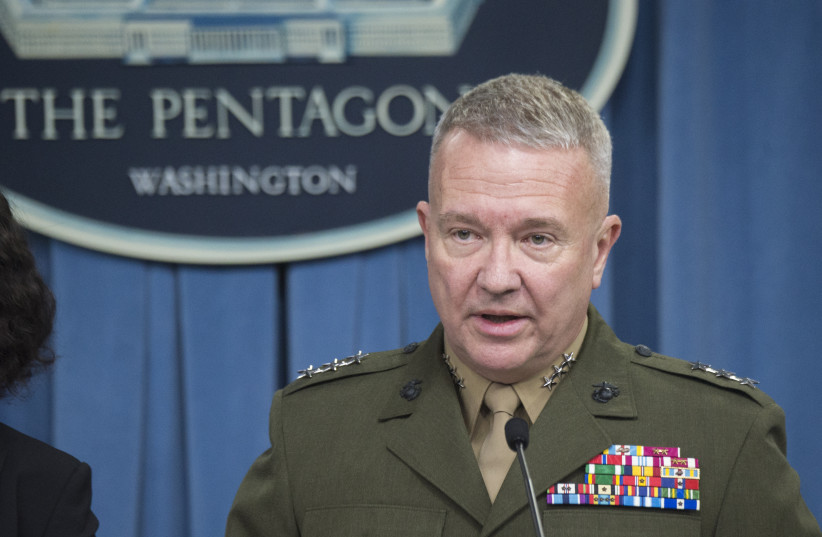

Commander Gen. Frank McKenzie held a press briefing Friday, as he prepares to handover CENTCOM to general Erik Kurilla.

CENTCOM Gen. Kenneth McKenzie (photo credit: Wikimedia Commons)
CENTCOM Gen. Kenneth McKenzie
(photo credit: Wikimedia Commons)

US Central Command head Gen. Frank McKenzie is concerned that Israel-Iran tensions could affect US forces in the region as he prepares to retire. “I do worry about these exchanges between Iran and Israel because many times our forces are at risk, whether we’re in Iraq or in Syria,” he said in a briefing on Friday, according to a transcript from the US Department of Defense.

McKenzie has been head of CENTCOM at a key time. His era has seen rising drone threats in the region, especially Iranian drones that have targeted US forces in Iraq and Syria and have also been used by the Houthis to target the United Arab Emirates and shipping in the Gulf of Oman.

The US has helped the UAE intercept attacks. That means Central Command is front and center in the new drone wars in the Middle East. He has also presided over a time of other rising Iran threats to US forces in Iraq and Syria. The US killed IRGC Quds Force head Qasem Soleimani in 2020. Iran has been attacking US forces in Iraq since 2019, using local militias.

While the US backs Israel’s attempts to reduce Iran’s entrenchment in Syria, it has also been concerned for years that there could be attacks on US forces by Iran as part of rising Israel-Iran tensions. The US reports to the Department of Defense have warned of this issue for several years. The CENTCOM head has articulated this now in the briefing. It comes after Iran used ballistic missiles to target an area near Erbil in the Kurdistan region of Iraq.

Iran has said it targeted an Israeli facility there. Reports in The New York Times hinted that this was a response to an attack on Iran drone facilities, but other reports said it was also a response to a March 7 airstrike in Syria that killed two IRGC officers.

The outgoing head of the US Central Command said Friday he was concerned about the increasing attacks between Israel and Iran “because many times our forces are at risk,” Al-Arabiya reported.

“I think it’s obvious that Israel is going to take steps to defend itself when it’s confronted with Iranian actions. And of course, Iran is dedicated to the destruction of Israel,” McKenzie said during a video call with reporters. The next head of CENTCOM is army general Erik Kurilla, who has been chief of staff at Central Command and has headed the 18th Airborne Corps.

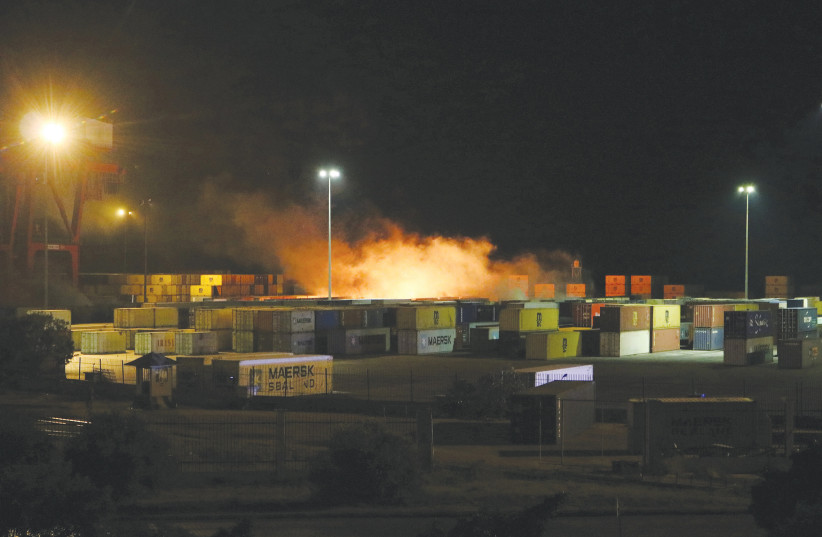
Smoke rises from a fire in a container storage area, after Syrian state media reported an Israeli air strike on the port of Latakia on December 7. (credit: SANA/REUTERS)Smoke rises from a fire in a container storage area, after Syrian state media reported an Israeli air strike on the port of Latakia on December 7. (credit: SANA/REUTERS)

Israel was incorporated into CENTCOM when McKenzie was in charge. He praised this new format. “CENTCOM is focused on operationalizing the Abraham Accords, as we brought Israel into our area of operations, and missile defense is one area of cooperation that all our partners understand. They all understand it’s particularly important when you consider the threat that Iranian missiles pose,” he said.

“While it continues to be nascent at this time, we have seen a willingness of traditional regional partners to work together in exercises with the Israeli Defense Force,” the general said.

“Air defense is an excellent opportunity for cooperation because improving regional missile defense can begin with a sharing of information, which doesn’t require any nation to approve the stationing of foreign forces on their territory. My hope is that this cooperation will continue to advance in the years to come,” he added

The CENTCOM head was asked several key questions about Iran. When asked about an Iran nuclear agreement, he noted that “the number-one objective of the United States with regard to Iran is that Iran not possess a nuclear weapon. So I think any solution that closes that path to them contributes to regional security because we’d all like to work with an Iran that is not a nuclear-armed Iran.

“The best way to get there is probably through a negotiated agreement,” he said. “Now, that does not solve Iranian proxies. It doesn’t solve the compelling problem of Iranian ballistic missiles, land-attack cruise missiles and small unmanned aerial vehicles, and we need to recognize that. That’s a separate problem.”

He discussed Iraq’s attempt to defeat ISIS but noted Iran’s role in Iraq. “Despite the many roadblocks that are being thrown up by Iranian-based proxy groups, they’re proceeding… maybe not the way we would do it, maybe slower than the way we would do it, but nonetheless, they’re moving forward.”

On Syria, the general said the US would remain and back the Syrian Democratic Forces, the key partner that defeated ISIS in eastern Syria. Rooted in the Kurdish resistance to ISIS that developed in 2013 and 2014, the group includes many fighters from across eastern Syria.

“In Syria, again, our principal task is to complete the defeat of ISIS,” McKenzie said. “You know, we are in support of our SDF partners as they continue that operation and also as they sit on top of the many displaced persons camps and the prison camps that are there. So there’s still work to be done in Syria.

“I don’t know how long we’re going to remain in Syria. That’s just not known to me, ultimately, that’ll be a policy decision that’ll be made by the national leadership of the United States as we go forward, based on the situation on the ground,” McKenzie said.

Discussing air defenses, he also delved into some issues the US is facing in the region. America now must contend with both missile and drone threats. Air defenses like Patriots can be used for these threats. The US also has C-RAM and has two batteries of the Iron Dome system; but the Iron Dome is deployed in Guam at the moment, reports say.

“I think the real story about air defenses in CENTCOM is not the US air defenses,” he said. It’s really the air defenses and particularly the Patriot systems and other high-end systems that our Gulf and other partners possess and how that is knitted together…. Saudi Arabia has a number of Patriot batteries, UAE has a number of Patriot batteries, as does Kuwait, as does Bahrain,” the general said. He talked about knitting the systems together in a “common operational picture so everybody sees the same thing, everybody gets an early warning, everybody can be prepared to react very quickly to a potential Iranian attack. That’s where the future in this theater is.”

McKenzie continued, “It’s principally because of the Iranians. They have invested enormous resources into improving the number and capabilities of their ballistic missiles. And, you know, as in the Al Asad attack in January of 2020, their missiles hit within tens of meters of the targets they were intended to hit. So you have to respect that capability, and believe me, our partners in the Gulf respect that capability.

“So nothing focuses the mind, you know, of a nation like an imminent threat just over the horizon with malign intent. It’s not only ballistic missiles, but it’s also land-attack cruise missiles and it’s also unmanned aerial systems. All of those things are now at a greater state of danger than we have ever seen in the Central Command AOR,” he noted.

“So now there’s pressure that really is immediate, and maybe hasn’t been there in the years prior for nations to come together and develop that defense architecture that will allow them to share information. And again, it’s a form of defense cooperation. It’s easier to get to than other forms of defense cooperation because as I noted, you’re really sharing information.”

McKenzie mentioned allied and partner nations. These include Israel, which is now in CENTCOM’s area of operations. “It is not the US systems,” he said. “It is actually our allied and partner nation systems, and they had a bunch more Patriot batteries than we do in the theater by a factor of three or four or five so there’s a lot of capability there.”

Iran’s threats are increasing as well. “The IRGC and the elite sub-element of the IRGC, the Quds Force, they’re the principal malign actor in the theater, so they’re very concerning to me,” he said.

“What might come next with Iran’s threats in the region? Iran wants sanctions,” the CENTCOM head said. “I believe they’re probably willing to talk about the nuclear issue in order to get the sanctions relief.”

The Iranians also want the US to leave the Middle East. They see Iraq as one place to pressure the US. “Over the past couple of years they have worked on political solutions to try to eject us that have not panned out for them, so they’ve turned to kinetic solutions, and the Iranians believed that they can undertake a certain level of kinetic action against us [i.e. actual attacks] and it won’t affect the larger negotiations, state-on-state,” he said.

“Over the last six months, as you know, we’ve been attacked a number of times in Syria and Iraq, and through very good action on the part of commanders on the ground, through good counter-UAS [counter-drone] action and a couple of other things, we’ve been able to avoid US casualties. Had US casualties occurred, I think we might be in a very different place right now, but we’ve been able to avoid that, and we’ll continue to use those best practices as we go ahead.”

McKenzie went further, noting that Iran wants a nuclear deal and the next months are crucial for that issue. “I think we don’t want Iran to have a nuclear weapon,” he said, “and the best way to get to that is probably through a negotiated solution. That will not solve the other problems of Iranian behavior in the theater, and I don’t think anybody in the United States government is blind to that fact.”

CENTCOM attempts to provide deterrence for Iran’s attacks, McKenzie said. “We work at that with force posture. We work at that through other activities that we carry out across the region, and we have had some success in doing that – not perfect success,” the general said.

“The phrase I use is ‘contested deterrence’ when we talk about the state of affairs that exist between us and Iran in the theater.”


https://www.jpost.com/international/article-701724


Bennett: US willing to pay ‘too high a price’ for Iran deal

The US is considering removing the Islamic Revolutionary Guard Corps’ designation as a Foreign Terrorist Organization for the nuclear deal.

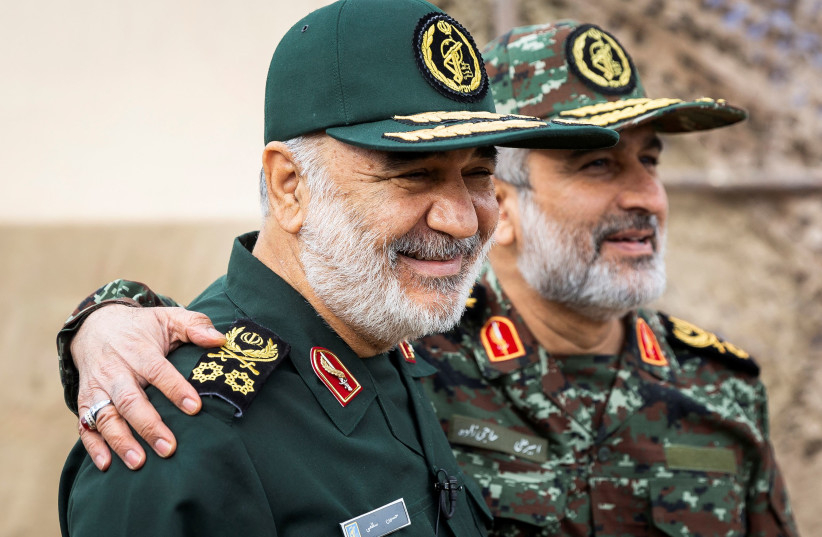
 Commander-in-Chief of the Islamic Revolution Guards Corps (IRGC) Hossein Salami smiles during a joint exercise called the 'Great Prophet 17' in the southwest of Iran (photo credit: SAEED SAJJADI/FARS NEWS/WANA (WEST ASIA NEWS AGENCY)VIA REUTERS)
Commander-in-Chief of the Islamic Revolution Guards Corps (IRGC) Hossein Salami smiles during a joint exercise called the ‘Great Prophet 17’ in the southwest of Iran
(photo credit: SAEED SAJJADI/FARS NEWS/WANA (WEST ASIA NEWS AGENCY)VIA REUTERS)

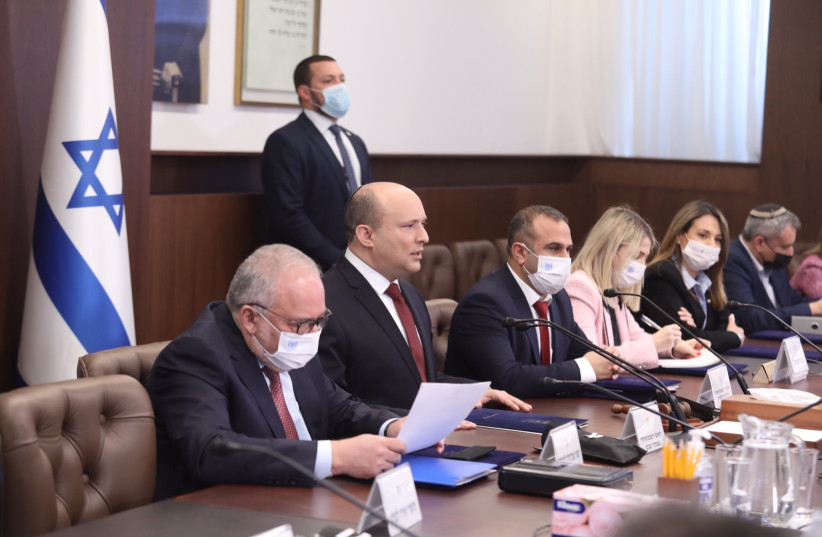
Removing the Islamic Revolutionary Guard Corps’ designation as a Foreign Terrorist Organization is too high a price to pay for a nuclear deal with Iran, Prime Minister Naftali Bennett warned at the start of Sunday’s cabinet meeting.

“Unfortunately, there is determination to sign a nuclear agreement with Iran at almost any price, including saying that the world’s largest terrorist organization is not a terrorist organization,” Bennett said. “That is too high a price.”

Bennett expressed concern about Iran’s “audacious” demand the remove the IRGC from the FTO list as a side deal to the revival of the 2015 Iran nuclear deal. The US has sought a public commitment from Iran to de-escalate in the region and not to attack Americans, something Bennett and Foreign Minister Yair Lapid said they “find hard to believe” in a joint statement on Friday.

“The IRGC is the largest, most murderous terrorist organization in the word, and unlike ISIS or other organizations, they have a state behind them,” Bennett said. “This is not just an Israeli problem; other countries, US allies in the region, are dealing with this organization day after day, hour after hour.”

Bennett pointed out that IRGC and its proxies have shot missiles and UAVs into countries throughout the region.

 Prime Minister Naftali Bennett addresses the cabinet on March 20, 2022 (credit: MARC ISRAEL SELLEM/POOL)Prime Minister Naftali Bennett addresses the cabinet on March 20, 2022 (credit: MARC ISRAEL SELLEM/POOL)

“Even now, the IRGC is trying to murder Israelis and Americans around the world,” he added.

If the US decides to de-list the IRGC, Israel will continue to treat it like a terrorist organization, the prime minister said.

“As usual, what determines our future is our actions, not words,” he said.

On Friday, Bennett and Lapid said they “believe that the United States will not abandon its closest allies in exchange for empty promises from terrorists.”

The US assured Israel in recent weeks that it “can find other ways to keep the IRGC in check,” an Israeli diplomatic source said, but they did not specify how. Israel is also concerned about the move sending a “terrible message.”

Bennett and Lapid issued a joint statement in order to make clear that there are not political differences between them, the source said.

The removal of the IRGC’s terrorist designation has the potential to boost Iran’s economy, in addition to lifting nuclear-related sanctions as per the 2015 Joint Comprehensive Plan of Action.

The IRGC has played a huge role in Iran’s economy for decades, with its hands in a range of industries like energy, water, transportation, communications, infrastructure and more.

With the IRGC considered a terrorist group since 2019, the US could initiate legal proceedings against companies that work with its subsidiaries – though it has never done so. Lifting the IRGC’s terrorist designation would enable foreign companies to do business with subsidiaries of the group.

The US and Iran have been indirectly negotiating for the past 11 months to return to compliance with the 2015 nuclear deal, which restricted Tehran’s uranium enrichment to 3.67% and cut almost all of its stockpile of enriched uranium in exchange for gradually lifting sanctions.

World powers and Iran have said in recent weeks that they are close to completing the deal. The IRGC designation is one of the final matters to be negotiated, along with Russia seeking an exception from Western sanctions related to the Ukraine war in order to be able to carry out civilian nuclear activities with Iran as stipulated by the JCPOA.

Israel opposed the original deal and the return to it, pointing out that most of its limitations on Iran’s nuclear activities expire at the end of 2025, and that the agreement does not restrict Iran’s malign actions in the region or its ballistic missile program, while lifting san

https://www.jpost.com/breaking-news/article-701794