
Tehran also releases more details of alleged thwarting Mossad hit on Fordow nuclear facility.
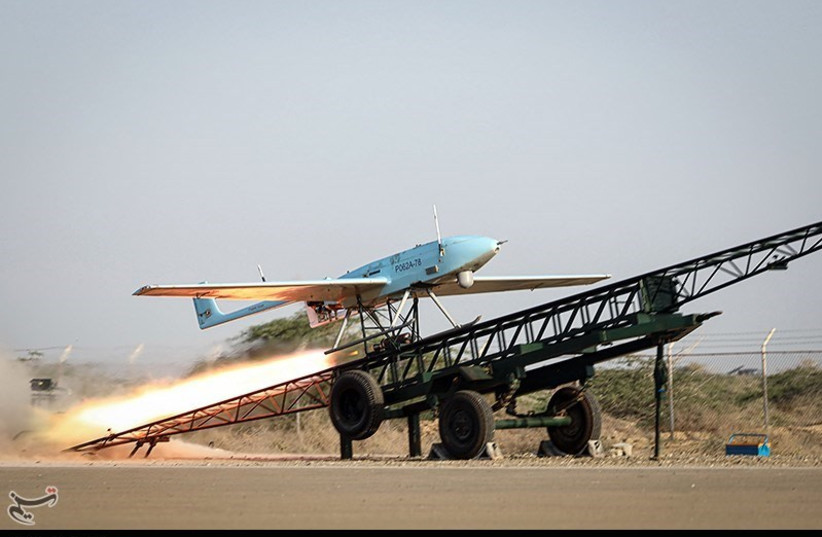
 A drone is seen during an Iranian Army exercise dubbed 'Zulfiqar 1400', in the coastal area of the Gulf of Oman, Iran, November, 2021 (photo credit: TASNIM NEWS AGENCY)
A drone is seen during an Iranian Army exercise dubbed ‘Zulfiqar 1400’, in the coastal area of the Gulf of Oman, Iran, November, 2021
(photo credit: TASNIM NEWS AGENCY)

The latest explosive exchanges between Israel and Iran may relate to Israel having destroyed hundreds of Iranian drones last month, according to a mix of Israeli and Lebanese reports.

Neither country had even mentioned the reported attack on a critical base in Western Iran until earlier this week, when it was first reported by the Lebanese television station Al Mayadeen, which is linked to both Hezbollah and Iran. Tehran blames Israel, but Jerusalem has not taken responsibility.

Subsequently, Haaretz on Tuesday confirmed the report and added a number of details with other Israeli media also filling in some details.

According to Al Mayadeen, this was the reason for Saturday night’s Iranian missile attack on Erbil on an alleged Mossad training base.

Iranian media on Tuesday continued to add details about the number of alleged Mossad agents who were hit by their attack on Erbil.
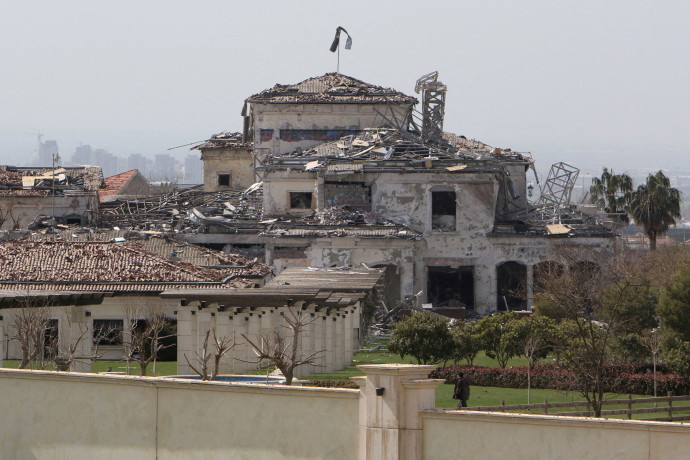
 

Many sources have contradicted the idea that there was a Mossad base there. The Islamic Republic often manufactures reports of busting Mossad agents to cover for going after local opposition figures.

But the juxtaposition with what most government officials and outside experts said was a massive Iranian cyberattack on Monday night suggests that Tehran genuinely felt it was hit hard somewhere and needed to hit back in a large and public way.

At the same time, Iranian media also continued to release more details about its alleged nabbing of Mossad agents who tried to recruit a member of Iran’s IR-6 centrifuge team at its Fordow nuclear facility.

While this report could also be disinformation, the degree of detail was unusual and resembled other earlier plots by the Mossad to infiltrate nuclear facilities via supply-chain penetration.

Moreover, some of the reports went into great detail about earlier successful reported Mossad hits on Iranian nuclear scientists, giving the reports at least the unusual appearance of heft since Tehran was not claiming perfection in its conflict with the Israeli spy agency by any means.

In mid-February, Reuters reported that a fire broke out at a military base in western Iran, potentially being the location of the drones though without mentioning the drones, based on a report from media affiliated with the country’s Supreme National Security Council reported.

“On Monday morning, a fire broke out in a stockroom where motor oil and other flammable materials were stored in one of the support bases of the Revolutionary Guards in the Mahidasht region of Kermanshah Province, causing damage to an industrial shed,” Nour news reported.

That report merely said that the fire was put out by rescuers, and that teams had been dispatched to the support base to investigate the cause of the incident, without referencing the drones.

Jerusalem Post Staff and Reuters contributed to this report.

https://www.jpost.com/middle-east/iran-news/article-701373


In Gen. Kenneth McKenzie’s written statement, he called Iran’s missile force the greatest threat to the region’s security.

AN IRANIAN ballistic missile on display in Tehran.  (photo credit: REUTERS)
AN IRANIAN ballistic missile on display in Tehran.
(photo credit: REUTERS)

Iran has more than 3,000 ballistic missiles, many of which can reach the State of Israel, commander of the United States Central Command Gen. Kenneth McKenzie said on Tuesday.

McKenzie, who is retiring from the military soon, was in Israel last week and held talks with Prime Minister Naftali Bennett, Defense Minister Benny Gantz and IDF Chief of Staff Lt.-Gen. Aviv Kohavi.

“At a military level my concern is first of all that they do not have a nuclear weapon but I am also very concerned about the remarkable growth and efficiency of their ballistic missile program,” McKenzie told the Senate Armed Services Committee.

“They have over 3,000 missiles of various types, some of which can reach Tel Aviv,” McKenzie said in response to a query by the senate committee. “None of them can reach Europe yet.”

In Mckenzie’s written statement, he called Iran’s missile force the greatest threat to the region’s security, and that Iran has developed an arsenal of nuclear-warhead capable ballistic missiles and has tested these weapon platforms multiple times. He told the committee that over the last 5-7 years Iran has invested heavily in its ballistic missile program.

US CENTCOM assessed in the prewritten statement that Syria and Iraq will continue to be used as supply routes and hubs to forward its “campaign against Israel.” This is in part to arm its proxy in Lebanon, Hezbollah. It was estimated last year that Hezbollah has 130,000-150,000 rockets that can reach deep into Israeli territory. This arms stockpile also includes Iranian ballistic missiles.

Iran has armed its proxy in Yemen, the Houthi rebels, with drones and ballistic and cruise missiles, the general wrote. The Houthis have also expressed hostility toward Israel, and have previously said that they have joined the “anti-Israel” front. They have also used these missiles and drones to attack the UAE and Saudi Arabia.

McKenzie also expressed concern about Iran’s drone program. Iran’s drone fleet has evolved from “commercial off-the-shelf” UAVs to drones that resemble cruise missiles in terms of increased speed, range, accuracy, resistants to electronic warfare, and warhead weight, he assessed in his statement. Iran has also been able to mass-produce the drone components, allowing them to be supplied with greater ease to the Islamic Republic’s proxy network.

Also in prepared remarks to the committee, McKenzie said that the transfer of Israel to CENTCOM two years ago “opens the doors to numerous strategic opportunities—including by enabling CENTCOM to more closely align our regional partners against common threats, such as those posed by Tehran.”

He said that the US remains steadfast in its commitment to Israel’s security and to support Israel’s right to defend itself, and “CENTCOM will continue to support the expansion of Israel’s military ties with regional counterparts through training, joint exercises, and other defense cooperation efforts.”

https://www.jpost.com/breaking-news/article-701383
