The jug is believed to be 5,000 years old.

 Ancient clay jug discovered in cave 53 of Qumran, Feb. 2022. (photo credit: Amir Ganor/Israel Antiquities Authority)
Ancient clay jug discovered in cave 53 of Qumran, Feb. 2022.
(photo credit: Amir Ganor/Israel Antiquities Authority)

An American tourist accidentally discovered an ancient and well-preserved pottery vessel from the Early Bronze Age in Qumran, which is located in the Judean Desert close to the Dead Sea.

For more stories from ALL ISRAEL NEWS go to allisrael.com

Robbie Brown stumbled upon the ancient find in February as he and a friend decided to climb 328 feet to examine a cave known as Cave 53. The ancient jug is believed to be around 5,000 years old and could potentially be the first discovered complete jug unearthed in the area from this remote time-period.

Brown and his friend alerted Dr. Yuval Baruch from the Israel Antiquities Authority (IAA), the Israeli authority responsible for antiquities in Israel.

Amir Ganor, the director of the IAA’s robbery prevention unit, expressed his astonishment at Brown’s discovery.

“It’s amazing. Only about two years ago, our archaeologists surveyed the cave as part of a survey of the Judean Desert caves, which has been conducted continuously for the past five years and was intended to document and locate all ancient finds in the desert caves,” Ganor told Israeli media.

He emphasized the importance of the unearthed ancient artifact.

“In a few caves, pottery sherds were found, providing evidence of the Early Bronze Age. This is perhaps the first complete vessel we have found from this period in the caves in the Judean Desert,” Ganor said in an interview.

Brown is no stranger to archaeological discoveries in Israel. In 2017, he took part in an excavation in the same region, which resulted in the discovery of an ancient blank scroll, as well as ancient olive seeds and dates.

Ganor praised Brown for his professional handling of the discovery.

“It’s good that the person who entered the cave was Robbie, who participated in the excavation and is aware of the importance of the finds and their role in completing the archaeological puzzle of the Land of Israel,” Ganor said.

The head of IAA’s robbery prevention unit urged the public to contact the Israel Antiquities Authority in connection with discoveries of ancient artifacts: “We call on citizens who discover artifacts to leave them in place and call us immediately so that we can maximize the archaeological information from the find.”

Smuggling of valuable antiques is a growing problem in Israel and in other Middle Eastern nations. Many of the stolen artifacts are bought by wealthy private collectors in the West.

In a complex operation in February, Israeli authorities succeeded in confiscating thousands of stolen rare artifacts and arrested an Arab antiquities dealer in the city of Nablus in the West Bank. The massive trove, which was believed to be worth thousands of shekels, contained rare ancient coins used in the Land of Israel and artifacts from the Hellenistic and Persian eras.

Brig.-General Faris Atila, the Civil Administration head, stressed the importance of preserving archaeological finds in region.

“The Civil Administration is pursuing many avenues, both public and confidential, in order to preserve the archaeology of Judea and Samaria,” stated Atila.

“Following a long and intricate operation, thousands of rare archaeological items that had been stolen by a specialist in archaeological theft were located. The operation was important, with significance in breaking the chain of traffic in antiquities in Judea and Samaria. The Civil Administration will continue working tirelessly against the shameful phenomenon of destruction and theft at the archaeological sites of Judea and Samaria, protecting the cultural and historical assets of the area,” Atila said.

Qumran, in the Judean Desert, is an area full of caves and became world famous when, by chance, a Bedouin discovered the priceless Dead Sea Scrolls in 1947. Due to its remote location and dry air, the Judean Desert contains a high concentration of well-preserved ancient artifacts. Over the years, the Judean Desert region has attracted a large number of professional archaeologists and amateur archaeology buffs like Brown.

Archaeologists and historians believe that hundreds of Jews lived in the Qumran area in ancient times based on the number of discovered buildings and Jewish ritual baths.

https://www.jpost.com/christianworld/article-700842

US wants Israel and other allies to impose sanctions on Russia

We would like to see all of our allies and partners imposing strong sanctions,” a senior US embassy official said.

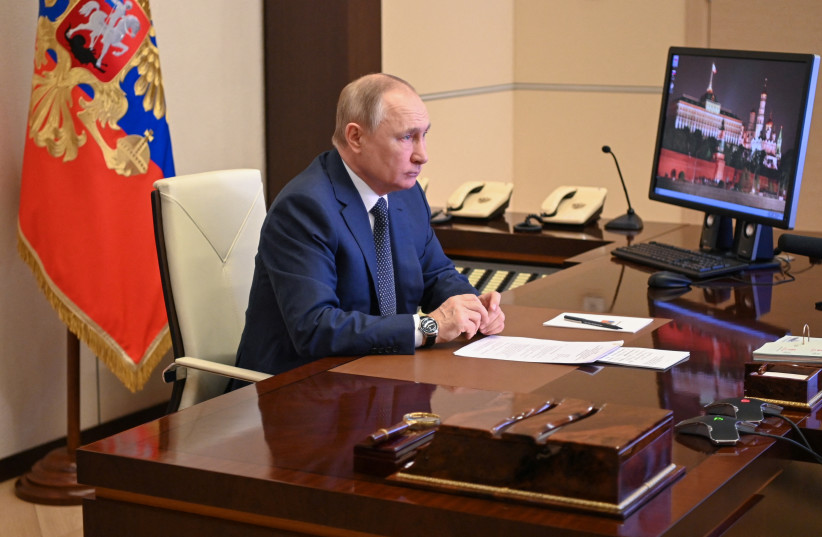
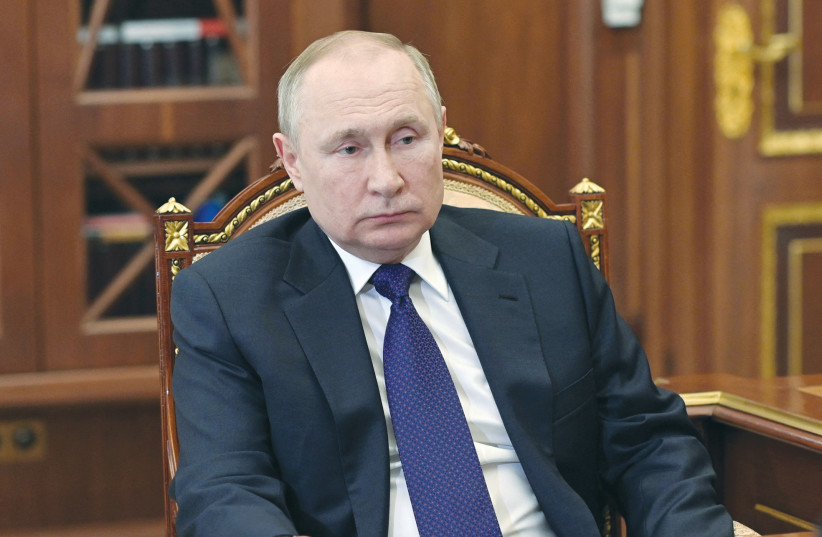
 RUSSIAN PRESIDENT Vladimir Putin attends a meeting in Moscow on Tuesday. (photo credit: Sputnik/Kremlin/Reuters)
RUSSIAN PRESIDENT Vladimir Putin attends a meeting in Moscow on Tuesday.
(photo credit: Sputnik/Kremlin/Reuters)

The United States wants Israel and its allies to enact strong sanctions on Russia to help force an end to its war against Ukraine.

“We would like to see all of our allies and partners imposing strong sanctions,” a senior US embassy official told reporters in Tel Aviv, specifying that this includes Israel.

Pressed for US reaction should Israel fail to apply sanctions, the embassy official said: “I’m telling you what we would like to see. The strength of our sanctions package depends on broad participation. Our economic measures are strong because we are united with all our allies and partners who joined us.”

Such sanctions, he explained, have harmed “Putin’s ability to seek vital technology and critical trade.”

The official spoke just one day after US President Joe Biden imposed an immediate ban on Russian oil and other energy imports.

 Russian President Vladimir Putin attends a flag-raising ceremony on the ferry Marshal Rokossovsky via a video link at his residence outside Moscow, Russia March 4, 2022. (credit: Sputnik/Andrei Gorshkov/Kremlin via REUTERS)Russian President Vladimir Putin attends a flag-raising ceremony on the ferry Marshal Rokossovsky via a video link at his residence outside Moscow, Russia March 4, 2022. (credit: Sputnik/Andrei Gorshkov/Kremlin via REUTERS)

Israel has condemned Russia’s action and sent humanitarian aid to Ukraine, but has not formally leveled sanctions. Individual Israeli companies, however, have halted their operations in Russia.

Israel has attempted to walk a thin diplomatic line over the war, taking a strong stand in support of Ukraine and maintaining strong ties with the US. At the same time, however, it has been careful in its condemnations not to take actions that would cut off ties with Moscow, such as sanctions.

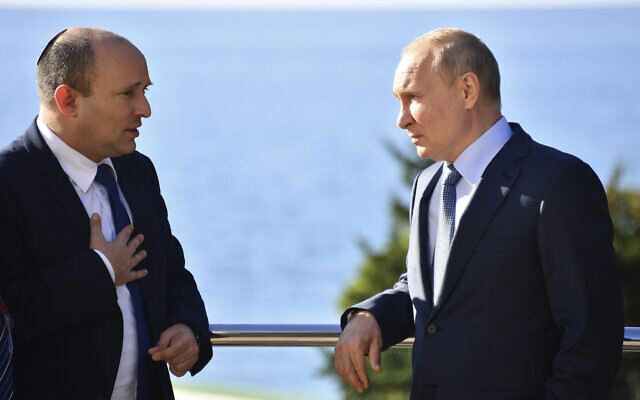
Prime Minister Naftali Bennett has used Israel’s strong ties with both Moscow and Ukraine to mediate between them. He met with Russian President Vladimir Putin in Moscow on Saturday and has engaged in telephone diplomacy with Putin and Ukrainian President Volodymyr Zelensky.

The US official spoke positively of diplomatic initiatives by Prime Minister Naftali Bennett and other international leaders to attempt to mediate an end to the war that began two weeks ago.

“We are supportive of all the efforts going on to try and bring this conflict to a close, including [from] EU leaders, individual EU country leader[s], PM Bennett,” he said.

The US official said that in all instances the Biden administration had been updated.

“In all these cases, these efforts have been closely coordinated with the US,” the official said. “There have been direct conversations before and after each of these encounters.”

He added that he sincerely hoped such diplomacy was successful but warned that the Russian engagement may not be sincere.

“We have seen Putin extend the false hand of diplomacy before,” he said.

The US official blamed Putin and Russian Foreign Minister Sergei Lavrov for the war, spoke vehemently of the need to end it, and accused Russia of inhuman acts that violate international law.

“Putin chose to start this war and the Russian Federation will be held accountable and bear the consequences of his actions,” the official said. The US, he said, has been “appalled by the brutal tactics and disregard for human life the Russian military has shown.”

HE CHARGED that Russia’s military actions were a “violation of International humanitarian law,” and that “criminal prosecution was appropriate.”

In the Middle East, he said, “Russian military and paramilitary forces have exploited conflicts for Moscow’s own selfish interests posing a grave threat to regional stability and global powers.”

Russia has a particular responsibility to uphold international law, given its role as one of five permanent members of the UN Security Council, the US official said.

He spoke of the bravery Ukraine has exhibited in defending itself against Russia, and the importance of supporting Ukraine, but said that public support in the US was against US military involvement in ending that war.

“We stand with Ukraine,” he said, but “it is also clear that at present, the US people are not looking for US forces on the ground on the front lines of this war.”

The official added that “the people of Ukraine are doing an outstanding job of defending themselves.”

When pressed later, he said that the US would honor its obligations as a member of the North Atlantic Treaty Organization (NATO), made up of 30 countries.

“The NATO charter is clear that an attack on one is an attack on all,” the official said. “Deterrence works.”

He said that the Biden administration would accept any agreement Ukraine might conclude with Russia that would end the war.

“The US is supportive of the solution that Ukraine is supportive of because we are backing Ukraine,” he said.

Among Putin’s demands have been Ukraine’s acceptance of Russia’s annexation of Crimea, and recognition of the Russia-occupied regions of Donbas (in eastern Ukraine) as independent states.

The US official was asked if the US would recognize those regions as part of Russia if that was part of a peace deal. He explained that he did not like to answer hypotheticals, but provided this observation.

“The US has a track record here with the Baltic states, which were for decades under Soviet rule and emerged as full states,” he said. “We tend to act on principle, at least historically.”

Meanwhile, Ukrainian President Volodymyr Zelensky asked Knesset Speaker Mickey Levy this week to address the Israeli parliament by videoconference, a spokesman for Levy said on Wednesday, confirming a Walla News report.

But Levy told him it was impossible because the Knesset is leaving on a two-month recess on Thursday.

Zelensky has addressed the European Union and British parliaments that way in recent days.

MK Eli Avidar, who is a former diplomat, asked Levy to convene a special session of the Knesset for Zelensky to address. But Levy said the best he could do was a meeting for the Ukrainian leader with MKs over Zoom.

“Unfortunately, the Knesset will also be going through renovations so physically it’ll be impossible to convene everyone back here,” a source close to Levy said.

Gil Hoffman and Reuters contributed to this report.

https://www.jpost.com/international/article-700768


Israel ‘will pay for this crime,’ Revolutionary Guard says, following airstrike near Damascus that reportedly targeted a weapons and ammunition depot operated by Iran

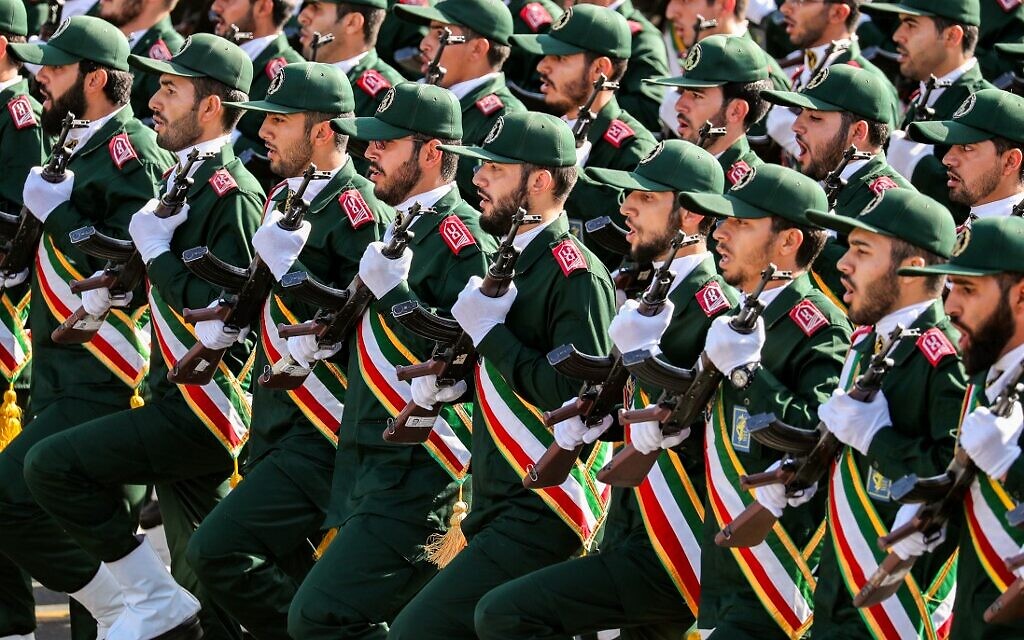
Members of Iran's Islamic Revolutionary Guard Corps (IRGC) march during the annual military parade marking the anniversary of the outbreak of the devastating 1980-1988 war with Saddam Hussein's Iraq, in the capital Tehran, on September 22, 2018. (Stringer/AFP)

Members of Iran’s Islamic Revolutionary Guard Corps (IRGC) march during the annual military parade marking the anniversary of the outbreak of the devastating 1980-1988 war with Saddam Hussein’s Iraq, in the capital Tehran, on September 22, 2018. (Stringer/AFP)

Iran’s Islamic Revolutionary Guard Corps (IRGC) has vowed revenge for the deaths of two of its members in an alleged Israeli airstrike near the Syrian capital Damascus on Monday, according to Iranian media reports.

“Guard colonels Ehsan Karbalaipour and Morteza Saidnejad were martyred — a crime committed by the Zionist regime during a rocket attack in the suburbs of Damascus, Syria, yesterday morning,” said a statement issued on the IRGC website on Tuesday evening.

Israel, it said, “will pay for this crime.”

While casualties in strikes attributed to Israel are somewhat common, it is far rarer that those killed are Iranian operatives.

Initial reports by the Syrian Arab News Agency SANA indicated that the casualties were Syrian civilians.

However, IRGC-affiliated Tasnim News Agency later identified the two IRGC fighters as the casualties in the Israeli offensive, confirming a previous report by the UK-based Syrian Observatory for Human Rights.

The war monitor said the strikes killed two pro-Iran militiamen and wounded six others, adding that it could not confirm civilian fatalities.

The target of the strikes was “a weapons and ammunition depot operated by Iran-backed militias near Damascus international airport,” the report said, rejecting SANA’s report that stated that the airstrike had destroyed a marble factory.

According to the Observatory, Israel has carried out raids in Syria at least seven times so far this year.

Last month, Israeli raids near the capital killed two Syrian soldiers and four Iran-backed militiamen, the Observatory said.

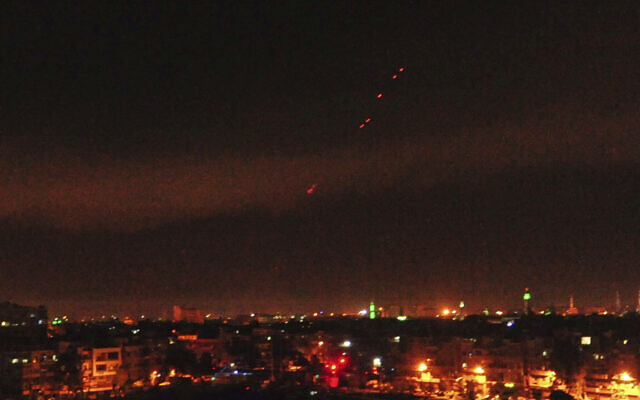
Illustrative: This photo released by the Syrian official news agency SANA shows anti-aircraft fire in the sky after US-led airstrikes targeting different parts of the Syrian capital Damascus in retaliation for the country’s alleged use of chemical weapons, on April 14, 2018. (SANA via AP)

Since civil war broke out in Syria in 2011, Israel has carried out hundreds of airstrikes inside the country, targeting government positions as well as allied Iran-backed forces and fighters of Lebanon’s Shiite terror group Hezbollah.

While Israel rarely comments on individual strikes in Syria, it has acknowledged mounting hundreds of them since 2011.

The Israeli military has defended them as necessary to prevent foe Iran from gaining a foothold on its doorstep.

Israel relies on coordination with Moscow to carry out airstrikes in Syria, which has placed Israel in a sensitive position in regard to the Russian invasion of Ukraine.

Russian President Vladimir Putin (right) and Prime Minister Naftali Bennett speak during their meeting in Sochi, Russia, on October 22, 2021. (Evgeny Biyatov, Sputnik, Kremlin Pool Photo via AP/ File)

Jerusalem and Moscow have in recent years maintained a so-called deconfliction mechanism that works to prevent Israeli and Russian forces from clashing in Syria. Russia is a main player backing the Syrian government in a grinding civil war, while Israel has waged a years-long campaign of airstrikes aimed at pro-Iranian fighters located there and at preventing the transfer of Iranian-supplied weaponry.

Last week, the Russian embassy in Israel said that military coordination with Israel in Syria will continue, even as the two countries spar over the ongoing war in Ukraine.

Jacob Magid contributed to this report.