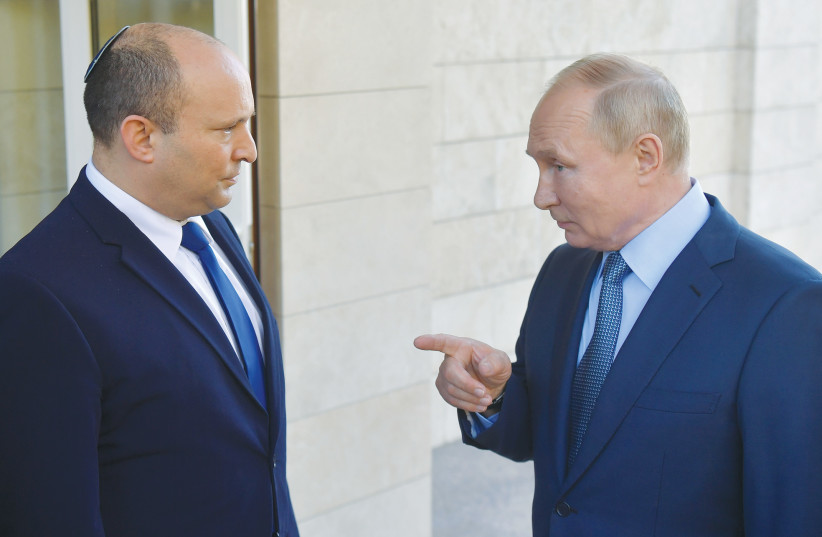
Bennett becomes first western leader to meet Putin since invasion of Ukraine amid speculation that Israel is mediating peace talks between the countries.
RUSSIAN PRESIDENT Vladimir Putin meets with Prime Minister Naftali Bennett in Sochi last month.
(photo credit: Evgeny Biyatov/Sputnik-Kremlin via Reuters)
Prime Minister Naftali Bennett met with Russian President Vladimir Putin in Moscow on Saturday.
Bennett departed Israel early Saturday morning for the trip, which was planned after he spoke with Putin on Wednesday about the war in Ukraine.
Building and Construction Minister Ze’ev Elkin, who has served as translator for prime ministers in meetings with Putin for over a decade, accompanied Bennett to Moscow.
In addition, National Security Adviser Eyal Hulata, Diplomatic Adviser Shimrit Meir and Spokesman Matan Sidi traveled with Bennett.
The meeting comes as Israel has been trying to balance the national security importance of coordination with Russia before airstrikes on Iranian targets in Syria, where the Russian Army is the dominant force, with Israel’s strongest strategic alliance with the US and support for democracy and international order.
Israel condemned Russia’s invasion of Ukraine through Foreign Minister Yair Lapid and a vote in the UN General Assembly, but Bennett has been reticent to say anything about Russia. In his recent statements he has expressed support for the Ukrainian people and called for negotiations.
Bennett spoke twice with Putin and Ukrainian President Volodymyr Zelensky since Russia invaded Ukraine. Zelensky has asked Bennett to try to mediate between the sides.
Lavrov says ‘avalanche of aggressive sanctions’ mustn’t impact Moscow’s rights under agreement, shortly after Tehran, IAEA announce ‘pragmatic approach’ to resolve remaining issues
Russian Foreign Minister Sergei Lavrov attends a meeting with his Kyrgyz counterpart in Moscow. on March 5, 2022. (Sergei Ilnitesky/Pool/AFP)
Russian Foreign Minister Sergei Lavrov said Saturday that Moscow is demanding guarantees from the US before backing the Iran nuclear deal, citing the current wave of Western sanctions against Russia.
Lavrov said that the nuclear talks have covered most issues and “from our point of view, if Iran agrees, this document can already be launched into the acceptance process.”
But he added that there are “problems that have appeared recently from the point of view of Russia’s interests,” due to concerns over the terms of the deal concerning Moscow’s involvement in the civilian nuclear sector in Iran and arms sales to Tehran.
Lavrov cited the “avalanche of aggressive sanctions that the West has started spewing out, which hasn’t ended as far as I understand,” over the Ukraine conflict.
He said this meant Moscow had to ask the US for guarantees first, requiring a “clear answer” that the new sanctions will not affect its rights under the nuclear deal.
“We requested that our US colleagues… give us written guarantees at the minimum level of Secretary of State that the current [sanctions] process launched by the US will not in any way harm our right to free, fully-fledged trade and economic and investment cooperation and military-technical cooperation with Iran,” Lavrov said at a news conference.
Ukrainians crowd under a destroyed bridge as they try to flee crossing the Irpin river in the outskirts of Kyiv, Ukraine, on March 5, 2022. (AP Photo/Emilio Morenatti)
A senior Iranian official criticized the Russian demand, telling Reuters it was “not constructive” to the ongoing nuclear talks in Vienna.
“Russians had put this demand on the table [at the Vienna talks] since two days ago. There is an understanding that by changing its position in Vienna talks Russia wants to secure its interests in other places. This move is not constructive for Vienna nuclear talks,” the unnamed official was quoted as saying.
The comments came shortly after Iran and the International Atomic Energy Agency said at talks in Tehran that they agreed on an approach to resolve issues crucial in efforts to revive the nuclear deal.
IAEA chief Rafael Grossi said the UN agency and Iran “did have a number of important matters that we needed… to resolve,” but that they had now “decided to try a practical, pragmatic approach” to overcome them.
Atomic Energy Organization of Iran chief Mohammed Eslami said the two sides had come to the “conclusion that some documents which need to be exchanged between the IAEA and the Iranian organization should be exchanged” by May 22.
Grossi of the International Atomic Energy Agency described his weekend visit to Tehran as a means “to address outstanding questions” as negotiators back in Europe appear to be reaching a deadline to see if the 2015 accord can be revived.
“It would be difficult to believe or to imagine that such an important return to such a comprehensive agreement like the [nuclear deal] would be possible if the agency and Iran would not be seeing eye to eye on how to resolve these important safeguards issues,” Grossi said. Safeguards in the IAEA’s parlance refer to the agency’s inspections and monitoring of a country’s nuclear program.
Grossi met later with Iranian Foreign Minister Hossein Amirabdollahian.
International Atomic Energy Organization, IAEA, Director General Rafael Mariano Grossi, left, and Iran’s Foreign Minister Hossein Amirabdollahian shake hands prior to their meeting in Tehran, on March 5, 2022 (AP Photo)
The nuclear deal saw Iran agree to drastically limit its enrichment of uranium in exchange for the lifting of crushing economic sanctions. But a 2018 decision by then-US President Donald Trump to unilaterally withdraw America from the agreement increased tensions and attacks across the wider Mideast.
Today, Tehran enriches uranium up to 60% purity — its highest level ever and a short technical step from weapons-grade levels of 90% and far greater than the nuclear deal’s 3.67% cap. Its stockpile of enriched uranium also continues to grow, worrying nuclear nonproliferation experts that Iran could be closer to the threshold of having enough material for an atomic weapon if it chose to pursue one.
Iran has long denied seeking nuclear weapons. However, US intelligence agencies, Western nations, and the IAEA have said Iran ran an organized nuclear weapons program until 2003. Grossi didn’t elaborate what outstanding issues remained, but some of them may deal with ongoing investigations into that program.
In this image made from April 17, 2021, video released by the Islamic Republic Iran Broadcasting, IRIB, state-run TV, various centrifuge machines line the hall damaged on April 11, 2021, at the Natanz Uranium Enrichment Facility, some 200 miles (322 km) south of the capital Tehran. (IRIB via AP, File)
The 2015 deal saw the IAEA’s then-director-general also come to Tehran and visit one suspected weapons-program site at Parchin, with inspectors taking samples for analysis.
Grossi’s inspectors also face challenges in monitoring Iran’s current advances in its civilian program. Iran has held IAEA surveillance camera recordings since February 2021, not letting inspectors view them amid the nuclear negotiations.
In Vienna, negotiators appear to be signaling a deal is near — even as Russia’s war on Ukraine rages on. Russia’s ambassador there, Mikhail Ulyanov, has been a key mediator in the talks and tweeted Thursday that negotiations were “almost over.”
Meanwhile, on Saturday, Iran’s paramilitary Revolutionary Guard unveiled what it described as two new underground missile and drone bases in the country.
An online state TV report said the bases contained surface-to-surface missiles and armed drones capable of “hiding themselves from enemy radar.”
Russian President Vladimir Putin chairing a videoconference meeting of permanent members of Russia’s Security Council. Photo: Reuters/TASS
CTech – Iran may be many kilometers from the Russia-Ukraine war, but there is a connection between the two fronts, one most people aren’t really aware of.
“I grew up in Iran,” Morgan Wright, Chief Security Advisor at Israeli cyber unicorn SentinelOne says with a smile. “I know their mentality and even understand Persian because I was there as a child.” Wright may seem like a likable American with gray hair and a carefully trimmed beard, but as an expert in security he has hopped between jobs in the CIA and the NSA and has advised and assisted governments and cyber companies.
Wright is an expert on cyber strategy, online terrorism, national security and intelligence. He serves as a senior fellow at the Center for Digital Governance, a research institute of the US Federal Government that deals with digital and governance issues.
He also serves as a senior consultant and expert on the Fox network. He has testified more than once in government committees, including the need to change the way the US government collects identifying data in its digital healthcare system (healthcare.gov). He taught NSA agents behavioral analysis and spent about 18 years in uniform at various law enforcement agencies. Beyond that, he has also developed quite a few solutions for technology giants such as Cisco, Unisys or Alcatel-Lucent. When Wright says that Russia and Iran are cooperating in the cyber field, it is worth listening to him because it also concerns us.
What exactly is the nature of relations between Russia and Iran?
“Russia is helping Iran in the offensive cyber field, not to mention enabling it. For the Russians the Iranians are a ‘useful idiot’. They provide them with means to influence remote arenas. The Iranians also serve as a kind of agents of chaos that can create moves that are convenient for the Russians not to appear involved in.”
Are they the only ones used in this role?
“It’s not just Iran, Belarus is also part of this game, especially in the cyber world,” Wright said, in an interview that was conducted before the Russian invasion of Ukraine, when it was not yet clear whether Belarus was part of the conflict or just saying yes to all the demands of the Kremlin from Ukraine. It is now clear that Belarus’s leader Alexander Lukashenko is a full-time Vladimir Putin puppet.
It’s no wonder Wright knows what’s going on there. Eastern Europe is an arena that every cyber expert today must know. The Russians and Ukrainians were once partners in criminal cyber activities. The war made the hackers enemies, and in some cases it even manifested itself in the use and exploitation of their talents to hunt down the other side.
In what way does Russia threaten Ukraine with cyber?
“The cyber war between Russia and Ukraine did not start today but a long time ago. The Russians act very symbolically: the Russians see Ukraine as a very important strategic place, and exactly one year after Ukraine decided to turn from a neutral state into an involved state – the Russians launched a deadly cyber attack on its energy infrastructure.”
Why do you think they have waited a year?
“The Russians are very patient, and have the ability to wait a long time until they take revenge. This is the country with the largest number of master chess players in the world. They always think strategically.”
Russia also helps Iran in cyber?
“The Russians are using Iran as a proxy. They are their partners. They are helping the Iranians in the cyber field. Look at the Kaspersky company, for example. It is a cyber company, but I am convinced it is a company that works for the Russian government. They are the ones who identified the Flame and Stuxnet damages that hit the Iranian nuclear program computers. The Russians are helping Iran on all levels – cyber weapons, technical support and more. And Iran is useful to them because they can use it remotely.”
Russia, then, turned Iran into a cyber power, it provided it with weapons, knowledge and capability. Wright believes, for example, that after Kaspersky provided access to Flame and Stuxnet, Iran or Russia reverse engineered the viruses and diverted them to Saudi Arabia and shut down the Saudi National Oil Company.
Are there any victories at all in the cyber wars?
“Enemies will always be able to get their hands on a sophisticated weapon used against them. We will never solve it, we will have to learn and live with it just like we will learn to live with the Coronavirus or terrorism.”
Which other countries pose a cyber threat?
“The Chinese. They have managed to overtake us, the Americans, technologically. They have capabilities that Russia does not have. Russia is successful because it is fast, but the Chinese are engineeringly sophisticated. I am concerned that China and Russia are getting closer to each other.”
What is missing in the West to address these cyber threats?
“The existing systems today rely on non-existent manpower. We lack between 300,000 and 400,000 cyber workers, and that is not going to change.”
Wright also does not spare his own government when it comes to cyber conduct. He said the main reason it took so long for the US administration to respond to Russia was that governments are infected with a deadly bureaucracy.
How are these delays manifested?
“I’ll give an example, we know that China has been planting ‘backdoors’, a port in a product that allows connection to it for the purpose of taking over or stealing information, in Huawei and ZTE products for a long time, more than ten years, and still it took the government many years to impose sanctions on these companies.” (Author’s note: Huawei was boycotted by the Western world under American pressure only about three years ago).
The Kaspersky cyber company was also boycotted by the US government a few years ago, but until then it was a recognized supplier of the US government.
“It is easy to develop systems that detect certain scenarios and work as soon as the conditions are met. For example, when a government employee inserts his flash drive into a computer running Kaspersky’s antivirus software, the information was transmitted directly to servers in Russia. This is information that was revealed in court and appears in official documents.”
This is a pessimistic worldview. Is there some positive aspect?
“I have great faith in the new technologies: artificial intelligence, machine learning and quantum computing. Traditional encryption today is likely to disappear because of the capabilities of quantum computing. China, for example, is at the top of the list in AI and quantum computing.
“Even Putin once said that whoever controls artificial intelligence will rule the world. So Russia and China will continue to be forces that will cause a lot of trouble in the Western world as agents of chaos, but in the end people are looking for freedom – so the situation will change for the better, but until then it will take time.”