
Israel said to target army base near Damascus used by Iranian forces

State media says surface-to-surface missiles fired from Golan Heights caused property damage; no reports of injuries in month’s second attack attributed to Israel


Illustrative: An explosion seen at the Syrian port of Latakia on December 28 2021 after an alleged Israeli strike (Screen capture/Twitter)

Illustrative: An explosion seen at the Syrian port of Latakia on December 28 2021 after an alleged Israeli strike (Screen capture/Twitter)

Israeli missiles fired from the Golan Heights struck targets south of Damascus late Wednesday night, according to Syrian state media.

SANA reported that Israel launched surface-to-surface missiles from the Golan Heights, which fell near the town of Zakiya, causing property damage.

While explosions from the strike rocked Damascus, there were no reports of Syrian air defense systems activated, likely due to the use of surface-to-surface munitions as opposed to missiles fired from the air. There were no immediate reports of casualties.

Local media reported that the target was a Syrian military base used by pro-Iranian militias.

Wednesday night’s attack was the second one attributed to Israel this month.

On February 9, SANA said the country’s air defenses “confronted an Israeli aggression” near Damascus. One soldier was killed and five were wounded in the Israeli strikes, according to the state news agency.

In response, the Syrian military fired an anti-aircraft missile that exploded in the air over northern Israel, setting off warning sirens in the town of Umm al-Fahm and communities in the northern West Bank.

There were no reports of casualties, but shrapnel landed near the Homesh outpost, causing a small fire.

Israel’s alleged use of surface-to-surface missiles — in place of munitions fired from aircraft — has been linked to a recent meeting between Prime Minister Naftali Bennett and Russian President Vladimir Putin, one of Syrian dictator Bashar Assad’s main allies, who has supplied much of Damascus’s air defense system. To avoid embarrassing Russia and its military technology, Israel reportedly agreed to rely less on airstrikes, which had repeatedly defeated the Russian batteries.

Israel has staged hundreds of strikes on targets inside government-controlled Syria over the years but rarely acknowledges or discusses such operations. Many of the strikes in the past had targeted the main airport in the capital Damascus, through which Iran is also believed to transfer advanced arms to its proxies.

Israel has acknowledged that it targets the bases of Iranian forces and Iran-allied terror groups, particularly along the Golan border, such as Lebanon’s Hezbollah, which has fighters deployed in southern Syria. It says it also attacks arms shipments believed to be bound for those groups.


Nasrallah reportedly left secure Beirut bunker to visit Tehran, where Iranians told him they expect his Lebanese terror group to respond militarily if Israel hits their facilities


Hezbollah leader Hassan Nasrallah speaks via a video link from a secret location through a giant screen, during a ceremony marking Prophet Muhammad's birthday, in the southern suburb of Beirut, Lebanon, Friday, Oct. 22, 2021. (AP Photo/Hussein Malla)

Hezbollah leader Hassan Nasrallah speaks via a video link from a secret location through a giant screen, during a ceremony marking Prophet Muhammad’s birthday, in the southern suburb of Beirut, Lebanon, Friday, Oct. 22, 2021. (AP Photo/Hussein Malla)

Hezbollah leader Hassan Nasrallah recently made a rare trip from his secure, secret location in Beirut to Tehran, where his Iranian backers impressed on him the expectation that the Lebanese terror group will respond militarily to any Israeli strike on Iran’s nuclear facilities, Channel 12 News reported Wednesday.

Iran, which backs Nasrallah and Hezbollah, expects a return on its investment according to the report, which did not cite sources or say when the visit, described as “definitely unusual,” was made.

The report also did not say what the outcome of the meeting was or what Nasrallah agreed on with the Iranians.

Earlier this month Nasrallah said Hezbollah would not necessarily become involved if Israel hits Iran’s nuclear sites, but also noted he didn’t think Israel was serious about attacking.

Israel sees Hezbollah, which controls a military more powerful than the Lebanese army, as a key strategic threat on the northern border due to its vast arsenal of rockets that can hit anywhere in the country.

An uneasy mutual deterrence largely exists between the two foes. However, Channel 12 said the Israeli defense establishment sees it as asymmetrical, with Nasrallah wary of striking Israel.

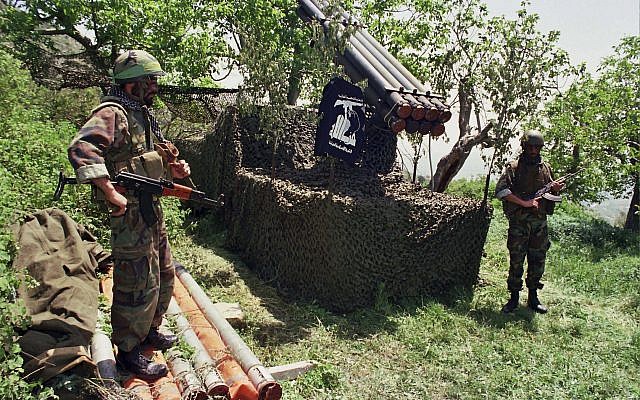
In this April 1996 file photo, two Hezbollah fighters stand near Katyusha rockets in the southern village of Ein Qana, Lebanon. (AP Photo/Mohammed Zaatari, file)

According to the station, which cited foreign media reports, over the past two years Israel has attacked Hezbollah operatives some 40 times, mostly in Syria and in some cases inside Lebanon, but Nasrallah has chosen not to respond.

Though rarely claiming responsibility, Israel has also carried out hundreds of strikes in Syria to prevent Iran from establishing a military foothold from which to attack the Jewish state. Most recently, an attack near Damascus on Wednesday night was blamed on Israel by Syrian state media. The strikes have also reportedly targeted shipments of advanced weapons and rocket guidance systems on their way to Hezbollah.

In an interview with Iranian state TV last month, Nasrallah appeared to attempt to assert Hezbollah’s independence from Tehran, also claiming Israel was afraid to go to war against either.

Amid domestic criticism that his group acts in Tehran’s interests and not Lebanon’s, he challenged anyone to “tell us about a single act that Hezbollah did for the sake of Iran rather than for the sake of Lebanon,” according to Naharnet.

The report on Nasrallah’s trip to Iran came amid ongoing multinational negotiations in Vienna to revive a 2015 deal that lifted sanctions on Iran in return for curbs on its nuclear program to prevent it from obtaining nuclear weapons.

In this image made from April 17, 2021, video released by the Islamic Republic Iran Broadcasting, IRIB, state-run TV, various centrifuge machines line the hall damaged on April 11, 2021, at the Natanz Uranium Enrichment Facility, some 200 miles (322 km) south of the capital Tehran. (IRIB via AP, File)

The US under the Trump administration pulled out in 2018 and Iran has since eased some of its commitments, in particular by enriching uranium to levels that have raised concerns it is approaching the threshold to produce a nuclear weapon.

Israel has repeatedly declared it will not allow Iran to become a nuclear-armed state and that, if necessary, it will strike Iranian nuclear facilities. regardless of the outcome of the Vienna talks to save the Joint Comprehensive Plan of Action.

Agencies contributed to this report.


Where did the ancient Israelites encounter God?

How Israel transformed from a desert to the land of milk of honey that God promised in the Bible.

Land of milk and honey (photo credit: FLICKR)
Land of milk and honey
(photo credit: FLICKR)

The Torah describes the land of Israel as “flowing with milk and honey” 14 times, according to Sefaria – a phrase that has become connected to God’s promise to return the Jews to Israel.

The same representation of freedom and new life has also made its way into Christian traditions. In Apostolic Christian traditions, for example, offering a baby a sweet mixture of milk and honey at baptism was a part of the baptismal rite.

Milk was referring to goat’s milk and honey to silan, a thick and sweet date syrup that is one of the seven species native to Israel.

Credit: FlickrCredit: Flickr

Today, this promise has been actualized in modern Israel. But the land was not flowing with milk and honey when the first Jews arrived.

Before the Jewish people settled Israel in what some consider a “prophetic” return to the land, with the first large-scale aliyah beginning by 1882, it was a desert.

Mark Twain, in his 1869 travelogue Innocents Abroad, described the land as “desolate,” “unpicturesque” and “unsightly.” He also wrote that “Palestine sits in sackcloth and ashes…. desolate and unlovely.”

Even in the Bible, in Jeremiah 25:11 and the Book of Lamentations, it states that “this whole land shall be a desolate ruin.”

These depictions are quite different from what visitors see when they come to Israel in 2022, where even in the Negev Desert, modern agriculture practices have turned sand into rich soil, ripe with cherry tomatoes, citrus and other fruits and vegetables – “the opposite to the desertification trend which much of the rest of the world is battling to prevent,” according to the Tourism Ministry.

In Tel Aviv, Milk and Honey (M&H) Distillery took its name from this ancient phrase.

“We thought it a fitting name because it references the abundance of resources and possibility of the land of Israel, and our whisky is yet another product of this rich country,” Rebecca Montag of the M&H Distillery Visitor’s Center told The Jerusalem Post.

Like much of Israel itself, the distillery creates new takes on traditional practices, namely, the Scottish practice of distilling and maturing single malt whisky using cooper stills and oak barrels.

The distillery even has the only kosher sherry cask whisky in the world – they flew out a Barcelona rabbi to kasher a winery where sherry originates, in Jerez, Spain. But despite the name, Montag related, no honey or flavoring is added to their whiskeys.

“Our distillery is very much a startup in the Tel Aviv style,” he said. “We were founded by a group of innovators who wanted to bring a new idea to Israel and have since integrated into the startup environment of Tel Aviv. We are also frequently trying new things with our whisky from aging in barrels that come from less traditional sources and maturing our whisky in interesting locations like the Dead Sea.”

Aside from an actualized promise, a Baptismal treat, and the rise of Israel’s fertile soil and innovation, the phrase “a land of milk and honey” can also be understood from a spiritual perspective.

According to Rabbi Julie Zupan, the phrase can be understood as both a physical description of the land and a spiritual metaphor. In the Book of Exodus (3:8), for example, the word for Egypt in Hebrew, mitzrayim, as Zupan points out, means “narrow places.”

“In other words, a life of slavery is constricted and oppressive, while living in freedom in Israel is wide and spacious,” Zupan writes. “A land so fertile that it flows with milk and honey stands in contradiction to the place of oppression.

“Perhaps the promise is of nourishing food, or perhaps the promise is for spiritual nourishment,” she continued. “Or, perhaps, the promise is for both.”

https://www.jpost.com/christianworld/article-696569

Where did the ancient Isras encounter God?
