Israel ups airstrikes in Syria as next step against Iran

At least seven airstrikes targeting Iranian and Shi’ite militias have been blamed on Israel in the past month alone.

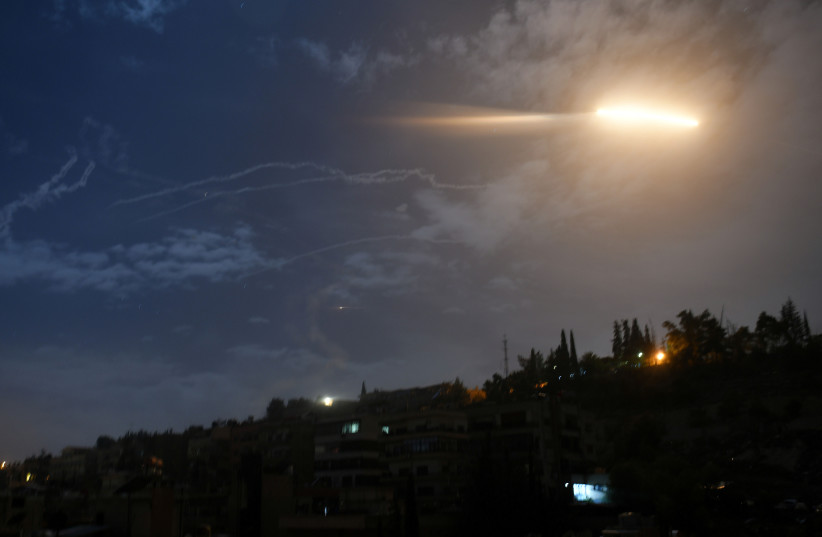
 Missile fire is seen over Damascus, Syria January 21, 2019.  (photo credit: SANA/HANDOUT VIA REUTERS)
Missile fire is seen over Damascus, Syria January 21, 2019.
(photo credit: SANA/HANDOUT VIA REUTERS)
Israel has seemingly upped its “war between the wars” campaign against Iran in Syria, as the country’s top officer warns that the IDF is accelerating its plans to deal with Iran’s nuclear program.
At least seven airstrikes targeting Iranian and Shi’ite militias have been blamed on Israel in the past month alone, the most recent one on Monday in the Homs province, as well as targets belonging to the regime of Bashar Assad and to Iranian militias in the northwestern coastal city of Tartus.
Last week Israel was blamed for an airstrike targeting a military post on the outskirts of Damascus, and last October five people were killed in another alleged Israeli airstrike in a rare daytime strike outside Damascus.
While Israel may be taking advantage of the unusually clear skies during a season where there are usually heavy clouds, it also comes weeks before Iran and the West are set to return to the negotiating table in Vienna.
The indirect talks are being brokered by the European Union and aim to bring Washington and Tehran back into the Joint Comprehensive Plan of Action, the formal title of the Iran nuclear deal, which the United States left under former president Donald Trump.
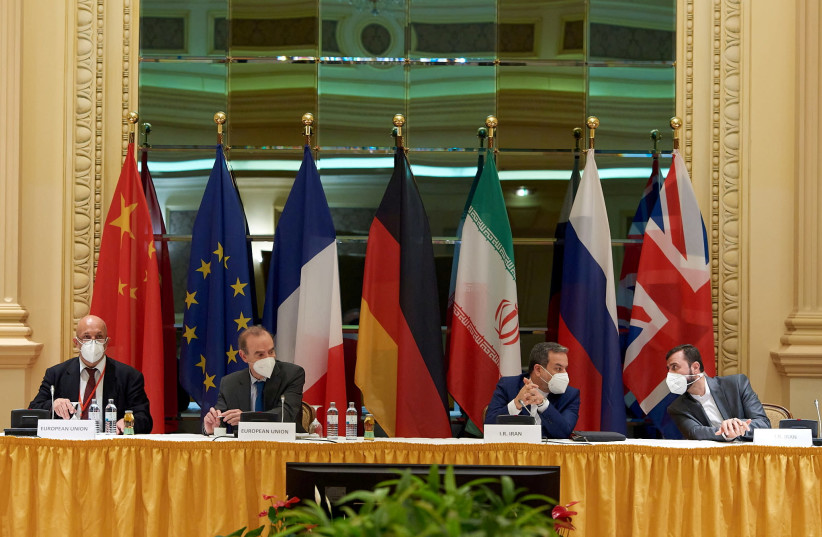
European External Action Service (EEAS) Deputy Secretary General Enrique Mora, Iranian Deputy at Ministry of Foreign Affairs Abbas Araghchi and Iran's ambassador to the U.N. nuclear watchdog Kazem Gharibabadi wait for the start of a meeting of the JCPOA Joint Commission in Vienna, Austria May 1, 202 (credit: EU DELEGATION IN VIENNA/HANDOUT VIA REUTERS)European External Action Service (EEAS) Deputy Secretary General Enrique Mora, Iranian Deputy at Ministry of Foreign Affairs Abbas Araghchi and Iran’s ambassador to the U.N. nuclear watchdog Kazem Gharibabadi wait for the start of a meeting of the JCPOA Joint Commission in Vienna, Austria May 1, 202 (credit: EU DELEGATION IN VIENNA/HANDOUT VIA REUTERS)

It is believed that Iran is continuing to develop the capabilities to produce a nuclear weapons arsenal and to produce ballistic missiles capable of carrying nuclear warheads.
And with no diplomatic options likely to push Tehran to stop its nuclear program, Israel’s military believes that the Islamic Republic needs to be aware that should it continue with its program, it will face a military option ready to stop it.
IDF Chief of Staff Lt.-Gen. Aviv Kohavi warned Tuesday during a meeting of the Knesset’s Foreign Affairs and Defense Committee that “the IDF is accelerating its operational plans and readiness to deal with Iran and its military nuclear threat.”
While an attack by Iranian proxies such as Hezbollah is a major concern for the IDF, it’s Iran’s nuclear and ballistic missile programs that worry Israel’s defense establishment the most.
“I am pleased that the budget allows us to meet the range of challenges, including a significant improvement of all operational plans of procurement, of training, both of the regular and of the reserve forces,” Kohavi said.
“The State of Israel has many security challenges in six different arenas,” he said, adding that “the IDF acts both defensively, in counterattacks, and offensively. In the past year we have continued to act against our enemies, including in covert operations throughout the Middle East.”
As reported by The Jerusalem Post, some NIS 5 billion of the defense budget will go exclusively to Israel’s “war between the wars” campaign against Iran. The funds will be allocated to intelligence gathering capabilities, increasing the military’s target bank even further, and training.
The budget will also allow the IDF to complete other important defensive projects, such as building the wall along the border with Lebanon and implementing a permanent defensive coverage in the airspace of northern Israel with additional fixed Iron Dome batteries that would be able to shoot down incoming drones or missiles.
In the past year, there has also been an increase in the number of targets struck during the campaign operations, with most airstrikes targeting Iranian entrenchment and weapons smuggling in Syria. Operations have even occurred at sea, where alleged Israeli attacks against Iranian ships have stopped an estimated $1.2 million-$2m. from going to terrorist groups in the Middle East.
“The IDF will continue to act to remove the threats and will respond forcefully to any violation of sovereignty, whether it is from the Gaza Strip or in the north, whether it is an Iranian force or a Palestinian force.”



 

IDF Chief of Staff Aviv Kohavi attends a Knesset Foreign Affairs and Defense Committee meeting on November 9, 2021. (Yonatan Sindel/Flash90)

IDF Chief of Staff Aviv Kohavi attends a Knesset Foreign Affairs and Defense Committee meeting on November 9, 2021. (Yonatan Sindel/Flash90)

IDF Chief of Staff Aviv Kohavi says the military is ramping up its preparations for a possible attack on Iranian nuclear facilities.

“The IDF is accelerating operational planning and preparedness to deal with Iran and the military nuclear threat,” he tells the Knesset’s Foreign Affairs and Defense Committee. “The budget that was approved makes it possible to contend with a variety of threats.”

His comments come as the Israeli Air Force is expected to resume practicing for a strike on Iran’s nuclear program.

In his remarks to the committee, Kohavi also tells Knesset members that Israel faces “many security challenges” on numerous fronts.

“In the past year we’ve continued to act against our enemies in missions and secret operations throughout the entire Middle East. The IDF will continue to act to remove threats and will respond forcefully to any violation of [Israeli] sovereignty,” he says.


IAF Bombs Iranian Targets in Syria for 3rd Time in 10 Days


The Israeli Air Force (IAF) conducted a series of strikes against Iranian-linked targets in Syria on Monday night, the third such attack in a week and a half.

Syria’s official SANA news reported that the Syrian army’s air defenses “repelled an Israeli air aggression that targeted some posts in the central and coastal regions, downing most of the missiles.”

A military source told SANA that the IAF carried out the attack from the direction of northern Beirut, targeting a number of posts in the central and coastal areas.

The attack wounded two soldiers and caused some material damages, the report said.

The timing of the strike was fairly early and unconventional, seven in the evening.

The Syrian Observatory for Human Rights (SOHR) reported that the attack hit areas in the south-eastern countryside of Homs hosting military barracks, the headquarters of a regime-backed military formation, and the al-Shayrat airbase where the Lebanese Hezbollah and Iranian-backed militias have been stationed.

Fires reportedly broke out as a result of the Syrian army air defense missiles falling on locations in the Homs and Tartus countryside. A woman was reportedly injured.

The Saudi Al-Hadath channel reported that in parallel with the Israeli attack today on Homs, Israeli aircraft also attacked an Iranian-made air defense system intended for Hezbollah that was on its way from Tartus.

Some reports from Syria pointed to a warehouse of a precision missile factory east of Tartus as one of the targets of the attack.

The IDF has remained silent on the reports, as it usually does in these cases.

Following the attack attributed to Israel in Syria, the airspace in the Golan Heights was closed to civilian flights.

Israel has carried out several strikes against Iranian and Hezbollah targets in Syria.

Last Wednesday, the IAF carried out an air attack against targets in the countryside of Damascus, causing material damage.

On the Saturday before that, in mid-day, the IAF hit a shipment of advanced weapons on its way from Syria to Lebanon, killing at least five terrorists.

In total, at least seven attacks in the area have been attributed to Israel in the past month.

Iran and Hezbollah have in recent years been working to build up a military presence in Syria, a threat that remains a red line for Israel.

Iran routinely attempts to arm the Lebanon-based Hezbollah with advanced weapons. Israel has exposed and thwarted multiple attempts by Iran to transfer game-changing weapons to Hezbollah, including by air shipments from Iran, through Damascus Airport.

The IAF has carried out thousands of attacks to thwart the Iranian entrenchment in the war-torn country and to prevent Hezbollah from accumulating advanced game-changing weapons.