Iran’s Military Holds Annual Drills Near Mouth of Gulf

by Reuters and Algemeiner Staff

A group of Iranian Navy ships. Photo: Wikimedia Commons.

Iran’s military launched an annual exercise near the mouth of the Gulf on Sunday, Iranian state television reported, a few weeks before resumption of talks between Tehran and world powers to revive a 2015 nuclear deal.

“The military exercise in Iran’s coast on the Gulf of Oman is to display the country’s military might and readiness to confront our enemies,” Admiral Mahmoud Mousavi, the spokesman for the Zolfaqar-1400 drill, told state television.

The exercise covers an area from the eastern parts of the Strait of Hormuz to the northern parts of the Indian Ocean and parts of the Red Sea, state television reported. About a fifth of the oil that is consumed globally passes through the strategic Strait of Hormuz waterway in the Gulf.

Periodic confrontations have taken place between Iran’s military and US forces in the Gulf since 2018, when former US President Donald Trump exited the nuclear pact and reimposed harsh sanctions on Tehran.

Iran has reacted by breaching the deal’s limits on its nuclear program.

Indirect talks between Iran and US President Joe Biden’s administration to revive the pact, which were put on hold since the election of Iran’s hardline President Ebrahim Raisi in June, are set to resume in Vienna on Nov. 29.


Foreign minister says Washington welcome to open mission to Palestinians in Ramallah if it wishes; believes there is ‘understanding’ in US toward blacklisting of rights groups


Prime Minister Naftali Bennett (right) and Foreign Minister Yair Lapid speak at a press conference in Jerusalem, on November 6, 2021. (Haim Zach/GPO)

Prime Minister Naftali Bennett (right) and Foreign Minister Yair Lapid speak at a press conference in Jerusalem, on November 6, 2021. (Haim Zach/GPO)

Prime Minister Naftali Bennett and Foreign Minister Yair Lapid presented a united front Saturday in their opposition to the United States reopening its consulate for the Palestinians in Jerusalem.

Speaking to the media after the approval of the state budget for 2021-2022, the prime minister said that “there is no place for an American consulate that serves the Palestinians in Jerusalem.” This had been conveyed to Washington “both by myself and by Foreign Minister Yair Lapid,” he said.

“We are expressing our position consistently, quietly and without drama, and I hope it is understood. Jerusalem is the capital of Israel alone.”

Lapid backed Bennett up, saying that “If the Americans want to open a consulate in Ramallah we have no problem with that.” But “sovereignty in Jerusalem belongs to one country — Israel.”

He rejected the notion that with the government more stable following the budget’s passing, the leaders may be more willing to take on such a politically touchy subject.

“It’s not a question of politics. It’s an Israeli objection on principle for opening a consulate in Jerusalem. There’s an American embassy [here].”

Late last month, a senior official in the US State Department told senators that Israel’s permission would be required before the US could reopen its consulate in Jerusalem serving Palestinians.

US President Joe Biden has pledged to reopen the consulate, but the issue has been a sticking point between Israel and the US, as well as among some members of Congress. The consulate was shuttered by then-US president Donald Trump in 2019 and its staff was folded into the US embassy — which had been moved from Tel Aviv to Jerusalem a year earlier — in what the Palestinians view as a downgrading of their ties with the US.
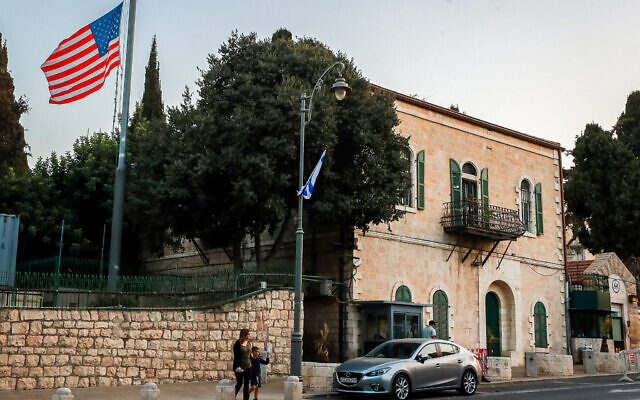
View of the US Consulate building in Jerusalem, on October 27, 2021, currently serving the US Embassy. (Yonatan Sindel/Flash90)

Asked about the issue during a press conference alongside Foreign Minister Yair Lapid in Washington two weeks ago, US Secretary of State Antony Blinken reiterated the Biden administration’s intention to proceed with the plan. “As I said in May, we’ll be moving forward with the process of opening a consulate as part of deepening those ties with the Palestinians,” he said.

Behind closed doors, Lapid reportedly warned Blinken that such a move could risk toppling Israel’s fragile coalition government.

Lapid was also asked on the different claims coming from Israel and the US as to whether Jerusalem had notified Washington in advance of its plan to blacklist half a dozen Palestinian human rights organizations, a step that was taken last month.

Israel has alleged the groups effectively operate as an arm for the Popular Front for the Liberation of Palestine terror group — a claim to which the international community has reacted with skepticism.

The foreign minister once again maintained that the Americans had been notified, saying there had been “a process of evidence gathering” for several months that the State Department had been updated on. “It’s incorrect that they were not told,” he said.

This contradicts comments by US State Department spokesman Ned Price.
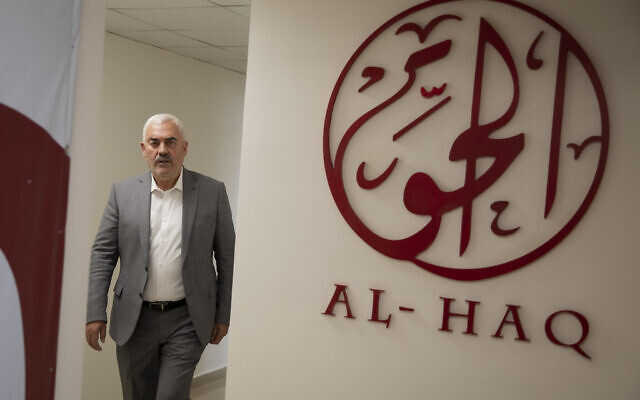
Shawan Jabarin, director of the al-Haq human rights group, at the organization’s offices in the West Bank city of Ramallah, on Saturday, October 23, 2021. (AP Photo/Majdi Mohammed, File)

“I understand some things were said just after the announcement,” Lapid said, “but in general we are on the same page with the Americans, they’re aware of it. Representatives of the Foreign Ministry were in Congress and the Senate in the past week to present the materials to the Senators and congressman on the various panels. I believe there is an understanding toward this step and the intelligence behind it.”

Amy Spiro and Jacob Magid contributed to this report.


Western officials and analysts believe Tehran’s escalation of enrichment is meant to gain leverage to extract more concessions when negotiations do resume.

 The Iranian flag flies in front of the IAEA headquarters in Vienna (photo credit: REUTERS/LISI NIESNER/FILE PHOTO)
The Iranian flag flies in front of the IAEA headquarters in Vienna
(photo credit: REUTERS/LISI NIESNER/FILE PHOTO)
Iran has increased its stockpile of 60% enriched uranium to 25 kilograms (55 pounds), state media reported on Friday, potentially adding to complications dogging efforts to revive Tehran’s 2015 nuclear deal with world powers.
Negotiations are due to resume on Nov. 29 in Vienna. But Western powers have said Iran’s accelerating enrichment of uranium closer to weapons grade, breaching limits set by the pact after Washington under then-president Donald Trump withdrew from the pact in 2018, is dimming chances of salvaging it.
“So far we have produced 25 kilograms of 60% uranium, which, except for countries with nuclear weapons, no other country is able to produce,” Iranian media quoted Behrouz Kamalvandi, spokesman for the Atomic Energy Organisation of Iran, as saying.
Iran has in the past denied seeking nuclear weapons, saying it is refining uranium only for civilian energy uses, and has said its breaches are reversible if the United States lifts sanctions and rejoins the agreement.
In April, the UN nuclear watchdog said Tehran had begun the process of enriching uranium to 60% fissile purity at an above-ground nuclear plant at Natanz, confirming earlier statements by Iranian officials.

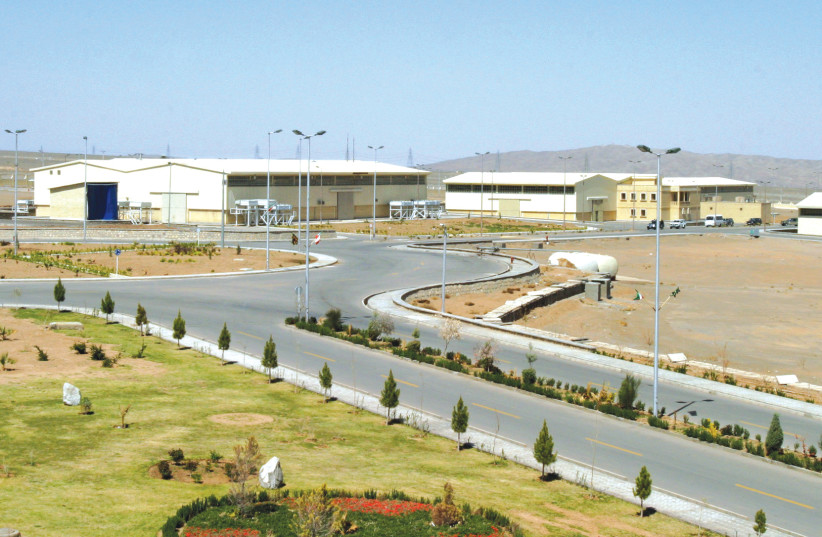
THE NATANZ uranium enrichment facility 250 km. south of Tehran. (credit: RAHEB HOMAVANDI/REUTERS)THE NATANZ uranium enrichment facility 250 km. south of Tehran. (credit: RAHEB HOMAVANDI/REUTERS)

Iran said in June it had made 6.5 kg of uranium enriched to up to 60%.
The nuclear deal caps the purity to which Tehran can refine uranium at 3.67%, the level suitable for most civilian nuclear energy, well under the 20% achieved before the 2015 deal and far below the 90% suitable for a nuclear weapon.
US President Joe Biden’s administration says it wants to return to the deal but disagrees with Iran on which steps need to be taken and when, with key issues being what nuclear limits Tehran will accept and what sanctions Washington will remove.
Western officials and analysts believe Tehran’s escalation of enrichment, while being in no hurry to return to talks that were adjourned in June when an anti-Western hardliner was elected president, is meant to gain leverage to extract more concessions when negotiations do resume.
The Biden administration said on Oct. 31 that it was unclear whether Iran was willing to rejoin the talks “in a meaningful way.”