
White House quietly removes sanctions on Iranian missile companies

Advocacy group calls on White House to explain why it lifted sanctions on two Iranian missile producers without explanation.
Iran

An advocacy group that warns about the threat of a nuclear Iran has sounded the alarm after the US Treasury Department last week without explanation lifted sanctions on two firms that produced ballistic missiles for the Iranian regime.

United Against Nuclear Iran is questioning why the Office of Foreign Assets Control (OFA) suddenly announced it would be removing sanctions on Mammut Industrial Group and its subsidiary Mammut Diesel.

Both companies were sanctioned in September 2020 for “providing support to an entity in Iran’s ballistic missile program.”

The Treasury Department said at the time that “Mammut Industries and Mammut Diesel are key producers and suppliers of military-grade, dual-use goods for Iran’s missile programs.”

“The delisting follows the July 2021 lifting of sanctions on three Iranians who were major shareholders and executives of the Mammut Industrial Group,” United Against Nuclear Iran said in a statement.

“The Biden Administration has thus far not been forthcoming on the reasons behind the lifting of these sanctions, and it has not confirmed that the delisted individuals and entities have verifiably ceased their sanctionable behavior,” the advocacy group said. “At the same time, the administration denied that its actions are indicative of a broader shift in Iran sanctions policy or are in any way linked to inducements to bring Tehran back to stalled nuclear negotiations.”

The group called for the White House to release more information about why the decision was necessary.

“Reducing economic pressure on Tehran absent meaningful behavioral change would signal to the Iranian regime that it can extract concessions from the U.S. through its intransigence,” they said.

They called on the Biden administration to show full transparency about the context within which the companies and individuals connected to Iran’s missile programs were delisted.

They also urged the White House to “reaffirm its commitment to bringing all the pressure at its disposal to bear on disrupting Iran’s development of nuclear-capable ballistic missiles.”

“Rather than undoing sanctions, the Biden administration should prepare to wage a full-scale diplomatic offensive in favor of extending the Iranian ballistic missile development restrictions contained in UN Security Council Resolution 2231 – set to expire just 24 months from now,” they said.
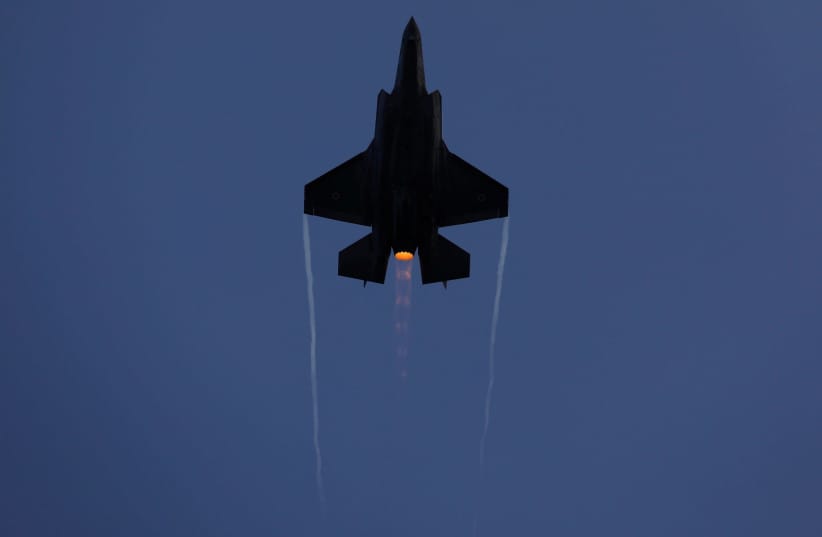

One Syrian soldier was killed and three were wounded in the second alleged Israeli airstrike in a week.

F-35 Fighter (photo credit: Courtesy)
F-35 Fighter
(photo credit: Courtesy)
Iranian militias warned of a “harsh response” after a number of Syrian and Iranian-backed forces were killed and wounded in an alleged Israeli airstrike near Palmyra in central Syria on Wednesday night, the second such airstrike in the past week.
The Syrian state news agency SANA reported that an Israeli airstrike targeted a communications tower and a number of nearby sites, killing one Syrian soldier and wounding three others. The strike was carried out from the direction of the al-Tanf area near the Jordanian and Iraqi borders with Syria, a Syrian military source told SANA.
On Thursday morning, a joint operations room affiliated with the Islamic Revolutionary Guards Corps, Hezbollah and the Assad regime warned that it had decided to respond harshly to the airstrikes after a number of operatives were killed and wounded in the strikes, according to Hezbollah-affiliated media. It is unclear if the statement was referring to casualties other than those reported by SANA.
The joint operations room stressed that its mission in Syria is only to help the Syrian state to confront “terrorists” and ISIS.
“For years, we have been subjected to attacks from the Israeli and American enemy in an attempt to drag us into side battles that were not a priority for our presence in Syria, and the Zionists’ excuse was that they were targeting accurate weapons and sensitive equipment that posed a threat to their usurping entity,” added the joint statement.
Around the time of the airstrike, the airspace above the Golan Heights was closed to flights until Friday at 12:15 a.m.
The airstrike comes just a week after an alleged Israeli airstrike on the T-4 airport, also near Palmyra, wounded six Syrian soldiers, according to SANA.
Satellite imagery from Sentinel Hub shared on social media showed damage on the runway at T-4 after the airstrike last week.
Before the airstrike last week, the last airstrike blamed on Israel in Syria took place in August, targeting the Qalamoun Mountains near the capital of Damascus. Four Syrian civilians were reportedly killed when Syrian air defense missiles fell in a residential area in the town of Qara.


General says Tehran is ‘perfectly prepared to protect sensitive and vital installations’ across the country


This photo released Tuesday, Oct. 12, 2021, by the Iranian Army, shows a missile being fired during a military drill at an undisclosed location in Iran. (Iranian Army via AP)

This photo released Tuesday, Oct. 12, 2021, by the Iranian Army, shows a missile being fired during a military drill at an undisclosed location in Iran. (Iranian Army via AP)

TEHRAN — The Iranian military said Wednesday it had successfully tested anti-missile defenses for “sensitive” sites during war games in central Iran, after Israeli and US warnings over its nuclear program.

“The country’s air defenses are perfectly prepared to protect sensitive and vital installations through a multi-layered defense system,” said General Amir-Qader Rahimzadeh, commander of Hazrat Khatam al-Anbiya airbase at Semnan, quoted by the Fars news agency.

The exercises, which began on Tuesday, combined the army’s “Majid” defense system with the “Dezful” system of the elite Revolutionary Guard Corps to destroy incoming cruise missiles. Iran’s central region is home to the Natanz enrichment plant and other nuclear sites.

The war games there came ahead of a visit to Iran expected on Thursday by a European Union envoy coordinating talks on reviving a troubled nuclear deal between Tehran and major powers including the United States.

“A solid and multi-layered defense against cruise missile attacks was one of the objectives of the joint air defense exercises that were carried out successfully,” Rahimzadeh said.

This photo released Tuesday, Oct. 12, 2021, by the Iranian Army, shows a missile being fired during a military drill at an undisclosed location in Iran. (Iranian Army via AP)

These air defense systems are from now on “deployed all over the country,” said the head of the aerospace branch of the Guard Corps, Brigadier General Amirali Hajizadeh. “We didn’t have this capability 15 years ago. We depended on foreign equipment for radar and ground-to-air systems,” he said.

Radars and electronic surveillance systems were also deployed in the operations, state news agency IRNA said.

EU envoy Enrique Mora is set to visit Iran with mounting pressure from European countries, as well as from the Biden administration, for a swift resumption of negotiations on a US return to the 2015 nuclear deal.

Iran’s foreign ministry announced Mora’s mission to the country.

Deputy Secretary-General and Political Director of the European External Action Service (EEAS), Enrique Mora, addresses the media in front of the ‘Grand Hotel Vienna’ where closed-door nuclear talks take place in Vienna, Austria, June 20, 2021. (Florian Schroetter/AP)

The 2015 deal gave Iran sanctions relief in return for curbs on its nuclear program, but has been on life support since 2018, when then US president Donald Trump unilaterally pulled out and reimposed crippling sanctions.

Iran has said repeatedly that it is ready to resume talks “soon.”

Rob Malley, the US negotiator who led indirect talks with Iran earlier this year, said in Washington on Wednesday that Biden’s administration preferred a return to the 2015 deal.

But it was possible Tehran will “choose a different path,” and the US is working with regional allies on a Plan B, he said.
