PM calls on world powers to hold Tehran accountable; World Jewish Congress head says Likud aiding Tehran by refusing to cooperate with new government


Prime Minister Naftali Bennett speaks at the Jerusalem Post conference in Jerusalem, October 12, 2021 (Kobi Gideon, GPO)

Prime Minister Naftali Bennett speaks at the Jerusalem Post conference in Jerusalem, October 12, 2021 (Kobi Gideon, GPO)

Prime Minister Naftali Bennett called on the international community to hold Iran accountable for its nuclear program, hinting at the possibility of military action if world powers do not act.

“Iran is blatantly violating the IAEA commitments,” Bennett said on Tuesday morning at the Jerusalem Post Conference at the Museum of Tolerance in downtown Jerusalem.

“We’re not going to wait. I expect the global powers to hold them accountable,” he emphasized.

“That would be the peaceful route. There are other routes,” Bennett warned.

In 2018, then-US president Donald Trump withdrew from the 2015 JCPOA nuclear accord and began reimposing sanctions. Tehran has gradually rolled back its nuclear commitments since 2019.

Talks in Vienna on a return to the deal are expected to restart in the coming weeks, for the first round since hardline President Ebrahim Raisi took office in August.
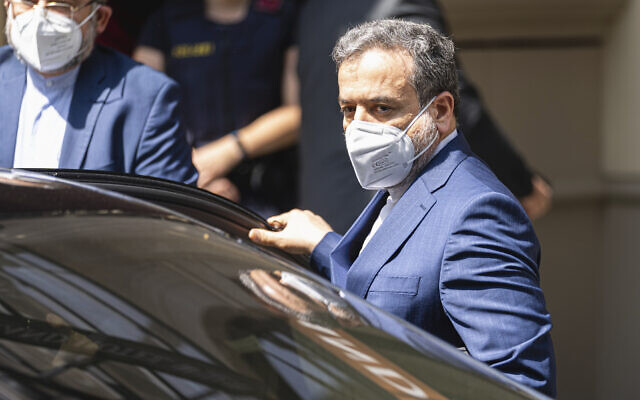
Iran’s deputy foreign minister, Abbas Araghchi, arrives at the ‘Grand Hotel Vienna’ where closed-door nuclear talks are taking place in the Austrian capital, on June 20, 2021. (AP Photo/Florian Schroetter)

In his address, Bennett called for Israel to show leadership on addressing global problems, especially COVID-19, “radical Islamic terror,” political polarization, and climate change.

He also laid out his overarching understanding of Israeli politics, calling it a “three-way tug-of-war” between the religious, the left, and the nationalist right wing.

“I’m happy there are Haredim, but we need to limit their political sway,” he said. “I wouldn’t want an Israel without a left wing; while clearly I feel differently on many issues, I’m happy there’s that counter so we can debate it.”

He said his government was pursuing policies that might be unpopular but were right for the country, pointing at raising the retirement age for women and spending NIS 150 billion on a Tel Aviv metro system.

Before Bennett’s address, Isaac Herzog revealed one of his top priorities as president, pledging that promoting tolerance would be “a focal point” of his tenure.

He argued that “the lack of tolerance has resulted in two interconnected challenges… a crisis of liberal democracy on the one hand, and a crisis of the liberal world order on the other.”

President Isaac Herzog speaks at the Jerusalem Post conference in Jerusalem, October 12, 2021 (Kobi Gideon, GPO)

Herzog said that both crises are caused by a failure to engage respectfully with people who don’t hold the same political views.

“I see my role as the president of Israel,” he continued, “to build bridges between the parts of this marvelous, diverse, and wonderful community and among the many extensions of our cherished family — which means Jews all around the world.”

Speaking after Bennett, World Jewish Congress president Ronald Lauder called for Jewish unity, blasting the Likud party for refusing to work with the current Naftali Bennett-Yair Lapid government, and insinuating that this refusal was benefiting Iran.

World Jewish Congress president Ronald Lauder speaks at the Rumbach Synagogue reopening in Budapest, Hungary, June 10, 2021. (Photo by Akos Szentgyorgyi)

“We have so many enemies out there — why on earth are we fighting each other?” he asked emphatically. “Why can’t Likud work with the new government? Is a political victory that important that you’re willing to jeopardize the future of the Jewish state? Is winning a political battle that important that you can give aid and comfort to Iran?’

The conference, titled “The Future is Now,” features senior Israeli officials, including Defense Minister Benny Gantz and Interior Minister Ayelet Shaked, and past US officials former secretary of state Mike Pompeo and former treasury secretary Steve Mnuchin.


Bennett: Iran aspires to build an army on Israel’s Golan border

Golan Heights development is a strategic goal for this government, Prime Minister Naftali Bennett said, as he promised to double, if not quadruple the population there.

 Prime Minister Naftali Bennett is seen addressing the Makor Rishon conference, on October 11, 2021. (photo credit: KOBI GIDEON/GPO)
Prime Minister Naftali Bennett is seen addressing the Makor Rishon conference, on October 11, 2021.
(photo credit: KOBI GIDEON/GPO)
Iran aspires to build an army on Israel’s Golan Heights border, Prime Minister Naftali Bennett said on Monday as he doubled down on Israeli sovereignty in that region and warned Tehran against continued entrenchment there.
“The Golan Heights is Israel, period,” Bennett said as he addressed the Makor Rishon newspaper conference that focused on economic and regional development of the mountainous region that Israel captured from Syria during the pre-1967 war.
Israel applied sovereignty to the Golan, but that move has been recognized only by the United States. Israel has long claimed that the region is a strategic necessity, particularly in light of the Syrian civil war and as one of the fronts in Iran’s continuous military battle with Israel.
“Iran, which has dispatched proxies and built armies to surround the State of Israel, aspires to build yet another army on the border of the Golan Heights,” Bennett said as he stood in the Golan.
“We will continue to act wherever and whenever necessary, at our initiative, and on a daily basis, in order to roll up the Iranian presence in Syria. They have nothing to look for there,” Bennett said.
“Their adventure on our northern border needs to end. Thus, we will ensure not only the peace of the residents of the Golan Heights but of all citizens of Israel,” he explained.

Israeli soldiers prepare to move down south on  May 11, 2021, El Poran, Golan Heights.  (credit: MICHAEL GILADI/FLASH90)Israeli soldiers prepare to move down south on May 11, 2021, El Poran, Golan Heights. (credit: MICHAEL GILADI/FLASH90)

But he clarified that Israel’s ties to the Golan were not dependent on the argument that it was territory necessary for Israel’s security.
“I would like to make one thing clear – our position regarding the Golan Heights is not connected to the situation in Syria,” Bennett said.
The “horrors: taking place in Syria may make it seem as if it would be preferable for the Golan to propers under Israeli hands then to be “yet another arena for killings and bombings,” Bennett said.
“But even in the situation – which could happen – in which the world changes direction regarding Syria, or regarding the Assad Regime, this has no connection to the Golan Heights” and Israeli sovereignty there, Bennett said.
Golan Heights development is a strategic goal for this government, Bennett said, as he promised to double, if not quadruple the population there.
In six weeks, the government will approve a national plan for the Golan Heights, that will include investment in development, infrastructure, business and renewable energy, Bennett said.
“We are now working to complete the plan that will change the face of the Golan Heights,” he said.


Iran claims 120 kg. jump in 20% enriched uranium

The amount is said to be almost 80% of what the Islamic Republic needs to build a nuclear bomb.

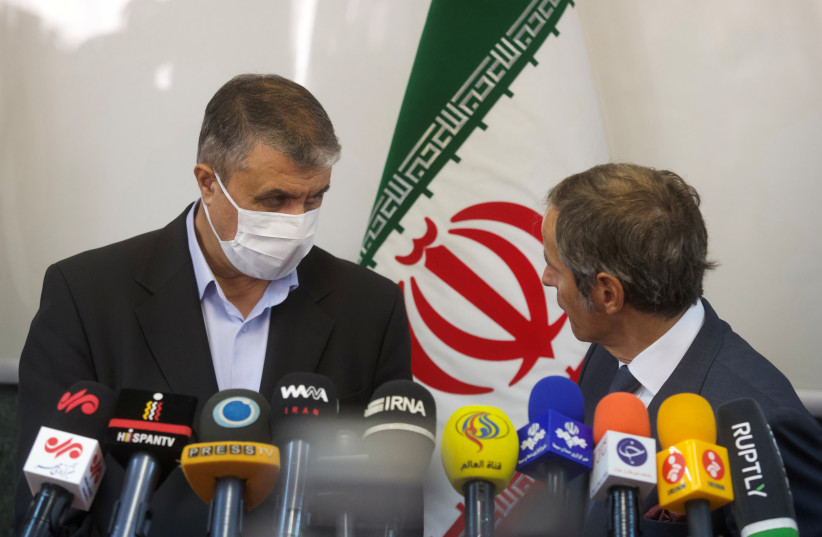
Head of Iran's Atomic Energy Organization Mohammad Eslami and International Atomic Energy Agency (IAEA) Director General Rafael Grossi attend a news conference, in Tehran, Iran, September 12, 2021. (photo credit: WANA (WEST ASIA NEWS AGENCY) VIA REUTERS)
Head of Iran’s Atomic Energy Organization Mohammad Eslami and International Atomic Energy Agency (IAEA) Director General Rafael Grossi attend a news conference, in Tehran, Iran, September 12, 2021.
(photo credit: WANA (WEST ASIA NEWS AGENCY) VIA REUTERS)
Iran has amassed more than 120 kilograms of 20 percent enriched uranium, Iran Atomic Energy Organization Chief Mohammad Eslami said Saturday, according to state news agency IRNA.
“We have passed 120 kilograms. We have more than that figure,” IRNA quoted Eslami as saying.
“Our people know well that they [Western powers] were meant to give us the enriched fuel at 20 percent to use in the Tehran reactor, but they haven’t done so. If our colleagues do not do it, we would naturally have problems with the lack of fuel for the Tehran reactor.”
If true, the numbers could be considered a major jump forward in Iran’s uranium enrichment efforts, taking Tehran closer to the threshold of a nuclear bomb, if it decides to go down that path.
Last month, the International Atomic Energy Agency (IAEA) reported that Iran had 84.3 kilograms of uranium enriched to 20 percent.

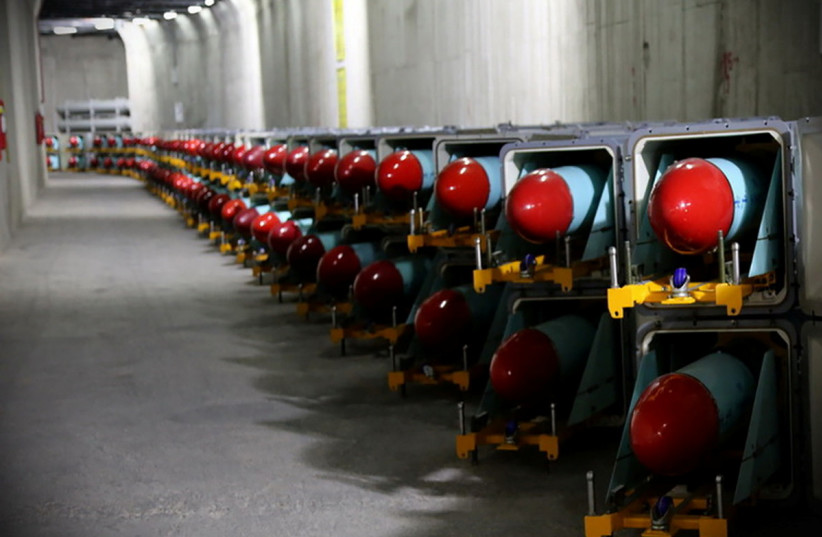
 Iranian missiles are seen at an underground of the new ''missile cite'' of Iran's Revolutionary Guards naval unit at an undisclosed location in Iran, in this picture obtained on March 15, 2021. (credit: IRGC/WANA/HANDOUT VIA REUTERS)Iranian missiles are seen at an underground of the new ”missile cite” of Iran’s Revolutionary Guards naval unit at an undisclosed location in Iran, in this picture obtained on March 15, 2021. (credit: IRGC/WANA/HANDOUT VIA REUTERS)

According to the Jewish Institute for National Security of America (JINSA), 155 kilograms of 20% enriched uranium would be enough to eventually be scaled up to weaponized uranium for a nuclear bomb, meaning that 120 kilograms would be almost 80% of the way there.
At the same time, a recent JINSA report said that “Iran is actively reducing the growth of its stockpile of 20 percent enriched uranium – which represents nine-tenths of the effort to achieve fissile material.”
“Since starting in January, Iran cumulatively has enriched an estimated 152 kg uranium to 20 percent at a rate of 19 kg/month,” the report said.
In addition, JINSA said that these statistics show “that Iran’s claim, in June, to have produced 108 kg at an average rate of 40 kg/month over the preceding three weeks was provocatively overstated.”
Putting all the pieces together, JINSA explained that “to limit its stockpile, Iran has been converting some of it to uranium metal, which, while worrisome because this process is one of the steps to a nuclear weapon, means this material can no longer be used to enrich fissile material.”
Before Iran’s announcement on Saturday night, JINSA had said that assuming Iran continues producing and diverting 20 percent uranium at its current rate, it would achieve enough uranium for a nuclear weapon by June-July 2022.
Last month, the Institute for Science and International Security estimated that Iran could produce enough enriched uranium for a single nuclear warhead within approximately one month.
The complex calculations on how fast the Islamic Republic can produce a nuclear weapon involve a mix and match of uranium it has enriched to three different levels: 5%, 20% and 60% – with 90% being the level required for weaponization.
Tehran has sent mixed messages in recent weeks about whether it will return to nuclear talks with the US and world powers in order to return to the JCPOA’s nuclear deal limits in exchange for Washington lifting sanctions or whether it is stalling for some other purpose.
In the meantime, since mid-September, the IAEA has heavily criticized Iran for blocking its access and disabling some of its monitoring equipment.
Iran has blamed the standoff over monitoring on an explosion in June at its Karaj nuclear facility that the ayatollahs have attributed to the Mossad.