Nearly everyone, religious or not, knows the story of how the Ten Commandments came to be.

The biblical book of Exodus, in chapter 19, lays out the scene: Moses and the Israelites, months after being freed from captivity in Egypt, arrived in the Sinai Desert. Moses was eventually called to the top of a mountain towering over the group’s camp, where God descended with fire, smoke and lightning. After being instructed to do so, Moses then gave God’s covenants to the people of Israel.

While the Ten Commandments have survived in their entirety, the exact location of “Mount Sinai” has remained a mystery for thousands of years.

Speculation over the years has placed the biblical mountain in modern-day Egypt, Saudi Arabia and even Israel.

Now, a team of archaeologists says they have pieced together the clues to show not only where the famous pinnacle is, but also the sites of other biblical events surrounding the chronicle of the mountain.

According to Ryan Mauro, a Middle East expert with the Doubting Thomas Research Foundation, people may have simply been looking in the wrong spot.

“One of the main reasons certain scholars claim that the Exodus is a myth is because little to no evidence for what the Bible records has been found at the traditional Mount Sinai in Egypt’s Sinai Peninsula,” Mauro told The U.S. Sun.

“Move over into the Arabian peninsula,” he continued, “and you find incredibly compelling evidence matching the Biblical account.”

One of the main clues discovered by the archaeologists is a mountain with a blackened ridge.

According to Mauro, the Jabal Maqla peak’s seemingly scorched top suggests this is the site where God descended as holy fire and smoke and handed down His commandments. A singed mountaintop is only the first clue, however.

The Bible records the Israelites making their way to the Sinai desert through the Red Sea, parted to allow safe passage as a vengeful Pharaoh descended upon the Hebrew host. The archeologists say they’ve found this path as well.

An Egyptian seaside site at Nuweiba and locations in the nearby Red Sea show signs of a land path, according to the team. On the other side, water sources similar to the 12 wells encountered by the fleeing Hebrews can still be found.

In the depths of the Red Sea, the team also says there is evidence of the Egyptian pursuers’ watery demise in the form of coral structures shaped like chariot axles and wheels. Chariots were a staple of bronze age warfare and would have allowed Pharaoh’s troops to rapidly approach a group traveling on foot.

Another clue is the existence of petroglyphs and carvings of people worshipping bulls in the area, which seem to match up with the biblical account of many impatient Hebrews turning back to an Egyptian god in the form of a golden calf.

Related:
Sodom and Gomorrah: Researchers May Have Found Evidence of God’s Wrath in Middle Eastern City

Nearby, the apparent remains of an altar to God can be seen. Stones and objects identified as pillars appear to match up with the book of Exodus’ account of the holy site.

One final clue might be the biggest for the group — the split rock at Horeb.

The rock, boasting a noticeable split directly down the center, is claimed to be the stone that Moses struck with his staff to produce water.

Despite being stuck in the middle of a desert, the team says major evidence of water erosion can be found all around.


Since the wandering Hebrews didn’t bother to write down exact coordinates to these key biblical places, the world will likely never know exactly where these events took place.

While the team’s evidence is compelling, it seems this is another Bible mystery that will continue to entice archaeologists and the faithful around the world.


October 3, 2021

Have archaeologists uncovered the remains of Noah’s Ark? Dimensions match biblical description

“This is not what you would expect to see if this site is just a solid block of rock or an accumulation of random debris from a mudflow,” said one researcher.

By Josh Plank, World Israel News

Researchers studying a boat-shaped formation in the mountains of Turkey have announced plans to conduct archaeological excavations at the site after new data suggests that the formation could be a man-made structure that appears to match the biblical description of Noah’s ark.

According to the researchers, ground-penetrating radar (GPR) surveys conducted at the “Durupinar site” in 2019 by Oregon-based Topa 3D show parallel lines and angular shapes, which are “strong indications of man-made construction,” between 8 and 20 feet below the surface.

“This is not what you would expect to see if this site is just a solid block of rock or an accumulation of random debris from a mudflow,” said Andrew Jones, a native of California who has been studying the site since the 1990s and now lives in Turkey to continue his investigations.

“But they are what you would expect to see if this is a man-made boat matching the biblical requirements of Noah’s ark,” he said.

In a statement released last month, the research group said the patterns unveiled by the GPR surveys appear to resemble rooms, possibly underneath a deck-like platform.

“I knew that the scientific consensus was that the Durupinar site is a geological oddity. Before learning about these scans, it seemed like those who continued to argue in favor of the Durupinar site just couldn’t accept the truth and let it go,” said Ryan Mauro, president of the Doubting Thomas Research Foundation.

“It’s a whole new ballgame now. Those judgments dismissing the site were made decades ago and based on limited data compared to what we have now,” he said.

Jones and Mauro, along with a team of Turkish scientists led by Dr. Fethi Ahmet Yuksel, are hoping to perform further scans of the site, collect core drilling samples, and ultimately conduct archaeological excavations to determine what really lies beneath the mysterious formation.

The group has already obtained a permit to begin their investigation and launched a website, NoahsArkScans.com, to increase public awareness and raise the necessary funds.

In 1959, a Turkish army captain named Ilhan Durupinar first noticed the boat-shaped formation in aerial photographs collected by the Turkish military.

According the biblical book of Genesis, Noah’s ark came to rest on the “mountains of Ararat” after the great flood. The Durupinar site is located in the foothills of the Akyayla Mountain, about 32 kilometers (20 miles) south of the summit of Mount Ararat.


Hossein Amirabdollahian quoted as saying that Tehran will only return to negotiations if US shows goodwill gesture by releasing funds blocked by sanctions


In this August 3, 2012, photo, then-Iranian Deputy Foreign Minister Hossein Amirabdollahian speaks during a press conference in Moscow, Russia (AP Photo/Misha Japaridze, File)

In this August 3, 2012, photo, then-Iranian Deputy Foreign Minister Hossein Amirabdollahian speaks during a press conference in Moscow, Russia (AP Photo/Misha Japaridze, File)

Iran said it has told the United States that it will only consider returning to nuclear talks if the State Department releases $10 billion of Tehran’s frozen funds as a sign of goodwill, Iranian Foreign Minister Hossein Amirabdollahian said Saturday.

“The Americans tried to contact us through different channels [at the UN General Assembly] in New York, and I told the mediators if America’s intentions are serious then a serious indication was needed… by releasing at least $10 billion of blocked money,” Amirabdollahian told Iranian state TV, according to quotes carried by Reuters.

“They are not willing to free $10 billion belonging to the Iranian nation so that we can say that the Americans once in the past several decades considered the interests of the Iranian nation,” Amirabdollahian said.

Iran says tens of billions of dollars of its assets are held in foreign banks due to US sanctions.

Last week, US Secretary of State Antony Blinken renewed warnings that time was running out for Iran to return to a nuclear deal, saying it was up to Tehran to act.

“The ball remains in their court, but not for long,” Blinken told reporters on Friday.

“There is a limited runway on that, and the runway is getting shorter,” he said.

US Secretary of State Antony Blinken meets with local labor leaders, Sept. 30, 2021, in Pittsburgh. (AP Photo/Rebecca Droke, Pool)

Blinken reiterated that US President Joe Biden was willing to return the United States to a 2015 accord in which Iran drastically scaled back nuclear work in return for promises of economic relief.

Former US president Donald Trump withdrew from the deal known formally as the JCPOA and reimposed sweeping sanctions, which Iran wants removed before it undoes a series of noncompliant steps that it took. Iran says all the steps are reversible.

“Simply getting back to the terms of the JCPOA at some point will not be sufficient to recapture the benefits of the agreement because of the progress Iran has made,” Blinken said.

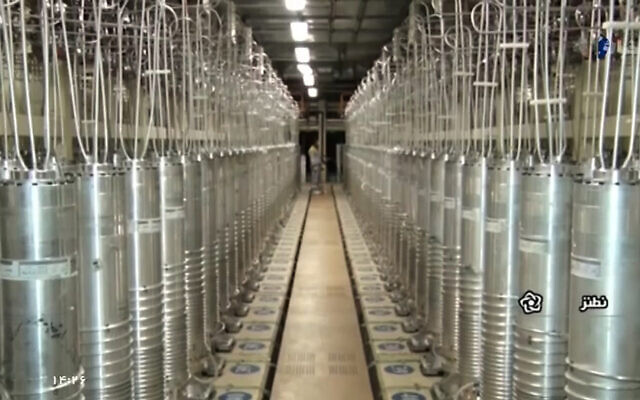
In this image, taken from an April 17, 2021 video released by the state-run TV station Islamic Republic Iran Broadcasting, various centrifuge machines line a hall at the Natanz Uranium Enrichment Facility. (IRIB via AP)

Blinken said that the Biden administration has been engaged “in very good faith for many months” in indirect talks in Vienna with Iran on returning to compliance.

Iran requested a break in talks in June due to a political transition as the ultra-conservative Ebrahim Raisi became president, replacing Hassan Rouhani who entered the nuclear deal and favored better relations with the West.

No date has been set for talks to resume, although Raisi has said that he backs diplomacy to end sanctions and Amirabdollahian has said it will be “soon.”