
Hamas won’t hesitate to strike another war with Israel – analysis

Sunday’s IDF operation dismantled a terror initiative with damage potential similar to the Second Intifada, making Hamas’ intention crystal clear.
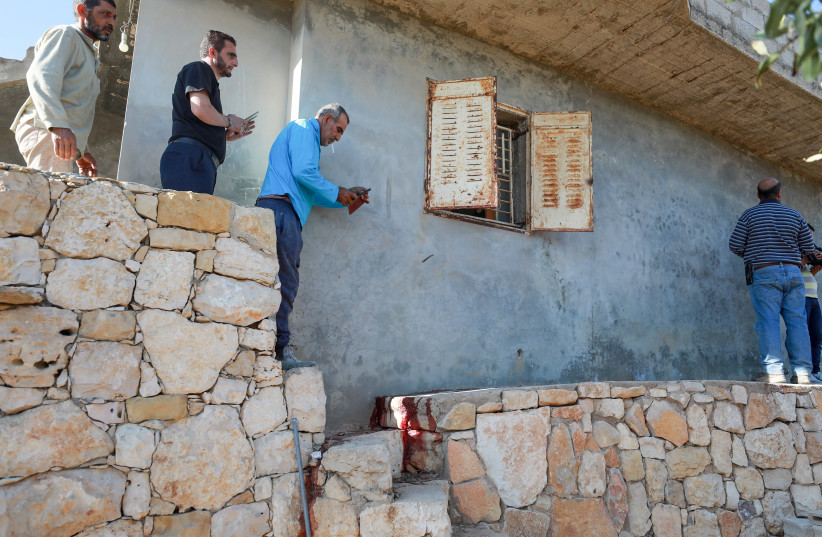
 Palestinians at the site where Palestinian militants killed during a raid of Israeli security forces on a Hamas cell, in the village of Beit 'Anan, Jerusalem, September 26, 2021.  (photo credit: FLASH90)
Palestinians at the site where Palestinian militants killed during a raid of Israeli security forces on a Hamas cell, in the village of Beit ‘Anan, Jerusalem, September 26, 2021.
(photo credit: FLASH90)
The arrest operation on Sunday targeting a dangerous Hamas cell in the West Bank not only stopped a ticking time bomb but showed just how serious the terrorist group is.
Based in the Gaza Strip, Hamas constantly attempts to carry out attacks in the West Bank. But this was on a different level.
The raids, which took place in five different locations in the West Bank, were aimed at dismantling a large decentralized Hamas terror infrastructure that was planning to carry out imminent terror attacks both in Israel and the West Bank.
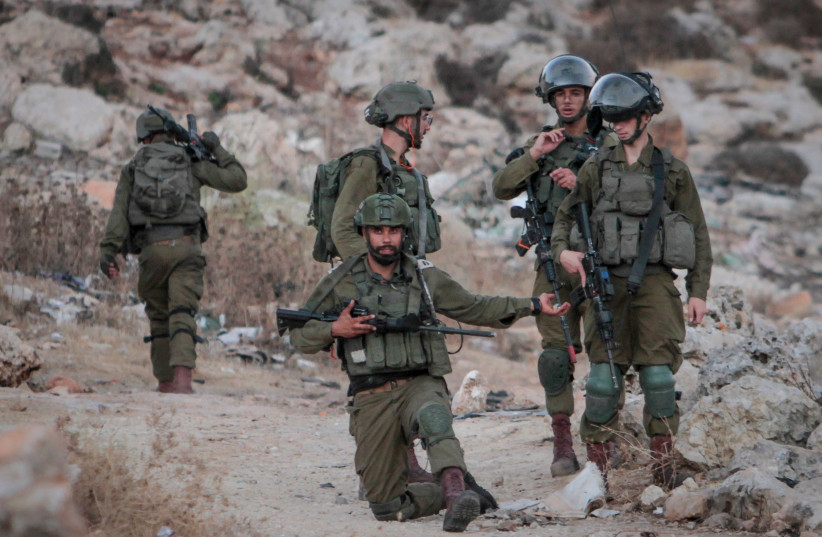
 Palestinians clash with Israeli security forces during a protest in the village of Deir al-Hatab, near Nablus, September 22, 2021.  (credit: NASSER ISHTAYEH/FLASH90)Palestinians clash with Israeli security forces during a protest in the village of Deir al-Hatab, near Nablus, September 22, 2021. (credit: NASSER ISHTAYEH/FLASH90)

The attacks could have been reminiscent of the terror attacks carried out by Hamas and other Palestinian terror groups during the Second Intifada, complete with bombings and the kidnappings of Israeli soldiers and civilians.
According to the military, Israel’s defense establishment had been following the cell closely and acted when the Shin Bet internal security agency received intelligence that they were about to follow through with their plans.
Over 20 operatives belonging to the cell were arrested by security forces as well as five weapons. Additional cell members and their weapons are still believed to be on the loose, with Israel on their trail.
Building the infrastructure’s capabilities must have taken several months, if not more than a year. It meant funneling funds to purchase the weapons and training needed to carry out the attacks.
The funds could have come from the group in Gaza or from Turkey where the group’s number two, Saleh Arouri, calls home.
Arouri the deputy head of Hamas, and one of the founders of its military wing, al-Qassam Brigades, is responsible for several bloody terrorist attacks against Israeli civilians and soldiers, including the 2014 kidnapping and murder of three Israeli teenagers in the West Bank that triggered Operation Protective Edge.
It would not be surprising if Arouri was also behind the cell that was targeted by Israel yesterday.
And it is not hard to imagine that had the cell been successful in carrying out their plans, that Israel could have found itself in another deadly conflict with the terror group, both in the West Bank and the Gaza Strip.
Since Operation Guardian of the Walls and the cancellation of the Palestinian Authority elections, Hamas and Fatah have been fighting for dominance. And ,with armed struggle gaining support following the May conflict, militants are feeling more confident to engage Israeli forces.
Hamas has a strong presence in many villages and cities in the West Bank, and a recent study published by the Palestinian Center for Policy and Survey Research found that 45% of Palestinians believe Hamas should lead and represent them, while only 19% said Palestinian President’s Mahmoud Abbas’ secular Fatah should represent them.
The poll found that 78% of Palestinians want Abbas to resign.
The Hamas cell that was targeted likely also wanted to increase the pressure on Abbas and the ongoing and important security coordination between Israeli security forces and Palestinian Authority security forces (PASF).
Though the PASF have been trained and armed by the United States and other international forces, they have struggled to crack down on Hamas’ activities, due in part to their fear of engaging with Hamas operatives. And due to that fear, the large Hamas cell was able to coalesce right under their noses.
The fact that one of the Palestinians killed during the raids was a member of Palestinian Islamic Jihad (PIJ) shows that the two terror groups cooperate not only in the firing of rockets from the Strip but also in terms of deadly attacks emanating from the West Bank.
The group also showed the Palestinian street that less than six months after Operation Guardian of the Walls, they are ready and willing to drag the IDF into another deadly conflict, both in the Gaza Strip and the West Bank.
Hamas has made it clear that even as they negotiate with Israel to rebuild the destroyed coastal enclave, they have not abandoned the armed struggle against its citizens.


Inspectors reportedly turned away when they try to replace surveillance equipment at Karaj centrifuge assembly facility


The alleged Karaj centrifuge parts plant near Karaj, Iran, seen in a photo posted online by Google user Edward Majnoonian, in May 2019. (Screenshot/Google Maps)

The alleged Karaj centrifuge parts plant near Karaj, Iran, seen in a photo posted online by Google user Edward Majnoonian, in May 2019. (Screenshot/Google Maps)

Iran reportedly denied access to UN inspectors who were seeking to visit the Karaj centrifuge assembly site on Sunday, several months after a sabotage incident at the facility, which Tehran blamed on Israel.

Citing several unnamed sources, the the Wall Street Journal reported that International Atomic Energy Agency (IAEA) inspectors were seeking to replace and fix up cameras at the site as part of a deal struck earlier this month.

Iran is preparing to send a note to the IAEA explaining that the denial of access was due to safety issues at the site and the ongoing collection of forensic evidence there, the report said.

However, the report cast doubt on the response, citing sources as saying that Iran has continued some activities at Karaj, a city about 40 kilometers (25 miles) northwest of Tehran.

The sources predicted that the incident would not lead to a new push for an IAEA resolution against Iran. By agreeing earlier this month to allow inspectors to replace memory cards in surveillance cameras, Iran averted IAEA censure over its refusal to grant inspectors access to sites.

The IAEA board is set to convene Monday for a previously scheduled meeting.

In June, Iran accused Israel of mounting a sabotage attack on the Karaj site, which makes components for machines used to enrich uranium. Without disclosing details, Iranian authorities acknowledged that the alleged strike had damaged the building.

Earlier this month, a confidential IAEA report revealed that the nuclear watchdog found that one surveillance camera was destroyed and a second was severely damaged, after their removal from the centrifuge manufacturing site in Karaj.

Days later, Iran admitted that it had removed several IAEA cameras from the site.

IAEA inspections are a key part of the 2015 nuclear deal struck between Iran and world powers.

The pact, known as the Joint Comprehensive Plan of Action (JCPOA), granted Iran relief from sanctions in return for dismantling parts of its nuclear program to prevent it from obtaining nuclear weapons.

After former United States president Donald Trump pulled out of the deal in 2018 and reapplied crippling sanctions, Iran also dropped some of its own commitments, notably upping its uranium enrichment to levels said to put it within a few months’ grasp of enough material for a weapon.

Iran’s hardline parliament in December approved a bill that would suspend part of UN inspections of its nuclear facilities if European signatories did not provide relief from oil and banking sanctions by February.

The Biden administration has said that it is willing to return to the JCPOA, if Iran first rolls back its recent moves and recommits. But the Vienna talks have been on hold since June, when ultraconservative Ebrahim Raisi was elected as Iran’s president.


German elections have some Jewish officials in the country worried

Under Merkel Israel enjoyed good relations with the German government, but the advent of a new political era has some Jewish officials in the country unnerved.

German President Frank-Walter Steinmeier speaks with a rabbi following a ceremony to complete the historic Sulzbach Torah Scroll from 1792, rediscovered in 2013 and just restored, on the 76th anniversary of the liberation of Nazi Germany's Auschwitz death camp, on International Holocaust Remembrance (photo credit: ODD ANDERSEN/POOL VIA REUTERS)
German President Frank-Walter Steinmeier speaks with a rabbi following a ceremony to complete the historic Sulzbach Torah Scroll from 1792, rediscovered in 2013 and just restored, on the 76th anniversary of the liberation of Nazi Germany’s Auschwitz death camp, on International Holocaust Remembrance
(photo credit: ODD ANDERSEN/POOL VIA REUTERS)
Germans flocked to the polls on Sunday in a historic election that will see longtime Chancellor Angela Merkel replaced after 16 years in office, and the possibility that the balance of power in the country may shift away from her party.
Polling has put Merkel’s successor, Armin Laschet, and her Christian Democratic Union (CDU) party behind its main rival the Social Democratic Party (SPD) led by Olaf Scholz, while the Green Party headed by Annalena Baerbock is likely to play a prominent role however the elections turn out.
During her decade-and-a-half tenure, Merkel has been strongly supportive of Israel, while the Jewish community has grown and flourished during her time in office.
But the advent of a new political era has some Jewish officials in the country unnerved.
Gadi Gronich of the Conference of European Rabbis said that under Merkel Israel enjoyed “excellent relations” with the German government, which he said was Israel’s most dependable partner.
“This probably won’t continue in this manner,” he said, even if Laschet’s CDU party was to emerge as the largest party and he were to win office as chancellor.

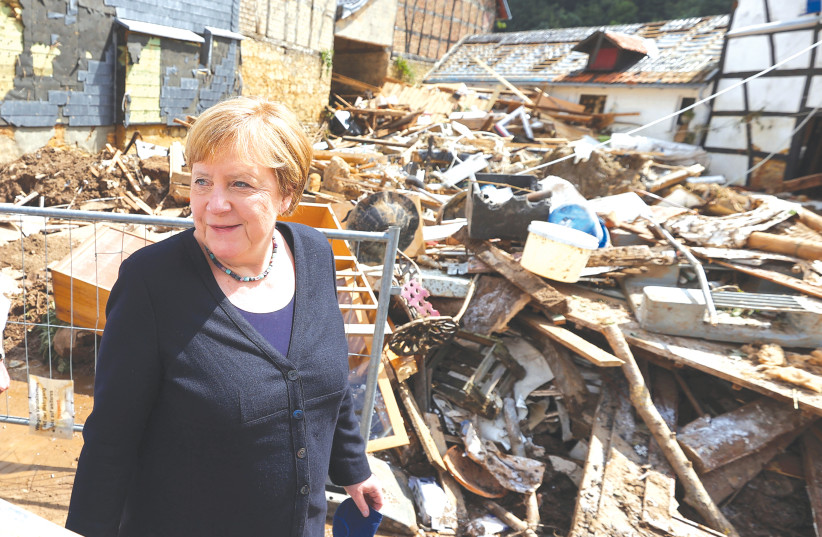
GERMAN CHANCELLOR Angela Merkel visits an area affected by floods caused by heavy rainfalls in Iversheim, a suburb of Bad Muenstereifel, North-Rhine Westphalian state, Germany, yesterday.  (credit: REUTERS)GERMAN CHANCELLOR Angela Merkel visits an area affected by floods caused by heavy rainfalls in Iversheim, a suburb of Bad Muenstereifel, North-Rhine Westphalian state, Germany, yesterday. (credit: REUTERS)

If the SPD becomes the biggest party and Scholz becomes chancellor, this could further reduce the warmth of feelings between the two countries.
Gonich noted that in most likely outcomes of the election, The Greens will enjoy significant power, and may even demand the foreign ministry in order to enter a coalition.
The party is less well disposed to Israel, said Gronich, and Baerbock as German foreign minister could result in more political pressure on Israel from both Germany and the European Union, where Germany is the leading power, alongside France.
“Germany would change from being a partner to Israel to something else,” said Gronich.
He also notes that Laschet himself has had close ties with Ditib, an organization representing Germany’s large population of Muslims of Turkish heritage, which has served as a mouthpiece for Turkish President Recep Tayyip Erdogan’s regime.
In particular, he observes disapprovingly of Ditib’s opposition to policies designed to ensure that imams serving Muslim communities in Germany are trained in Germany, and worries that Laschet might be reluctant to adopt such a stance.
Charlotte Knobloch, the head of the Munich Jewish Council and a former president of the Central Council of Jews in Germany, opines that what matters is not who ends up winning the election but instead how the coalition is formed.
If there is a grand coalition, as has been since 2017 between the CDU and the SPD, then there will be few problems regarding the relationship with Israel and communal issues, including antisemitism, that arise for the German Jewish community.
“If there is a grand coalition with a strong CDU, we can expect much fewer problems, and it wouldn’t matter who the chancellor is,” said Knobloch.
But, she said, if the SPD led a government with a prominent role for The Greens then things might be different.
“We can assume that there will be a change toward Israel and the Middle East, and less supportive back than there was in the past,” said Knobloch.
The same goes for the international Boycott, Divestment and Sanctions campaign against Israel.
“The support we have seen until now will not remain the same in the future if SPD is in power.”
Even on issues of Jewish communal practices, such as shechita (kosher slaughter), and brit milah (religious circumcision), Knobloch says she would be less confident in a government dominated by the SDP and The Greens to fight for Jewish rights on such matters.
Various green parties and others across Europe have advocated for, and in some cases succeeded in securing, policies that ban religious slaughter on animal rights grounds.
And legal challenges have also been made against circumcision as well.
“Things wouldn’t change from one day to the next, but if these issues get raised, the attitude of SPD and the Greens wouldn’t be so warm and embracing as the current government,” said Knobloch.
“If these questions would get raised then there might be a change in attitude. We are not so warmly connected to these parties, and neither is Israel.”
