Hezbollah chief Hassan Nasrallah gives a speech, on August 7, 2021. (Screen capture: Twitter)

Hezbollah chief Hassan Nasrallah gives a speech, on August 7, 2021. (Screen capture: Twitter)

In a televised address, Hezbollah Secretary-General Hassan Nasrallah says that the terror group does not seek escalation with Israel, but will respond in kind to any Israeli air strikes in south Lebanon.

“We wanted to tell our Israeli enemy that any airstrike against Lebanon will absolutely be met with a response — but in an appropriate, proportional way,” Nasrallah says.

Nasrallah delivers his remarks during a speech celebrating Hezbollah’s self-described “victory” in the 2006 war against Israel. The address was scheduled before tensions escalated between Israel and the terror group along the Lebanese border.

Israel struck targets in south Lebanon late Wednesday in response to rocket fire by Palestinian terror groups in the area, according to the Israeli military. The next day, Hezbollah fired missiles towards open areas in northern Israel.

For now, Nasrallah says, Hezbollah’s response has been confined to open military zones in Har Dov, which Lebanese see as occupied territory.

“This is a message that is clear as day: you bombed open areas, so we bombed open areas,” Nasrallah says. “This maintains the existing rules of engagement.”

Nasrallah adds, however, that if Israel continues to conduct airstrikes in Lebanon, Hezbollah may broaden its range of fire.

“Our response could be in the Galilee, or parts of the Lebanese Golan that Israel has occupied. But this will all be considered in due time,” Nasrallah says.

Lebanon has been undergoing a spiraling economic and political crisis in recent months, with some observers warning the ever-fragile state could totally collapse. Nasrallah says, however, that Hezbollah will not allow the domestic political situation to affect its ability to fight Israel.

“We always say — we do not want war. But we are not afraid of it, we are ready for it, and we wait for it each day. And we shall win it, with God’s help, as it is His promise and that of his prophet,” Nasrallah says.


Iran believes it has Israel on the run

Iran is coordinating with Hezbollah, Hamas to target Israel after drone attack on tanker off Oman.

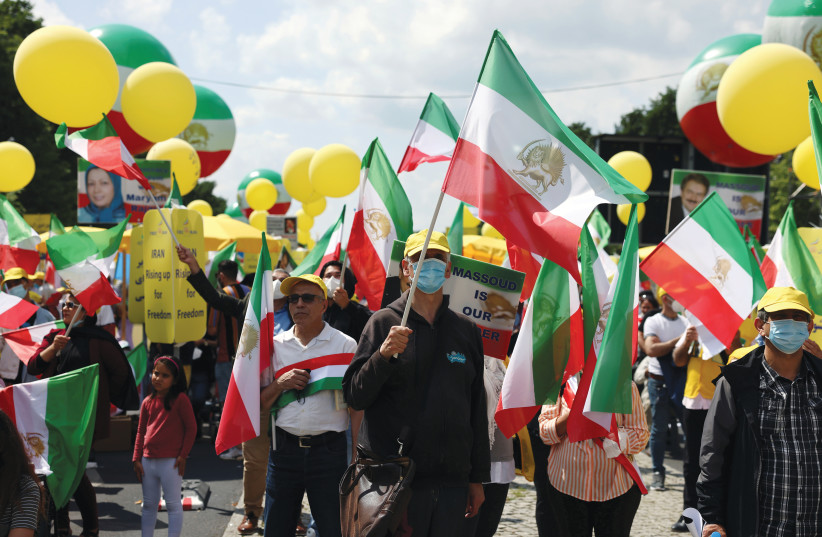
SUPPORTERS OF the National Council of Resistance of Iran gather to protest against the government in Tehran, in front of the Brandenburg Gate in Berlin, last month.  (photo credit: CHRISTIAN MANG / REUTERS)
SUPPORTERS OF the National Council of Resistance of Iran gather to protest against the government in Tehran, in front of the Brandenburg Gate in Berlin, last month.
(photo credit: CHRISTIAN MANG / REUTERS)
Iran believes it has been able to outplay Israel in the last week following Tehran’s drone attack on the Mercer Street ship.
When tensions rose with the US, UK and Israel after the attack, Iran shifted the frontline to Lebanon and Gaza, targeting Israel with rockets last week. When Israel responded, Iranian-backed Hezbollah fired more than 10 rockets from southern Lebanon at Israel on Friday.
What we are seeing is a multi-front conflict in which Tehran shows it can heat up the Lebanon front, the Syrian front, Gaza and areas off the coast of Oman, like playing a piano in which each key is a threat to Israel.
Iran has been messaging about this for a week via media like Al-Alam TV, which claimed that the drone attack on the ship off Oman’s coast was a response to an Israeli airstrike near Qusayr, Syria. Iran’s Press TV also ran an article by Elijah Magnier noting how Iran is now making the commercial sea lanes a quagmire for Israel. He also asked: “Will Israel stop playing and breaking its teeth in the ‘Axis of the Resistance’ playground?”
Tehran says that the “recent clashes between the Zionist regime and the resistance groups indicate a significant weakness and decline in the intelligence capabilities of this regime, which in turn shows the development of the resistance-oriented capabilities in the field of intelligence.”
Iran’s argument is that the “Palestinian resistance” has shown its readiness to strike at Israel. This builds on the view that the Islamic Republic thinks that Hamas won the conflict with Israel in May after it appears to have encouraged the terrorist group controlling the Gaza Strip to strike at the Jewish state with more than 4,000 rockets.
Iran also encouraged Palestinians in Lebanon to fire rockets, and used a drone to fly from Syria into Israel in May, during Operation Guardian of the Walls.
“The internal situation in Lebanon may be the reason for the resistance’s greater readiness for confrontation, not retreat,” Tasnim News says. “One of the issues to be noted in the clashes in southern Lebanon over the past few days, which began with Israeli aggression and Hezbollah missile responses, [shows] once again Israel’s intelligence failure to assess resistance positions to respond to aggression.”
Indeed, Iran says that the “recent clashes between the Zionist regime and the resistance groups indicate a significant weakness and decline in the intelligence capabilities of this regime, which in turn shows the development of the resistance-oriented capabilities in the field of intelligence.”
IRAN NOW admits that there “is a high level of coordination and intelligence cooperation between members of the Axis of Resistance, which was mentioned by the leaders of the Palestinian Hamas and Lebanese Hezbollah movements during the battle,” Tasnim said. This means that these groups have honed their close contacts in recent months.
Palestinian groups and Hezbollah attended the inauguration of Iran’s new president, Ebrahim Raisi. Hamas leader Ismail Haniyeh went to Tehran to meet with Ali Shamkhani, who is the secretary of the Supreme National Security Council of Iran.
He also met Palestinian Islamic Jihad leader Ziyad Nakhalah and Iraqi Popular Mobilization Forces leader Faleh al-Fayadh. Shamkhani told Fayadh that the US withdrawal from Iraq is important.
The point Iran is making is that everything is now linked, even more than in the past, from Gaza to Lebanon, to Syria, Iraq and the Gulf of Oman; Iran has an arc of power and proxies that run several thousand kilometers.
What else is Iran thinking?
It believes that Israel’s power of deterrence has eroded. It noted that Jerusalem carried out airstrikes and artillery strikes in Lebanon for the first time since the 2006 war, saying that Israel “thought that the resistance would not respond or would be content to carry out symbolic attacks to the maximum; but the reality is against the will and imagination of the Israelis.”
Iran says that Israel has relied heavily on intelligence technology that led it to think Hezbollah would not respond. It also says that the Jewish state works closely with countries in the region.
“Recent events have shown that they cannot assess the orientation and positions and thinking of the resistance.”
IRAN HAS assessed that Israel made a mistake in believing Hezbollah was suffering from Lebanon’s economic crisis. “This made the Zionist enemy think of changing the fixed rules of conflict between the Israeli army and the Lebanese resistance since the July 2006 war, which, contrary to the Zionists’ expectations, did not change – and Hezbollah immediately responded with aggression with its missiles.”
Iran predicts that escalation might continue. “The general conclusion that can be reached is that the Zionist enemy can no longer assess the positions and orientations of the resistance in Gaza, Lebanon, Iran and other areas dependent on the Axis of Resistance.
“Accordingly, Israel’s repeated intelligence failures may lead the regime to escalate its aggression under the pretext of trying to change the rules of the conflict in its favor, which will certainly be accompanied by more decisive responses from the resistance.”
This is an important Iranian assessment through its messaging that has been put out through its media. The point Iran is making is that it works closely with Hamas and Hezbollah, and that it used them to distract from the growing condemnation of Iran after the July 30 drone attack on Oman.
It also wanted to test Israel’s responses. Hezbollah had a green light from Iran to fire missiles from Lebanon. Hezbollah caused some controversy by using a Druze village to move missiles via a truck. A Hezbollah member was detained and released. The terrorist group also made it clear it could fire the rockets with impunity but also targeted open spaces in the contested Mount Dov area.
Israel also appeared to communicate that it was willing to de-escalate. What is important from Iran’s view is that Hezbollah took responsibility. Previous incidents like this – such as after the Hezbollah drone team was killed in the fall of 2018 and the July 2020 incident near Mount Dov where the IDF said it foiled a Hezbollah attack – are other instances where Hezbollah sought to show it could confront Israel on equal footing.


Top Three Reports in Biblical Archaeology – July 2021

July was a banner month in biblical archaeology with three significant finds announced, each of which has a good chance of making my year-end top ten list (you can find my list of the top ten discoveries in biblical archaeology for the past five years here: 2020, 2019, 2018, 2017, and 2016). Here were the top three reports in biblical archaeology for July 2021.

3. Magnificent Banquet Hall Discovered Near Western Wall

The remains of a 2000-year-old building discovered beneath the Old City of Jerusalem near the Western Wall. Photo: Yaniv Berman/Israel Antiquities Authority

The Israel Antiquities Authority recently announced the discovery of a lavish structure underneath the Old City of Jerusalem near the Western Wall. Part of the building was noted by British archaeologist, Charles Warren, in the 19th century, but he only penetrated one of the chambers and found it filled with earth. The recently-excavated structure contains two rooms decorated with Corinthian capitals, which protrude from the walls. These rooms are connected by another which once featured a fountain with running water. Based on pottery and Carbon-14 samples taken from the floor, it was constructed ca. 20 AD, and was likely used as a triclinium, or dining room for the upper class on their way to worship. At one time, the rooms would have had wooden sofas running all around the walls, where visitors reclined and ate; the furniture has not survived, but the imprint on the walls where they once were can still be seen. Sometime prior to the destruction of Jerusalem, the fountain was taken out and a mikveh (ritual bath) was added. This structure will soon be open to the public as a new stop on the Western Wall Tunnels Tour, which allows people to visit the ancient city below the modern one.

NEWS LINK: https://www.jpost.com/archaeology/lavish-second-temple-period-building-found-by-western-wall-in-jerusalem-673205

2. Section of Ancient Wall Discovered in Jerusalem

A section of the Iron Age wall recently unearthed in Jerusalem. Photo: Kobi Harati/City of David

A portion of the Iron Age city wall of Jerusalem was recently discovered on the eastern slope of the City of David. It lies between two other sections of the ancient city fortifications: one to the north discovered by Kathleen Kenyon and one to the south unearthed by Yigal Shiloh. It was likely constructed sometime in the 8th century BC, possibly during King Hezekiah’s reign, although archaeologists are awaiting radiocarbon dating to confirm this. The newly excavated sections are 15 ft/5m wide and stand up to 10 ft/3 m high; one part of the wall extends 130ft/40m and another is 10ft/3m long. Other artifacts, including LMLK jar handles, a bulla, and a small Babylonian stamp seal were also discovered nearby. While other sections of Jerusalem’s wall were destroyed by the Babylonians in 586 or 587 BC (depending on one’s chronology), this portion of the city wall may have been spared as it lies on a such a steep slope and would have been difficult to demolish.

NEWS LINK: https://www.haaretz.com/israel-news/MAGAZINE-israeli-archaeologists-find-new-section-of-jerusalem-s-ancient-defensive-wall-1.9998944

1. Biblical Name Jerubbaal Found on Pottery Sherd from the Time of the Judges

This ostracon from Khirbet er-Ra’I bears the name Jerubbaal, the same nickname given to the the biblical judge Gideon. Photo: Dafna Gazit / Israel Antiquities Authority

An ostracon (a pottery sherd with writing) bearing the name Jerubbaal, has been unearthed at Khirbat er-Ra‘I, located near the ancient city of Lachish. Jerubbaal (“Let Baal contend against him”) was the nickname that Gideon was given after he destroyed the altar of Baal (Judges 6:32). The ostracon dates to the 12th-11th century BC based on typology and radiocarbon dating from organic samples taken from the same archaeological layer in which it was found. The name Jerubbaal is only ever used for Gideon in the Bible, and this is the first discovery of it in an archaeological context. Due to the uniqueness and rarity of the name, some scholars believe this to be a reference to Gideon. Others have urged caution, noting that is impossible to know for certain if this inscription refers to the biblical judge without more information (ie. father’s name, title, or epithet). Regardless, this discovery is significant in that it affirms the name Jerubbaal was used during the time the Bible describes.

NEWS LINK: https://www.timesofisrael.com/five-letter-inscription-inked-3100-years-ago-may-be-name-of-biblical-judge/