Putin believes that Washington is not in favor of the Israeli strikes on Syria, paving the way for Russia to publicly voice its opposition.

By Lauren Marcus, World Israel News

Russia’s Defense Ministry issued rare public statements celebrating the success of Syria’s air defense system against missiles fired by the Israeli Air Force last week, marking a shift in how Russia will respond to Israeli aerial strikes against Iranian-backed sites in Syria.

London-based Arabic newspaper Asharq Al-Awsat reported that Russia is taking a more aggressive stance against Israeli air strikes, with a source telling the outlet that U.S. President Joe Biden is not supportive of Israel’s military actions.

According to the source, Russian President Vladimir Putin believes that Washington is not in favor of the Israeli strikes, paving the way for Russia to publicly voice their opposition.

Russia has provided Syria with advanced missile defense systems, the source said, citing “7 out of 8 missiles” launched by the Israeli Air Force, which Russian media reported were successfully shot down in early July.

Putin has “run out of patience” with the Israeli strikes, the source added.

Last week, Vadim Kolet, deputy head of the Russian Reconciliation Center in Syria, said that missile defense systems gifted to Syria from Moscow had intercepted and destroyed IAF-launched missiles.

“Two F-16 fighter jets of the Israeli Air Force made a strike with four guided missiles on facilities in Homs province from the airspace of Lebanon,” Kolet told Russian state-owned news service Tass.

“All four missiles were destroyed by the Syrian duty air defense facilities, with the use of Buk-2ME systems of Russian manufacturing.”

Syria’s foreign ministry asked the UN and the international community to condemn the Israeli strikes, arguing that they are a violation of the country’s sovereignty.

“The Syrian Arab Republic has repeatedly called on the Security Council to condemn the repeated Israeli attacks on its…territorial integrity and to take firm and immediate measures to suppress these attacks and hold Israel accountable for them,” the ministry said in a statement.

“[Syria] has reiterated its warning to Israel of the dangerous repercussions of its continuous attacks and holds it fully responsible for them,” the statement continued.

Since the onset of the Syrian civil war in 2011, Israel has carried out hundreds of airstrikes in the country.

Most of the attacks have targeted Iran-backed terror and intelligence-gathering sites.


Govt. faces major diplomatic tests – analysis

The test case in this category is Russia. Moscow wields enormous influence in the region and is parked squarely on Israel’s doorstep in Syria, where for the last six years it has propped up.

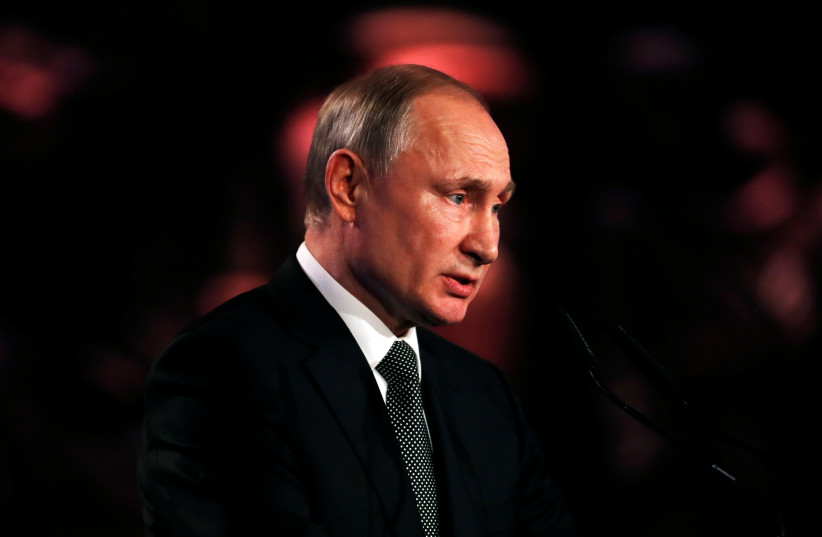
Russian President Vladimir Putin speaks at the World Holocaust Forum marking 75 years since the liberation of the Nazi extermination camp Auschwitz, at Yad Vashem Holocaust memorial centre in Jerusalem January 23, 2020 (photo credit: REUTERS/Ronen Zvulun)
Russian President Vladimir Putin speaks at the World Holocaust Forum marking 75 years since the liberation of the Nazi extermination camp Auschwitz, at Yad Vashem Holocaust memorial centre in Jerusalem January 23, 2020
(photo credit: REUTERS/Ronen Zvulun)
Much has been written since Prime Minister Naftali Bennett and Foreign Minister Yair Lapid came to power six weeks ago about how a new government presents a golden opportunity to reset Israel’s relations with some key partners around the world.

First and foremost is the relationship with the US Democratic Party, a relationship that suffered during the 12 years of prime minister Benjamin Netanyahu’s rule. Then there were the ties with the American progressives, and with liberal American Jews.
The signal coming from Jerusalem was that this government was different than the previous one, that it would not confront the Biden administration frontally on Iran, that it was open to trying to build a more productive relationship with the Palestinian Authority in Ramallah, and – for American Jewry – that it was keen on trying to make them feel more positive about, and more welcome in, Israel.
Bennett and Lapid also moved swiftly to turn a new page in Israel’s relationship with Jordan, with Bennett having already met King Abdullah and Lapid having already visited his Jordanian counterpart, Ayman Safadi. Furthermore, Lapid already went to Brussels to try and re-boot ties with the European Union.  The perception he tried to convey was that of an Israel that  Paris, Berlin and Copenhagen – not only Bucharest, Budapest and Vienna – could feel comfortable with.
A reboot is good when it comes to relations with countries with whom there were points of friction and tension under the previous government.  But what about those countries and leaders with whom Netanyahu seemed to have cultivated excellent relations?  What happens to ties with those countries under the new government?
The test case in this category is Russia.
Love Russian President Vladimir Putin or hate him, Moscow wields enormous influence in the region and is parked squarely on Israel’s doorstep in Syria, where for the last six years it has propped up  Syrian President Bashar Assad’s vicious regime.
Soon after Moscow became directly involved in the fighting in Syria in September 2015 to prevent the loss of its ally Assad, Netanyahu moved to create deconfliction mechanisms that would prevent any direct confrontation between Russian and Israeli forces over Syria.
And, for the most part, this worked. Not only did the two countries create mechanisms to prevent crisis, but they also came to a tacit agreement whereby they both recognized the interests of the other in Syria, and tried not to harm those interests.
What did that mean? It meant that Moscow’s main interest was in the survival of Assad, and that Israel – in its military actions in Syria – would refrain from hitting sites or assets that would lead to the toppling of Assad.
And on the flip side it meant that Russia understood that Israel’s vital interest was in preventing Iran and its Hizbullah proxy from entrenching itself on Israel’s border, or transferring game-changing weapons through Syria to Lebanon, and that when Israel hit targets related to those aims, Russia would not interfere.
This is why Israel has been able to act with relative impunity in Syrian airspace without the Russians stopping them over the last six years.
Part of this arrangement is attributable to the close relationship that Netanyahu developed with Putin, the leader he met with and spoke with on the phone more often than any other leader during his time in office.  This close working relationship also resulted in Putin making clear before each of the last four elections – both in word and in action – that Netanyahu was his preferred candidate.
The counterargument to Netanyahu’s frequent boast about his good ties with Putin and how strategically significant this was for Israel was that relations are between states, not leaders, and that as good as the relationship between Netanyahu and Putin might have been, it was really about interests. According to this line of reasoning, no matter who leads Israel, it is in the interest of both countries to cooperate regarding Syria.
If recent reports are to be believed, this premise will now be put to the  test as the London-based Asharq Al-Awsat cited a Russian official saying that Moscow has “run out of patience” with Israeli action in Syria and would supply Assad with better air defense systems. Last week a senior Russian security official was quoted as saying that Syrian air defense shot down seven of eight missiles launched by Israel toward targets in Syria.
If all, or even some of that is true, it is a significant development that may force Jerusalem to rethink its Syria policy and how to keep the Iranians from entrenching there.  This will test Bennett and Lapid’s argument that anything Netanyahu can do, they can do better, and that relationships are between countries, not leaders.
Reinstating the modus operandi that existed over the last 6 years with Russia in Syria needs now to be a major foreign policy aim of this government – no less than improving ties with the Democratic Party or the EU — and is a major diplomatic test this government is now facing.
Another crisis is shaping up over the Pegasus software from the Israeli firm NSO that is at the center of a storm because the terrorist-tracking software was allegedly used by some governments to hack into the phones of human rights activists, journalists, and politicians.
One of those politicians was French President Emmanuel Macron, who called Bennett about the matter over the weekend to discuss it with him and make sure, according to various reports,  that Israel was looking into it and taking it seriously.
Numerous questions are being asked regarding the export licenses provided to the firm enabling it to export the powerful spyware.  Bennett, according to Channel 12, said that the issue was being investigated, the necessary conclusions will be drawn, and that the events under question took place before his government took power.
Unlike the situation with Russia, where no Israeli politician had a better relationship with Putin than Netanyahu, with Macron it is Lapid who has developed a good personal relationship. This was evident in April 2019, before the first of Israel’s recent four-elections cycle when Macron invited Lapid to France just four days before the election, in a move widely viewed as a way to counterbalance the pre-election gestures that both Putin and US President Donald Trump showered on Netanyahu. With France it is Lapid who has a personal relationship with the country’s leader that could help soften something that has the potential of ballooning into a full-blown crisis.
A potentially game-changing situation with Russia in Syria, as well as how the government deals with the NSO scandal,  will be good early indicators of how Bennett and Lapid — just six weeks in power — stack up against  Netanyahu in being able to navigate through choppy international waters.


Is Russia sending a message to Israel or to the US, or is someone else trying to create controversy? What is the goal of Iran here – or the Syrian regime or other regional powers?

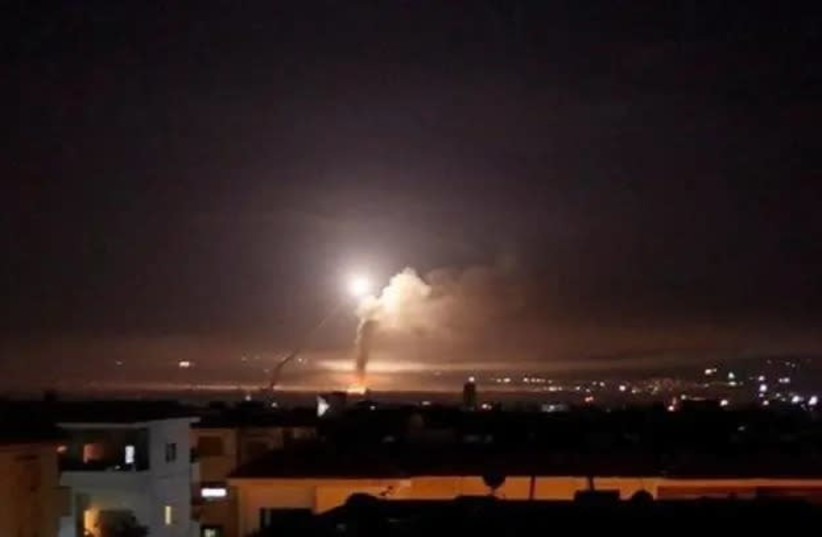
Attack in Syria on August 25, 2019. (photo credit: ARAB MEDIA)
Attack in Syria on August 25, 2019.
(photo credit: ARAB MEDIA)
Russia could be moving to pressure Israel to stop airstrikes in Syria. These reports began to surface this weekend, beginning with an article at the London-based Asharq Al-Awsat that cited a “well-informed” Russian source. The report was reported in Turkey and other media in the region with interest. According to these reports, Russia might even strengthen the Syrian regime’s air defenses.

What do the reports say? The Arabic media report in London says that the Russian sources have hinted at the possibility of “closing Syrian airspace” to Israeli planes. This comes in response to allegations that Israel has “intensified their raids in the past two days against Iranian and Hezbollah sites in northern and central Syria.” The report says Russia released two statements in the wake of a raid “targeting a research center in the countryside of Aleppo, and the other on a site for Iranian forces to be stationed in Al-Qusayr, near Homs.”
The source told the Arabic website that “this is directly related to the talks that were launched with the United States following the first summit that brought together presidents Vladimir Putin and Joe Biden last month,” and that “Moscow was calculating its reactions in the past because Tel Aviv [Jerusalem] is coordinating all its movements with Washington, while the Russian communication channels with Washington were cut off – and it appeared, from the current contacts with the American side, that Moscow obtained confirmation that Washington does not welcome the continuous Israeli raids.”

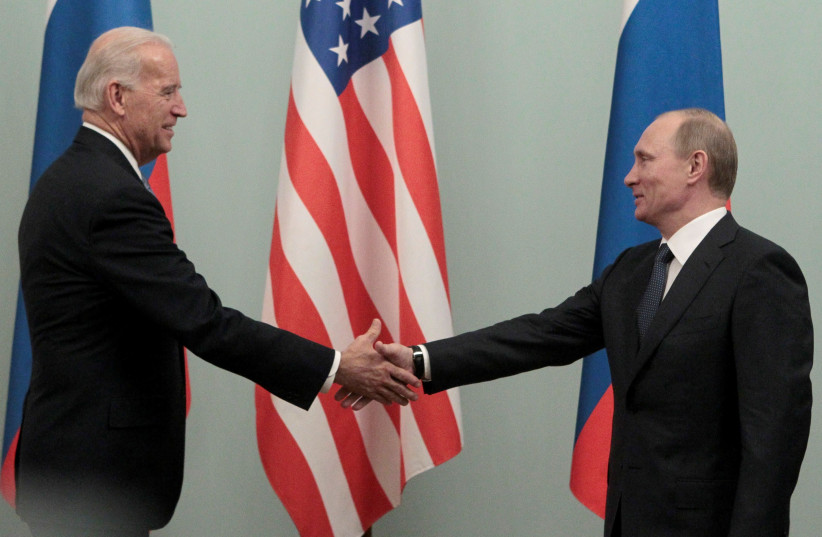
Russian Prime Minister Vladimir Putin (R) shakes hands with then US Vice President Joe Biden during their meeting in Moscow March 10, 2011. (photo credit: REUTERS/ALEXANDER NATRUSKIN/FILE PHOTO)Russian Prime Minister Vladimir Putin (R) shakes hands with then US Vice President Joe Biden during their meeting in Moscow March 10, 2011. (photo credit: REUTERS/ALEXANDER NATRUSKIN/FILE PHOTO)

THIS IS a complex puzzle. “The Israelis felt that the air defenses in Syria had been activated, and the fact that practically all the launched missiles had been destroyed, indicates a fundamental change in the mechanisms for dealing with this file – and that Israel’s aviation has not since entered the Syrian airspace, and is carrying out attacks from the ground.” Russia supposedly provided the Syrian regime with “modern air defense.”
The source went on to claim that Russia’s demands might involve closing off “all possible targets” inside Syria. The author notes that in the past, Moscow didn’t object to attacks on Iranian targets in Syria. It has “run out of patience,” the article says, but then also quotes the Russians as saying they are actually not impatient. This hints that high-level talks with the US have some impact on the issue of staying silent about Israeli airstrikes.

But it is not clear from the article what is really going on. Why would Moscow reveal to a newspaper that it heard the US does not “welcome the continuous Israeli raids”?

This “impression left space for Russia to act more freely in supporting Assad forces in Syria with more advanced anti-missile systems and know-how, to make them more capable of shooting down Israeli armaments.” Turkish media noted “Israel has been targeting Iran-linked military targets in the war-torn country’s regime-held areas with airstrikes without entirely acknowledging doing so. The Israeli strikes have also been repeatedly criticized by the Syrian regime ally Russia.”

Meanwhile, the reports said that Russian Foreign Minister Sergey Lavrov had asked Israel to provide Russia with information on any Iranian threats in Syria so that it could deal with them. “If Israel is really forced to respond to threats to Israeli security coming from the Syrian territory, we have told our Israeli colleagues many times: If you see such threats, please give us the information,” Lavrov was cited as saying at the time by Russia’s Sputnik media.

Add to this a third detail noting that airstrikes carried out earlier this year “were carried out with intelligence provided by the US, a senior American intelligence official told The Associated Press (AP).”
THIS LEAVES many questions. Is Russia sending a message to Israel or to the US, or is someone else trying to create controversy between Russia and Israel? What is the goal of Iran here – or the Syrian regime or other powers in the region?

It is known that Gulf countries, as well as Egypt, Iraq and Jordan, likely want the Syrian regime to be stabilized and stronger so that it can rejoin the network of Arab states in the region, after having been kept out in the cold since 2011’s Arab Spring. In short, there are many interests to see Syria return as a normalized state and thus the free-for-all of airstrikes by various countries in the beleaguered country may end. This would include a desire to see the US and Israel reduce airstrikes, and also have Turkey stop destabilizing northern Syria.

It would also likely mean wanting Iran to stop its entrenchment. Tehran may have reduced forces in Syria slightly in recent years. However, Iran has a network of facilities, such as Imam Ali base near the Iraq border and T-4 base. It also backs militias, and Hezbollah has been operating freely in Syria.

The other interesting messaging here relates to Moscow’s apparent view that the US also may be shifting its views on the airstrikes. It was widely reported in January that the US was backing Israeli airstrikes in Syria. The reports that the US wanted to work more closely with Israel in Syria date from the period of the Trump administration and were tied to key figures in the US administration who appeared to approve of Israel’s policies in Syria, including Mike Pompeo, John Bolton and US envoy James Jeffrey.

The key here is that the US saw Israel’s “war between wars” campaign, designed to prevent Iran’s entrenchment in Syria and its weapon trafficking to Hezbollah, as important for US policy. In years past it was reported that Iran moved ballistic missiles to pro-Iran militias in Iraq and drones to Syria that threaten Israel – and that it sought to move precision-guided munitions to Hezbollah. Iran also tried to move the 3rd Khordad air defense system to Syria in April 2018.

THERE HAVE been tensions before. Syria shot down a Russian military plane in September 2018, mistaking it for an Israeli jet. This angered Moscow; Jerusalem sent officials to discuss the crisis. Russia at the time hinted it would send Syria the S-300 air defense system. There were also reports then that Russia would try to keep Iranian forces away from the Golan as the Syrian regime retook areas near the heights. Hezbollah did set up sites near the Golan, however, and sought to launch drones against Israel in August 2019.
The tensions with Syria have also led to other incidents, such as errant Syrian air-defense missiles being fired wildly – one landed in the Negev in April, and in 2017, Syria fired an S-200 at Israeli planes that flew over Jordan. In November 2019, Moscow revealed alleged Israeli airstrikes, claiming Israel flew over Jordan during a strike on Syria. In January 2019 and February 2020, Russia also expressed concern to Israel about airstrikes in Syria.
In light of all this, the reports on July 24 about Russian views on Israeli airstrikes in Syria could either reflect a policy change, or more of the same rhetoric as in the past. It could also be messaging to the US and Iran. Pro-Iran militias are increasingly operating in Syria, and acquiring land and basing. A member of the Fatemiyoun Brigade, a unit of Afghan Shi’ite fighters that works with Iran in Syria, was reportedly killed in recent airstrikes, according to Al-Hadath. Iran has been relatively quiet about this, but pro-Iranian militias in Iraq have been upping threats to the US and its forces in Iraq and Syria.

This could all be tied together. In the past, pro-Iran militias in Iraq have accused Israel of airstrikes, illustrating that the issue of airstrikes in Syria or the “war between wars” campaign is not just about Iran’s role in Syria, but Iran’s role in the wider region.