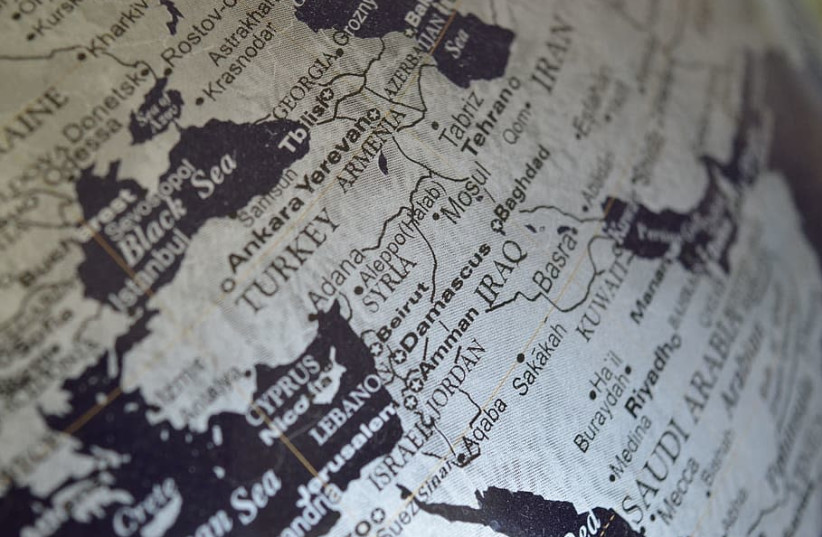
An article in Iranian media looked to a Russian political analyst to understand how Russia might aid Iran in its own ambitions in the region. “The main goal of the United States in the Middle East and Central Asia at the moment is to create problems for strong political and economic partnerships,” the article notes.
Iran’s media frequently has long interviews when it is trying to project its own beliefs through the interviewed expert. This interview should be seen in that light. The goal of the interview was to shed light on how the US was seeking partners in Central Asia, and what Russia,
China and Iran might do about it.
The US is leaving Afghanistan so America’s adversaries sense this is the time to unite. “Russia has supported the construction of the Uzbek-Afghanistan-Pakistan railway (Mazar-e-Sharif-Kabul-Peshawar), which is seen as a competitor and alternative to the North-South international transport corridor, in which Iran and Russia also participate,” the article notes.
In the analyst’s view Russia must be involved in a trans-Afghan transport corridor. “That is why Russia has been invited to join the consortium to build this corridor.” These are not competing corridors but complement each other.
“Providing Uzbekistan access to the sea is a good goal , but ongoing instability in Afghanistan, including civilian casualties, does not currently allow all sides to talk about the sea and peaceful trade.” Uzbekistan has traditionally been close to the US.
The article says that Uzbekistan, Afghanistan and Pakistan are not known to be opposed to Moscow. The article notes “the need to strengthen Russia’s cooperation with China against the United States.”
The analyst discusses the US initiative called the “New Silk Road” which was proposed in 2011. It notes this was a competing concept with China’s “Belt and Road” concept. Russia thinks the two projects seek opposite goals and views one of the projects as linked to former US Secretary of State Hilary Clinton.
Meanwhile China was seeking to connect itself to partners and bridge gaps in Central and South Asia. “So Washington decided to seize the idea of a political superstructure by making claims of creating a continental-Eurasian counterweight to [China’s] ‘one belt-one road’.”
The article notes that under US President Donald Trump the “bizarre” behavior of Trump led the US to walk away from the Trans Pacific Partnership. “In any case, the United States is determined to disrupt a strong political and economic partnership between China and its Eurasian partners across the continent, which the new [US] president will pursue more seriously.”
Moscow and Beijing want to work together to thwart this. “Despite the existing statements and achievements, this important and big trend is still in its early stages.” Russia is also growing closer to Pakistan, despite years of difficulty in the Soviet era. “Pakistan is becoming a very interesting regional and even transcontinental partner due to its comprehensive potential.”
Russia wants stability in Afghanistan and Pakistan can play a role. “Given Pakistan’s crucial position not only on the region’s political map, but also as the center of convergence and intersection of the New Silk Road and Silk Road Economic Belt projects, Moscow’s approach will be both tactical and strategic.”
What about the new 25-year deal between
Iran and China? The analyst notes that “the strategic agreement between Iran and China has significantly shaken the world….Surprisingly, sociological polls in Russia in 2010 showed that Russian respondents rated China as the number one enemy among the rest of the world.
But after the important events of 2014, the process of rapid rapprochement between Moscow and Beijing began, which is not limited to the economic sphere.” A real alliance could form that would be a concern for the West. “But given the growth of global processes, it is time for words to become a reality for the West to take such alliances seriously. It is in this way that the West’s practical efforts to prevent the functioning of these alliances will take shape.”
However, East and West are not yet fully polarized, the article notes. “Iran communicates with China by land, sea and sea. The United States will try to block all routes, especially by sea, creating problems in the South China Sea and the Straits of Malacca.” The withdrawal of US troops from Afghanistan is important, the article notes. “Some of these forces may be transferred to Tajikistan, for example, while other options for deploying them in the region are being discussed….Some information is currently leaking from various sources, including from a Chinese embassy staffer in Dushanbe [Tajikistan] that ‘the United States will try to establish a presence in Tajikistan and apparently did not realize that such a move…It will mean challenging not only Moscow but also Beijing, and it will not go unanswered.’”
Russia and Iran are concerned about terror groups in Afghanistan. Will the US move forces to Tajikistan? The article also looks at Kyrgyzstan, “which is in a complicated and endless process of determining its internal situation, and Mongolia are somehow in a corner where all these important areas are for the creation of new Eurasian routes and for the disruption of connections that are likely to take shape.” The article argues for more attention for Mongolia. “There is currently no country in Central Asia that can openly oppose the interests of Iran and China.”
What about military transport routes connecting Kazakhstan-Uzbekistan-Afghanistan at the request of the United States, the article asks. “If the situation worsens, they will inevitably run counter to the interests of Iran and China.”
Another issue touched upon in the article is something called the Uzbekistan-Turkmenistan-Iran-Oman International Transport and Transit Corridor (Ashgabat Agreement) as well as Iran-Afghanistan-Uzbekistan and Kyrgyzstan-Tajikistan-Afghanistan-Iran Road Corridors, which “are the most important routes of mutual access and cooperation between Iran and Central Asia and are of considerable importance in the field of strategic partnership between Iran and China.”
The article notes that controversy between Turkmenistan’s policies toward Iran and Tajikistan have slowed application of these agreements. “Can such actions of Turkmenistan be considered in line with US efforts to prevent projects in Central Asia.”
The analyst argues that “Turkmenistan’s isolationism is internal, but when it comes to a large group of countries in the region and their strategic future, it must somehow move beyond formal neutrality….The Eurasian Economic Union is also a channel of communication between Iran and China.”
The expert suggests special attention be given to “complex relations between Turkmenistan and Tajikistan” as the US leaves Afghanistan. The article notes that while Trump bragged of dropped a MOAB bomb on terrorists in Afghanistan, US President Joe Biden is more “cunning.”
This sounds like a compliment coming from Iran. “Turkmenistan is not a very important target for the United States. In any case, Turkmenistan needs to get out of its ‘cocoon’ of neutrality and think seriously about Eurasian cooperation.”
Meanwhile trade from Iran to Central Asia has declined due to actions of the West. “The United States will try to block Iran’s cooperation with Central Asian countries. This goal becomes closer to reality when the interactions of the countries in the region with the United States become more serious. Kazakhstan and Uzbekistan, for example, operate in a single logistics chain with Afghanistan,” the expert argues. “The US problem is that Iran is in fact present at the same time on several platforms, from the Persian Gulf and Oman to the South Caucasus , the Caspian Sea and Central Asia. So it is very difficult to block this whole large area. That is why the United States has not yet found a ‘suitable’ option for a faster impact on Iran.”
The article then brings up the Shanghai Cooperation Organization and the Collective Security Treaty Organization, two organizations that are important because in 2019 those who attended meetings of them argued for a multi-polar world to balance the US.
The expert says “Iran’s future depends directly on the future of China and Russia, and especially their relationship.” He argues that the EU is now a “puppet” of the US and is powerless. “Certainly structures like the Shanghai Cooperation Organization and the BRICS are good, but they are declaring their activities rather than taking real action. More precisely, these organizations do not see direct and joint efforts to resist Western pressures.”
Particularly interesting, the expert says “our countries rely heavily on the establishment of formal institutions that are largely devoid of lively and effective thinking. In addition, there are many internal concerns in each of these organizations. For example, some experts believe that the SCO is a Chinese structure and therefore should not be overdeveloped.”
Who else is dabbling in Central Asia. South Korea, Turkey, the UAE and Israel have the most relations with Central Asian countries, the article notes. The expert replies: “The countries you mentioned are at the top of this conditional list and are unlikely to act without US consent. In addition, when they prepare their projects with Central Asian countries, they put obstruction in the interests of Iran on the agenda…It seems that Turkey has been trying to get out of this situation to some extent in recent years. But this is only because ‘Ankara’ tried to take advantage of Trump’s presidency, [because Trump] was not originally a politician.”
This very interesting comment, toward the end of the article reveals how Russia and Iran view Trump. Russia believes, according to this analyst, that Trump set back US interests in Central Asia and that Turkey took advantage of Trump. Ankara knows this because it bulled the US to leave part of Syria and attacked US partners, held a US pastor hostage and did other actions against the US, often threatening US allies and exporting chaos.
The article notes that Turkey is thus leaving the western orbit and had only momentarily sought to work with Trump. But, the article cautions that Turkey is still in NATO and that “we must also remember how the United States led the country to the war in Syria in 2013.” Turkey has also strengthened its influence over Central Asia through Azerbaijan and the recent Nagorna-Karabkah war. This could narrow Iran’s role in Central Asia, depending on how Iran uses the “mentioned tools,” and if Iran plays its card right then “everything can change,” the article notes.