
Prime Minister Benjamin Netanyahu is expected to be replaced in twelve days following the announcement of a new coalition government; The primary coalition consists of Naftali Bennett, Yair Lapid, and Mansour Abbas.

Wednesday evening marked the beginning of what is going to be a new era for the Jewish state following the announcement from Yair Lapid of a new coalition government, ousting Prime Minister Benjamin Netanyahu in less than two weeks. Netanyahu has been serving as Israel’s prime minister since 2009 and served one term from 1996-1999. Netanyahu has been known for his conservative, nationalist stance.

After Netanyahu failed to form a government in the 28 allotted days, President Rivlin handed the mandate over to Netanyahu’s primary opponent, Yair Lapid, of the Yesh Atid party. As of Wednesday, Yair Lapid informed the president that he was able to form a coalition government consisting of his party, Yamina, Ra’am, and others. It was the first coalition agreement ever to be signed by an Arab party.

Lapid reportedly told the president, “I commit to you, Mr. President, that this government will work to serve all the citizens of Israel including those who aren’t members of it, will respect those who oppose it, and do everything in its power to unite all parts of Israeli society.”

Abbas, representing the Arab party, said, “The decision was hard, and there were several disputes, but it was important to reach agreements.”

While there were several details involved in the multiple negotiations, at the end of the day, the chief goal was to remove Netanyahu from power – something the other parties have been determined to do for years.

Though one side of the spectrum might be celebrating, there are unquestionably those with great concern regarding the nation’s safety with Netanyahu no longer at the helm, especially in light of Iran’s ever-growing aggression.

In 2015, former US President Barack Obama set a precedent when he pushed for and signed the deal with the Islamic Republic. It caused a reordering of the balance of power in the region.

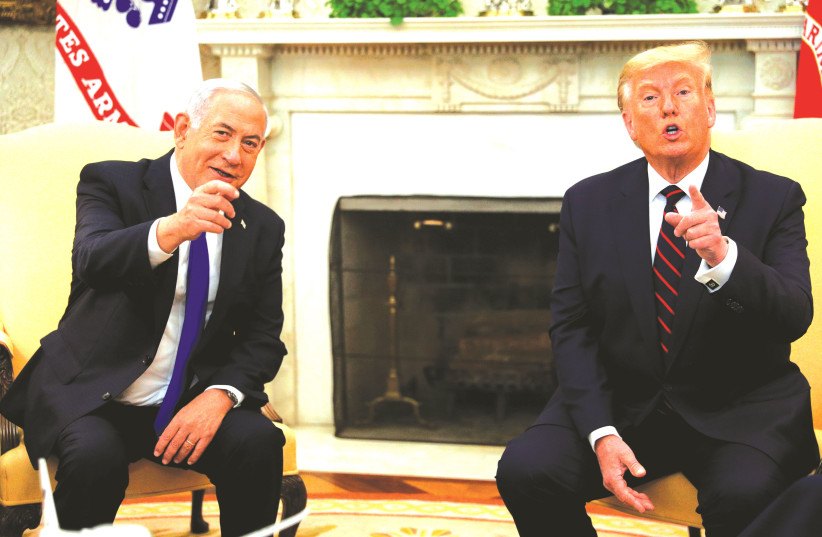
RIME MINISTER Benjamin Netanyahu meets with President Donald Trump at the White House in Washington, DC, in September. (photo credit: TOM BRENNER/REUTERS)
RIME MINISTER Benjamin Netanyahu meets with President Donald Trump at the White House in Washington, DC, in September.
(photo credit: TOM BRENNER/REUTERS)
The cementing of a coalition deal between Naftali Bennett and Yair Lapid not only appears to herald the end of Benjamin Netanyahu’s prime ministerial reign, for now, at least, it also removes the last major thorn in the side of the parties seeking a return to the Joint Comprehensive Plan of Action (JCPOA), the Iran nuclear agreement.

In 2015, former US President Barack Obama set a precedent when he pushed for and signed the deal with the Islamic Republic. It caused a reordering of the balance of power in the region.

Cooperation, or at least detente, with Iran was in, the importance of the Saudi Arabia-Gulf states alliance was diminished, and Israel’s options to act against Tehran were restricted.

There were many twists and turns, but the next major turning point came in May 2018 when former US President Donald Trump pulled the US out of the JCPOA, and once again, the ground rules shifted.

The ayatollahs were more isolated than ever, a window opened for the formulation of the Abraham Accords, and this brought with it security cooperation that allowed Jerusalem to covertly hit Iran on a nearly unprecedented scale. The change was engineered by many, but the two most prominent actors were Trump and Netanyahu.

Trump was voted out in November and Joe Biden took over in the White House in January and now, assuming the Bennett-Lapid coalition gains the confidence of the Knesset next week, Netanyahu will be gone too.

The Gulf states still oppose a return to the JCPOA and a Bennett-Lapid government, notably Benny Gantz as defense minister and Gideon Saar as one of the new administration’s policy architects, will also have issues with such a return.

But Gantz, Saar and Lapid are all on record as slamming Netanyahu for opposing the US’s policy of returning to the JCPOA. It is still unclear what will be Bennett’s position.

But even if Bennett feels the same as Netanyahu, he will be prime minister of a new government where he is in the ideological minority and he will have to consider the attitudes of Gantz, Saar and Lapid on defense issues far more than Netanyahu did with his ministers.

No doubt, a new Bennett-Lapid government will communicate its concerns to the US about holes in the JCPOA, something that Gantz may even be doing on Thursday in his meetings in Washington.

Some also think that Iran’s Supreme Leader, Ayatollah Ali Khamenei, has himself not yet made a final decision whether he wants to return to the deal.

But the most likely scenario is that there will be a return to the JCPOA in the coming weeks, quite possibly before the June 24 deadline when without a deal, IAEA inspections will end.

Some will see this as a defeat because Netanyahu knew how to translate his own public criticism of the JCPOA into some gains in talks with the US and among Gulf states.

Some may consider this as a positive move, because US-Israel relations may be less rocky if Israel’s leaders make their concerns known behind closed doors.

Of course, the JCPOA would probably have gone ahead even with Netanyahu in office, but with him and Trump out of the way, a return to the deal appears far more likely, and if it is sealed, it will have a major influence on regional actors’ behavior, including what Israel will be able to do to counter Iran’s nuclear ambitions.


Massive fire breaks out at oil refinery near Iran’s capital

Unclear if there are injuries in blaze, which firefighters believe struck a pipeline for liquefied petroleum gas at the facility


A picture taken on June 2, 2021, shows smoke billowing from the site of a refinery fire in the Iranian capital Tehran. (ATTA KENARE / AFP)

A picture taken on June 2, 2021, shows smoke billowing from the site of a refinery fire in the Iranian capital Tehran. (ATTA KENARE / AFP)

TEHRAN, Iran — A massive fire broke out Wednesday night at the oil refinery serving Iran’s capital, sending thick plumes of black smoke over Tehran. It wasn’t immediately clear if there were injuries.

The fire struck the state-owned Tondgooyan Petrochemical Co. to the south of Tehran, said Mansour Darajati, the director-general of the capital’s crisis management team.

Firefighters believe it struck a pipeline for liquefied petroleum gas at the facility, Darajati told Iranian state television. He did not elaborate.

Associated Press journalists in central Tehran, some 20 kilometers (12.5 miles) away, could see the black smoke rise in the distance. Another AP journalist saw flames shooting into the sky from the site.

A picture taken on June 2, 2021, shows smoke billowing from the site of a refinery fire in the Iranian capital Tehran. (ATTA KENARE / AFP)

Mojtaba Khaledi, the spokesman for Iran’s emergency department, told the semiofficial ISNA news agency that 10 ambulances and other equipment had been deployed at the scene of the fire. Hospitals in the area are on standby as well, he said.

It wasn’t immediately clear what started the blaze. Temperatures in Tehran reached nearly 40 degrees Celsius (104 degrees Fahrenheit) on Wednesday. Hot summer weather in Iran has caused fires in the past.

The blaze came the same day a fire struck the largest warship in the Iranian navy, which later sank in the Gulf of Oman.
