by Benjamin Kerstein

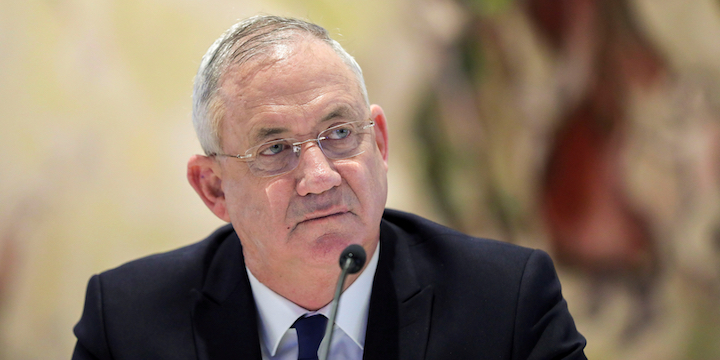
Israeli Defense Minister Benny Gantz attends a cabinet meeting of the new government, at the Chagall Hall in the Knesset, the Israeli parliament in Jerusalem, May 24, 2020. Photo: Abir Sultan / Pool via Reuters / File.

Israeli Defense Minister Benny Gantz will make a snap visit to the US on Thursday for talks with the White House, the ministry said.

Gantz is expected to meet with US Secretary of Defense Lloyd Austin and US National Security Adviser Jake Sullivan to discuss the Iran nuclear issue.

Also on the agenda will be the just-finished Operation Guardian of the Walls against the Gaza-based terror group Hamas, regional issues, and Israeli acquisition of military materiel from the US.

Gantz, who will be the highest ranking Israeli official to visit the White House thus far, will reportedly also discuss the aftermath of Guardian of the Walls, including a possible prisoner exchange deal with Hamas, the reconstruction of Gaza, the strengthening of the Iran Dome defense system, and tensions on Israel’s northern border

CTech – Israel Aerospace Industries (IAI) announced on Tuesday that it has recently signed a $200 million contract to provide…

Israel news site Walla reported that the US is concerned that Israeli Prime Minister Benjamin Netanyahu — who now appears to be on the brink of losing his position to a “change government” — may attack Iran in order to stay in office.

According to an Axios report, Israel will ask the US for $1 billion in emergency aid in order to replace the Iron Dome interceptors used in Guardian of the Walls and to purchase precision-guided munitions from the US.

US Republican Senator Lindsey Graham — who met on Monday with both Gantz and Netanyahu in Jerusalem — told Fox News, “There is going to be a request made by the Israelis to the Pentagon on Thursday for $1 billion in aid to replenish Iron Dome batteries. It will be a good investment for the American people. I will make sure in the Senate that they get the money.”

Gantz also appeared to take a swipe at Netanyahu on Tuesday, after the prime minister said that the Iranian nuclear program had to be stopped, even at the expense of Israel’s relationship with the US.

“The US has been and will continue to be Israel’s most important ally, protecting Israel’s security and its qualitative edge in the region,” Gantz tweeted. “The Biden administration is a true friend of Israel, and Israel doesn’t have nor will it ever have a greater partner than the United States.”

“Even if differences arise, they will be resolved through direct dialogue, behind closed doors, not through provocative statements that serve to harm Israeli security,” he added.

Reuters|
Published: 05.31.21 , 20:15
Iran has failed to explain traces of processed uranium found at several undeclared sites, a quarterly report by the UN nuclear watchdog showed on Monday, possibly setting up a fresh diplomatic clash between Tehran and the West.
Three months ago Britain, France and Germany scrapped a U.S.-backed plan for the International Atomic Energy Agency’s 35-nation Board of Governors to criticize Iran for failing to fully explain the origin of the particles; the three backed off as IAEA chief Rafael Grossi announced fresh talks with Iran.
“After many months, Iran has not provided the necessary explanation for the presence of the nuclear material particles at any of the three locations where the Agency has conducted complementary accesses (inspections),” a report by Grossi to member states seen by Reuters said. Grossi had hoped to report progress in the talks before the board meets again next week.


2,000-year-old basilica unearthed in Ashkelon

“The basilica was first discovered in the 1920s by British archaeologist John Garstang who then covered it once again,” said Dr. Rachel Bar Nathan, IAA director of excavation.

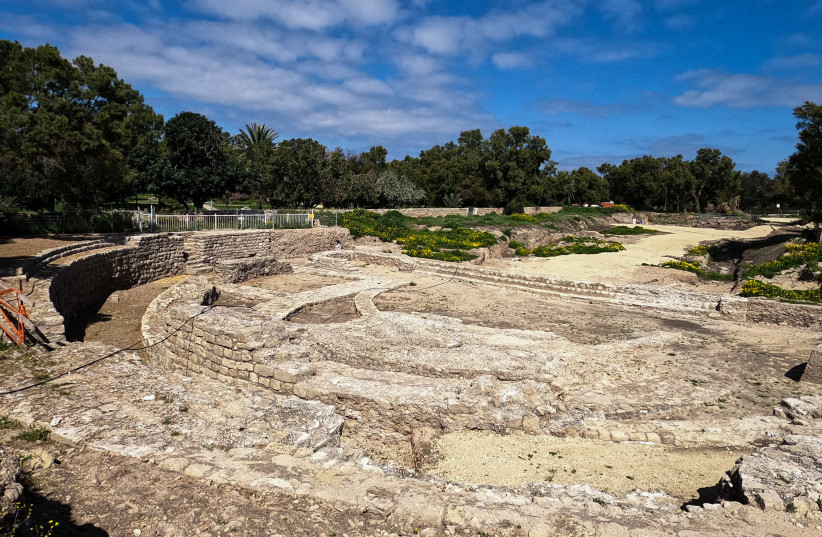
The Basilica and the Odeon Complex in the Tel Ashkelon National Park (photo credit: YANIV COHEN/NATURE AND PARKS AUTHORITY)
The Basilica and the Odeon Complex in the Tel Ashkelon National Park
(photo credit: YANIV COHEN/NATURE AND PARKS AUTHORITY)
The remains of a 2,000-year-old basilica, the largest in Israel, were uncovered in Ashkelon in an excavation conducted by the Israel Antiquities Authority within a development project of the Tel Ashkelon National Park, the Nature and Parks Authority announced on Monday.

The building, a Roman public building, was divided into three sections, a main hall and two side parts. According to the archaeologists, the main hall was surrounded by marble columns as high as 13 meters and ornated with elaborated capitals.
“The basilica was first discovered in the 1920s by British archaeologist John Garstang who then covered it once again,” said Dr. Rachel Bar Nathan, IAA director of excavation together with Saar Ganor and Federico Kobrin.

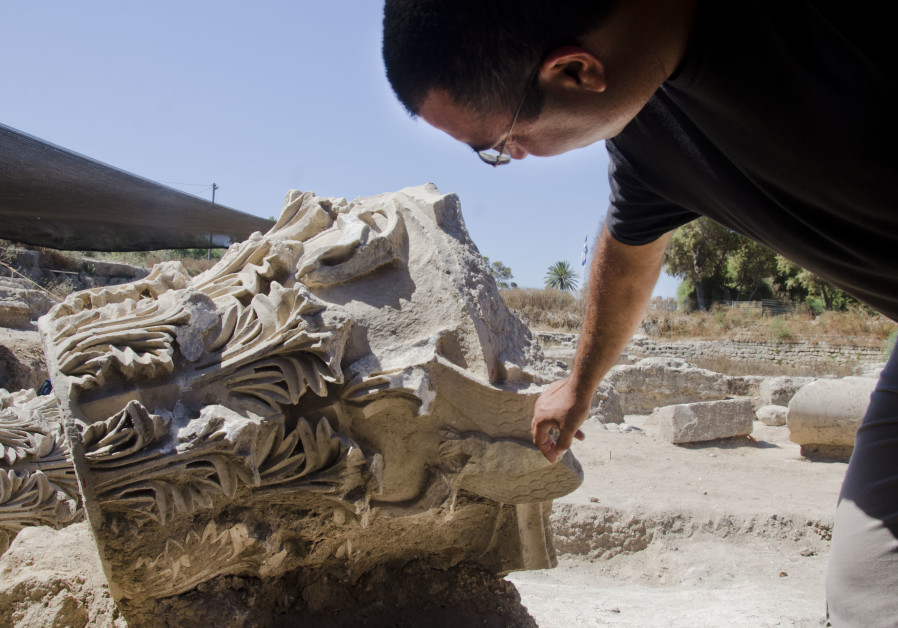
 Archaeologist Saar Ganor with a capital in Tel Ashkelon National Park. (Credit: YOLI SHWARTZ ISRAEL ANTIQUITIES AUTHORITY)  Archaeologist Saar Ganor with a capital in Tel Ashkelon National Park. (Credit: YOLI SHWARTZ ISRAEL ANTIQUITIES AUTHORITY)

The area would not be excavated again for almost a century, until a few years ago the works started one more time. Among other things, a small theater (odeon) was uncovered.
When the National Park Authority decided to develop the area and reconstruct part of the colonnade, the excavations began once again.
“Garstang had already calculated the dimensions of the building, and seeing the remains of the marble columns, made with materials imported from Asia Minor, he had suggested that the basilica dated back to the time of Herod The Great, since historian Josephus described how the king built a colonnaded hall,” Bar Nathan said.
“Our project started in 2016,” she noted said. “When we excavated the basilica we realized that that some of the remains did not date back as early as Herod, but later to the 2nd-3rd century CE the time of emperor Septimius Severus, but the original structure did date back to the time of Herod, so Garstang was right.”
The archaeologists found a coin from Herod’s times at the site.
Septimius Severus rebuilt the structure in an even more grandiose style. Several sculptures were also found.
In Roman times, the basilica was not a religious building, but rather a public building in the center of the city, used for commerce, court cases and other civic functions. Later on, Christian churches would be inspired by this architectural structure.
When Herod rule over Judea, Ashkelon was a free city. A Jewish population live there but did not represent the majority. Later it became a Roman city, before it was destroyed by an earthquake in 363 CE.
The excavation is part of a joint project by the Nature and Parks Authority, the Ashkelon Municipality and the Leon Levy Foundation to preserve and restore the theater and the basilica and make them accessible to visitors.