Newspaper editor affiliated with Lebanese terror group claims Hezbollah sent weapons and ammunition to Gaza during conflict


Illustrative: A woman covers her face in the style of Palestinian and Lebanese militants as she holds a Palestinian flag in a pro-Palestinians gathering in Tehran, Iran, May 19, 2021. (AP Photo/Vahid Salemi)

Illustrative: A woman covers her face in the style of Palestinian and Lebanese militants as she holds a Palestinian flag in a pro-Palestinians gathering in Tehran, Iran, May 19, 2021. (AP Photo/Vahid Salemi)

Iran’s Islamic Revolutionary Guard Corps and Hezbollah coordinated with Hamas on the recent fighting in Gaza between Palestinian terrorists and Israel, according to the editor-in-chief of a Lebanese daily affiliated with Hezbollah.

Ibrahim Al-Amine, editor of the pro-Hezbollah Lebanese daily Al-Akhbar, told Hezbollah’s Al-Manar network over the weekend that during the 11-days of fighting in the Hamas-ruled Gaza Strip, officers from the IRGC, Hamas and Hezbollah set up a joint military operations center in Beirut.

The commander of the IRGC’s overseas Quds Force, Esmail Ghaani, visited the operations center twice during the military hostilities, according to Al-Amine.

The newspaper editor claimed Hezbollah sent weapons and ammunition to Gaza and “moved a number of Palestinian resistance officers out of the Strip during the aggression,” according to Al-Manar.

Palestinian factions were also provided with data on the movements of Israeli forces, Al-Amine asserted, asserting drones were used to prevent Israel from springing an “ambush” on terror operatives along the border.

He also said if Israel “expanded its aggression, the entire axis of resistance would have confronted it,” referring to Iran and its regional proxies.

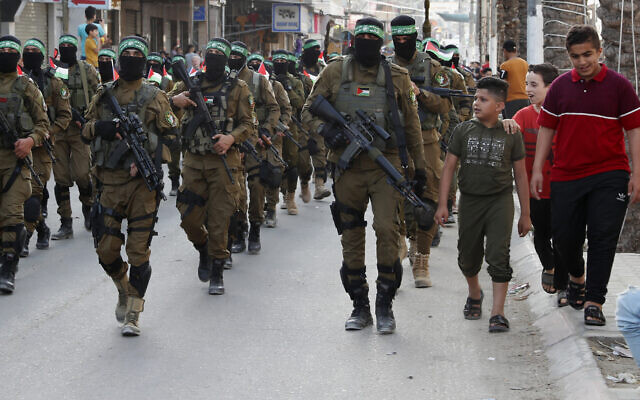
Members of the Hamas terror group’s military wing parade in Khan Yunis, in the southern Gaza Strip on May 27, 2021, as Hamas claims victory following an 11-day conflict with Israel.(SAID KHATIB / AFP)

Al-Amine’s comments came days after Yahya Sinwar, the leader of Hamas in Gaza, said Hamas coordinated with the IRGC and Hezbollah throughout the fighting, in a press conference quoted by Israel’s Kan news.

Sinwar also said there was “full coordination between the resistance in Lebanon and resistance in Gaza,” referring to several rockets fired at Israel from Lebanon during the conflict.

The Israeli military blamed several of the rocket attacks from Lebanon on Palestinian factions in the country, not the Hezbollah terror group. However, it is unlikely that terrorists in southern Lebanon would be able to fire rockets without at least the tacit approval of the Iran-backed militia, which maintains a tight degree of control over southern Lebanon.

Meanwhile, Ghaani on Saturday issued fresh threats against Israel.

“I’d advise all Zionists to go back and repurchase the houses they have sold in Europe, the US and elsewhere to come to the Palestinian territories before the houses become more expensive than today,” he said, according to the Tasnim news agency.

During the conflict in Gaza, known in Israel as “Operation Guardian of the Walls,” Iranian state television reported that Ghaani spoke by phone with Hamas chief Ismail Haniyeh to laud the Islamist terror organization’s attacks on Israel.

Iranian Quds Force commander Esmail Ghaani (L) and Hamas leader Ismail Haniyeh (R). (AP)

The fighting in the Strip, which erupted on May 10 after Hamas fired rockets at Jerusalem amid escalating Israeli-Palestinian tensions in the city, ended last week with a ceasefire between Israel and the Gaza-ruling terror group.

Thirteen people were killed in Israel, all but one of them civilians, including a 5-year-old boy and a 16-year-old girl. Some 357 people in Israel were wounded. Terror groups in Gaza fired more than 4,300 rockets at Israel during the fighting.

The Hamas-run health ministry in Gaza said at least 243 Palestinians were killed, including 66 children and teens, with 1,910 people wounded. It does not differentiate between terror group members and civilians. The Israeli military maintained that it killed some 225 terrorist operatives and that the Palestinian death toll was in fact considerably higher than was reported. It also said some of the civilian fatalities were caused by Hamas rockets falling short and landing in the Strip.


ASHKENAZI TO VISIT CAIRO FOR SUNDAY TALKS WITH COUNTERPART

Israel reportedly demands ceasefire and reconstruction discussions include negotiations on return of captives; Egyptian intelligence head to visit Israel Sunday for talks with PM

Today, 2:23 pmUpdated at 2:38 pm  0


Clockwise from top left: Oron Shaul, Avera Mengistu, Hadar Goldin and Hisham al-Sayed (Flash 90/Courtesy)

Clockwise from top left: Oron Shaul, Avera Mengistu, Hadar Goldin and Hisham al-Sayed (Flash 90/Courtesy)

Egypt has notified the Hamas terror group that Israel says any long-term truce negotiations must include the subject of a prisoner exchange between the sides, according to a Saturday report.

Hamas has so far insisted on separating prisoner negotiations from any discussions related to a potential long-term truce or the reconstruction of the Gaza Strip, sources told the London-based Al-Araby Al-Jadeed newspaper.

Two Israeli civilians and the bodies of two Israel Defense Forces soldiers are currently being held in Gaza. Avraham Avera Mengistu and Hisham a-Sayed entered the Strip of their own accord, and their families say they suffer from mental illness. Hamas is also holding the bodies of Oren Shaul and Hadar Goldin, two IDF soldiers who were killed in the Strip during the 2014 Gaza war.

Prime Minister Benjamin Netanyahu and the Israeli government came under harsh criticism for not demanding a prisoner swap as part of the original deal to end the recent fighting.

Israelis attend a rally calling for the return of the remains of IDF soldiers Oron Shaul and Hadar Goldin held by Hamas in Gaza, near the home of Defense Minister Benny Gantz in Rosh Haayin, May 21, 2021 (Flash90)

However, sources told Al-Araby Al-Jadeed that Cairo informed Hamas of the prisoner swap request after Israel linked it to any further negotiations.

The message was passed to the terror group in its third meeting with the Egyptian security delegation since the ceasefire began last Friday.

Egyptian intelligence chief Abbas Kamel at Tahrir Palace, in Cairo, Egypt, February 8, 2018. (Khaled Elfiqi/Pool photo via AP)

Meanwhile, the Walla news site reported that the head of the Egyptian intelligence service Abbas Kamel, will arrive in Israel on Sunday for talks with Netanyahu and National Security Adviser Meir Ben-Shabbat, as well as other senior security officials.

The report said Kamel will also visit Ramallah to meet with Palestinian Authority President Mahmoud Abbas before he travels to Gaza for further talks on stabilizing the ceasefire, which could include the matter of a potential prisoner exchange.

Additionally, Foreign Minister Gabi Ashkenazi will fly to Cairo on Sunday for talks with his Egyptian counterpart Sameh Shoukry.

The reports came after Defense Minister Benny Gantz said earlier this week that Israel will not permit the full reconstruction of Gaza or the entry of any aid that is not humanitarian, until the terror group releases the two Israeli civilians and the two bodies.

Hamas officials in the terror group told the Lebanese Al-Akhbar newspaper in response that they “cannot be blackmailed.”

Defense Minister Benny Gantz speaks to air defense soldiers operating an Iron Dome missile defense battery in southern Israel on May 11, 2021. (Judah Ari Gross/Times of Israel)

Israel has over the years worked to secure the release of the soldiers’ bodies and the civilians, often using the Egyptian military, which maintains ties with both Jerusalem and Hamas, as an intermediary.

Hamas has sought, in exchange, the release of Palestinian security prisoners in Israeli jails — members of Hamas and of other terror groups.

Some of the prisoners were freed during the 2011 prisoner exchange deal but re-arrested during a 2014 crackdown on the terror group in the West Bank following the abduction and murder of three Israeli teenagers.

Children talk with masked members of the military wing of Hamas, while marching along the streets of Nusseirat refugee camp, central Gaza Strip, May 28, 2021. (AP Photo/Adel Hana)

Meanwhile, a week after a ceasefire brought an end to 11 days of hostilities between Israel and Hamas, the Israel Defense Forces is reportedly already preparing for the next round of fighting, with senior army officials said concerned an escalation from the Gaza-based terror group could come at any time.

Hamas officials have also threatened to resume rocket attacks if Israel seeks to impose a new status quo on Gaza following the recent fighting, after some Israeli officials called for a harsher response to the terror group, including the renewal of assassinations of Hamas leaders.


Israel welcomed a wave of more than 500 new Olim (Jewish immigrants) from more than 20 countries this week, according to figures from The Jewish Agency for Israel, which has billed this an “Aliyah Super Week.”

Jews came from Argentina, Australia, Belarus, Brazil, Chile, Colombia, Ethiopia, France, Finland, Kazakhstan, Mexico, Netherlands, Sweden, Switzerland, Ukraine, the United Kingdom, the United States, and a number of other former Soviet republics.

The wave of new immigrants came despite the recent tensions with the Gaza Strip and Operation Guardian of the Walls.

The International Christian Embassy Jerusalem (ICEJ) joined in as one of the main supporters of this effort and sponsored flights for 148 new immigrants.

“Given the intense conflict we have witnessed here over recent weeks, it is quite remarkable to see these hundreds of Jewish immigrants coming home to Israel from all directions,” said ICEJ President Dr Jürgen Bühler.

“This is truly inspiring to see these Jewish families cast their lots with Israel just days after the country was under such intense rocket barrages, and it bodes well for the future of the Jewish State,” he added.

In addition, the ICEJ will be covering flight costs and other travel expenses for 99 members of the Bnei Menashe community who have been approved to come to Israel under an emergency decision of the Israeli cabinet due to the current coronavirus surge in India.

The decision will allow 548 Bnei Menashe to come as soon as possible, with the first flight of 274 currently scheduled to land on Monday.

In total, the ICEJ will be sponsoring aliyah flights for 247 new immigrants over an eight-day period. This will bring to 1,132 the total number of aliyah flights sponsored by the ICEJ so far this year.