
Downing happened on sidelines of Gaza fighting. “I think that says everything about the real patron of terror in the Middle East and the world – Iran.”
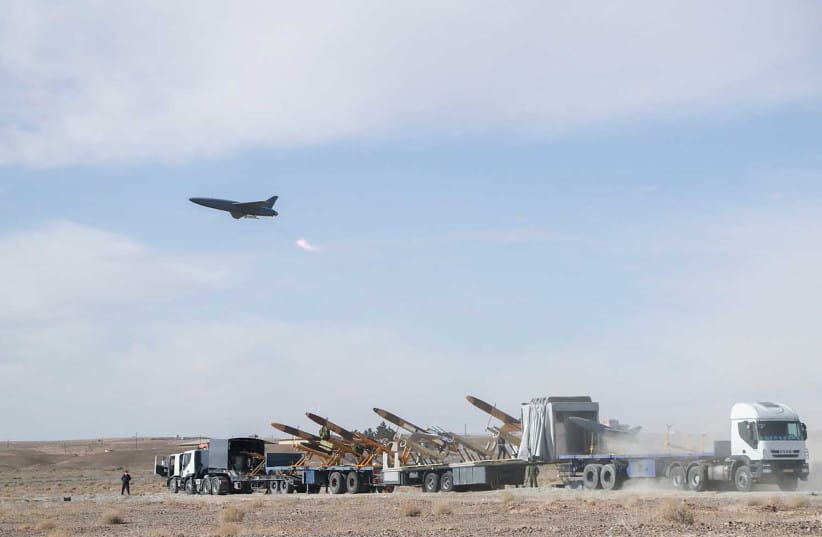
A drone is launched during a large-scale drone combat exercise of Army of the Islamic Republic of Iran, in Semnan, Iran January 4, 2021. Picture taken January 4, 2021 (photo credit: IRANIAN ARMY/WANA/REUTERS)
A drone is launched during a large-scale drone combat exercise of Army of the Islamic Republic of Iran, in Semnan, Iran January 4, 2021. Picture taken January 4, 2021
(photo credit: IRANIAN ARMY/WANA/REUTERS)
The drone Israel shot down near the border with Jordan on Tuesday was Iranian, Prime Minister Benjamin Netanyahu said on Thursday.
“While we were engaged in these hostilities a few days ago, Iran sent an armed drone from Iraq or from Syria,” Netanyahu told German Foreign Minister Heiko Maas, who was in Jerusalem. “Iranian forces launched an armed drone, which our forces intercepted on the border between Israel and Jordan.
“I think this says everything on the true patron of terror in the Middle East and in the world: Iran,” Netanyahu added, showing Maas a piece of the drone.
The IDF shot down a drone on Tuesday that was approaching the Israeli-Jordanian border, traveling toward the Emek Hama’ayanot Regional Council in northern Israel.
IDF units collected the fragments of the destroyed aircraft for further examination.
At the time, residents of Beit She’an – which sits within the regional council – were instructed to lock themselves in their homes for nearly an hour, before the IDF announced that the area had been secured, and that it was again safe for people to leave their homes.
Netanyahu said he described to Maas how Israel is fighting on multiple fronts, and that Iran is behind all of them.
“Iran not only supports completely the Islamic Jihad in Gaza, and gives them all the finance, they also give weapons to Hamas as well as to Hezbollah, and they provide the scaffolding on which these organizations really work,” he stated.
Iranian Quds Force Commander Ismail Ghaani wrote a letter of support to Hamas’s Izzadin al-Qassam Brigades commander Mohammed Dief this week, according to Iranian news site Khabar Online. Ghaani wrote to Dief that he was “faithful to your promise to the enemy. The usurper tasted the fear, defeat and humiliation… This war has ushered in a new phase in the battle with the enemy… The equation is that the enemy cannot isolate Quds [Jerusalem] without receiving a tough response.”
World powers continued negotiations with Iran in Vienna throughout the time that Hamas and other Gaza terrorist groups rained rockets on Israel with material support from the Islamic Republic. The goal of the negotiations is for Iran to return to compliance with the Joint Comprehensive Plan of Action, as the 2015 nuclear deal is known, and for the US to lift sanctions placed on Iran since 2018.
Russian Ambassador to International Organizations in Vienna Mikhail Ulyanov tweeted photos from ongoing talks with Iranian Deputy Foreign Minister Abbas Araghchi on Wednesday, and said on Thursday that while negotiations for Iran to return to the JCPOA would not be completed by the May 21 target date, “the talks will continue until a successful outcome.”
Enrique Mora, the EU official leading indirect talks between the US and Iran, said Wednesday that he was confident talks were “on the right track,” and that a deal would be reached as a fourth round of negotiations adjourned.
However, diplomats from Britain, France and Germany, known as the E3, were more reserved in their assessments of the talks’ progress, saying “there are still some very difficult issues ahead.”
Maas, Czech Foreign Minister Jakub Kulhanek and Slovakian Foreign Minister Ivan Korcok paid a solidarity visit to the region, as Operation Guardian of the Walls continued on Thursday.
“Germany stands with Israel and its right to defend itself,” Maas said ahead of a meeting with Foreign Minister Gabi Ashkenazi. “I came to Israel to show solidarity and support Israel after the rocket fire from Gaza. Israel has the right to defend itself. Israel’s security and that of the Jewish residents here are not negotiable.”
Maas added that he has been following the humanitarian situation in Gaza with great concern, but that he is aware of Israeli efforts to bring humanitarian aid to the coastal enclave.
In recent days, Hamas twice shelled humanitarian aid convoys from Israel into Gaza, killing two civilians and injuring 10, according to the Foreign Ministry.
Maas also said that Germany supports efforts to bring about a ceasefire, and that he has been in contact with the US, Egypt and others toward that aim.
“We need to look to the future and make sure there is sustainable peace in the region that allows for a situation in which Israelis and Palestinians can live here with self-determination,” Maas stated. “The current situation is one of uncertainty that only serves to strengthen those who spread hate and terror.”
Maas met with Ashkenazi, who also accompanied him to Petah Tikva to see a home that was destroyed by a Hamas rocket and receive a security briefing from Home Front Command commander Maj.-Gen. Ori Gordin.
Soon after, Kulhanek and Korcok visited the same house.
Kulhanek said he was “speechless” after seeing the destruction that terrorism against Israel has wrought.
“In these trying times, Israel, more than ever, needs to be reminded that it has friends in the world,” he stated. “The Czech Republic proudly waved an Israeli flag over its government institutions as a sign of identification with and support for Israel. Israel has the full right to defend itself.”
Korcok said that Israel and Slovakia are “true friends,” and that he is in Israel to show the power of that friendship.
“Hamas’s shooting must stop,” he said. “Israel has the right to defend itself.”
Ashkenazi thanked the foreign ministers for their countries’ support, and said that raising an Israeli flag over the Czech Foreign Ministry and Bratislava’s City Hall is “heartwarming and cannot be taken for granted.”
Ashkenazi explained that the current round of fighting is different from the past: “Hamas’s missile attacks on Israel broke out following a brutal attempt by Hamas to strengthen its political status and take over the Palestinian agenda and Palestinian Authority leadership.
“Hamas chose to do this through terrorist attacks and shooting missiles and rockets at Israeli civilians in Jerusalem, Tel Aviv and the south. [Hamas] is doing this from populated areas, in backyards and schools, while using residents of Gaza as human shields. Hamas is committing a double war crime.”
Ashkenazi pointed out that Hamas rockets have destroyed electric lines running to Gaza, and then Hamas shot at Israeli Electric Company staff that tried to fix them.
“This is another example of how Hamas harms the population of Gaza and cynically takes advantage of its distress,” Ashkenazi said.
Maas also met with Defense Minister Benny Gantz, who updated him on developments in the fighting against Hamas and progress toward the goal of attaining long-term quiet and security for Israelis.
The German foreign minister also met with President Reuven Rivlin, and traveled to Ramallah to meet Palestinian Authority Prime Minister Mohammed Shtayyeh. He returned to Germany on Thursday.
Reuters and Jerusalem Post Staff contributed to this report.


Egyptian security source – whose country has been mediating between the sides – said they had agreed in principle to a mutual halt in hostilities.

A missile falls as smoke rises near a tower housing AP, Al Jazeera offices (C) during Israeli missile strikes in Gaza city, May 15, 2021.  (photo credit: REUTERS/ASHRAF ABU AMRAH)
A missile falls as smoke rises near a tower housing AP, Al Jazeera offices (C) during Israeli missile strikes in Gaza city, May 15, 2021.
(photo credit: REUTERS/ASHRAF ABU AMRAH)
The Israeli security cabinet voted to accept a ceasefire late Thursday as the Israeli south and Gaza remain inflamed.

The security cabinet unanimously agreed to a “mutual and unconditional” cessation of hostilities, according to a statement from the Prime Minister’s Office.

The ceasefire will begin at 2:00 a.m., Israeli media reported.

New Hope Party leader Gideon Sa’ar expressed his disappointment at the unconditional ceasefire, tweeting that it was embarrassing that, with the best intelligence and air force in the world, Netanyahu managed to extract from Hamas an “unconditional ceasefire.”

A Hamas official confirmed to Reuters that the ceasefire would be “mutual and simultaneous,” while Walla news reported a Hamas official also confirmed the hour.

While according to the security cabinet the ceasefire will be unconditional, Senior Hamas official Osama Hamdan said he had received guarantees from the mediators that, “The occupation will remove its hand from Sheikh Jarrah and al-Aqsa,” Walla added.

Regarding the ceasefire agreement, Defense Minister Benny Gantz said the, “reality on the ground will determine the continuation of the campaign,” implying that Israel will be keeping with the principle of “quiet would be met by quiet.”

Gantz added that “the defense establishment continues its readiness to protect Israeli citizens.”

Additionally, the prime minister told the IDF to prepare to attack in the case that Hamas does not respond to Egypt’s ceasefire offer, N12 news reported.

Top international envoys had worked feverishly to end the war while Israel’s security cabinet debated the details of a restoration of calm in a late-night meeting.
US President Joe Biden spoke with Egyptian President Abdel Fattah al-Sisi about ceasefire efforts, while US Vice President Kamala Harris talked with Jordan’s King Abdullah.

According to Kan News, Israel’s National Security adviser, Meir Ben-Shabbat, received a proposal from the Egyptians for a restoration of calm. Egypt along with the UN and others were working on a truce 11 days after Hamas escalated tensions by launching rockets at Jerusalem.
“We have seen reports of a move toward a potential ceasefire,” White House press secretary Jen Psaki told reporters in Washington. “That’s clearly encouraging. We believe the Israelis have achieved significant military objectives that they laid out to achieve, in relation to protecting their people and to responding to the thousands of rocket attacks from Hamas. So that’s why, in part, we feel they’re in a position to start winding their operation down.”
Linda Thomas-Greenfield, US ambassador to the United Nations, told a special General Assembly meeting that the US was working to attain a trust, and that “in the hours and days ahead, we will continue to relentlessly push for peace.”
US Deputy Assistant Secretary for Israel and Palestinian Affairs, Hady Amr, remained on the ground to advance those efforts.
United Nations Special Coordinator for the Middle East Peace Process Tor Wennesland was in Doha, Qatar, on Thursday, “on an official visit as part of the United Nations’ intensified efforts to restore calm in Gaza and Israel,” a diplomatic source told The Jerusalem Post. “The UN is actively engaged with all the relevant parties in order to de-escalate the situation on the ground.”
Hamas leaders Ismail Haniyeh and Khaled Mashaal are based in Qatar, and Haniyeh met with Wennesland, a diplomatic source said.
UN Secretary-General Antonio Guterres told the UNGA that Wennesland had “undertaken extensive diplomatic efforts within the region, including with Egypt, Jordan and Qatar and with key partners in the international community, to encourage all sides to halt the violence. We are engaging directly with the parties to the conflict, including Hamas, in our efforts to secure an end to hostilities.”
Guterres also held a meeting with Arab ministers to discuss the current situation, according to his spokesperson Stephan Dujarric.
During a Wednesday phone call between Biden and Netanyahu, the US president said he “expected a significant de-escalation on the path to a ceasefire.”
Netanyahu told Biden that the operation will continue until Israeli citizens are secure, and repeated that line in subsequent public statements.
But on Thursday, the matter of timing was absent from Netanyahu’s statements, as it focused more on the Iranian origin of an armed drone shot down over Israel earlier this week.
As IDF and Hamas firing was expected to die down, the Palestinian Authority’s diplomatic battles against Israel at the United Nations heated up.
In Geneva, UN Human Rights Council planned to hold a special session on the war. The last time it held a special meeting on the conflict was in 2018, and before that it convened one in 2014.
Since the UNHRC’s creation in 2006, it has held 30 sessions on humanitarian crises in specific countries, of which nine have been held on alleged Israeli human rights abuses. No other country has faced so many special sessions.
Among the countries who supported holding the special session were Bahrain, Morocco and the United Arab Emirates. All three signed normalization deals with the Israel last year.
The UN Security Council has met four times in the last two weeks, with the US blocking its issuance of a statement in support of a ceasefire that did not mention Hamas or the rockets.
It has also rejected French efforts to bring a ceasefire resolution to the UNSC.
The UN General Assembly also met on Thursday to discuss the issue, with many of the speakers portraying the Palestinians as victims of an aggressive Israel.
Palestinian Authority Foreign Minister Riyad al-Malki accused Israel of war crimes, with Gilad Erdan, Israel’s UN and US ambassador, walking out during Malki’s speech.
Guterres called out both Hamas and the IDF, saying that both had committed war crimes.
“Sadly, in today’s debate, we are not seeing a defense of the goals laid out for the UN, but rather an indifference to Hamas’s charter, which, like the Nazis, is committed to the genocide of the Jewish People,” Erdan said. “We see an attempt to create a false moral equivalence, an immoral equivalence, between Israel, a democracy that seeks peace and abides by international law, and a murderous terrorist organization with an ideology similar to ISIS, that is carrying out the double war crime of firing at Israeli civilians while hiding its weapons behind Palestinian civilians, using them as human shields.”
Guterres said that both the IDF and Hamas had attacked innocent civilians.
“Even wars have rules,” Guterres said. “First and foremost, civilians must be protected. Indiscriminate attacks, and attacks against civilians and civilian property, are violations of the laws of war. So are attacks against military objectives that cause disproportionate loss of civilian life and injury to civilians.”
While many UN members have hesitated to mention Hamas or its rockets, Guterres spoke out against both.
He urged “Hamas and other militant groups to stop the indiscriminate launching of rockets and mortars from highly populated civilian neighborhoods into civilian population centers in Israel, also in clear violation of international humanitarian law. Densely populated civilian areas must not be used for military purposes.
“I urge the Israeli authorities to abide by the laws governing armed conflict, including the proportionate use of force. I call on them to exercise maximum restraint in the conduct of military operations. It’s impossible to excuse the killing of innocent civilians. There is no justification, including counterterrorism or self-defense, for the abdication by the parties to the conflict of their obligations under international humanitarian law.”
Guterres took issue with IDF bombing of media offices in Gaza – in a tower block the IDF said also housed a Hamas intelligence base – and Hamas shelling of the Israeli crossings into the Strip when humanitarian goods were passing through.
Guterres said that his heart went out to the “victims and their loved ones.” He expanded on the harm done to the Palestinians in Gaza, stating that he was “deeply shocked by the continued air and artillery bombardment by the IDF in Gaza.”
He was upset in particular, he said, by reports that “nine members of one family were killed in al-Shati refugee camp. If there is a hell on earth, it is the lives of children in Gaza today.”
Reuters contributed to this report.


Turkey’s anti-Israel obsession reaches new heights

Among the recent statements include a demand by Turkey to separate Jerusalem from Israel.

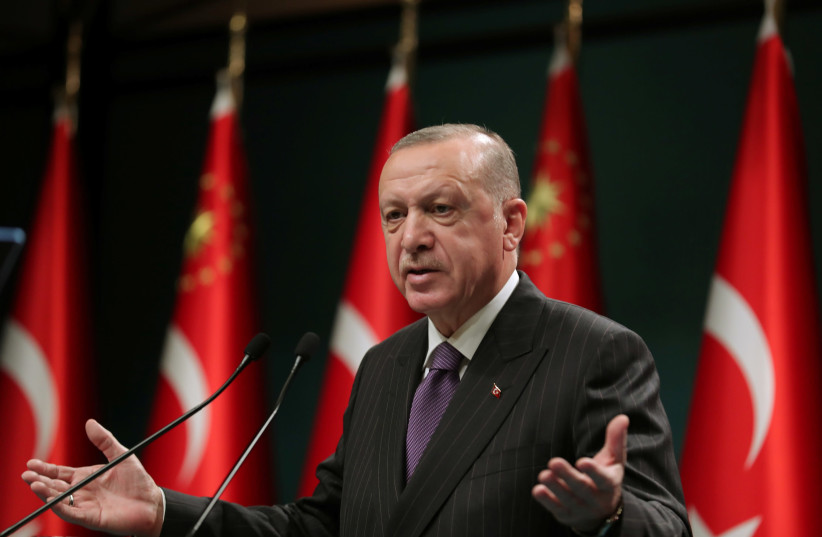
Turkish President Tayyip Erdogan speaks during a news conference following a cabinet meeting in Ankara, Turkey, December 14, 2020 (photo credit: PRESIDENTIAL PRESS OFFICE/HANDOUT VIA REUTERS)
Turkish President Tayyip Erdogan speaks during a news conference following a cabinet meeting in Ankara, Turkey, December 14, 2020
(photo credit: PRESIDENTIAL PRESS OFFICE/HANDOUT VIA REUTERS)
Turkey’s anti-Israel rhetoric has rapidly increased during the past eight days of fighting. The rhetoric targeting Israel and Jews has reached such heights that the US has condemned Turkey’s president for antisemitic comments.

While the US works to bring an end to the Hamas war against Israel, Turkey is fanning the flames.

Among its recent statements is a demand by Turkey to separate Jerusalem from Israel. The latest comments by Turkish President Recep Tayyip Erdogan were to demand a “separate arrangement” for Jerusalem.

Since 2020, when Turkey turned Hagia Sophia into a mosque, the Turkish religious and political leadership of the AKP Party, which supports Hamas, has sought to “liberate” al-Aqsa Mosque and claims it will take over Jerusalem.

Turkey has condemned Austria for supporting Israel and flying the Israeli flag. Erdogan said Austria was “trying to make Muslims pay for the Jews they subjected to genocide.” In short, the argument was that Austria was somehow punishing Muslims for the Holocaust.

Ankara then called Israel a “terror state.” In 2019, Erdogan compared Israel to Nazi Germany. At the time, the pro-Turkey stance of the Trump administration and the US State Department, some of whose officials were pro-Turkey, did not condemn the comments.

The current US administration is different, and Ankara does not get the green light to host Hamas and bash Israel as much as it used to.

Another of Erdogan’s comments was to call on the world to stop the “aggression on al-Quds,” a reference to Jerusalem. If the world did not stop Israel, then this “brutal mentality” would harm others tomorrow, he said.

The US on Tuesday strongly condemned the recent comments emanating from Turkey. State Department spokesman Ned Price said: “We urge President Erdogan and other Turkish leaders to refrain from incendiary remarks, which could incite further violence. Antisemitic language has no place anywhere.”

He did not specify which Erdogan remarks the US considered antisemitic.

The comments by the leadership of the AKP are also represented in far-right media in Turkey. Yena Safak, a newspaper that caters to the populist Right in the country and is close to the regime, argued for Turkey to lead an Islamic alliance to attack Israel.

The alliance would include Turkey, Iran, Qatar, Malaysia and Pakistan, countries that either back Hamas or are close to the Muslim Brotherhood. Ankara had consulted with Tehran last week about how to confront Israel, and Turkey has called on the pope and others to encourage sanctions against the Jewish state.

Compared with Turkey’s rhetoric against Israel, Iran’s has been relatively muted. Turkey has become one of the most anti-Israel states in the world, and its constant anti-Israel rhetoric, fed through its state-controlled media that run the most outlandish articles about Israel, fuels antisemitism in Turkey and abroad. Turkish flags can be seen at many antisemitic rallies in Europe.

This is a relatively new phenomenon, as Ankara encourages its European diaspora to play a more aggressive role. At one rally in Vienna, when a man shouted, “Shove your Holocaust,” there was widespread cheering among the men and women present, including a man with a Turkish flag.

Reuters contributed to this report.