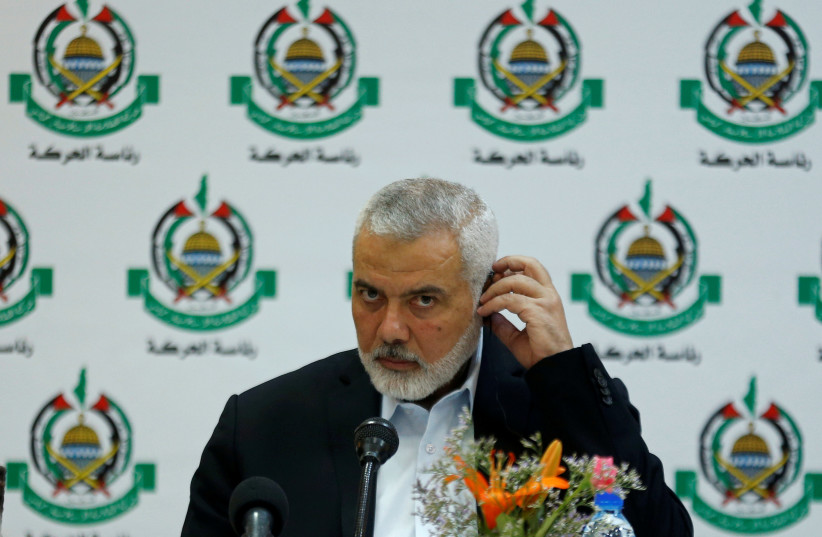
Iran’s Islamic Revolutionary Guard Corps Quds Force head Esmail Ghaani spoke with Hamas leader Ismail Haniyeh over the weekend and they discussed the latest developments in the situation and the conflict in Gaza. Tasnim news reported the discussion in Iran. It comes amid an Iranian regional push to support Hamas, including pro-Iran leader Hadi al-Amiri in Iraq indicating his support for Hamas. Turkey and Iranian-backed Houthis and Hezbollah also support the Hamas war against Israel. The press release about Ghaani being in touch with Hamas senior leadership comes days after Hamas leader Khaled Meshaal also spoke to Turkish media and was quoted in Iranian media about Hamas strategy.
What is important here is that the conversation with Ghaani comes as Iranian media published a unique look at Israel’s air defense systems, asserting that Israel is showing new vulnerabilities. Iran’s Tasnim argued on Saturday that the Iron Dome system is vulnerable to large barrages of rocket fire. Hamas has conducted unprecedented large volume of rocket fire, up to 135 rockets in five minutes, during this campaign. Hamas is driving the tempo of the war against Israel. Hezbollah is watching. Reports indicate Hezbollah could fire 2,000 rockets a day at Israel in a future war. Iran may have revealed the blueprint Hamas is using.
Ghaani’s discussions with Haniyeh included public comments where the IRGC commander, who replaced the late Qasem Soleimani in 2020, “reiterated the support of the Islamic Republic of Iran for the Palestinian nation and the Palestinian resistance in the face of the incessant aggression and crimes of the Zionist enemy against Jerusalem and Gaza,” Tasnim noted.
Ghaani praised Hamas in its performance so far. He condemned Israel’s “brutal crimes” and “he praised the positions of the Islamic Republic of Iran in support of the nation and the just cause of Palestine.” The overall context of this is that a week ago Iran’s IRGC head Hossein Salami warned that Israel could be cut off via maritime attacks and claimed that a large tactical operation could harm Israel because Israel is such a small country.
A senior commander of the IRGC also said that the “Zionist regime of Israel is caught off guard and fully encircled by the resistance front,” according to Press TV reports. “Incidents over the past days in the occupied territories well displayed the resistance [front]’s capability in confronting the Zionists’ military power and revealed the Zionist regime’s faulted defense system,” the IRGC deputy commander for political affairs, Brigadier General Yadollah Javani, said on Saturday. Iran is watching closely and likely advising Hamas on its tactics. “The Zionist regime is under pressure both from inside the occupied territories and from international public opinion, he added, noting that the situation is changed in favor of Palestine and the resistance front,” Press TV said. “The Zionist regime has no capability at all to change the situation in its own favor, and based on realities on the ground, the process of the Zionists’ decline has gained momentum,” the IRGC commander said.
Hamas has launched unprecedented barrages of 130 rockets fired over several minutes targeting Ashkelon and other Israeli cities. Some of the rockets are getting through and hitting the cities and killing people. Iran is watching and so is Hezbollah. On May 13, Iran military chief Mohammed Baqeri said that there was a shift in the balance of power in the region and Israel is losing. Iran says Hamas is targeting Iron Dome batteries and Israeli infrastructure such as chemical factories. Iran also highlights how Hamas has targeted Israel’s airports. Hamas says it has rockets to keep up the war for six months.
As Ghaani spoke with the Hamas leader, Tasnim news in Iran noted that “since the beginning of the conflict, there have been differing views on the capability of the Israeli military’s defense systems, to the extent that some have assessed their capability as positive and some as lacking the capability to counter Palestinian rockets.”
The Tasnim report included detailed information about Iron Dome and other Israeli defenses. This appears to go beyond just a military analysis and in fact represents how the IRGC is providing Iranian media hints of its strategy. For instance Tasnim says that the “Zionist Army are organized in such a way that the Iron Dome systems, which are organized in the form of 137th and 947th Battalions, are responsible for dealing with low-altitude targets. After that, the 138th and 139th Battalions of the Patriot Systems and the 66th Battalion of the David [Sling] Systems are tasked with engaging medium-altitude targets, and the 136th Battalion Megan Battalion, consisting of Arrow 2 and Arrow 3 systems, has been deployed to counter high-altitude threats and ballistic missiles.”
The article then notes that “on the other hand, the only Israeli defense system that has been active in recent years is the Iron Dome system, and other defense systems of the regime army, except for a few cases, have not yet entered into a serious conflict, and therefore the correctness of their operation is questionable.” What does Iran think Hamas should be doing. Tasnim says that the Iron Dome system also has several weaknesses. “First, the number of available systems is not able to cover all the occupied territories, and therefore in the event of a multi-front war, this system will not be able to respond to rocket and missile attacks, and the air defense of the Israeli low altitude will be extremely vulnerable.” In addition the report says that “on the other hand, one of the weaknesses of this system is its inability to deal with large volumes of fire; This is an issue that the resistance groups have also realized and this is one of the reasons why these groups fired rockets at high volumes.”
Tasnim says that Hamas, likely with Iranian advice, has increased the speed of their rockets, making them harder to intercept. It has also increased accuracy and volume of fire. “This shows that the resistance groups have gradually increased the quality of their rockets and missiles by carefully studying the strengths and weaknesses of the Zionist Army Air Defense Organization and especially its Iron Dome system, and so far they have been able to balance the acceptable power with the Zionist regime. If this continues, it will lead the resistance groups to acquire much more advanced weapons than today and to inflict heavier blows on the Zionist regime.”
This indicates a clear blueprint for how Hamas conducted this war. Hamas has moved from the 130-rocket barrage specifically targeting Ashkelon to say that it targeted airports and used kamikaze drones, based on an Iranian export design for the Houthis, and that it has other advanced weapons. It also has a new 250km range missile.
Ghaani’s discussion with Haniyeh may indicate that Iran’s hand is even closer to the conflict then yet acknowledged. Iran had predicted this war between May 6 and 8. Hamas launched the war on May 10 on Jerusalem Day. This is clearly a message. Iran had indicated that Israel could be defeated in Quds Day speeches on May 7 and 8. Hamas moved forward on May 10 with the strike aimed at Jerusalem as a symbol of “defending Al-Aqsa.”
What degree of “advise and assist”, to use the term the US often uses to describe its relations with partner forces, is Iran giving Hamas. Is Iran working “by, with and through” Hamas to defeat Israel or merely to test Israel’s defenses as a test run for Hezbollah. Earlier in the year reports warned of Houthis acquiring long range drones to threaten Israel. Hezbollah has sought PGMs or precision guided munitions to strike at Israel as well. Israel conducted thousands of airstrikes on Iranian targets in Syria to interdict the flow of weapons to Hezbollah over the last ten years. However in the last days there has been rocket fire from Lebanon and Syria. This may be symbolic, but it also shows that Iran’s multi-front war approach is increasing. Iran says this openly. “Therefore in the event of a multi-front war, this system will not be able to respond to rocket and missile attacks.” This is Iran’s blueprint. Iran has said it openly. Hamas has listened.