
Military says 160 aircraft dropped 450 missiles on 150 targets in operation, as ground troops in Israel struck terror operatives who try to attack them

Volume 90%

According to the Israel Defense Forces, in this air campaign, which lasted nearly 40 minutes, some 450 missiles were dropped on 150 targets in northern Gaza, particularly around the city of Beit Lahiya. The military said it was still working to determine the extent of the damage caused to the underground infrastructure, which IDF Spokesperson Hidai Zilberman told reporters was a “strategic asset” to Hamas, and the number of terrorist operatives killed in the strikes.

In addition to the aerial assault, Israeli tanks, artillery cannons and infantrymen on the Gaza border conducted accompanying barrages at Hamas operatives — specifically anti-tank guided missiles and rocket-launching teams — who came out during the assault to conduct attacks on Israeli targets, Zilberman said.

He clarified that the ground troops remained on Israel’s side of the border and did not enter the Gaza Strip, despite earlier claims to the contrary by the IDF, causing incorrect reports of a ground invasion to spread through leading news outlets around the world. The spokesman said the military was investigating what caused the “miscommunication.”

In total, some 500 artillery shells — some flares and some explosive — along with 50 tank shells were fired during this subsequent bombardment. Palestinians in Gaza reported that the Israeli strike lasted over an hour and caused a number of casualties, though an exact tally was not immediately available.

An IDF artillery unit near the Israel-Gaza border in southern Israel, May 13, 2021. (Gili Yaari /Flash90)

Zilberman said the operation was the result of large amounts of intelligence and careful planning. The military released video footage (above) showing both its preparations for the attack and some of the strikes themselves on the tunnel network, which the IDF refers to as “the metro.”

The IDF spokesman said that throughout early Friday morning, the military conducted further attacks on Hamas and Palestinian Islamic Jihad targets in the Strip, specifically rocket production facilities and additional anti-tank guided missile teams.

The Hamas-run Gaza health ministry on Friday morning raised its total death toll to 115 Palestinians, 27 of whom it said were children. These updated figures did not appear to include all those killed in the IDF’s midnight attack. Israel maintains that most of those killed in Gaza were terror group members or, in a few cases, died from errant Palestinian rockets, including several of the children.

Ido Avigal, who was killed in his home in Sderot by a rocket fired from Gaza, May 12, 2021. (Twitter)

Shortly after the start of the assault, Prime Minister Benjamin Netanyahu vowed to exact a “very heavy price” from Hamas, the Gaza-ruling terror group which has fired upwards of roughly 2,000 projectiles at Israel since Monday afternoon, killing nine people, including a 5-year-old boy hit by a rocket fragment in Sderot, an 87-year-old woman who suffered a head injury while running to a bomb shelter, a 50-year-old woman who fell while rushing to a bomb shelter on Tuesday and was pronounced dead Friday, and a soldier hit by an anti-tank guided missile on the Gaza border. Dozens of Israelis have also been injured, and a number of elderly Israelis have also suffered heart attacks brought on by air raid sirens.

Following the Israeli attack, Hamas launched multiple waves of rocket attacks on southern and central Israel, firing rockets toward the cities of Ashkelon, Ashdod, Beersheba, Yavne and many surrounding communities, injuring at least two people.

Rockets (l) are seen in the night sky fired towards Israel from Beit Lahia in the northern Gaza Strip on May 14, 2021, while Iron Dome interceptors rise to meet them (Photo by ANAS BABA / AFP)

One rocket directly struck a building in the city of Ashkelon, seriously injuring a 60-year-old man, Israeli authorities said. A 90-year-old man in the same building was lightly injured after he hit his head while running to a bomb shelter, medics said.

Hamas attacks continued into Friday morning around Ashdod, Ashkelon and Israeli communities surrounding the Gaza Strip.

Some of the incoming projectiles were intercepted by the Iron Dome missile defense system, several landed in open areas where they caused no injuries, and a small number landed inside populated areas, causing damage.

Minutes after the IDF onslaught began, Netanyahu issued a statement promising the operation would continue as long as needed to punish Hamas.

“I said that we would exact a very heavy price from Hamas and the other terrorist organizations. We are doing so and we will continue to do so with great force,” he said. “The last word has not been said and this operation will continue as long as necessary in order to restore the quiet and security to the State of Israel.

The IDF’s campaign in Gaza has so far been conducted primarily by airstrikes, as well as artillery shellings from the ground and the sea, but the military said it was preparing for the possibility of a ground incursion.

Zilberman said plans for a ground invasion were presented for approval by the IDF General Staff on Thursday, at which point they were given to Israel’s political leadership for consideration.

However, Israeli defense officials have made clear that the goal of this current Gaza campaign, known as Operation Guardian of the Walls, was not to topple the Hamas terror group, but only to weaken the group significantly and restore deterrence to prevent future attacks.

In total, the IDF on Friday said it had so far bombed more than 750 targets in the Strip since the outbreak of fighting, including many dozens of terrorist operatives and several senior commanders; four high-rise buildings used, at least in part, as Hamas military facilities; dozens of tunnels and bunkers; and nearly 200 buried rocket launchers, according to Israeli Air Force statistics.

The military has also destroyed dozens of rocket production facilities, some of which the IDF believes will take years to replace.

International efforts to broker a ceasefire, mostly led by the Egyptian military and the United Nations, have not made significant progress, as Israeli leaders have said they plan to continue the operation until it has achieved its goals.

Mourners attend the funeral of Israeli soldier Omer Tabib, 21, in Elyakim in northern Israel, on May 13, 2021. Tabib was killed when Palestinian terrorists in Gaza fired an anti-tank missile near the border. (JACK GUEZ / AFP)

According to the IDF, some 2,000 rockets and mortar shells have been fired toward Israel by terror groups in Gaza since fighting broke out on Monday evening, including 220 projectiles launched between 7 p.m. Thursday and 7 a.m. on Friday. Around 330 of the total projectiles launched landed inside the Palestinian enclave, and in at least one case killed a number of children when the rocket hit a school.

The majority of the rockets have been fired toward southern Israel, particularly the city of Ashkelon, which has been pummeled in this round of fighting, as well as the town of Sderot and small communities surrounding the Strip, known as the Gaza periphery. Hundreds of rockets have also been fired toward central Israel, at the Tel Aviv metropolitan area, including Ben Gurion International Airport.

In light of the attacks, Israel closed the Tel Aviv-adjacent airport to incoming passenger flights, diverting them to Eilat’s Ramon Airport. Hamas said it subsequently targeted that airfield as well, though its attack fell far short of the city.

Hundreds of the projectiles fired from Gaza have been intercepted by Iron Dome missile defense batteries, according to the military, which refuses to give precise statistics on the matter as they could be used by terror groups to find ways to outmaneuver the system.

The IDF on Thursday said the air defense system had a roughly 90 percent interception rate of projectiles heading toward populated areas, stressing that it did not provide “hermetic” protection. Terror groups have been launching rockets in massive barrages to try and overwhelm the system. A number of rockets in these barrages have made it past the Israeli air defenses in this way.

Volume 90%

Hamas also said it had launched a number of “suicide drones,” unmanned aerial vehicles carrying explosive payloads, into southern Israel from the Gaza Strip and out to sea, in an apparent effort to strike Israel’s Tamar natural gas rig, which was depressurized and put temporarily out of service toward the start of the fighting this week. The military confirmed downing at least six such drones as of Friday morning, including with an Iron Dome missile defense battery, in the first known use of this system, which was initially designed to intercept only rockets. In one case, a drone heading out to sea was shot down using an F-16 fighter jet, the military said.

On Thursday, the IDF said it bombed seven Hamas cells preparing to launch anti-tank guided missiles at targets in southern Israel over the course of the day, striking the teams before they could carry out their attacks. The military said it also hit an anti-tank guided missile launcher that had been positioned on an apartment building in the southern Gaza Strip.

Palestinian media reported that a number of Israeli airstrikes launched on Thursday targeted residential areas. Some of those reports claimed entire families were killed in some cases.

IDF officials have said the military makes a significant effort to prevent civilian casualties, calling buildings ahead of attacks to tell those inside to leave and using what’s known as the “knock on the roof” method of dropping non-explosive munitions on a target as a warning before bombing the building, but that collateral damage was effectively unavoidable as Hamas intentionally operates within a densely populated area to use Palestinian civilians as human shields.

Relatives mourn during the funeral of Reema Telbani and her 5-year-old son Zaid, who were killed in Israeli airstrikes on their family apartment building, at Dar Al-Shifa Hospital in Gaza City on May 12, 2021. (AP/Adel Hana)

The IDF in recent days has deployed additional ground troops — from the Paratroopers Brigade, Golani Infantry Brigade and 7th Armored Brigade — to the Gaza border, sending with them tanks and armored personnel carriers, which could be seen being transported by trucks on highways throughout southern Israel.

On Thursday, the army said it was canceling all weekend leave for combat soldiers as it prepared for the possibility of a ground operation. Zilberman said the military had called up 7,000 reservists. Roughly half of those were troops from air defense, artillery and medical units, and half serve in administrative and intelligence positions, Zilberman said.

Israel has fought three large operations against Hamas and other terror groups in the Gaza Strip since 2008, most recently in 2014 with a 51-day war known as Operation Protective Edge, as well as over a dozen smaller battles.

IDF kills top Hamas commanders on Wednesday, including close operatives to Mohammed Deif, in joint operation with the Shin Bet.

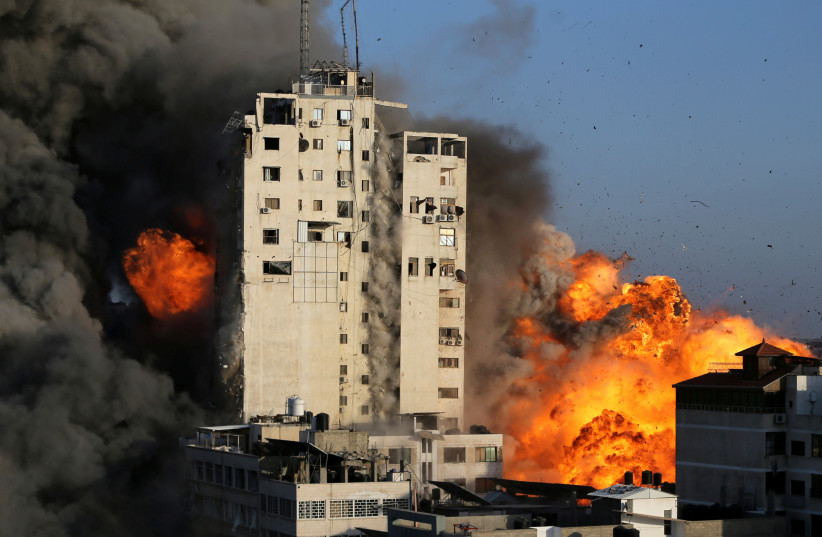
Smoke and flames rise from a tower building as it is destroyed by Israeli air strikes amid a flare-up of Israeli-Palestinian violence, in Gaza City May 12, 2021. Mustafa (photo credit: IBRAHEEM ABU MUSTAFA / REUTERS)
Smoke and flames rise from a tower building as it is destroyed by Israeli air strikes amid a flare-up of Israeli-Palestinian violence, in Gaza City May 12, 2021. Mustafa
(photo credit: IBRAHEEM ABU MUSTAFA / REUTERS)
The IDF carried out a series of bombing strikes against Hamas targets in the Gaza Strip early Thursday morning, destroying the terror group’s central bank and internal security headquarters, as well as the home of a top Hamas commander.

Caption: The expansive operation by the IDF to take out weapon warehouses in the Gaza Strip, May 11, 2021.

Additionally on Thursday, the IDF struck at least four terrorist cells that were preparing to launch anti-tank guided missiles (ATGM’s) towards Israel within about two hours. Further ATGM cells were hit later in the afternoon.

The IDF said that it destroyed the buildings in a series of airstrikes across Gaza throughout the pre-dawn hours of Thursday.

One target was the home of Iyad Tayib, a top Hamas commander who oversaw a number of battalions. The IDF said that the home was being used for terrorist purposes. In addition, the military bombed a building that it said was being used as Hamas’s central bank, as well as a force that the Israeli military said belonged to the terrorist group’s navy unit.

On Thursday afternoon, Abu Ubaida, spokesman of Hamas’s military wing the Izzadin al-Qassam Brigades, claimed that Hamas has launched “massive rocket strikes” larger than any launched on Israel since the 1948 War for Independence.
“The decision to bomb Tel Aviv, Jerusalem, Dimona, Ashkelon, Ashdod, Beersheba and closer and further than it, is easier for us than drinking water,” added Abu-Ubaida.
The Al-Qassam spokesperson dared Israel to “mobilize whatever forces you want from land, sea and air,” warning that the terrorist group has “prepared for you varieties of death.”
“What distinguishes this battle is the solidarity of our people in all arenas and their unanimity on the option of resistance,” said the Al-Qassam spokesperson adding in a statement addressed to Arab-Israelis and Palestinians in the West Bank that “Our weapons are your weapons, our blood is your blood, and our fate is yours.”
On Wednesday, Israel succeeded in striking at Hamas’s top military command, killing a number of its top operatives. The men were killed in a joint IDF-Shin Bet (Israel Security Agency) operation early Wednesday when the IDF said it carried out a series of targeted killings in Gaza City and Khan Younis, eliminating senior members of Hamas’s General Staff who were considered close to the head of the group’s military wing, Mohammed Deif.
The dead men were identified as Bassem Issa, the head of the Gaza City brigade since 2017, and Jamaa Tahla, head of the group’s cyber network and missile improvement project. According to the Shin Bet, Tahla was the right-hand man of Deif and the central leader of the group’s efforts to improve its military capabilities.
“Hitting him is a significant blow to Hamas’ capabilities,” the security agency said of Tahla.
Gamal Zabda, the head of the group’s development and projects department, who was the main player in Hamas’s rocket unit, was also killed. According to the Shin Bet, Zabda who held a PhD in mechanical engineering with a specialty in aerodynamics, was a significant source of knowledge for Hamas. Also killed was deputy chief of staff Khazem Khatib, who was head of the engineering department in Hamas’s production division.
Early Thursday morning, the home of Hamas battalion commander Iyad Tayeb was destroyed by IDF forces in continued strikes in the Gaza Strip.
For more on rocket attacks against Israel read here
 
For more on Israeli strikes on Gaza read here

For more on live rocket attack updates read here

For more on riots in Israel read here

For more on world reactions to Gaza violence read here

Palestinian media reported that around 83 people had been killed in the IDF strikes, including 17 children, and that more than 487 had been wounded. The Gaza Health Ministry claimed on Wednesday morning that 43% of the casualties were women and children, due to what it claimed were targeted attacks against civilians.

Casualties were reported on Wednesday in Gaza after the IDF targeted a motorcycle near Khan Younis in the southern Gaza Strip and a car near Beit Lahia in the northern Gaza Strip.
A number of strikes on apartments and vehicles were reported on Wednesday, causing multiple deaths and injuries.

Another 13 members of Hamas’ weapons manufacturing staff were also killed. They were named as Zaher a-Shahri, the head of Hamas’ R&D and production project, Mahmoud Fares a mechanics in the group’s R&D and production project, Majad Hadidi, control engineer, Akram Aleta, assistant to Bassem Issa, Hassan Aki and Kamal Krike both active in Hamas’s special units.

The IDF struck a 14-story building in southern Gaza on Wednesday evening, claiming that the building housed the Hamas’s military intelligence offices.

In an earlier attack, the IDF eliminated two Hamas intelligence operatives who it said were responsible for rocket barrages into Israel: Hassan Kaogi, the head of Hamas’s military intelligence security wing, as well as his second-in-command, Wail Issa, the head of its intelligence counter-espionage wing.

The IDF also eliminated three additional senior Hamas officials: Gaza Brigade commander Bassam Issa, Khan Younis Brigade commander Rafa Salama and Hamas intelligence chief Mohammed Yazouri.

On Tuesday, the military killed two top Islamic Jihad terrorists, striking a blow, it said, to the terror group’s rocket infrastructure. It also eliminated the head of the Hamas anti-tank missile unit Tuesday evening in an airstrike.

One of the terrorists was identified as Samah Abed al-Mamlouk. The IDF and Shin Bet (Israel Security Agency) said that Mamlouk, attacked in a hideout together with a number of additional Islamic Jihad operatives, was in charge of Islamic Jihad’s rocket arsenal.

In another strike, Hassan Abu al-Ata, deputy commander of Islamic Jihad’s Gaza Brigade, was also killed when the IDF struck an apartment in an eight-story building in Gaza’s Rimal neighborhood. He was the brother of Baha abu Al-Ata who was killed by Israel in 2019. Both brothers were known senior members of Islamic Jihad and were behind many of the group’s rocket attacks against Israel in recent years.

Islamic Jihad said that the response to the killings of its operatives would be harsh.

Earlier Tuesday, Hamas and the IDF expressed opposition to efforts by Egypt to mediate a ceasefire on Monday night and Tuesday, with terrorist groups in the Gaza Strip firing over 1,200 rockets and killing seven Israelis since the violence began on Monday.

Several hundred failed rocket launches fell back into the Gaza Strip; Air Defense Artillery combat soldiers intercepted several hundred more.

Early Thursday the Israeli Air Force carried out a massive attack in the northern Gaza Strip, during which they destroyed Hamas’ internal security headquarters.

Earlier in the night they destroyed the National Bank in the Gaza Strip, as-well as the communication network used by the Hamas military wing.

As of Wednesday evening, seven Israelis had been killed in the rocket fire.

Flames and smoke rise during Israeli air strikes amid a flare-up of Israel-Palestinian violence, in the southern Gaza Strip May 11, 2021. (Credit: Reuters/Ibraheem Abu Mustafa)Flames and smoke rise during Israeli air strikes amid a flare-up of Israel-Palestinian violence, in the southern Gaza Strip May 11, 2021. (Credit: Reuters/Ibraheem Abu Mustafa)


IDF Spokesperson Brig.-Gen. Hidai Zilberman said that the plans are being put together and will then be given to Israel’s political echelon for approval.

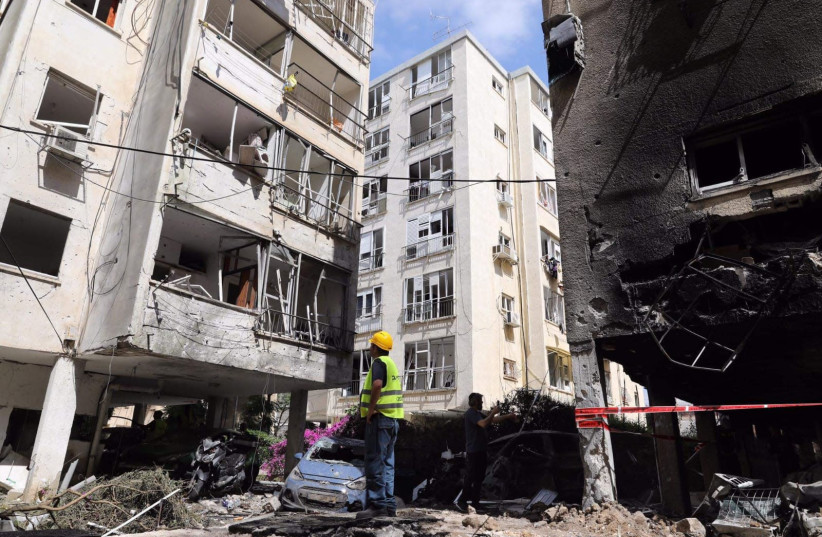
Site where rocket landed in Petah Tikva, May 13, 2021 (photo credit: MARC ISRAEL SELLEM)
Site where rocket landed in Petah Tikva, May 13, 2021
(photo credit: MARC ISRAEL SELLEM)
As the Israeli military intensifies its strike on Hamas, plans for a possible ground invasion of the Gaza Strip will be presented to IDF Chief of Staff Lt.-Gen. Aviv Kohavi for approval later on Thursday.

Speaking to reporters, IDF Spokesperson Brig.-Gen. Hidai Zilberman said that the plans are being put together by the Gaza Division and Southern Command and will then be given to Israel’s political echelon for approval.
The IDF has hit government targets and banks as well senior leaders in the terror organization. On Thursday morning, the IDF struck a terrorist cell that was preparing to launch an anti-tank guided missile (ATGM) towards Israel.
“The organization is losing everything,” Zilberman told reporters on Thursday morning.
“Tonight we started destroying government targets in the Gaza Strip, such as central banks and internal security buildings. Hamas is beginning to discover cracks and there is pressure in the organization, even among the Gaza public who is losing its patience and sees these ruins on the eve of the holiday [of Eid al-Fitr],” he said.
Over 650 targets belonging to Hamas have been struck since the beginning of Operation Guardian of the Walls, such as those belonging to their police, Interior Ministry, banks, homes of commanders including that of the battalion commander of Khan Younis, a naval commando unit and a defensive tunnel inside a school.
Three high-rise buildings were also destroyed by Israel Air Force airstrikes and some 60 Hamas operatives have been killed, including 10 senior commanders.
