John Kerry, Enemy of Israel

U.S. climate envoy John Kerry speaks at a press briefing at the White House in Washington, D.C., January 27, 2021. (Kevin Lamarque/Reuters)

Let’s pause to reflect on how monumentally stunning it is that the former U.S. secretary of state allegedly tattled on Israel to Iran.

NRPLUS MEMBER ARTICLEWe know now that former secretary of state John Kerry isn’t merely a critic of Israel; he is an adversary. In leaked audiotapes obtained by the U.K.-based Iran International, as reported by the New York Times, Iranian foreign minister Mohammad Javad Zarif told a supporter that the former secretary of state had informed him about “at least” 200 covert Israeli actions against Iranian interests in Syria. Zarif listened to this information in “astonishment.”

It’s predictable, perhaps, that the Times glides over this remarkable exchange in a single-sentence paragraph that is submerged near the bottom of the piece. (I guess it’s better …


The fishing zone in the Gaza Strip has been completely closed until further notice.

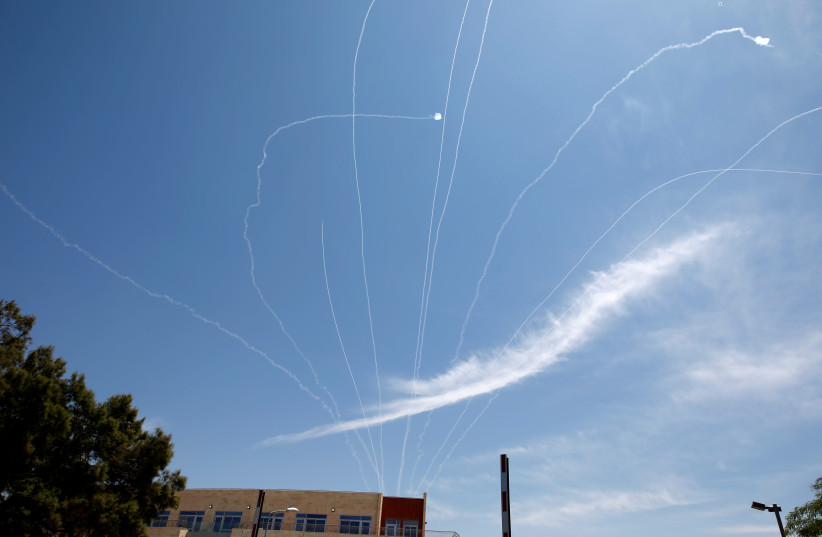
TRAILS ARE seen in the sky as an Iron Dome projectile intercepts a rocket fired from Gaza, above Ashkelon in May 2019.  (photo credit: AMIR COHEN/REUTERS)
TRAILS ARE seen in the sky as an Iron Dome projectile intercepts a rocket fired from Gaza, above Ashkelon in May 2019.
(photo credit: AMIR COHEN/REUTERS)
The IDF will respond powerfully if rocket fire from Gaza continues, the security cabinet decided on Monday after an hours-long debate.

The cabinet authorized Prime Minister Benjamin Netanyahu and Defense Minister Benny Gantz to instruct the IDF to react strongly if Gazan terrorist groups launch more rockets on the heels of a weekend that saw more than 40 rockets launched into southern Israel.

The ministers also voted in favor of an operational plan to strike Hamas.

UN Special Envoy Tor Wennesland and Egypt said Hamas does not want an escalation, Maj.-Gen. Ghassan Alian, coordinator of government activities in the territories (COGAT), told the security cabinet.

Terrorists launched three rockets from Gaza into Israel in the early hours of Monday morning. Iron Dome missiles intercepted two, and one projectile exploded inside the Gaza Strip. More than 40 rockets have been launched from the Gaza Strip into the South since violence began on Friday.

The IDF responded with fighter jets and tank fire on Friday, but it refrained from doing so since then. On Monday, the army denied reports it had reinforced troops near the Gaza Strip.

About 250 Palestinians held protests and burned tires near the security fence in several venues, the IDF said. The army dispersed them with tear gas.

Early Monday morning, Alian said the Gaza Strip fishing zone would be completely closed starting at 6 a.m. until further notice.

COGAT had issued an earlier statement that the fishing zone would be restricted from 15 to nine nautical miles. But after more rockets were fired, the decision was made to completely close it.

“The decision was made in light of repeated terrorist acts from the Gaza Strip against the citizens of the State of Israel during recent days, which constitute a violation of Israeli sovereignty,” COGAT said.

“Hamas is held accountable for all that is done in and from the Gaza Strip toward Israel, and it will bear the consequences for the violence committed against the citizens of the State of Israel,” it said in a statement.

Also on Monday, Col. Iyad Sarhan, head of the coordination and liaison administration for Gaza, approached residents of the Gaza Strip through Facebook and said Hamas was to blame for the escalation. He stressed that by doing so, Hamas was hurting the Strip’s residents.

“The blessed month of Ramadan is intended to be a time for families, and yet, Hamas has chosen a course to the detriment of the Gaza Strip, and rather than investing in the improvement of the civil and economic situation, it is escalating and bringing harm first and foremost to you,” Sarhan said.

“Following three days of rocket fire from the terrorist organizations, Israel has decided to close the fishing zone that has been significantly contributing to the Gaza Strip’s economy and welfare,” he said.

“The security stability is a direct factor that affects the civilian reality in the Strip,” Sarhan said. “Unless the security stability returns, the fishing zone of the Gaza Strip won’t be extended.”


Israeli energy company signs memorandum of understanding with Mubadala Petroleum, owned by Abu Dhabi government


The Tamar offshore natural gas platform. (Delek Drilling)

The Tamar offshore natural gas platform. (Delek Drilling)

Israeli energy giant Delek Drilling announced Monday that it had signed a memorandum of understanding to sell its entire stake in Israel’s Tamar offshore gas field to the Abu Dhabi government-owned Mubadala Petroleum, potentially handing the United Arab Emirates a major share in one of the Jewish state’s key strategic and economic assets less than a year after the countries established diplomatic ties.

The deal for the 22 percent stake is worth $1 billion, with an additional $100 million conditioned on certain terms and goals being met, according to a notification about the agreement sent by Delek Drilling to the Tel Aviv Stock Exchange and the Israel Securities Authority. The companies said they aim to finalize the deal by May 31.

If completed, the deal will be the biggest commercial agreement made so far since Israel and the UAE signed a normalization pact in August 2020, brokered by former US president Donald Trump.

“This transaction has the potential to be another major development in our ongoing vision for Natural Gas commercial strategic alignment in the Middle East, whereby Natural Gas becomes a source of collaboration in the region,” Yossi Abu, CEO of Delek Drilling, was quoted as saying in the statement. “The development is not only a significant endorsement of the quality of the Tamar reservoir and the Levant basin but also a major support for the East Mediterranean Natural Gas sector.”

Under the terms of the so-called gas framework, drawn up by the Israeli government in 2015 to regulate the domestic natural gas market and allow a competitive and decentralized structure, Delek — owned by tycoon Yitzhak Tshuva — was required to sell off its non-operated stake in Tamar by the end of 2021.

Yossi Abu, CEO of Delek Drilling. (Delek Drilling)

The other partners in Tamar are Noble Energy Mediterranean Ltd. (25%), Isramco Negev-2 Limited Partnership (28.75%), Tamar Petroleum Ltd. (16.75%), Dor Gas Exploration Limited Partnership (4%), and Everest Infrastructures Limited Partnership (3.5%).

Mubadala Petroleum is an international oil and gas exploration company, mostly focused on the Middle East, North Africa, Russia, and Southeast Asia, though it has assets in 10 other countries. It is a subsidiary of the Mubadala Investment Company, which is owned by the government of Abu Dhabi.

Discovered in 2009, the Tamar field is located in Israel’s Exclusive Economic Zone, about 90 kilometers west of Haifa in the Mediterranean Sea. It contains around 369 billion cubic meters of recoverable reserves.

Production from the field is piped to a processing facility 25 kilometers off the coast of Ashkelon and another facility opposite the port city of Ashdod.

Six wells at Tamar have an annual production of 11 billion cubic meters, according to Delek figures. In addition to providing natural gas for Israel, some of the gas is also exported to Egypt and Jordan.

Israeli businessman Yitzhak Tshuva speaks at an energy conference in Tel Aviv, February 27, 2018. (Flash90)

The normalization deal between Israel and the UAE, the so-called Abraham Accords, also included normalizing ties with Bahrain. Since then Israel has moved to normalize relations with Sudan and Morocco.

The accords have brought a rush of other major investments, including deals between Israel’s Bank Hapoalim and two financial centers in the UAE.
