
Foreign Ministry appears to rule out mutual trust-building measures, reiterates all US sanctions must be removed before it takes any steps toward compliance with deal


Iranian foreign ministry spokesman Saeed Khatibzadeh during an interview, November 2020 (video screenshot)

Iranian foreign ministry spokesman Saeed Khatibzadeh during an interview, November 2020 (video screenshot)

With the United States and Iran set to open indirect talks next week in Vienna as part of efforts to revive the 2015 nuclear deal, Tehran on Saturday appeared to reject an approach that would see both sides take gradual mutual steps to build trust and return to the accord.

“No step-by-step plan is being considered,” Foreign Ministry spokesman Saeed Khatibzadeh told Iran’s Press TV.

“The definitive policy of the Islamic Republic of Iran is the lifting of all US sanctions, whether those which [former US president Donald] Trump reimposed after withdrawing from the JCPOA or those which he initiated, as well as sanctions imposed under any other heading,” he added.

The European Union is spearheading efforts to bring US President Joe Biden’s administration back into the accord.

Participants in the deal over Tehran’s nuclear ambitions — including China, France, Germany, Russia, and Britain — will meet in person on Tuesday in the Austrian capital, the European Union said after a video conference.

The United States will not take part directly but, for the first time since former leader Donald Trump pulled out of the agreement in 2018, a US delegation will be present.

The European Union said its mediator will hold “separate contacts” with the United States in Vienna.

The painstakingly negotiated 2015 accord saw Iran granted relief from international sanctions in exchange for accepting limits on its nuclear program aimed at easing fears it could acquire an atomic weapon.

Biden has promised to rejoin the agreement on condition Iran first returns to respecting commitments it abandoned in retaliation for Trump pulling out and reimposing swingeing sanctions.

Tehran says Washington has to end the sanctions before it will make any moves to get back in line, and is refusing to hold direct negotiations with the US.

Iranian Foreign Minister Mohammad Javad Zarif insisted the aim of the talks was to “rapidly finalize sanction-lifting and nuclear measures for choreographed removal of all sanctions, followed by Iran ceasing remedial measures.
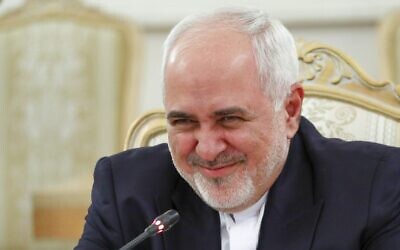
Iranian Foreign Minister Mohammad Javad Zarif smiles during talks in Moscow, Russia, September 24, 2020. (Russian Foreign Ministry Press Service via AP)

“No Iran-US meeting. Unnecessary,” he wrote on Twitter.

US State Department spokesman Ned Price called the Vienna talks a “healthy step forward” and said Washington “remains open” to a direct encounter with Tehran.

He cautioned that “these remain early days, and we don’t anticipate an immediate breakthrough as there will be difficult discussions ahead.”

The deputy State Department spokeswoman, Jalina Porter, said sanctions relief steps will be “up for discussion” but declined to elaborate further.

EU diplomat Enrique Mora described Friday’s virtual meeting that he chaired as “positive,” but warned there was much left to do to revive the deal.

“Substantial work ahead for a key opportunity to bring JCPOA back to life,” he tweeted, using the acronym for the nuclear deal’s formal name.

A senior EU official said Brussels — which acts as coordinator — hoped to see a final agreement on a US return to the deal within the next two months.

The official said two groups of experts from the remaining participant countries would work simultaneously, with one focused on US sanctions and the other on rolling back Iran’s breaches.

In this file photo taken on March 31, 2021, US State Department spokesman Ned Price speaks during a press briefing at the State Department in Washington, DC (Carolyn Kaster / POOL / AFP)

German Foreign Minister Heiko Maas said it was “good that all the relevant actors would meet in Vienna next week.”

“We have no time to waste. A treaty that is fully respected once again would be a plus for security throughout the region,” he said.

Russian diplomat Mikhail Ulyanov said “the impression is that we are on the right track but the way ahead will not be easy and will require intensive efforts. The stakeholders seem to be ready for that.”

“Possible US return to JCPOA apparently will require Washington’s full compliance with the nuclear deal,” he wrote on Twitter.

In 2018, Trump dramatically withdrew from the pact and reimposed crippling economic sanctions on Tehran. The following year, Tehran announced it would start breaking limits agreed on nuclear activity.

The remaining participants in the deal have scrambled in recent years to salvage it from total collapse as Tehran has made good on its threat, while insisting it is not seeking a nuclear weapon.

Mikhail Ulyanov, then head of the Russian Foreign Ministry’s arms control and non-proliferation department, speaks at a news conference in Moscow, Russia, November 2, 2017. (Pavel Golovkin/AP)

Some analysts have seen Biden’s hesitation at immediately removing sanctions as a way to pressure Iran — or a way to preserve political capital for other priorities as the nuclear deal remains fiercely opposed by Trump’s Republican Party.

Republicans quickly pounced on news of the Vienna meeting. Senator Tom Cotton, who has called in the past for attacking Iran, tweeted that the Biden administration was “so desperate to get back to a broken deal that they’re giving up all their leverage and offering concession after humiliating concession.”

But some observers saw the Vienna meeting as a way to break the logjam and return to an accord with which UN inspectors say Iran was complying before Trump trashed it.

“Proximity talks are a creative solution to overcoming the current impasse,” said Suzanne DiMaggio, a senior fellow at the Carnegie Endowment for International Peace.

Israel is also strongly opposed to a return to the deal in its original form, and has communicated as much to Washington. The sides recently reestablished a bilateral group for cooperating in the effort to prevent Iran from acquiring nuclear arms, agreeing to set up a joint team for sharing intelligence about Iran’s nuclear program.


US secretary of state to Foreign Minister Ashkenazi: ‘Israelis and Palestinians should enjoy equal measures of freedom, security, prosperity and democracy’


US Secretary of State Antony Blinken speaks about the release of the '2020 Country Reports on Human Rights Practices,' at the State Department in Washington, March 30, 2021. (Mandel Ngan/Pool via AP)

US Secretary of State Antony Blinken speaks about the release of the ‘2020 Country Reports on Human Rights Practices,’ at the State Department in Washington, March 30, 2021. (Mandel Ngan/Pool via AP)

US Secretary of State Antony Blinken called Friday on Israel to ensure “equal” treatment of the Palestinians as the new US administration cautiously steps up efforts for a two-state solution.

In a telephone call with Foreign Minister Gabi Ashkenazi, Blinken “emphasized the administration’s belief that Israelis and Palestinians should enjoy equal measures of freedom, security, prosperity and democracy,” State Department spokesman Ned Price said.

Blinken also committed to Israel’s security, the “strengthening all aspects of the US-Israel partnership” and voiced support for the Jewish state’s agreements over the past year to normalize relations with four more Arab nations.

The call came amid another spell of political uncertainty in Israel, after last week’s inconclusive election, Israel’s fourth in two years.

US President Joe Biden, while stressing his support for Israel, has also signaled he will back away from the unwavering support of the right-wing Netanyahu by his predecessor Donald Trump.

The administration has stepped up humanitarian aid to the Palestinians and in recent days made clear that it believes that Israel’s control of the West Bank is “occupation.”

“We believe when it comes to settlement activity that Israel should refrain from unilateral steps that exacerbate tensions and that undercut efforts to advance a negotiated two-state solution,” Price said Thursday.

Blinken’s predecessor Mike Pompeo broke precedent by saying he did not consider Israeli construction on land seized in 1967 to be illegal and he visited a settlement in the West Bank last year.

Foreign Minister Gabi Ashkenazi, left, speaks alongside US Secretary of State Mike Pompeo after a security briefing on Mount Bental in the Golan Heights, near the Israeli-Syrian border, November 19, 2020. (AP Photo/Patrick Semansky, Pool)

Blinken has nonetheless made clear that the administration will not roll back some of Trump’s signature moves, including recognizing Jerusalem as Israel’s capital.

Blinken’s call with Ashkenazi came the same day the US revoked sanctions on top officials at the International Criminal Court that were imposed under the Trump administration.

Blinken had said the economic sanctions imposed on ICC chief prosecutor Fatou Bensouda and a top aide in 2019 “were inappropriate and ineffective,” and were therefore lifted.

The Hague-based court is probing alleged war crimes in Afghanistan by Afghan forces, the Taliban and US military. It also recently opened a probe into alleged war crimes by US ally Israel and Palestinian terror groups. Neither the US nor Israel are members of the ICC.

Blinken reportedly informed Ashkenazi of the move before it was announced by the State Department.

Last month, the administration said it “firmly” opposes the ICC’s decision to open an investigation into alleged war crimes committed by Israel and the Palestinians in the West Bank, Gaza Strip and East Jerusalem.

Times of Israel staff contributed to this report.


US State Department spokesman Ned Price said the United States welcomed the meeting as “a positive step.”

Iran's top nuclear negotiator Abbas Araqchi and EEAS Secretary General Helga Schmid attend a meeting of the JCPOA Joint Commission in Vienna, Austria to discuss the Iran nuclear deal (photo credit: REUTERS/KIRSTI KNOLLE)
Iran’s top nuclear negotiator Abbas Araqchi and EEAS Secretary General Helga Schmid attend a meeting of the JCPOA Joint Commission in Vienna, Austria to discuss the Iran nuclear deal
(photo credit: REUTERS/KIRSTI KNOLLE)
PARIS – Officials from Iran, China, Russia, France, Germany and Britain will meet virtually on Friday to discuss a possible return of the United States to the 2015 nuclear deal, the European Union said in a statement on Thursday.

The Biden administration has been seeking to engage Iran in talks about both sides resuming compliance with the deal, under which US and other economic sanctions on Tehran were removed in return for curbs on Iran’s nuclear program to make it harder to develop a nuclear weapon – an ambition Tehran denies.

US President Joe Biden’s predecessor, Donald Trump, withdrew from the deal in 2018 and reimposed US sanctions, prompting Iran, after waiting more than a year, to violate some of the pact’s nuclear restrictions in retaliation.

The United States and Iran have yet to agree even to meet about reviving the deal and are communicating indirectly via European nations, Western officials have said.

“Participants will discuss the prospect of a possible return of the United States to the JCPOA (Joint Comprehensive Plan of Action) and how to ensure the full and effective implementation of the agreement by all sides,” the EU said.

Two diplomatic sources said Britain, France and Germany had already held talks with Iran on Monday and one said there had been talks about an Iranian proposal. The sources spoke on condition of anonymity.

France’s foreign ministry spokeswoman told reporters in a daily briefing that the European powers were working closely with Russia and China – the other remaining parties to the deal – to find a solution to the deadlock and had been talking with both Tehran and Washington.

“These exchanges are more than necessary because Iran has not accepted to take part in direct contacts between the other participants of the JCPOA and the United States … which would have eased discussions,” spokeswoman Agnes von der Muhll said.

Without elaborating, she said that they were now looking at alternative formats to enable talks.

US State Department spokesman Ned Price said the United States welcomed the meeting as “a positive step.”

“We have been clear for weeks now that we are ready to pursue a return to compliance with our JCPOA commitments consistent with Iran also doing the same,” said Price, adding that Washington was willing to achieve that “through a series of initial mutual steps.”
