by Shimon Shapira / JNS.org

OPINION

Posters of Hezbollah’s flag and the terrorist group’s leader, Hassan Nasrallah, in Beirut. Photo: Al Aan Arabic Television via Wikimedia Commons.

JNS.org – An official Hezbollah delegation, headed by Lebanese Parliament member Mohammad Ra’ad, arrived in Moscow on Monday for a three-day visit at the Russian Foreign Ministry’s invitation. Hezbollah representatives met with Russian Foreign Minister Sergey Lavrov; his deputy, Mikhail Bogdanov, President Vladimir Putin’s representative to the Middle East; the national security adviser; and members of the Duma, Russia’s parliament.

Russia is seeking to find a solution to Lebanon’s political crisis, which is preventing the formation of a permanent government in Beirut and threatening the checks and balances underlying the sectarian government system that has existed in Lebanon since 1943.

In the background, the Lebanese economy is collapsing. The Lebanese lira has lost 90 percent of its value since October 2019. The decline in living conditions in Lebanon has already led to angry demonstrations in Beirut that threaten the stability of the state.

At the same time, Hezbollah operates an alternative governmental system, separate from the central government in Beirut. It includes an independent economic system, including Hezbollah banks with ATMs, as well as a health system that provides a partial solution to the state’s inability to cope with the coronavirus pandemic. There is an independent education system, which includes kindergartens, elementary and secondary schools; a scouts framework; and a system of 32 hawzat (religious-studies seminaries) and welfare institutions throughout Lebanon.

To be honest, I have never voted for Netanyahu and the Likud. I would prefer to vote for a center-wing…

Funding for this all-encompassing system is estimated at $1 billion a year, and funds continue to come from Iran despite the economic sanctions imposed on it. In the words of Hezbollah leader Hassan Nasrallah: “As long as Iran has money, we have money … Just as we receive the rockets that we use to threaten Israel, we are receiving our money.”

Iran’s maintenance of Hezbollah in Lebanon does not stem from any altruistic motive. Large parts of the Shi’ite community are faithful to the theological principle of Velâyat-e Faqih, which views Iranian Supreme Leader Ali Khamenei as the political and religious guardian and Nasrallah as his representative in Lebanon.

Iran’s expanding footprint in Lebanon

Since the outbreak of the uprising in Syria a decade ago, Iran has increased its involvement in Hezbollah’s affairs. Nasrallah was forced to comply with then-Iranian Quds Force commander Gen. Qassem Soleimani’s orders and send more than 8,000 fighters to Syria. More than 2,000 returned in coffins, and twice as many were wounded in the fighting.

When the commander of Hezbollah forces in Syria, Mustafa Badreddine, expressed reservations about Hezbollah’s continued participation in the war in Syria, he was eliminated by Soleimani, with Nasrallah’s consent. There is no portrait of Badreddine, one of Hezbollah’s most important commanders, among the pictures on display during the “Day of The Martyred Commanders,” alongside Ragheb Harb, Abbas al-Musawi and Imad Mughniyeh.

Nasrallah is aware of the weight of responsibility Iran places on his shoulders. The collapse of the central government in Beirut, together with the dysfunction of the government and economic systems, transformed Lebanon from a failed state to a Hezbollah state, where Hezbollah’s alternative system is fully backed by Iran.

Hezbollah refrains from formally taking over the governing structure, and Nasrallah understands the far-reaching significance of seizing power at Lebanon’s presidential palace in Baabda. At this stage, Iran has geostrategic objectives that prevent it from realizing the vision of turning Lebanon into an Islamic republic as Ayatollah Khomeini commanded. Iran’s immediate goal is to take advantage of the window of opportunity opened by the Biden administration and return to the nuclear agreement on Tehran’s terms.

However, the internal processes in Lebanon seem to be advancing at a faster rate than Iran and Hezbollah would like. In this situation, an extreme scenario may arise in which the Lebanese state will fall into Hezbollah’s hands like a ripe fruit, enabling Iran to realize its vision of taking over the country. That scenario presents Iran with the following strategic options:

• Bringing warships into the Port of Beirut and taking it over, taking advantage of Hezbollah’s control of Beirut International Airport to use it as a military airfield, while at the same time establishing a military airfield in Baalbek.

• Sending the Quds Force from Iran and Syria to Lebanon’s Baalbek and Baqaa regions, to serve as an umbrella for Afghani, Pakistani, Iraqi and Yemeni Shi’ite militias, which will enter from Syria. These forces were previously invited by Nasrallah to participate in the next war against Israel.

Hezbollah would threaten that any attacks on Iranian and Shi’ite forces in Lebanon would result in missile strikes deep inside Israel, and, with Iran’s support, increase the production of precision warheads for long- and medium-range missiles.

The scenario is extreme, but given the continued deterioration of the situation in Lebanon, not impossible. Such a development would alter the regional balance of power and directly threaten Israel.

IDF Brig. Gen. (ret.) Dr. Shimon Shapira is a senior research associate at the Jerusalem Center for Public Affairs. He served as military secretary to the prime minister and as Israel’s Foreign Ministry chief of staff. He is the editor of the Jerusalem Center eBook “Iran: From Regional Challenge to Global Threat.”


Can ships be defended from Iranian attacks in the Gulf?

No real attempt has been made to protect tankers and cargo ships, making them vulnerable.

An oil tanker loads gas in Assaluyeh seaport at the Persian Gulf, 1,400 km (870 miles) south of Tehran, Iran May 27, 2006. (photo credit: MORTEZA NIKOUBAZI/ REUTERS)
An oil tanker loads gas in Assaluyeh seaport at the Persian Gulf, 1,400 km (870 miles) south of Tehran, Iran May 27, 2006.
(photo credit: MORTEZA NIKOUBAZI/ REUTERS)
Iran’s attacks on ships in May and June 2019, as well as the recent incident involving an Israeli-owned ship in the Gulf of Oman, continue to raise questions about the vulnerability of shipping to attacks from both states and non-state terrorists.

Tankers and cargo ships are particularly vulnerable, and there has been no real attempt to find a way to protect them or even punish those who might attack these types of vessels.

When six ships were targeted in May and June of 2019, the US and European countries sought to increase maritime security in the Gulf. That seemed to reduce the attacks, although it was unclear if Iran was deterred or merely shifted tactics, not wanting too much evidence of its involvement to come to light.

Although the US blamed Iran, many countries held back from punishing Iran for the actions of those two months. It appears this sent a message that Iran continued to enjoy impunity. It is not clear if the February 26 incident involving the Israeli-owned Helios Ray has had any consequences for the perpetrators.

Attacks on shipping are not a new phenomenon. During the Iran-Iraq war in the 1980s, there was a “tanker war” that developed between the two countries that threatened to suck the Gulf and the US into conflict.

Some 40% of the world’s oil came through the Straits of Hormuz in the 1980s, leading the US to launch Operation Ernest Will in 1987 in response to the tanker war, to protect the oil supply and reflag tankers with US flags to stop Iran’s attacks.

Later ships were plagued by piracy off the coast of Somalia, leading to another round of security initiatives to protect shipping.


2,000-year-old biblical manuscripts discovered in Judean Desert cave in Israel • First discovery of this kind since Dead Sea Scrolls.

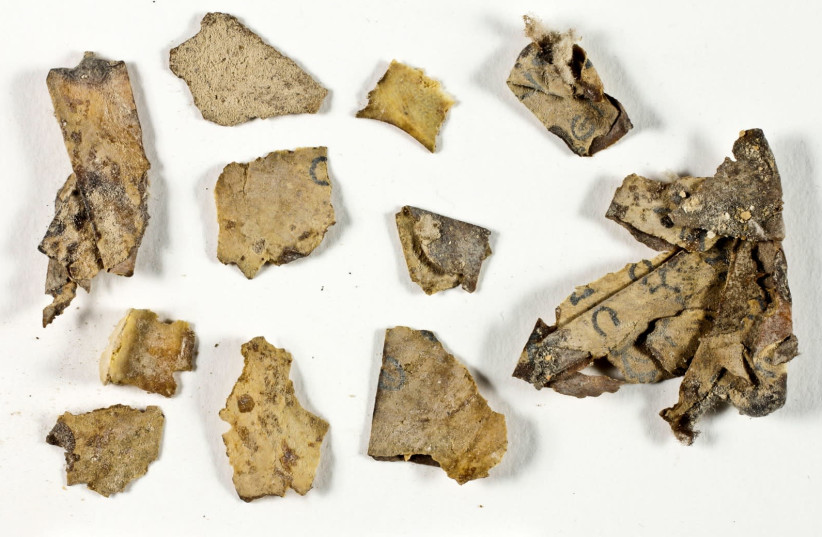
Sections of the Book of the Twelve Minor Prophets scroll discovered in the Judean Desert expedition prior to their conservation. (photo credit: SHAI HALEVI / ISRAEL ANTIQUITIES AUTHORITY)
Sections of the Book of the Twelve Minor Prophets scroll discovered in the Judean Desert expedition prior to their conservation.
(photo credit: SHAI HALEVI / ISRAEL ANTIQUITIES AUTHORITY)
A 2,000 year old biblical scroll was unearthed in the Judean desert, the Israel Antiquities Authority announced Tuesday. The groundbreaking discovery marks the first time that such an artifact is uncovered in decades, since the time of the Dead Sea Scrolls.

Excavations in Muraba‘at Cave. Photo: Yoli Schwartz, Israel Antiquities AuthorityExcavations in Muraba‘at Cave. Photo: Yoli Schwartz, Israel Antiquities Authority

The fragments were found in a cave in the Judean Desert, as a result of a several-year-long operation with the purpose of surveying all the caves of the area carried out by the IAA in cooperation with Staff Officer of the Archaeology Department of the Civil Administration in Judea and Samaria, and funded by the Ministry of Jerusalem Affairs and Heritage.

The excavation of the caves was conducted in difficult conditions Photo: Yoli Schwartz, Israel Antiquities AuthorityThe excavation of the caves was conducted in difficult conditions Photo: Yoli Schwartz, Israel Antiquities Authority

“These are the things you are to do: Speak the truth to one another, render true and perfect justice in your gates. And do not contrive evil against one another, and do not love perjury, because all those are things that I hate—declares the Lord,” one of the fragments reads, featuring an excerpt of the biblical book of Zecharia.
The scroll was written in Greek, but God’s name appears in paleo-Hebrew. It contains passages from the Minor Prophets, including Nahum.
“The aim of this national initiative is to rescue these rare and important heritage assets from the robbers’ clutches,” IAA director Israel Hasson said in a press release. “The newly discovered scroll fragments are a wakeup call to the state. Resources must be allocated for the completion of this historically important operation. We must ensure that we recover all the data that has not yet been discovered in the caves, before the robbers do. Some things are beyond value.”
The cave, known as “the Cave of Horror” in the Judean Desert reserve’s Nahal Hever, stands some 80 meters below the cliff top and can be accessed only by clinging to ropes.

Rappelling to the Cave of Horror. Photo: Eitan Klein, Israel Antiquities AuthorityRappelling to the Cave of Horror. Photo: Eitan Klein, Israel Antiquities Authority

First discovery of this kind since the Dead Sea Scrolls

“This is definitely an exciting moment, as we present and reveal to the public an important and significant piece in the history and culture of the Land of Israel,” Hananya Hizmi, Head Staff Officer of the Archaeology Department of the Civil Administration in Judea and Samaria. “In as early as the late 1940s, we became aware of the cultural heritage remains of the ancient population of the Land of Israel with the first discoveries of the Dead Sea Scrolls. Now, in this national operation, which continues the work of previous projects, new finds and evidence have been discovered and unearthed that shed even more light on the different periods and cultures of the region. The finds attest to a rich, diverse and complex way of life, as well as to the harsh climatic conditions that prevailed in the region hundreds and thousands of years ago.”
The conditions of the region remain challenging to this day. Some 80 kilometers of caves have been surveyed within the operation, including very remote and inaccessible hollows. Drones and mountain equipment were employed. About half of the area is still to be explored.

Excavations at Qumran. Photo: Shai Halevi, Israel Antiquities AuthorityExcavations at Qumran. Photo: Shai Halevi, Israel Antiquities Authority

Besides for the manuscript, the cave harbored several other unique findings, including a trove of coins from the time of the Bar Kochba Revolt, the skeleton of a child dating back to some 6,000 years, and a 10,000 year old exceptionally preserved basket which experts say might be the earliest item of this kind ever uncovered.

A rare cache from the Bar Kokhba period. Photo: Dafna Gazit, Israel Antiquities AuthorityA rare cache from the Bar Kokhba period. Photo: Dafna Gazit, Israel Antiquities Authority

The skeleton, which probably belonged to a child aged 6-12, was wrapped into a cloth and mummified.
“On moving two flat stones, we discovered a shallow pit intentionally dug beneath them, containing a skeleton of a child placed in a fetal position,” IAA prehistorian Ronit Lupu explained. “It was obvious that whoever buried the child had wrapped him up and pushed the edges of the cloth beneath him, just as a parent covers his child in a blanket. A small bundle of cloth was clutched in the child’s hands. The child’s skeleton and the cloth wrapping were remarkably well preserved and because of the climatic conditions in the cave, a process of natural mummification had taken place; the skin, tendons, and even the hair were partially preserved, despite the passage of time.”