
PM issues warning after Tehran begins restricting access to IAEA inspectors, in further breach of nuke deal; top Israeli officials hold policy meeting as US seeks to reenter accord
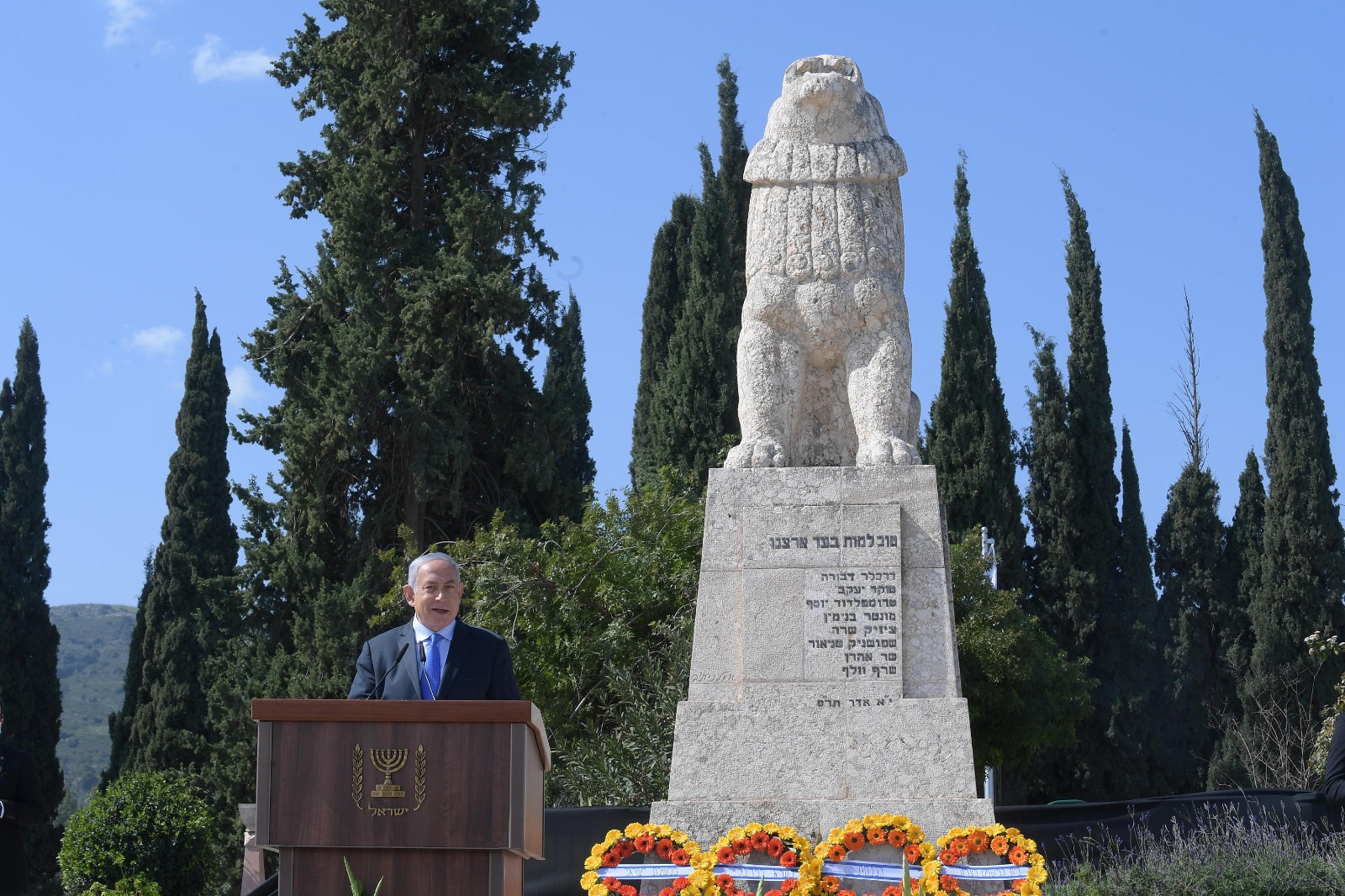
 

Prime Minsiter Benjamin Netanyahu gives a speech at a memorial ceremony in Tel Hai on February 23, 2021. (Amos Ben Gershom/GPO)

Prime Minsiter Benjamin Netanyahu gives a speech at a memorial ceremony in Tel Hai on February 23, 2021. (Amos Ben Gershom/GPO)

Prime Minister Benjamin Netanyahu on Tuesday vowed Israel would prevent Iran from obtaining a nuclear weapon, regardless of whether a multilateral accord is in place to prevent Tehran from doing so.

The comments came hours after Iranian state TV reported that the Islamic Republic has officially begun restricting international inspections of its nuclear facilities.

“On the eve of the Purim holiday, I say to those who seek to harm us — Iran and its proxies in the Middle East: 2,500 years ago, another Persian tyrant tried to destroy the Jewish people and just as he failed then – you too will fail,” Netanyahu said at a memorial ceremony in the northern town of Tel Hai, referencing the Purim story.

Addressing Iranian leaders, Netanyahu said Israel wouldn’t allow “your extremist and aggressive regime” to acquire nuclear arms.

“We did not make the generations-long journey for thousands of years back to the Land of Israel, to allow a delusional regime of the ayatollahs to end the story of the resurrection of the Jewish people,” he said.

“We do not place our trust in any agreement with an extremist regime like yours,” Netanyahu said, in remarks likely to make the Biden administration uneasy as it seeks to reenter the 2015 nuclear deal limiting Iran’s nuclear program, which former president Donald Trump unilaterally withdrew the US from in 2018.
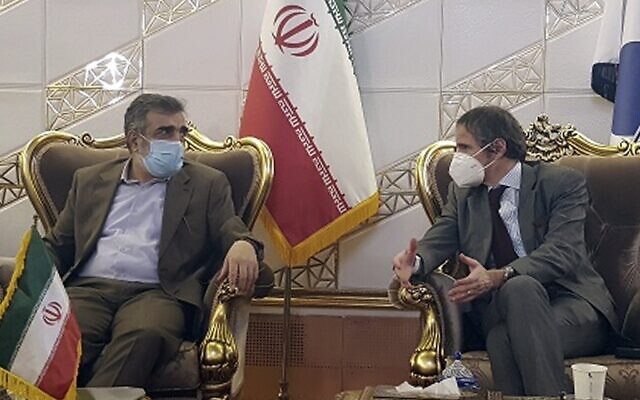
In this February 20, 2021, photo, Director General of International Atomic Energy Agency, IAEA, Rafael Mariano Grossi, right, speaks with the spokesman of Iran’s atomic agency Behrouz Kamalvandi upon his arrival at Tehran’s Imam Khomeini airport, Iran. (Atomic Energy Organization of Iran via AP)

The premier added: “We have already seen the nature of agreements with extremist regimes like yours, in the past century and also in this century, with the North Korean government. With an agreement or without an agreement, we will do whatever is necessary so you do not arm yourselves with nuclear weapons.”

On Monday, Netanyahu held the first major intra-ministerial meeting to discuss Israel’s policy vis-a-vis Iran since US President Joe Biden took office.

Among the senior officials who took part in the meeting were Defense Minister Benny Gantz, Foreign Minister Gabi Ashkenazi, IDF Chief of Staff Aviv Kohavi, Mossad chief Yossi Cohen and Israel’s Ambassador to the US Gilad Erdan.

Also participating were former national security council chairmen Yaakov Amidror and Yaakov Nagel, who Netanyahu is bringing on as external advisers on the issue, the Walla news site reported. Both of them are considered to have a hawkish stance on Iran more in line with Netanyahu’s.

Amidror was national security adviser while the agreement was being crafted and sparred with his American counterpart at the time, Susan Rice. Nagel, a nuclear expert, also served as an adviser during that period but stayed on longer, leading talks with the Trump administration to institute its “maximum pressure” sanctions campaign.
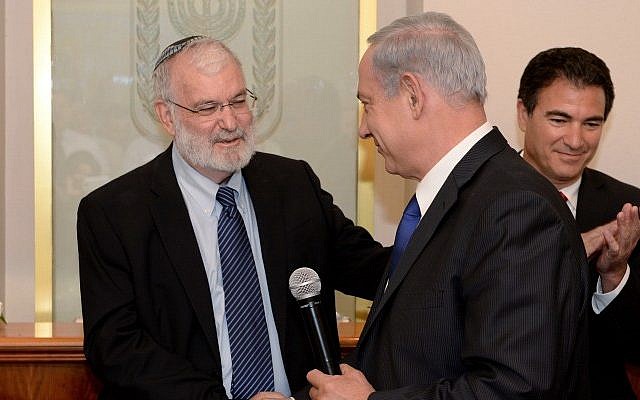
Outgoing national security adviser Yaakov Amidror with Prime Minister Benjamin Netanyahu at a farewell ceremony in Amidror’s honor, on November 3, 2013. (Kobi Gideon/GPO/Flash90)

Also expected to serve as an external adviser on the matter is longtime Netanyahu aide and Erdan’s predecessor Ron Dermer, who is set to return to Israel in the coming weeks.

During Monday’s meeting, Kohavi and Cohen emphasized the importance of working to build goodwill with the new US administration by not sparring publicly with Washington over the Iran deal, Walla reported.

“We have not moved from our position against returning to the nuclear deal, but we want to work together with the administration and have a constructive discussion with it, not a confrontation,” a senior official said.

Additionally, Netanyahu plans to delegate talks on Iran to senior staff to prevent any personal tension between him and Biden, according to Reuters.

“The intent is to work everything out at that level, and to keep that communication channel open,” a senior official told Reuters. “Obviously this has benefits where there is a risk of a ‘cold shoulder’ at chief-executive level.”
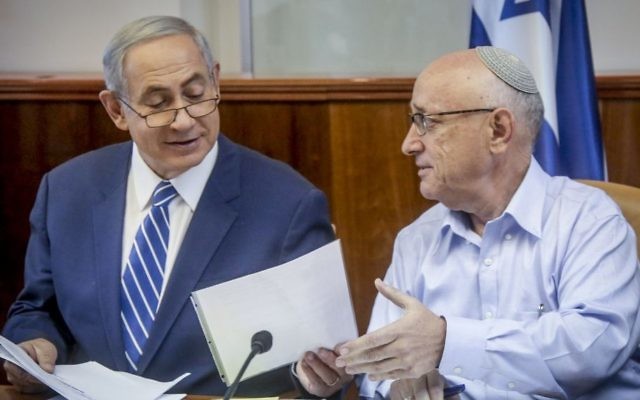
Prime Minister Benjamin Netanyahu (L) sits with former interim Israeli National Security Adviser Yaakov Nagel (R) at the weekly cabinet meeting at the Prime Minister’s Office in Jerusalem on September 18, 2016. (Marc Israel Sellem/Flash90)

Jerusalem is hoping to keep disputes with the new administration “under the radar” for the time being, Army Radio reported.

Also Tuesday, the Kan public broadcaster reported that senior Israeli and Saudi officials have recently held several phone calls to discuss the Biden administration’s plans to rejoin the Iran nuclear deal.

During the conversations, the Saudis also expressed concern over the new US administration and lamented its focus on human rights violations in the kingdom, the report said. Israel and Saudi Arabia do not have diplomatic relative but have maintained clandestine ties. Netanyahu visited Saudi Arabia in November for the first known meeting between Israeli and Saudi leaders.


Netanyahu after Iran strategy meeting: Nuclear agreement is worthless

“Israel isn’t pinning its hopes on an agreement with an extremist regime like Iran. With or without an agreement we will do everything so Iran isn’t armed with nuclear weapons.”

Prime Minister Benjamin Netanyahu at the memorial service for the 1920 Battle of Tel Hai, February 23, 2021.  (photo credit: DAVID COHEN/FLASH 90)
Prime Minister Benjamin Netanyahu at the memorial service for the 1920 Battle of Tel Hai, February 23, 2021.
(photo credit: DAVID COHEN/FLASH 90)
Israel will not rely on efforts to return to a nuclear deal with Iran, Prime Minister Benjamin Netanyahu said on Tuesday.
“Israel isn’t pinning its hopes on an agreement with an extremist regime like [Iran]. We already saw what these agreements are worth…with North Korea,” Netanyahu said at a memorial service for the 1920 Battle of Tel Hai.
“With or without an agreement,” he added, “we will do everything so [Iran isn’t] armed with nuclear weapons.”
Netanyahu referred to the story of Purim, which begins on Thursday night: “2,500 years ago, a Persian oppressor tried to destroy the Jewish people, and just as he failed then, you will fail today…We didn’t make a journey of thousands of years to return to the Land of Israel in order to allow the delusional Ayatollahs’ regime to finish the story of the rebirth of the Jewish People.”
Netanyahu’s remarks came a day after he met with Defense Minister Benny Gantz, Foreign Minister Gabi Ashkenazi, IDF Chief of Staff Aviv Kochavi Mossad chief Yossi Cohen, National Security Adviser Meir Ben-Shabbat, Ambassador to the US Gilad Erdan and others, to discuss Israel’s strategy and response to the Biden administration’s attempted rapprochement with Iran.
In recent days, US Secretary of State Antony Blinken said in a statement with the European countries party to the 2015 Iran Deal that the US is seeking to start a dialogue with Iran and move towards a return to that agreement. Officials in Washington have called on Iran to return to compliance with the deal before the US would remove sanctions.
Officials in the meeting were split on whether Israel should advocate for the US to stay out of the Iran Deal until it can get a better, more secure agreement, or be more supportive of what US President Joe Biden’s stated plan is, to rejoin the Joint Comprehensive Plan of Action, as the 2015 deal is known, and then negotiate tougher terms. Netanyahu reportedly took the first, harder line, while Gantz and Ashkenazi supported a less-confrontational approach.


Iran’s leader also warns it may enrich uranium to 60%, as it steps further away from nuclear deal; top US diplomat says DC willing to reenter pact if Tehran in ‘strict compliance’


Supreme Leader Ayatollah Ali Khamenei speaks during a meeting with army's air force and air defense staff in Tehran, Iran, February 7, 2021 (Official Website of the Office of the Iranian Supreme Leader via AP)
Supreme Leader Ayatollah Ali Khamenei speaks during a meeting with army’s air force and air defense staff in Tehran, Iran, February 7, 2021 (Official Website of the Office of the Iranian Supreme Leader via AP)

Iranian Supreme Leader Ayotallah Ali Khamenei claimed Monday that his country has no interest in a nuclear weapon, but said that if it wanted one, no one — including Israel — could prevent it.

Khamanei also said Iran could increase uranium enrichment to 60 percent, in the latest sign of the Islamic Republic stepping away from the 2015 nuclear deal, as the Biden administration seeks to revive the accord rejected by former US president Donald Trump.

“That international Zionist clown has said they won’t allow Iran to produce nuclear weapons. First of all, if we had any such intention, even those more powerful than him wouldn’t be able to stop us,” Khamenei wrote on his Twitter account, in apparent reference to Israel’s Prime Minister Benjamin Netanyahu.

Netanyahu, a leading critic of the nuclear deal, has repeatedly vowed Israel is prepared to act militarily to prevent Iran from obtaining an atomic weapon.

Khamenei again insisted Iran has no interest in acquiring nuclear arms, a position he said was “based on Islamic fundamentals and commands that prohibit weapons that are used for killing ordinary people.” He then charged: “The one that massacres 220,000 people with nuclear weapons is the US.”

But at the same time he vowed to “not back down on the nuclear issue” and indicated Iran would further ramp up uranium enrichment.

An Iranian technician walks through the Uranium Conversion Facility just outside the city of Isfahan 255 miles (410 kilometers) south of the capital Tehran, Iran, February 3, 2007. (Vahid Salemi/AP)

“Iran’s enrichment limit will not be 20%, and we will act to the point that is needed and the country requires,” he was quoted as saying on his official website, adding that “we may bring enrichment to 60%” for nuclear propellants and other purposes.

Iran is currently enriching uranium to 20%, which is just a technical step away from weapons-grade levels of 90%. Under the accord limiting Iran’s nuclear program in exchange for sanctions relief, Tehran was limited to enriching uranium to 3.67%.

Khamenei’s remarks came as Secretary of State Antony Blinken said the United States was prepared to return to the nuclear deal if Tehran shows “strict compliance” with it.

Speaking to the UN-backed Conference on Disarmament, Blinken laid out a US wish list about many issues including the proliferation of weapons of mass destruction and space-borne threats in the future. He expressed concerns about a Russian anti-satellite weapons test last year and China’s “provocative and dangerous weapons development programs,” in addition to the message about Iran.

Blinken’s comments by video signaled another step by the Biden administration to re-engage with many international institutions and agreements that were shunned, rejected or largely ignored by Trump. It is the first time in years that a top US diplomat has spoken to the disarmament body, which has become mainly a venue for countries to voice concerns about disarmament because it has failed to usher in any accords.

The comments on Iran were perhaps Blinken’s most timely message, coming in the wake of fresh signs that Tehran is moving away from — not toward — compromise with Western governments over the nuclear deal.

Blinken said the United States is prepared to return to the accord “if Iran comes back into strict compliance” with it.

He emphasized that the US remains committed to making sure that Iran “never acquires a nuclear weapon,” adding: “Diplomacy is the best path to achieve that goal.”

Working with allies and partners, he said the US will aim to “lengthen and strengthen” the nuclear deal, which was struck during the Obama administration between Iran and Germany, France, Britain, Russia, China and the US. Trump pulled the US out three years later.

US Secretary of State Antony Blinken (R) speaks to staff at the State Department in Washington during US President Joe Biden’s first visit, February 4, 2021. (Saul Loeb/AFP)

On Sunday, International Atomic Energy Agency chief Rafael Grossi told reporters after an emergency trip to Tehran that Iran’s government would begin offering “less access” to UN weapons inspectors — involving unspecified changes to the type of activity the agency can carry out.

Grossi said that monitoring would continue in a “satisfactory” manner, pointing to a three-month “technical understanding” to ensure some type of inspections would continue. He stressed that European and US leaders needed to salvage the situation through negotiations.

Khamenei said Monday that Iran must make good on its pledge to end international inspections at its nuclear facilities. Iran’s conservative-dominated parliament months ago passed a law stipulating that if the US does not lift sanctions by this Sunday, Iran will suspend some IAEA inspections from Tuesday.

“God willing, tomorrow another part of this legislation will be implemented. This law, which is good, should be executed precisely,” he tweeted.

According to a report Friday, International Atomic Energy Agency inspectors last summer found uranium particles at two Iranian nuclear sites that Iran tried to block access to.

Iranian authorities had stonewalled the inspectors from reaching the sites for seven months before the inspection, and Iranian officials have failed to explain the presence of the uranium, the Reuters news agency reported, citing diplomats familiar with the UN agency’s work.

The inspections took place in August and September of 2020, the report said. The IAEA keeps its findings secret and only shared the details of the find with a few countries.

The Wall Street Journal reported the suspicious findings earlier this month, without identifying the material.

The Reuters report did not identify the sites. Earlier reports said one of the sites was in Abadeh, south of Isfahan — a location that in September 2019 was flagged by Netanyahu as the site of an alleged secret nuclear facility. Iran denies that it seeks nuclear weapons; Netanyahu is adamant that the regime is fooling the world, and has said that a trove of nuclear documents concerning its rogue program, smuggled out of Tehran by the Mossad two years, proves Iran’s duplicity.

https://www.timesofisrael.com/khamenei-if-we-wanted-nukes-nobody-including-zionist-clown-could-stop-us/
