
Iran Tells IAEA It Plans to Scale Back Cooperation in a Week

by Reuters and Algemeiner Staff
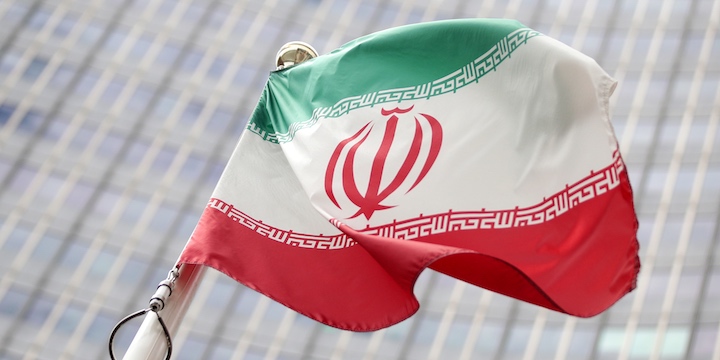
The Iranian flag flutters in front the International Atomic Energy Agency (IAEA) headquarters in Vienna, Austria July 10, 2019. Photo: REUTERS/Lisi Niesner

Iran has told the UN nuclear watchdog it will dramatically scale back cooperation with it in a week, a report by the agency to its member states showed on Tuesday, ratcheting up protests against US sanctions still choking its economy.

Iran has accelerated its breaches of its 2015 nuclear deal with major powers in recent months, partly as demanded by a law passed in response to the killing in November of its top nuclear scientist, which Tehran has blamed on its foe Israel.

The breaches began in 2019 in response to a US withdrawal from the deal under then-President Donald Trump, and Iran is now locked in a standoff with President Joe Biden’s administration over who should move first to save the accord.

“Iran informed the IAEA on 15 February that the country will stop implementing voluntary transparency measures under the JCPOA as of 23 February, including the Additional Protocol,” an International Atomic Energy Agency statement said. JCPOA stands for the Joint Comprehensive Plan of Action, the deal’s official name.

FEBRUARY 16, 2021 11:27 AM
0

US Forces in Iraq Hit by Rockets, Contractor Killed

A rocket attack on US-led forces in northern Iraq killed a civilian contractor on Monday and injured a US service member, the US coalition…

Under the deal, Iran is applying the Additional Protocol, which grants the IAEA the power to carry out short-notice inspections at locations not declared to it. It is in addition to core obligations under a country’s so-called Safeguards Agreement with the IAEA. Iran has signed but not ratified it.

The IAEA gave more details on what Iran had told it, however, in a report to its member states on Tuesday seen by Reuters. It listed seven other “transparency measures” that Iran said it plans to stop implementing, some of them worded very similarly to section headings in the text of the deal.

“Use of modern technologies and long term presence of IAEA” was one item, which is a close match for a section of the deal that increased the number of designated IAEA inspectors for Iran and required Tehran to allow the use of technologies like online measurement of uranium enrichment and electronic seals, which enable remote, real-time monitoring of activity by the agency.

“Transparency measures related to enrichment” was another, resembling a section of the deal that says Tehran will grant the agency “regular access, including daily access as requested by the IAEA, to relevant buildings at Natanz”, Iran’s main uranium enrichment site.

“Given the serious impact of the above-mentioned measures being implemented”, IAEA Director General Rafael Grossi reminded Iran of an offer to visit to “find a mutually agreeable solution for the agency to continue essential verification activities”, the report added, referring to a letter sent by Grossi to Tehran on Tuesday.

Germany has warned Iran against obstructing IAEA inspections, saying it would be “completely unacceptable” and urging it to desist to give diplomacy a chance, a diplomatic source in Berlin told Reuters on Tuesday.

Iran Tells IAEA It Plans to Scale Back Cooperation in a Week

Israel hints it may not engage Biden on Iran nuclear strategy

“We will not be able to be part of such a process if the new administration returns to that deal,” Ambassador Gilad Erdan told Israel’s Army Radio.

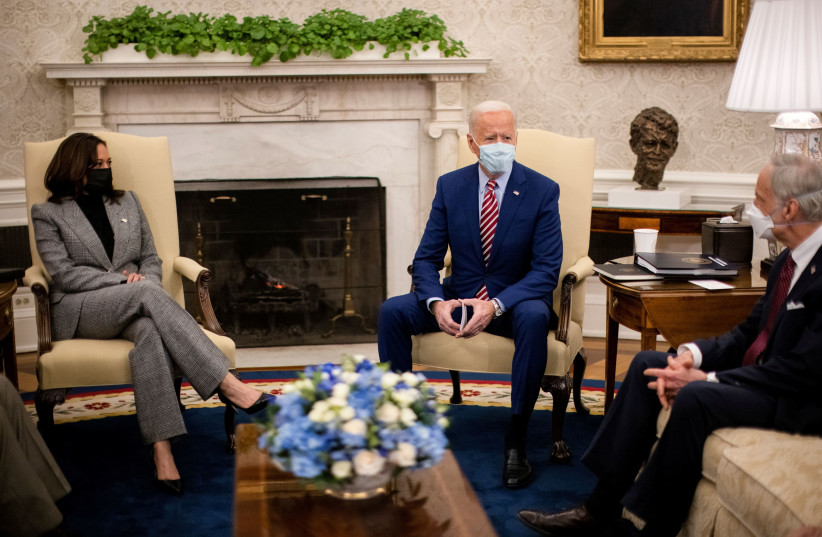
 U.S. President Joe Biden and U.S. Vice President Kamala Harris attend a meeting with bipartisan Senators on infrastructure investment at the Oval Office of the White House in Washington, U.S., February 11, 2021 (photo credit: CARLOS BARRIA / REUTERS)
U.S. President Joe Biden and U.S. Vice President Kamala Harris attend a meeting with bipartisan Senators on infrastructure investment at the Oval Office of the White House in Washington, U.S., February 11, 2021
(photo credit: CARLOS BARRIA / REUTERS)
Israel held out the possibility on Tuesday it would not engage with US President Joe Biden on strategy regarding the Iranian nuclear program if he returns to a 2015 deal with Tehran.

The remarks by Israel’s envoy to Washington came at a touchy juncture for Prime Minister Benjamin Netanyahu. Up for re-election next month, he has revived tough rhetoric on Iran while not yet having any direct communication with Biden.
The new administration has said it wants a US return to the 2015 nuclear deal – which former President Donald Trump quit, restoring sanctions on Tehran – if the Iranians recommit to their own obligations. Washington has also said it wants to confer with allies in the Middle East about such moves.
“We will not be able to be part of such a process if the new administration returns to that deal,” Ambassador Gilad Erdan told Israel’s Army Radio.
Netanyahu aides have privately questioned whether engaging with US counterparts might backfire, for Israel, by falsely signaling its consent for any new deal that it still opposes.
Israel was not a party to the 2015 deal. It has powerful advocates within the US Congress, however, and Netanyahu’s threats to take unilateral military action on Iran if he deems diplomacy a dead end also figure into big-power planning.
“We think that if the United States returns to the same accord that it already withdrew from, all its leverage will be lost,” Erdan said.


Prof. Eytan Gilboa, an expert on US-Israel relations, does not buy the White House’s explanations for Biden not yet having called Netanyahu.
Tags: Joe Biden Professor Eytan Gilboa Binyamin Netanyahu Israel-US

Shimon Cohen , Feb 16 , 2021 6:13 AM
Joe Biden

Joe Biden

09:00
זה לא במקרה. פרופ’ גלבוע

Prof. Eytan Gilboa, an expert on US-Israel relations from Bar Ilan University, spoke to Arutz Sheva on Monday about the fact that US President Joe Biden has yet to call Prime Minister Binyamin Netanyahu since taking office.

Biden is “methodically ignoring” Netanyahu, said Gilboa, adding, “I do not accept the explanations of the spokespeople of the White House and State Department for this. There are two reasons for this ignoring. One is that Biden wants to prove that there is now a new White House and there will not be the intimate relationship Netanyahu had with Trump and therefore Netanyahu is in a low priority.”

“The second reason has to do with the elections [in Israel]. Biden does not want to be seen as helping Netanyahu. He remembers, perhaps traumatically, that three weeks before the 2015 election, Netanyahu arrived in Washington to address the two houses of Congress against Obama’s plan for a nuclear deal with Iran.”

“It is difficult to accept the arguments made by the White House, that he apparently has more important internal issues to deal with such as the coronavirus and the interracial crisis, because the Americans do deal with Middle Eastern affairs all the time. They want to reach a nuclear agreement with the Iranians. They talk about suspending or freezing arms deals with the United Arab Emirates and Morocco and talking about changing attitudes toward the Palestinians such as opening a consulate in East Jerusalem and restoring $400 million in aid to the PA, restoring aid to UNRWA and reopening the PLO office in Washington that Trump shut down. Therefore, it is not true to say that the Middle East does not interest them as much, but rather that Netanyahu does not interest them as much,” argued Gilboa.

Prof. Gilboa estimated that “Biden would like a different Prime Minister,” and to that end he would prefer even a more right-wing Prime Minister provided it is not Netanyahu.

“There are two main reasons for this. One is that [Netanyahu] represents problematic policies, especially regarding the settlements, and the second is that Netanyahu does not seem credible because he made promises to American administrations and did not keep them. Therefore, even another right-wing Prime Minister would be better than Netanyahu [as far as Biden is concerned]. He would prefer Bennett and Sa’ar over Netanyahu for these reasons,” Gilboa asserted.

“The interesting thing is that the White House says that Biden has not spoken to any leader in the Middle East. That is true, but he can’t both not talk to Netanyahu and also bypass him and talk to leaders of Arab countries. He will not be able to talk to Arab leaders without talking to Netanyahu. Until now he has spoken to US allies, he spoke to China, which is going to be one of the important issues in his foreign policy. The fact that he did not call Netanyahu does not mean that he does not see Israel as an important ally. This is about Netanyahu himself and not necessarily about Israel.”

Gilboa added that “past disagreements are having an impact, from Netanyahu’s support for Mitt Romney and Trump in the previous election campaigns, the close relationship with Trump and the famous speech Netanyahu gave against Obama on the Iranian nuclear issue and relations with the Palestinians. This has left a lot of impact and most of the people in the administration who are engaged in foreign relations are people who have accounts to settle with Netanyahu. It can harm the relationship.”

On the proposals made by various personalities in Israel to gravitate more toward Russian President Vladimir Putin and China and thus make it clear to Biden that Israel is not in the pocket of the Americans, Prof. Gilboa said that this is impossible.

“Our dependence on the US is significant so no one can replace them. China and Russia have dictatorial governments that the values ​​that Israel represents are the last thing that interests them, so they cannot be trusted,” he said.

“In addition, we receive $3.8 billion worth of military aid from the United States, all of our equipment and aircraft are from the United States. We will not get such planes from anywhere else. The support for Israel in international organizations, even if it is not the same as it was during the Trump era, is still significant. Same goes for the International Criminal Court and for other organizations and institutions. Our dependence on them is irreplaceable,” added Prof. Gilboa.
