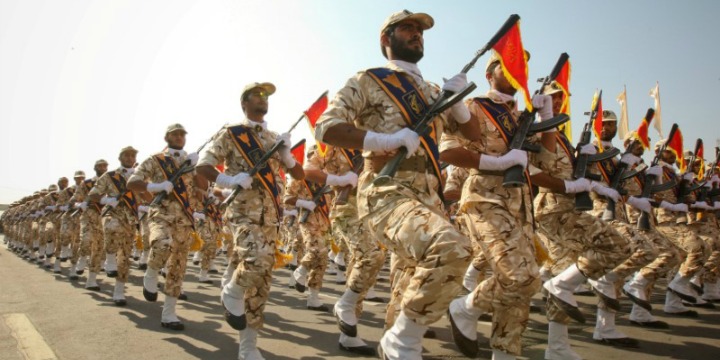
Iran’s willingness to use drones and cruise missiles to target Saudi Arabia and allegations of Iranian patrol boats last year in the Gulf of Oman, mean countries know what Iran’s response could look like.

by Seth J. Frantzman
Iran’s regime increasingly pointed the finger a Israel over the assassination of a top nuclear military scientist at the end of November. It is the second high-profile killing that was revealed in November, after the assassination of Al Qaeda’s second in command was revealed on Nov. 14. Together, the killing of the nuclear scientist Mohsen Fakhrizadeh, and claims that Israel was able to penetrate Iran’s security, have increased tensions in the region. Countries usually on opposite sides, such as Qatar and the United Arab Emirates, have condemned the killing. Iran’s willingness to use drones and cruise missiles to target Saudi Arabia and allegations of Iranian patrol boats last year in the Gulf of Oman, mean countries know what Iran’s response could look like.
Iran’s Press TV said on Nov. 30 that there are indications of an “Israeli role” in the killing and that the weapons used were from Israel. Accounts in Iran’s Fars News also provided specific details alleging a remote-controlled weapon was used to kill Fakhrizadeh and then to detonate a Nisson truck. Fakhrizadeh was well known in intelligence circles. Back in 2008, he was sanctioned by the United States for the role he played in Iran’s military nuclear industrial complex, which served as the foundation for Iran’s nuclear program.
Iran and Israel have been on a collision course this year. Cyberattacks in the spring brought into the spotlight apparent tit-for-tat attacks. Three joint Israeli drills with the United States using F-35 jets have sent a message to Iran about close coordination between Washington and Jerusalem. Israel is acquiring new Sa’ar 6 Corvette ships for its navy to protect its coast and they have the most advanced defense technology to keep up with Iran’s supply of rockets and precision-guided munitions to Hezbollah. Also, Israel revealed in November that Iran’s Islamic Revolutionary Guard Corp had planted an improvised explosive devise, using local Syrians, near an Israeli post on the Golan Heights. At the same time, as part of the Momentum plan and other advanced military activities, Israel has been conducting an increased tempo of joint training with infantry and armored forces and using hi-tech war games. Israel calls this stand-off with Iran, especially airstrikes in Syria designed to reduce Iranian entrenchment there, the “Campaign Between the Wars.” The Syrian regime reported at least two rounds of Israeli airstrikes in November. Hezbollah, Iran’s ally in Lebanon, has also vowed revenge against Israel for the killing of one of its men in July.
This is the backstory of the assassination of Fakhrizadeh on a road east of Tehran near the city off Absard. It comes after the U.S. election and before a new administration comes into office in January, a fact that has led to concern that the timing is linked to this interregnum period. However, at the same time Israel, Bahrain and the United Arab Emirates have been growing closer due to a new peace deal that was pushed through in August and September. For Abu Dhabi, this deal helped prevent Israeli annexation of the West Bank and also has led to the UAE being approved to acquire F-35 jets from the United States, and is part of the UAE pushing for a corridor of stability in the Middle East after years of conflict tore apart Iraq, Syria, Yemen and Libya. The UAE says the F-35 deal is not linked to the peace deal and Israel also denies there is a correlation, but as with many things, the timing is important. The UAE has wanted F-35 jets and armed drones for many years. If it gets them, then it will be the second country in the region to have the advanced warplane and it will have access to some of the best U.S. military systems, knitting it into the existing ties between Israel the United States that are built on advanced defense technology. For instance, Israel delivered the first Iron Dome batteries that the United States has acquired this year and Israel is seeking new KC-46 refuelers from the United States, too. Iran, which is viewed as a destabilizing force by the United States and its allies in the Gulf, could try to spoil these emerging relations and push for stability. Iran weighs that against wanting a smooth landing with the new U.S. administration of Joe Biden.
Seth J. Frantzman is a Jerusalem-based journalist who holds a Ph.D. from the Hebrew University of Jerusalem. He is the executive director of the Middle East Center for Reporting and Analysis and a writing fellow at the Middle East Forum. He is the author of After ISIS: America, Iran and the Struggle for the Middle East. Follow him on Twitter at @sfrantzman.
https://nationalinterest.org/blog/buzz/are-israel-and-iran-brink-war-173485?fbclid=IwAR2wXiKuJ4XafOFGQXnN6OvYxooKRP-DSWEVTm_iHnFLkPKLHJ2UHjLwL20