Ex-CIA official: Israel striking in enemy territory in ‘unprecedented’ manner and Iranians seem unable to stop it; Israeli minister: Fakhrizadeh’s assassination good for the world
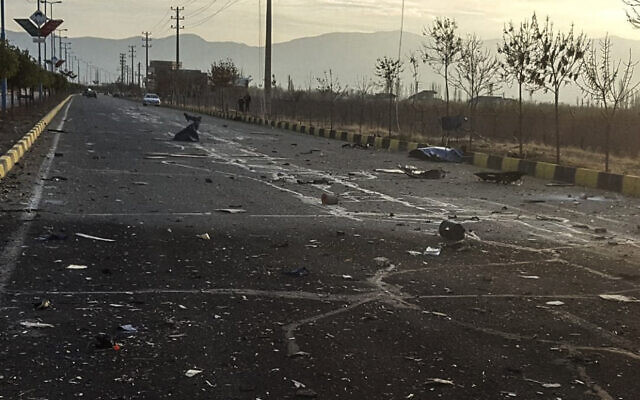
 

  • This photo released by the semi-official Fars News Agency shows the scene where Mohsen Fakhrizadeh was killed in Absard, a small city just east of the capital, Tehran, Iran, Friday, Nov. 27, 2020. (Fars News Agency via AP)
    This photo released by the semi-official Fars News Agency shows the scene where Mohsen Fakhrizadeh was killed in Absard, a small city just east of the capital, Tehran, Iran, Friday, Nov. 27, 2020. (Fars News Agency via AP)
  • Students of Iran's Basij paramilitary force burn US and Israeli flags during a rally in front of the foreign ministry in Tehran, on November 28, 2020, to protest the killing of prominent nuclear scientist Mohsen Fakhrizadeh a day earlier near the capital.(ATTA KENARE / AFP)
    Students of Iran’s Basij paramilitary force burn US and Israeli flags during a rally in front of the foreign ministry in Tehran, on November 28, 2020, to protest the killing of prominent nuclear scientist Mohsen Fakhrizadeh a day earlier near the capital.(ATTA KENARE / AFP)
  • Iran's Judiciary Chief Ayatollah Ebrahim Raisi pays his respect to the body of slain scientist Mohsen Fakhrizadeh among his family, in Tehran, Iran, November 28, 2020. (Mizan News Agency via AP)
    Iran’s Judiciary Chief Ayatollah Ebrahim Raisi pays his respect to the body of slain scientist Mohsen Fakhrizadeh among his family, in Tehran, Iran, November 28, 2020. (Mizan News Agency via AP)
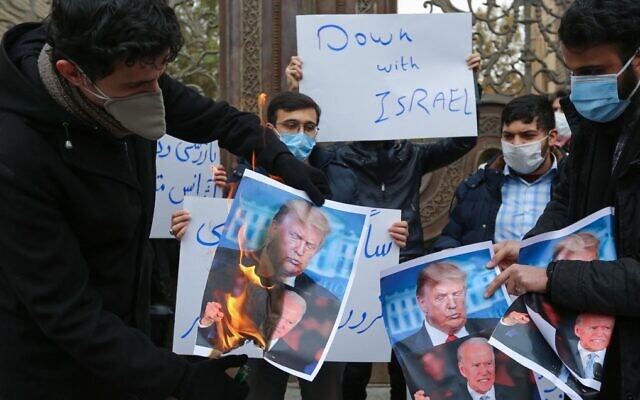
  • Students of Iran's Basij paramilitary force burn posters depicting US President Donald Trump (top) and President-elect Joe Biden, during a rally in front of the foreign ministry in Tehran, on November 28, 2020, to protest the killing of prominent nuclear scientist Mohsen Fakhrizadeh a day earlier near the capital. (Atta Kenare/AFP)
    Students of Iran’s Basij paramilitary force burn posters depicting US President Donald Trump (top) and President-elect Joe Biden, during a rally in front of the foreign ministry in Tehran, on November 28, 2020, to protest the killing of prominent nuclear scientist Mohsen Fakhrizadeh a day earlier near the capital. (Atta Kenare/AFP)
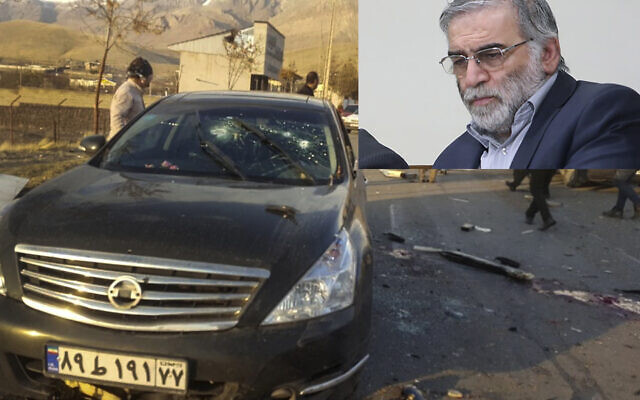
  • A photo released by the semi-official Fars News Agency shows the scene where Mohsen Fakhrizadeh was killed in Absard, a small city just east of the capital, Tehran, Iran, Friday, Nov. 27, 2020 (Fars News Agency via AP); insert: Mohsen Fakhrizadeh in an undated photo (Courtesy)
    A photo released by the semi-official Fars News Agency shows the scene where Mohsen Fakhrizadeh was killed in Absard, a small city just east of the capital, Tehran, Iran, Friday, Nov. 27, 2020 (Fars News Agency via AP); insert: Mohsen Fakhrizadeh in an undated photo (Courtesy)

An unnamed Israeli official told the New York Times on Saturday that the world should thank Israel for the assassination of Iran’s alleged nuclear weapons mastermind Mohsen Fakhrizadeh, even as Jerusalem hasn’t officially claimed responsibility for the operation.

The senior official, who according to the report was involved for years in tracking Fakhrizadeh for Israel, also said the country would continue to take any necessary steps against Tehran’s nuclear program.

Brookings Institution researcher Bruce Reidel, a former official at the Central Intelligence Agency with experience in Israel, told the US newspaper that Jerusalem was showing extraordinary levels of ability in striking at key individuals in enemy territory.

“It’s unprecedented,” Riedel said. “And it shows no sign of being effectively countered by the Iranians.”

Bruce Riedel. (Courtesy: Brookings)

Reidel also said that Israel had used its close ties with countries neighboring Iran, such as Azerbaijan, for surveillance and recruitment of operatives, noting the Azeri use of Israeli-made drones in its recent conflict with Armenia, which is presumably a facet of that relationship.

Reidel said the killing of Fakhrizadeh, who died on Friday in a bombing and shooting attack outside Tehran that has been widely attributed to Israel, could be an indication that after a hiatus, the Jewish state was reactivating its network of operatives made up of Iranian immigrants to Israel and Iranian collaborators.

“I think it is a signal that the game is afoot, or coming,” the former intelligence official said.

The assassination of Fakhrizadeh was the highpoint of a lengthy Israeli strategic plan to sabotage Iran’s nuclear program and deprives the Islamic Republic of an irreplaceable source of knowledge, Israeli television reported Saturday.

An unnamed Western intelligence source told Channel 12 the killing of the nuclear physicist, described in the past as the “father” of Iran’s project to develop nuclear weapons, was the “pinnacle” of Israel’s long-term plans.

Energy Minister Yuval Steinitz told the Kan public broadcaster on Sunday that the assassination of Fakhrizadeh was a positive thing for the world.

“The assassination in Iran, whoever did it, it serves not only Israel, but the whole region and the world,” Steinitz said.

There has been little formal comment from Israeli officials on the assassination, but in a video uploaded to Twitter Friday shortly after news of the alleged killing emerged, Prime Minister Benjamin Netanyahu, counting off various achievements of the week, noted that this was “a partial list, as I can’t tell you everything.” However, he may have been referring to his widely reported — though not officially confirmed — visit to Saudi Arabia.

Opposition MK Ram Ben-Barak of the Yesh Atid party, who formerly served as deputy director of the Mossad intelligence agency, said on Sunday that he was concerned by the leaking of information.

“I am very upset about what they are doing with this whole operation,” Ben-Barak told Army Radio. “The greatness of this campaign is in its secrecy, but there are deliberate leaks, as also happened on the flight to Saudi Arabia. It leaves me sleepless that there is a prime minister who only consults with those who are closest to him.”
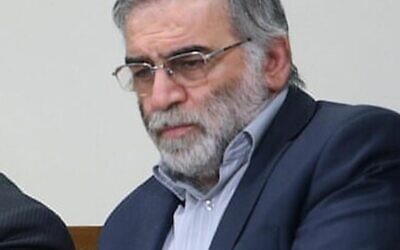
Dr. Mohsen Fakhrizadeh in an undated photo. (Courtesy)

Meanwhile, Israel was bracing for possible Iranian retaliation, as Iranian officials and US media asserted that the Jewish state was behind the hit. Israel has not officially commented on the matter.

An opinion piece published by a hardline Iranian newspaper on Sunday suggested Iran should attack the northern Israeli port city of Haifa if Israel were indeed responsible for the killing of Fakhrizadeh.

Though the Kayhan newspaper has long argued for aggressive retaliation for operations targeting Iran, Sunday’s opinion piece went further, suggesting any assault be carried out in a way that destroys facilities and “also causes heavy human casualties.”

According to the New York Times, while some in Iran’s leadership prefer to see how things develop under the Biden administration, pressure is growing from hardliners to respond forcefully following Fakhrizadeh’s killing. Such a response could lead to an escalation that would see the outgoing Trump administration carry out fresh military action and lead to a far larger conflict.

The matter of how Tehran might react remained up for debate in Israel, with pundits suggesting various scenarios: ramping up its nuclear program and enrichment work while abandoning international treaties; launching a major attack on Israel using missiles or other means; attacks on Israeli embassies or Israeli and Jewish targets around the world; attacks on Israeli ships; or attacks via its proxies along Israel’s borders in Gaza, Lebanon and Syria.

TV reports said Israel had raised its alert level in embassies around the world, and Jewish communities across the globe were taking precautions.

Israel’s security cabinet was set to convene Sunday for a meeting that had been scheduled in advance. There has been no word so far of the Israeli military raising its alertness level along the country’s borders.

The New York Times speculated Saturday that the main goal of the assassination was actually to impede the incoming US administration’s ability to reach a diplomatic solution to the conflict with Iran. US President-elect Joe Biden has stated his intention to reenter the 2015 nuclear deal with Tehran, which has largely disintegrated since President Donald Trump left the deal in 2018.

US President-elect Joe Biden at The Queen Theater in Wilmington, Delaware, November 10, 2020 (AP Photo/Carolyn Kaster)

Amos Yadlin, the former head of Israeli military intelligence and the current head of the Institute for National Security Studies think tank, told Channel 12: “Whoever made this decision knows that there are 55 more days in which the White House has someone who sees the Iranian threat the way they do… Biden is a different story.”

Yadlin also speculated that US Secretary of State Mike Pompeo’s visit to Israel earlier this month may have been connected to Friday’s killing.

“Apparently Pompeo didn’t come here to drink wine at the Psagot winery,” he said dryly.

Iran has suffered several devastating attacks this year, including the killing of top general Qassem Soleimani in a US drone strike in January, and a mysterious explosion and fire that crippled an advanced centrifuge assembly plant at the Natanz uranium enrichment facility, which is widely believed to have been an act of sabotage.
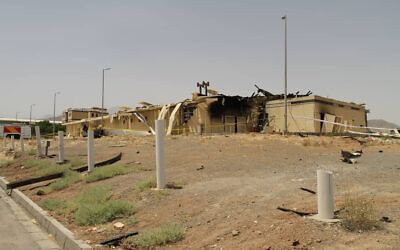
This photo released July 2, 2020, by the Atomic Energy Organization of Iran, shows a building after it was damaged by a fire, at the Natanz uranium enrichment facility some 200 miles (322 kilometers) south of the capital Tehran, Iran. (Atomic Energy Organization of Iran via AP)

After years of being in the shadows, the image of Fakhrizadeh suddenly was to be seen everywhere in Iranian media, as his widow spoke on state television and officials publicly demanded revenge on Israel for the scientist’s slaying.

Iranian President Hassan Rouhani accused Israel of being behind the killing of the top nuclear scientist.

“Once again, the evil hands of global arrogance were stained with the blood of the mercenary usurper Zionist regime,” Rouhani said in a statement. Iran generally uses the term “global arrogance” to refer to the United States.

“The assassination of martyr Fakhrizadeh shows our enemies’ despair and the depth of their hatred… His martyrdom will not slow down our achievements,” he added.

Iran’s supreme leader Ayatollah Ali Khamenei urged “punishing” those behind the assassination, adding that his work must be carried on.

Iran’s atomic program has continued its experiments and now enriches a growing uranium stockpile up to the level of 4.5 percent purity, following the US’s 2018 withdrawal from the nuclear deal. That’s still far below weapons-grade levels of 90%, though experts warn Iran now has enough low-enriched uranium for at least two atomic bombs if it chose to pursue them.

Fakhrizadeh was killed on Friday in an ambush in Absard, a village just east of Tehran, as his vehicle neared a truck that exploded when he approached. Local reports then described a barrage of automatic gunfire as gunmen emerged from a nearby car. A firefight erupted between the assassins and Fakhrizadeh’s bodyguards. The attackers wounded Fakhrizadeh and killed at least three of the guards before escaping.
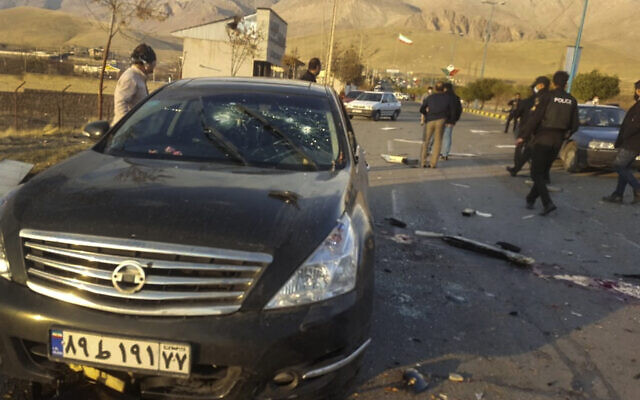
This photo released by the semi-official Fars News Agency shows the scene where Mohsen Fakhrizadeh was killed in Absard, a small city just east of Tehran, Iran, Nov. 27, 2020. (Fars News Agency via AP)

Photos and video shared online showed a Nissan sedan with bullet holes in the windshield, blood pooled on the asphalt and debris scattered along a stretch of the road.

Fakhrizadeh led Iran’s so-called AMAD program that Israel and the West have alleged was a military operation looking at the feasibility of building a nuclear weapon.
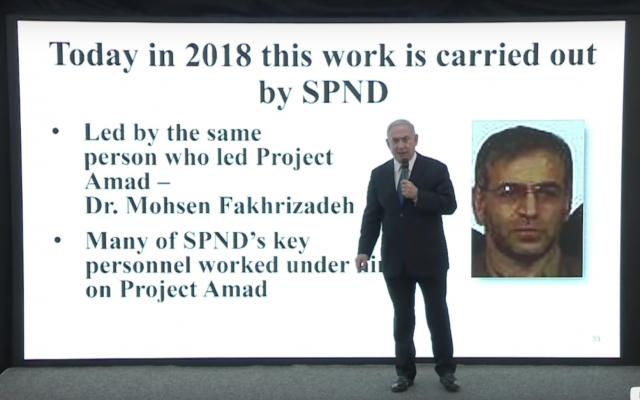
Prime Minister Benjamin Netanyahu stands in front of a picture of Mohsen Fakhrizadeh, who he named as the head of Iran’s nuclear weapons program, April 30, 2018 (YouTube screenshot)

Fakhrizadeh was named by Prime Minister Benjamin Netanyahu in 2018 as the director of Iran’s nuclear weapons project.

When Netanyahu revealed then that Israel had removed from a warehouse in Tehran a vast archive of Iran’s own material detailing with its nuclear weapons program, he said: “Remember that name, Fakhrizadeh.”


Analysis: Although the regime in Tehran is enraged by the brazen killing of Mohsen Fakhrizadeh, it will most likely not react in a way that would destroy ties with the Biden administration before they even began, opting instead for more ‘creative’ alternatives

Ron Ben Yishai|
Published: 11.29.20
The Iranian regime is more determined than ever to strike Israel, causing maximum pain.
The tone used on Friday by leaders of the Islamic Republic, following the assassination of Iran’s leading nuclear scientist Mohsen Fakhrizadeh, was concerning.
מדען הגרעין האיראני איראן שחוסל מוחסן פחריזאדה גופתו
The funeral of Iran’s nuclear scientist Mohsen Fakhrizadeh on Saturday
(Photo: AP)


It indicates that they are not only seeking revenge for the killing attributed to Israeli agents, but are also concerned of its effect on public perception in Iran, after alleged Mossad operations increased in number and scope in the country, damaging the regime’s image in the eyes of Iranians.
The operations, allegedly carried out by Israeli security services, impacted Iran’s efforts not only when it comes to their nuclear aspirations but also their strategic plan to establish a second front against Israel in Syria and solidify their deterrence in the region
After the killing by the U.S. of Revolutionary Guard Corps Quds Force leader Qasem Soleimani in January, Iran launched a missile strike on two American military bases in Iraq, using pro-Iranian proxies, in retaliation.
But despite any desire to carry out a similar revenge on Israel, the regime is now forced to calculate its next move carefully.
Iran believes Israel is behind the assassination, and not without cause.
Israelis have been seeking to eliminate Fakhrizadeh for awhile in order to disrupt Iran’s military nuclear program. But beyond that, Jerusalem wants to hamper any renewal of diplomatic ties between Iran and the incoming administration of President-elect Joe Biden, who has indicated he would be seeking to re-enter the 2015 nuclear deal that outgoing President Donald Trump backed out of in 2018.
Iranian leaders have said they suspect the assassination on Friday to be a provocation by Israel to force Iran to respond, thereby granting Trump the excuse – he apparently seeks – to attack Iranian nuclear instillations before he leaves the White House.
If Iran’s revenge is to be successful in deterring Jerusalem from further attacks and satisfying the vengeful needs of the Islamic Republic, it would require time and planning.
A far-reaching Iranian response, however, one that might cause fatalities in Israel, would compel Biden to postpone any plans to remove the crippling sanctions placed on Tehran by his predecessor.
As a result, as long as there is the slightest chance that the incoming administration will lift sanctions, Iranians will refrain from a response that would deteriorate the bilateral relations any further.
זירת החיסול בטהרן
Fakhrizadeh’s car found laced with bullets
(Photo: AFP)


Therefore, the risk of a retaliation carried out by Iran’s Lebanese proxy, the Hezbollah terror organization, is small. Tehran understands that any aggression by Hezbollah would be met by a massive, disproportioned response by the IDF, one that Lebanon, already crumbling under economic and political chaos and suffering greatly from the coronavirus pandemic, could not bear.
While planting more IEDs along the Syrian-Israel border would hardly constitute a grandiose act of revenge.
But, the Iranians already have an infrastructure in place in cities across the world, from which to launch attacks against Israeli and Jewish institutions, like their attack on the Jewish community building and the Israeli Embassy in Argentina in the 1990s.
They can also deploy their new arsenal of Iranian-made ballistic missiles and UAVs. They may attempt to target Saudi Arabia’s oil production, as they had done in 2019 when a well-coordinated strike that included missiles, drones and suicide bombers, halted half of the Gulf kingdom’s ability to produce oil for many weeks but exacted no human toll.
סעודיה ערב הסעודית תקיפה תקיפות מפעל
Aftermath of an attack on the Saudi oil processing facilities at Abqaiq and Khurais in 2019
(Photo: AFP)


Should Iran opt to attack Israel in a similar matter, they would have to carry out such a strike from a base closer to Israeli borders. They would also likely use proxies so as not to leave their own identifying prints on such an operation.
Since the regime in Tehran understands they are compromised in terms of intelligence inside their own borders as well as in Syria and Iraq, an attack – should one be planned – would likely come from the south, probably using the Houthi rebels in Yemen to carry it out, perhaps targeting an Israeli vessel in the Red Sea or even launching a ballistic missile at the southern city of Eilat.
Iran’s leaders have proven their ability to be patient and calculated in their responses. As a result, Israel’s intelligence agencies have mobilized their resources, as has the IDF, to respond to any attack that might be forthcoming.
https://www.ynetnews.com/article/H17viRxjD?fbclid=IwAR2ZeVnxLsuzhmbg7mdQrqMOTVO0ONz0txb7o14WTgRamW3ToP_yLM4N4ng


Beyond recognition of the day, activities will be held by the Education Ministry to help teach Israelis and provide resources on the history of the Spanish Inquisition.

‘AUTO-DA-FE ON Plaza Mayor, Madrid,’ by Francisco Rizi, 1680, illustrates the Spanish Inquisition-era ritual of public penance of condemned heretics. (photo credit: Wikimedia Commons)
‘AUTO-DA-FE ON Plaza Mayor, Madrid,’ by Francisco Rizi, 1680, illustrates the Spanish Inquisition-era ritual of public penance of condemned heretics.
(photo credit: Wikimedia Commons)
A law to commemorate the victims of the Spanish Inquisition in 1478 (and expulsion of Jews in 1492) was submitted to the Knesset for approval on Thursday by Blue and White MK Michal Cotler-Wunsh, proposing to establish November 1 as the date of commemoration.
Co-signatories to the bill include MK Tzvi Hauser (Derech Eretz), Chairman of the Foreign Affairs and Defense Committee, MK Oded Forer (Yisrael Beytenu), Chairman of the Knesset Caucus for Renewing the Relations With the Descendants of the Jewish Communities in Spain and Portugal, MKs Amit Halevi and Michal Shir (Likud), MKs Michael Malchieli and Yosef Taieb (Shas), and MK Tehila Friedman (Blue and White).
Beyond recognition of the day, activities will be held by the Education Ministry to help teach Israelis and provide them with resources on the history of the Spanish Inquisition, the forcible conversion of Jews (conversos), the descendants of whom are called Anusim, and the expulsion from Spain and Portugal.
Diaspora Affairs Minister Omer Yankelvich will also promote a report on building greater ties with the Anusim, many of whom share a strong affinity with Israel, and provide recommendations as to their role in national and Jewish organizations.
Cotler-Wunsh noted the importance of the day in a  webinar hosted by the Board of the Fundación Hispanojudía (Hispanic-Jewish Foundation), which focuses on building greater ties between Spanish-speaking countries and the Jewish people via outreach and promotion of Jewish culture.
Cotler-Wunsh, who is also the Chair of the Subcommittee on Israel-Diaspora Relations, highlighted the significance of the law by saying that “This bill will create a day of memory and reminder in the Knesset for us to recognize this tragic event in our collective history and learn from it, in order to ensure ‘never again’ in a world of ‘again and again.’”
“It also provides us with an opportunity to connect with the descendants of those affected by the Spanish Inquisition, in Israel and in the diaspora, based on our shared history and values,” the MK added.
President of the Fundación David Hatchwell also spoke of the law’s importance, which will increase interest in the Spanish-speaking world on Jewish heritage.
“The Spanish-speaking world, whether in Spain or in Latin America, is gaining a greater understanding of its common roots, culture and traditions with the Jewish People,” Hatchwell said.
“The Inquisition was a dark chapter for humanity and in both of our peoples’ history. It should be remembered as pure religious fanaticism and intolerance. Nevertheless, we should also use these historic events to chart a more positive future between the Spanish-speaking world and the Jewish people based on respecting diversity emulating the modern State of Israel,” he added.
At the moment, the Fundación is working on establishing a museum in Madrid, focusing on the thousands of years of Jewish history in Spain and Latin America, and the unique identity of the Sephardim.
Ashley Perry (Perez), President of Reconectar and advisor to the Fundación, said that the law is historic, praising it as an important step towards recognition of Spanish Jewish history and particularly the Anusim.
“There are tens, if not hundreds, of millions of people around the world who have both Jewish and Hispanic ancestry, and the Inquisition played a major role in the disconnection of our peoples,” Perry said.
“This law is a vital recognition of a reign of terror which still has such a great effect on so many people even today, many without knowing. This Day of Commemoration will hopefully not just be for Israelis, or even just for Jews, but for all those whose ancestors were hunted, tortured or prosecuted by the Inquisition.”
Recent academic research has found that the descendants of Spanish and Portuguese Jews may number around 200 million, consisting of nearly one in four Hispanics and Latinos. A potential reconnection with these communities may have significant diplomatic, demographic, political and economic advantages for Israel, the press release noted.


https://www.jpost.com/israel-news/law-to-commemorate-victims-of-spanish-inquisition-submitted-to-knesset-650430?fbclid=IwAR1Rh1QPHppyzwJoMGli9YH1-3l-SPFiocgatMPjpOp2HpXv4c19Ovey_oc