
Rouhani: Iran will retaliate for killing of nuclear scientist

Iran’s nuclear program will continue undeterred, Rouhani said.

A view shows the scene of the attack that killed Prominent Iranian scientist Mohsen Fakhrizadeh, outside Tehran, Iran, November 27, 2020. (photo credit: WANA (WEST ASIA NEWS AGENCY) VIA REUTERS)
A view shows the scene of the attack that killed Prominent Iranian scientist Mohsen Fakhrizadeh, outside Tehran, Iran, November 27, 2020.
(photo credit: WANA (WEST ASIA NEWS AGENCY) VIA REUTERS)
Iranian President Hassan Rouhani has blamed Israel for the killing of Iranian nuclear scientist Mohsen Fakhrizadeh.

“Once again, the evil hands of global arrogance were stained with the blood of the mercenary usurper Zionist regime,” Rouhani said in a statement Saturday morning, according to Reuters, citing state TV.

“The assassination of martyr (Mohsen) Fakhrizadeh shows our enemies’ despair and the depth of their hatred… His martyrdom will not slow down our achievements,” he said, adding “Our people are wiser than to fall in the trap of the Zionist regime (Israel) … Iran will surely respond to the martyrdom of our scientist at the proper time.”

The head of Iran’s nuclear program, Fakhrizadeh, 59, was assassinated in Damavand, east of Tehran, Iran confirmed on Friday afternoon.

“The nuclear scientist Mohsen Fakhrizadeh was assassinated today by terrorists,” the Iranian Defense Ministry wrote in a statement, not blaming any specific entity for the incident.

However, both Iran’s Foreign Minister Mohammad Javad Zarif and Iran’s UN envoy later stated Friday that a “serious indication” pointed to Israeli involvement, with Zarif also urging the international community to condemn the attack.

Pictures from the scene show two vehicles, one blown up and one shot at from the front, which had been carrying Fakhrizadeh and his bodyguards. Several local reports in Iran indicated that a suicide bomber was involved in the attack, but that has not yet been confirmed.

A military adviser to Iran’s supreme leader Ali Khamenei accused Israel of trying to provoke “a full-blown” war by killing Fakhrizadeh.

“In the last days of the political life of their … ally (US President Donald Trump), the Zionists (Israel) seek to intensify pressure on Iran and create a full-blown war,” commander Hossein Dehghan tweeted.

“We will strike as thunder at the killers of this oppressed martyr and will make them regret their action,” Dehghan added.

Later on Friday, Iran wrote in a letter to UN Secretary-General Antonio Guterres and the U.N. Security Council that there are “serious indications of Israeli responsibility” in the assassination and that it reserves the right to defend itself.
“Warning against any adventuristic measures by the United States and Israel against my country, particularly during the remaining period of the current administration of the United States in office, the Islamic Republic of Iran reserves its rights to take all necessary measures to defend its people and secure its interests,” Iran’s UN envoy, Majid Takht Ravanchi, wrote in the letter, which was seen by Reuters.

UN Secretary-General Antonio Guterres urged restraint on Friday evening, before the Iranian letter had been sent.
“We have noted the reports that an Iranian nuclear scientist has been assassinated near Tehran today. We urge restraint and the need to avoid any actions that could lead to an escalation of tensions in the region,” Guterres’ spokesman Farhan Haq said.

Also on Friday, Hezbollah‘s deputy spokesperson, Sheikh Naim Qassem, addressed Fakhrizadeh’s assassination and said that the response for the incident is in Iran’s hand, and that Iran has every right to seek revenge for Fakhrizadeh’s death.

“We condemn this heinous attack and see that the response to this crime is in the hands of those concerned in Iran,” Sheikh Naim Qassem said in an interview with Al Manar television.

He said Fakhrizadeh was killed by “those sponsored by America and Israel” and said the assassination was part of a war on Iran and the region.

The death Fakhrizadeh is likely to complicate any effort by US President-elect Joe Biden to revive the detente of Barack Obama’s presidency, and may lead to confrontation between Iran and its foes in the last weeks of Donald Trump’s presidency.

Prime Minister Benjamin Netanyahu’s Office and the Pentagon have yet to comment on the reports.

Fakhrizadeh was a senior Iranian Revolutionary Guards Corps (IRGC) officer and headed Iran’s nuclear weapons project. He was a professor of physics at the Imam Hussein University in Tehran and was former head of Iran’s Physics Research Center (PHRC).

The semi-official Fars News Agency, affiliated with the IRGC, stated that Fakhrizadeh was injured in the attempted assassination and later died in the hospital.
“News sources say a scientist has been the victim of an assassination attempt in an armed attack by unknown people on his team of bodyguards,” Iranian state television said in rolling coverage of the incident.
“Unfortunately, the medical team did not succeed in reviving him, and a few minutes ago, this manager and scientist achieved the high status of martyrdom after years of effort and struggle,” a statement by Iran’s armed forces carried by state media said.

Chief of Staff of Iran’s Armed Forces Mohammad Bagheri said that terrorist groups and the perpetrators of this blind act need to know that “severe revenge” awaits them.

The Iran Atomic Energy organization has yet to confirm the reports, saying that no incident involving nuclear scientists took place to the best of its knowledge, ISNA News Agency reported.

Fakhrizadeh has long been suspected by Western, Israeli and Iranian exile foes of the Islamic Republic to have masterminded what the UN nuclear watchdog and US intelligence services believe was a coordinated nuclear weapons program in Iran shelved in 2003.
He had the rare distinction of being the only Iranian scientist named in the International Atomic Energy Agency’s 2015 “final assessment” of open questions about Iran’s nuclear program and whether it was aimed at developing a nuclear bomb.

In 2018, Prime Minister Benjamin Netanyahu said, “remember that name,” referring to Fakhrizadeh, after he announced that the Mossad had obtained 100,000 files from Iran’s secret nuclear archives.

The files retrieved by Mossad focused on the secret Iranian nuclear program that was developed from 1999 to 2003 called Project Amad, which was led by Fakhrizadeh. When Iran entered the 2015 nuclear deal, it denied that such a program existed.
In 2003, Iran was forced to shelve Project Amad, but not its nuclear ambitions. It split its program into an overt program and a covert one that continued the nuclear work under the title of scientific knowhow development, Netanyahu said at the time.

It continued this work in a series of organizations, which in 2018 were led by SPND, an organization inside Iran’s Defense Ministry led by the same person who led Project Amad – Dr. Mohsen Fakhrizadeh, Netanyahu said.
Tovah Lazaroff and Idan Zonshine contributed to this report. 


The killing of Fakhrizadeh is major news globally. As such it is a huge embarrassment for Iran.

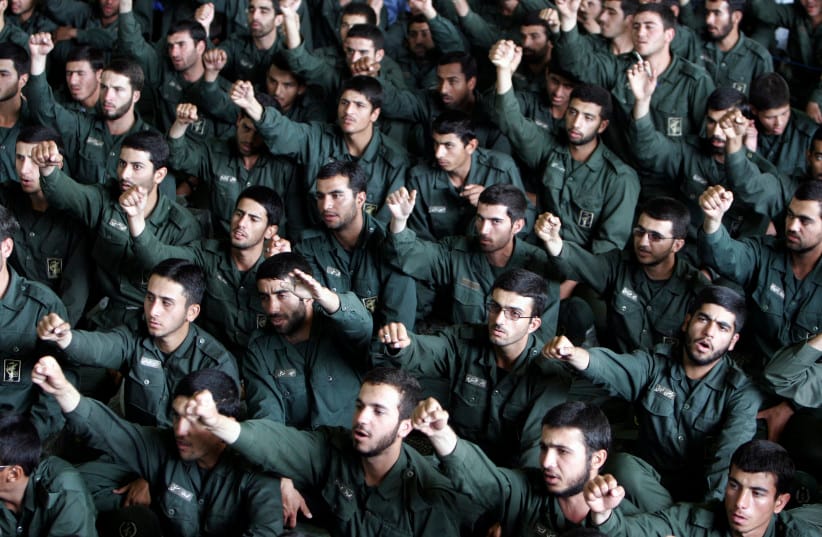
Iranian revolutionary guard corps chant slogans in support of Iran's nuclear programme during Friday prayers in Tehran (photo credit: RAHEB HOMAVANDI/REUTERS)
Iranian revolutionary guard corps chant slogans in support of Iran’s nuclear programme during Friday prayers in Tehran
(photo credit: RAHEB HOMAVANDI/REUTERS)
The killing of Mohsen Fakhrizadeh in Iran, a key nuclear engineer behind Iran’s clandestine nuke program, was not just a hit, it was a bloody and symbolic killing. According to the photos posted online he wasn’t just killed, one of the cars in his entourage was eviscerated and the other peppered with bullet holes. This was a hit like the killing of Gambino crime boss Paul Castellano in New York in 1985, a serious assassination that shows the power of those responsible and shows that any Iranian linked to the nuclear program can be found and killed.
He was shot down on a road in broad daylight. This was not a clandestine hit, but a brutal clear killing, the destruction of a major and well-known Iranian figure. He was not well known like Iran’s foreign minister, not a glad-hander who sucks up to western politicians and is known for nice suits and “moderation,” but a man well known in intelligence circles, among the kinds of people who follow Iran. They say he was not a “household name.” But in the households where people know about Iran’s nuclear efforts, ostensibly on hold since the Iran nuclear deal in 2015, he was known. Iran has been increasing its advanced centrifuges in the last years and enriching uranium. One key nuclear site, Natanz, was impacted by sabotage in July.
What we know is that this man was a brigadier general in the IRGC, Iran’s key military ideological unit. “Even as a scientist he reportedly retained a senior rank in the RGC as a brigadier general,” notes the Guardian. He was spotlights in 2011 by an Iranian nuclear watchdog. He was named again in 2018 by Israel. He was at the pinnacle of the nuclear weapons program. His death is considered to have a major impact on Iran. This is more than the killings of other scientists, such as one killed by an assassin on a motorbike in 2010 or by a car bomb in 2012. Iran’s regime is also embarrassed. It comes the same month Al Qaeda’s second-in-command was gunned down in Tehran. Tehran can’t keep safe al-Qaeda terrorists it harbors or its own head scientists and generals. No one is safe in Iran’s Iran.
The killing of Fakhrizadeh is major news globally. As such it is a huge embarrassment for Iran. On social media some compare it to the killing of IRGC Quds Force head Qasem Soleimani. These are two key men, one key to the expeditionary force of Iran, in places like Iraq and Syria, while the other was key to the internal Iranian nuclear program, which is a point of pride for Iran.
The killing comes days after Iran’s IRGC lose personnel in airstrikes in Syria. This means Iran is under pressure from setbacks. It illustrates how vulnerable Iran is despite Iran’s claims that it is a strong power in the region. On the one hand Iran seeks hegemonic power, controlling or blackmailing Iraq, Yemen, Syria and Lebanon through militias and influence. It has strong power among proxy forces, built up since the 1980s. But on the streets of Tehran, or the road to Absard, east of Tehran, the IRGC has been shown to be vulnerable. Despite Iran’s new advances in drones and radar, when it comes to old style assassinations, like the ones of the 1980s, it seems Iran cannot protect its own at the highest levels.
https://www.jpost.com/middle-east/bloody-and-brutal-killing-of-irgc-iran-nuke-chief-symbolic-analysis-650475?fbclid=IwAR32rpqcYn77TpkblLIb4RGc_fzwac_PnDLpsekVqgvFi6z-npUJ9ffhDoI


Were the Qumranites preparing for the War of Gog and Magog?

A visit to Qumran National Park and the history of the Dead Sea Scrolls

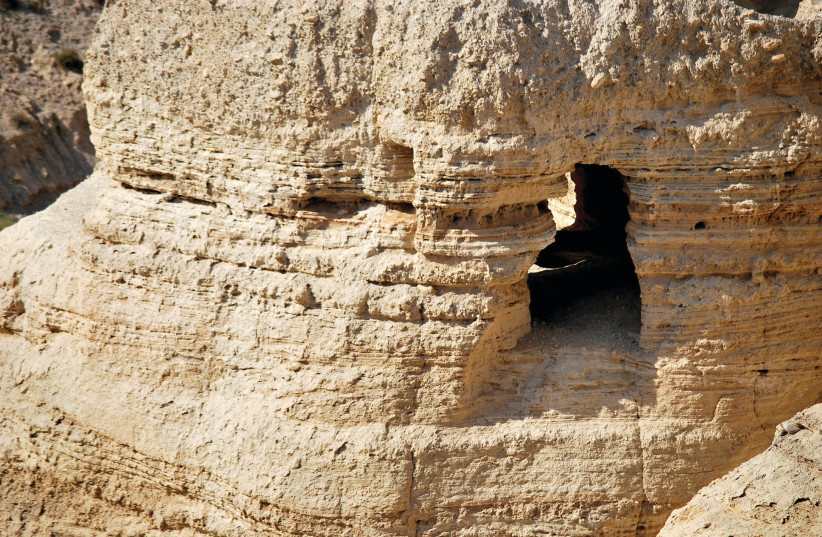
The site of the Qumran Scrolls, known as the Dead Sea Scrolls (photo credit: HADAR YAHAV)
The site of the Qumran Scrolls, known as the Dead Sea Scrolls
(photo credit: HADAR YAHAV)
Have you ever met an Israeli who loves hiking and who hasn’t been to Masada? I doubt it. But did you know that just north of Masada, at the northwestern tip of the Dead Sea and down the road from Einot Tzukim (Ein Fash’ha), you’ll find Qumran National Park, one of Israel’s most fascinating archaeological sites?

Imagine you’re out on a hike when you suddenly come upon a cave and, upon entering, discover a treasure. Well, that’s what happened to a Bedouin goatherd one day back in 1946 when one of his goats had strayed from the herd. During his fateful search, he came across a cave in the crevice of a steep rocky hillside.

Upon entry, he discovered weathered ceramic jugs with ancient, rolled-up manuscripts inside. Following this discovery, investigations and then excavations commenced of this and the other Qumran caves, which led to the discovery of a village dating from 130 BCE, and to the uncovering of another 929 manuscripts, which are now known as the Dead Sea Scrolls or the Qumran Scrolls. A national park was built at the site, and tourists can visit Qumran to learn about its fascinating historical significance.

Israel might be geographically small, but it is laden with a diverse history of peoples belonging to a number of religions, who suffered through bloody battles. In fact, there’s almost nowhere in the entire country that doesn’t have some connection with historical events.

A number of researchers have concluded that the ancient village at Qumran was inhabited by a Jewish sect known as Qumranites, or Essenes, that lived in the Judean Desert and whose culture and values were far removed from its Jewish contemporaries.

These theories are based on the writings of Yosef ben Matityahu (aka Josephus) and some of the Qumran scrolls, which prove that this sect decided to withdraw to the desert after the establishment of Hasmonean control over Judea and to establish a community in isolation. Some researchers claim that the Qumranites believed that they had to prepare for the War of Gog and Magog, which is described in the Book of Ezekiel as a prerequisite for the coming of the Messiah.

WHEN YOU reach the entrance of Qumran National Park, the tour begins with a short film describing the archaeological findings uncovered at the site, including the scrolls. If you are interested in seeing the actual scrolls, you are welcome to visit the Shrine of the Book at the Israel Museum in Jerusalem.

After the film, visitors can walk around the site, using the map they are given at the entrance to guide themselves through the site.

The first room contains a mikveh, or ritual bath, which lends credence to the thought that the sect had cut itself off from the main Jewish community. The Qumranites had served as priests in the Temple, but were pushed aside by the Hasmoneans, and the discovery of the mikvaot in their village shows that they were eager to remain ritually pure for the upcoming arrival of the Messiah. Although it is estimated that only about 200 Qumranites lived in the village, in a total of 30 caves, 13 ritual baths were found at the site.

The site of the Qumran Scrolls, known as the Dead Sea Scrolls (Hadar Yahav)

In the second room, you will find ceramic utensils and kitchenware that survived the earthquake that destroyed the village. Meals were extremely important ceremonies for the Qumranites, and sermons were oftentimes given while they ate. Sect members who didn’t follow the ways of the group were excommunicated or forbidden from participating in meals.

The third room was apparently where the scribes sat to carry out their writing. Next to the scribes’ room is the base of a defensive tower, and a kitchen was found in the northernmost section of the courtyard.

Next, the tour continues outside in the first courtyard, where you will see the ancient aqueduct that led researches to the conclusion that the Qumranites had constructed a complex water system that conducted water from the Qumran Stream to a number of cisterns. As you cross over the bridge, you will see down below remains from the many ritual baths that were uncovered at the site. At the end of the bridge, you will see a large cistern that’s connected by channels to the aqueduct.

The fifth room was also a room for the scribes, based on the discovery of a number of inkwells and a broken desk, which was refurbished and is currently on display at the Rockefeller Museum in Jerusalem. A small adjacent room was apparently used to house the scrolls that were deemed invalid.

The large, tiled courtyard next to this room was supposedly used to dry dates, since archaeologists found an inordinate amount of date pits while excavating this section.

There are a number of benches in the courtyard, including one that overlooks Cave No. 4, where the Qumran Scrolls were discovered.

When you’re done looking down into the cave and contemplating what life might have been like here in the second century BCE, you can walk back to the parking area where you left your car.

I recommend ending the tour with a visit to the Shrine of the Book at the Israel Museum in Jerusalem.

Translated by Hannah Hochner.

Location: Northern Dead Sea.
Length: 6 km.
Time: Half day.
Season: All year long.
Type: Appropriate for families and the disabled. Circular path.

Directions: From Jerusalem, drive east on Highway 1. Turn right (south) onto Road 90 and follow signs for Qumran National Park. Situated next to Kibbutz Kalya.

https://www.jpost.com/israel-news/a-visit-to-the-site-of-the-dead-sea-scrolls-650332
