The war between Armenia and Azerbaijan, the latter backed heavily by Turkey and also supplied with weapons from Israel, came to an ostensible end on November 10. That’s when Armenian Prime Minister Nikol Pashinyan announced he was accepting a Russian-brokered ceasefire that involved very significant Armenian territorial concessions.
Whether this ceasefire will hold, and whether Pashinyan’s Government survives, are still open questions. Multiple ceasefires have collapsed in the past two months.
Some analysts have argued that one of the losers of this war is Iran. Because Azerbaijan is allied to Israel, which has allegedly used it as a base to spy on and potentially conduct operations against Iran, its victory could be seen as a loss for Iran, which has traditionally been very close to Armenia. Furthermore, some argue that Turkey and Iran are enemies, and therefore Turkey’s victory in this war, which it planned and oversaw, is Iran’s loss.
In addition, one of the terms of the ceasefire agreement, jointly announced by Russia, Armenia and Azerbaijan, is “the construction of new transport communications” connecting Azerbaijan to its Nakhchivan Autonomous Republic exclave on the other side of Armenia, arguably reducing Iran’s leverage over Azerbaijan’s and Turkey’s strategic transport routes.
The truth, however, is actually far more complicated than the picture painted by these analysts.
In the first place, Turkey and Iran are not enemies. On the contrary, despite strategic disagreements, particularly in Syria over the fate of Bashar al-Assad’s regime, Turkey and Iran have close ties and are becoming closer, whether it’s Turkey’s sanctions-busting in support of Iran’s nuclear program, facilitation of Hezbollah and Hamas, cooperation against the Kurdistan Workers’ Party (PKK) or blowing the cover of Israeli spies in Iran.
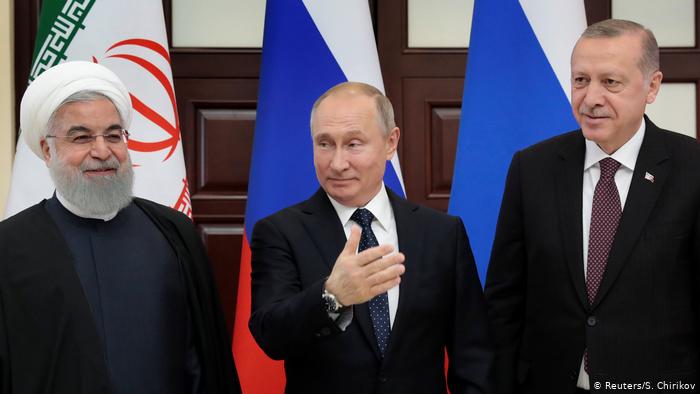
One of Turkey’s goals in coordinating Azerbaijan’s successful war against Armenia was to replace the Organisation for Security and Co-operation in Europe (OSCE) Minsk Group controlling international diplomacy relating to the Armenia-Azerbaijan conflict – co-chaired by Russia, France and the US – with a new trilateral system overseen by Russia, Turkey and Iran. This would be akin to the “Astana” group that now controls the diplomatic and military developments on the ground in Syria, which Erdogan referred to as a “tripartite alliance” in a joint press conference with Russian President Vladimir Putin in 2019.
Iran, being militarily weaker than both Turkey and Russia, has been a junior player in these affairs, but it has been a player nonetheless. Russia has long held sway over the Nagorno-Karabakh conflict and the broader Caucasus, and it quickly involved Iran in its attempts to force a settlement, coordinating and consulting with Teheran throughout October. In late October, Iran’s special envoy Seyyed Abbas Araqchi launched a peace initiative involving Russia and Turkey, and in November Russia said it would consider the Iranian proposal.
Several days later, Russia, Armenia and Azerbaijan announced the final terms of a ceasefire deal that was actually brokered between Russia and Turkey, despite the final announcement not mentioning them by name. Turkey’s President Recep Tayyip Erdogan called Putin about the final deal and asserted it showed “the importance of the cooperation between Turkey and Russia in the solution of regional conflicts and crises.”
While both Russia and Iran were unhappy with Turkey’s war and especially its decision to send Syrian mercenaries, neither has lost anything as a result of the outcome. Russia has gained an even greater hold over the region, Turkey has successfully replaced multilateral mechanisms with a Turkey-Russia bilateral substitute, and Iran – an ally of Russia and friend of Turkey’s – will also only gain from the new arrangements. In welcoming the deal, Iran announced it “stands ready to help deploy Russian peacekeeping troops along the lines of contact based on clauses 3 and 4 of the ceasefire agreement.”
Iran’s relationship with both Armenia and Azerbaijan is also more complicated than analysts make out. While traditionally friendlier with Armenia and at odds with Azerbaijan, Iran has in recent years moved towards a relatively neutral stance, insofar as it has been involved at all.
During the most recent war, Iran deployed troops and its Islamic Revolutionary Guard Corps (IRGC) along the border with Azerbaijan after several rockets landed in its territory. There are reports that Iran had begun supplying energy and food to Nagorno-Karabakh itself as part of its broader relationship with Armenia, but no concrete evidence of Iranian military involvement one way or the other in the conflict has emerged. The truth is Teheran ultimately lacks the conventional military capabilities to have had a major impact regardless.
During the first Armenia-Azerbaijan war in 1993, the IRGC reportedly intervened on Azerbaijan’s side with advisors and weapons. According to Chris Sands and Fazelminallah Qazizai, the authors of Night Letters: Gulbuddin Hekmatyar and the Afghan Islamists Who Changed the World, it actually contracted out most of the fighting to infamous Afghan mujahideen warlord Gulbuddin Hekmatyar’s group Hezb-i-Islami.
However, during the 2000s, Iran and its Lebanese proxy Hezbollah reportedly attempted several major attacks against Israeli interests in Azerbaijan, sending relations spiraling. In 2012, Azerbaijan arrested 22 people it accused of spying for Iran. Whether all of these allegations are true or not, the tension between the two nations was palpable.
Meanwhile, Armenia had been deepening its ties to Iran, facilitating Iranian weapons purchases in 2003 that allegedly led directly to the death of US troops in Iraq in 2007, according to a leaked US diplomatic cable. In 2019, the US sanctioned the Armenian company Flight Travel LLC for facilitating Iran’s Mahan Air as a general sales agent. Mahan Air is itself sanctioned by the US and banned in several European countries for acting as a travel and logistics service for the IRGC.
But by 2017, Iran had begun to try to better balance its relationship with Armenia and Azerbaijan and move politically closer to the latter, leading Iranian Foreign Minister Javad Zarif to say in mid-August this year, “Today, we have very good relations with the Azerbaijan Republic.” Iran’s Supreme Leader Ayatollah Khamenei even asserted, in early November, “Azerbaijan has the right to liberate its occupied territories”. Khamenei’s representative in Baku released a statement proclaiming “Karabakh belongs to Azerbaijan… occupiers (Armenia) are aggressors” and that Iran “has and will stand by Azerbaijan”.
Armenia, for its part, is not directly geopolitically aligned with Iran. In a relatively low-key affair, Armenia finally opened its first embassy in Israel on September 18 2020, although less than 2 weeks later recalled its ambassador over Israel’s provision of sophisticated drones, missiles and other military aid to Azerbaijan – which ironically refuses to establish an embassy in Israel despite decades of promises to do so.
In general, Iran was not a key player in this conflict. Unlike in Syria, Iran has no major strategic stake in the outcome despite bordering both Armenia and Azerbaijan. There may be genuine fears in Teheran over what Azerbaijan’s victory, along with Turkey’s rising assertiveness and prestige, means for Iran’s own large, restive Azeri Turkic minority. However, given current trends, Iran is not a loser in any conflict in which Russia and Turkey are the winners, as they clearly were in this year’s Armenia-Azerbaijan war.
https://aijac.org.au/featured/was-iran-a-winner-or-a-loser-in-the-armenia-azerbaijan-war/