
The regime feels that all of the current administration’s pressures will be lifted soon and the golden days will be back again.

By Majid Rafizadeh, Gatestone Institute

The Iranian regime has excitingly announced former Vice-President Joe Biden’s possible victory in the U.S. presidential elections and is celebrating that the next U.S. administration will, they hope, be from the Democrat Party.

Iranian authorities view even the chance that Biden might take over the White House as a definite win for Tehran.

Hesameddin Ashena, an advisor to Iran’s President Hassan Rouhani, tweeted that Iranians “stood their ground bravely until that coward’s time [Donald Trump] came to leave.”

Headlines in the state-controlled newspapers, which celebrated the news, included, “World without Trump!” (Aftabe Yazd newspaper), “Mr Withdrawal is Close to Being Kicked Out of White House,” “Go to Hell You Gambler!” (Sobhe Now newspaper) “Trump’s Card No Longer Valid for Media!” (Aftabe Yazd newspaper), “The Bankrupt US President Got Humiliated” (Mardom Salari newspaper), and “Trump Must Leave” (Donyaye Eghtesad newspaper).

The last three years has indeed been a nightmare for the Iranian regime and its proxies. No U.S. administration before the current one has imposed such a draconian pressure on the mullahs, their rogue state and their allies.

At the beginning, President Donald J. Trump pulled the U.S. out of the Joint Comprehensive Plan of Action (JCPOA), commonly known as the Iran nuclear deal, which Iran never signed and which paves the way for Iran to have nuclear weapons. Then, the Trump administration re-imposed primary and secondary sanctions on Iran’s energy, banking and shipping sectors.

During the last two years, several other Iranian entities were added to the sanction list. The killing of General Qassem Soleimani was also a huge blow to Iran’s regime, particularly the Islamic Revolutionary Guard Corps (IRGC) and its proxies across the Middle East.

The sanctions, in fact, have imposed significant pressure on the Iranian government — to such an extent that the Iranian leaders have had to cut their funding to their allies, militia and terror groups.

A year into the pressure, the state-controlled Syrian newspaper Al-Watan reported that Iran halted its credit line to the Syrian government. Some of Iran’s authorities publicly announced that they also do not have money to pay their mercenaries abroad. In an interview with the state-run Ofogh Television Network, for instance, Parviz Fattah, the current head of the Foundation for the Underprivileged (Mostazafan Foundation) stated:

“I was at the IRGC Cooperative Foundation. Haj Qassem [Soleimani, commander of the IRGC Quds Force who was killed by a U.S. drone strike] came and told me he did not have money to pay the salaries of the Fatemiyoun [Afghan mercenaries]. He said that these are our Afghan brothers, and he asked for help from people like us.”

Tehran’s diminishing resources have also caused Iranian leaders to cut funds to the Palestinian terror group Hamas and the Lebanese militant group, Hezbollah. Hamas was forced to introduce “austerity plans” while Hassan Nasrallah, the leader of Iran’s proxy, Hezbollah, has also called on his group’s fundraising arm “to provide the opportunity for jihad with money and also to help with this ongoing battle.”

The country’s economic situation became so dire that the Iranian President Hassan Rouhani admitted that the Islamic Republic is encountering the worst economic crisis since its establishment in 1979. The political deputy of the province of Bushehr, Governor Majid Khorshidi, told a gathering on July 14 that they should not ignore U.S. sanctions: “We used to see this approach [of ignoring U.S. sanctions] from the previous [Ahmadinejad] administration and unfortunately it still continues,” he added. “But I have to say that sanctions have broken the economy’s back.”

Thanks to the current administration’s pressure, Iran’s currency, the rial, has been in free fall in the last three years. As of November 7, 2020, a U.S. dollar is worth approximately 250,000 rials. Before the current U.S. administration imposed a “maximum pressure” policy against Tehran, a U.S. dollar had equaled nearly 30,000 rials. During the last year, Iran’s oil exports also sank to a record low. The country’s budget heavily relies on selling oil.

As pressure kept mounting against the regime, Tehran also faced several widespread protests in the country, which endangered the hold on power of the ruling clerics. Now, the regime feels that all of the current administration’s pressures will be lifted soon and the golden days will be back again.

It is unfortunate that Iran’s ruling mullahs view a possible victory of the Democrat Party in U.S. elections as a win for the Tehran regime, its proxies and militia groups. President Rouhani has already called for restoring the nuclear deal. It could well be a loss for continuing peace in the region and for finally restoring the violated Iranian people’s hoped-for human rights.

Dr. Majid Rafizadeh is a business strategist and advisor, Harvard-educated scholar, political scientist, board member of Harvard International Review, and president of the International American Council on the Middle East. He has authored several books on Islam and US foreign policy. He can be reached at Dr.Rafizadeh@Post.Harvard.Edu
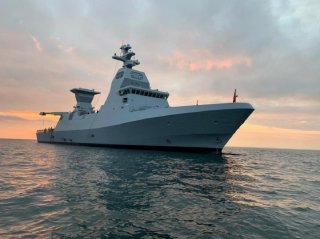

The Israeli Navy’s New Sa’ar 6 Warships Are a Gamechanger

Why are they needed? Think gas deposits.

Israel has been known for its expertise in counter-insurgency and using hi-tech aircraft, like the F-35 jet, to confront enemies across the Middle East. Israel’s power was concentrated on land with its Israel Defense Forces investing in the best air defenses and new combat vehicles. Now that may be changing as Israel takes delivery of its new Sa’ar 6 corvette ships. These four new 2,000 ton vessels, which will be delivered from Germany over the next year, will give Israel new firepower at sea and the ability to protect its emerging gas fields off the coast.

In a recent statement the commander of the Israeli Navy, Maj. Gen. Eli Sharvit: Said that “the mission of defending Israel’s exclusive economic zone and strategic assets at sea is the primary security mission of the Israeli Navy. These assets are essential to the operational continuity of the State of Israel, and having the ability to protect them holds critical importance.” The gas exclusive economic zone stretches over an area twice the size of Israel. Gas fields off the coast, near Lebanon and Gaza, both could be threatened by missiles. Israel confronted a surprise missile threat like this in 2006 when Hezbollah targeted the INS Hanit.

More recently reports indicated Hezbollah may have access to the Russian-made Yakhont missile or a variant. The group already has stockpiled some 150,000 missiles and rockets with Iran’s support. It is also developing precision-guided munitions. The threat of missiles at sea is well known, especially after the Houthis targeted ships off the coast of Yemen and after militants in Gaza struck an Egyptian ship in 2015. Anti-ship missiles can pose a major threat to modern navies. During the Falklands war in 1982 Argentinian Dassault-Breguet Super Etendard planes air-launched Exocet missiles that struck several British ships. During the Iran-Iraq war in 1987, the USS Stark was hit by a missile as well.

For this reason, Israel is putting to sea advanced ships with stealth technology and the latest in Israel’s Adir phased array radar, as well as numerous interceptors designed to protect it from missile threats. Many of the combat systems on the Sa’ar 6 ships will be new or recent designs and more than ninety percent will come from Israel’s defense companies. For instance, Rafael Advanced Defense systems reportedly supplies the C-Gem offboard active decoy, which defends against missile threats. Elbit Systems electronic warfare suite will be incorporated along with IAI’s Barak missiles and the sea version of Israel’s Iron Dome. Israel has made rapid advances in all this technology over the last several years, attempting to keep up with the threats emerging from Iran and Hezbollah Lebanon. For instance, Israel announced it had tested a new ship-to-ship missile in September. The missile represented a partnership between IAI and Israel’s research and development division within the Ministry of Defense. At the time Israel said, “the new missile system offers enhanced offensive precision capabilities, has longer range, possesses improved offensive flexibility and is better equipped to engage advanced threats.”

On November 11, the Israeli Navy will receive the new ship but it will still be in Kiel in Germany where it was laid down at Thyssenkrupp Marine Systems. It will then sail to Israel. Israel’s navy says that “Upon the arrival of the corvette to Israel and after the operationalization and installation of battle systems, of which the vast majority are Israeli-designed systems, INS Magen will start its operational service in the Navy and will lead the defense of the Israeli economic exclusive zone and maritime strategic assets.”

The name of the ship and the program, “Magen,” comes from the Hebrew term for “shield.” This is because the ship is a shield for the gas platforms and off-shore infrastructure Israel is investing in. This will include a new gas pipeline to Cyprus and Greece, according to a recent agreement. It is also part of Israel’s increased role in the eastern Mediterranean Gas Forum, which was established this summer. Israel is increasingly a naval ally of Egypt, Cyprus and Greece. As tensions have increased between Turkey and Greece, Ankara has also laid claim to rights to the Mediterranean stretching to Libya, which puts it astride the potential pipeline. An Israeli ship was harassed by the Turkish navy in December 2019 as Ankara pushed its demands in the Mediterranean. The IDF has assessed that Turkey could be a future challenge and reports in British media have indicated the Mossad also sees Turkey as an emerging threat.

This shift in naval strategy, although it is not tailored to relate to Turkey, gives Israel more eight at sea and a more relevant navy that can operate further from shore. Previously Israel relied on small patrol boats to deal with terror threats from Gaza, as well as a handful of missile boats. It also commissioned a half dozen submarines since the late 1990s. Now Israel will have fifteen surface vessels, the four Sa’ar 6 ships, three Sa’ar 5 ships and eight missile boats. The decision to build the Sa’ar 6 was made in 2013 and represents a major investment in the navy. The last time Israel put new surface ships to sea in such a build-up was in the 1990s. The Sa’ar 6 is supposed to be the backbone of the navy for thirty years. Combined with the Dolphin-class submarines, it will give the Israeli navy the latest technology for naval warfare.

Israel’s navy held a briefing and put out an explainer about the new ships in early November. The navy says that the ships will defend the gas fields up to several hundred kilometers offshore and that they can not only be on station at the rigs for a significant period of time but can also do other missions. “The ability to carry mid-size helicopters, such as the Seahawk: The new Seahawk helicopters that will be used by Sa’ar 6-Class Corvettes will be powerful, and able to operate over long ranges and extended periods of time. In this fashion, the ships will be able to provide a comprehensive defensive envelope.”

The understanding of the threat Israel faces has grown in recent years. Israel once had to confront convention armies, fighting the Soviet-armed Egyptians and Syrians in the 1960s and 1970s. In the 1990s the threat shifted more to counter-insurgency. Now the threat has moved to what Israel calls the “third circle,” a term used for Iran. Israel incorporated this understanding into its new Momentum plan. That means Israel is reducing some of its older units, making its armored corps and infantry more “multi-dimensional” and relying on communications, artificial intelligence and algorithms to bring the most amount of information to frontline troops to give them more lethality in times of conflict. That is designed to land a knock-out blow on an enemy.

Israel is also training more with the United States using the F-35, of which Israel is acquiring at least fifty of the advanced aircraft for several squadrons. The goal of Israel’s current operations, called the Campaign Between the Wars, is to reduce the Iranian threat and Iranian entrenchment in Syria and prolong the period before the next war. At sea, that means dealing with potential missile threats from places like Lebanon. Only one missile getting through Israel’s defense net can harm the gas platforms. That necessitated ships of the type Israel is putting to sea, and also knitting them in to Israel’s advanced early warning systems on land. This means confronting “blue water” and “brown water” threats, at sea and closer to land.

Israel receives most of its trade from the sea. It’s two Mediterranean ports, Haifa and Ashon, now account for around 43 percent and 53 percent respectively, with the Red Sea port of Eilat taking in only four percent of the country’s trade. New relations with the UAE and new pipeline deals could change some of that situation. Changing Israel’s strategy meant assigning ships to the three gas fields and taking into consideration that one ship might always be at port or on other missions. It also means having better naval-air connectivity, and multiple layers of defense. This basically means extending the Iron Dome and David Sling and other defense system umbrellas to the sea.

Recent attacks by Iran, such as the drone and cruise missile swarm used to attack Saudi Arabia’s Abqaiq in September 2019, point to the kinds of threats that Israel must consider. The Sa’ar 6 will have around 80 personnel on board and Israel is also hoping to have a quarter of the personnel on the new ships be female. In recent years, Israel’s navy increased the number of women in the service. It is thus a technological and societal leap for the country.

The ship was custom-designed so that it has the stealth capabilities and room to install the weapon systems Israel wants. This is an upgrade of existing corvette-class ship models. Many navies today are racing to put to sea better ships, especially as the naval arms race continues in the Pacific and elsewhere. Not all the plans for new types of ships, such as the American Zumwalt-class destroyers or the littoral combat ships like the USS Independence, have proven successful. Israel hopes its updates will be a model that does perform well.

Israel engaged in what I call a “design spiral” to build these ships. That included making sure the payloads, such as the massive radar, could be incorporated. It also meant making it flexible and with a low radar cross-section. It is the boat with the highest firepower per square meter, the Israeli navy says. In the end, I will also have a 76mm cannon as its main gun, along with the missiles it carries. Together the firepower and defenses will be a gamechanger off the coast of Tel Aviv and extending far into the sea.

Seth J. Frantzman is a Jerusalem-based journalist who holds a Ph.D. from the Hebrew University of Jerusalem. He is the executive director of the Middle East Center for Reporting and Analysis and a writing fellow at Middle East Forum. He is the author of After ISIS: America, Iran and the Struggle for the Middle East. Follow him on Twitter at @sfrantzman.

https://nationalinterest.org/blog/buzz/israeli-navy%E2%80%99s-new-sa%E2%80%99ar-6-warships-are-gamechanger-172211?fbclid=IwAR3iiqnJRvjNWugC9siZUe0-l0r6j3LkMBl0rP5IOaHLCUu8JXqeuh3ZeVU&page=0%2C1


Excavations in the Old City of Jerusalem unearth ancient pottery juglet containing four gold coins more than 1,000 years old.

Arutz Sheva Staff , 09/11/20 09:50 AM
Juglet with the coins

Juglet with the coins
Dafna Gazit, Israel Antiquities Authority

A juglet (a small pottery jar) containing four pure gold coins dating from more than a thousand years ago (the Early Islamic period), was unearthed during archaeological excavations conducted by the Israel Antiquities Authority (IAA), as part of the Jewish Quarter Development Corporation’s plan to build an elevator and make the Western Wall Plaza accessible to visitors coming from the Quarter.

The juglet was found by Israel Antiquities Authority inspector Yevgenia Kapil during preliminary digging at the site last month. Some weeks later, as excavation director David Gellman was examining the finds, he emptied the contents of the juglet.

“To my great surprise,” says Gellman, “

along with the soil , four shiny gold coins fell into my hand. This is the first time in my career as an archaeologist that I have discovered gold, and it is tremendously exciting.”

According to Israel Antiquities Authority’s coin expert, Dr. Robert Kool, “The coins were in excellent preservation and were immediately identifiable even without cleaning. The coins date from a relatively brief period, from the late 940s to the 970s CE.”

“This was a time of radical political change, when control over Eretz Israel passed from the Sunni Abbasid caliphate, whose capital was Baghdad, Iraq, into the hands of ​​its Shiite rivals—the Fatimid dynasty of North Africa, who conquered Egypt, Syria and Eretz Israel in those years. The profile of the coins found in the juglet are a near perfect reflection of the historical events.”

“Two gold dinars were minted in Ramla during the rule of Caliph al-Muti‛ (946–974 CE) and his regional governor, Abu ‛Ali al-Qasim ibn al-Ihshid Unujur (946–961 CE). The other two gold coins were minted in Cairo by the Fatimid rulers al-Mu‘izz (953–975 CE) and his successor, al-‘Aziz (975–996 CE).”

According to Dr. Kool, “This is the first time in fifty years that a gold cache from the Fatimid period has been discovered in Jerusalem’s Old City. In the large-scale excavations directed by Prof. Benjamin Mazar after the Six Day War, not far from the current discovery, five coin and jewelry hoards from this period were uncovered south of the Temple Mount.”

“Four dinars was a considerable sum of money for most of the population, who lived under difficult conditions at the time,” added Dr. Kool. “It was equal to the monthly salary of a minor official, or four months’ salary for a common laborer.”

“Compared with those people, the small handful of wealthy officials and merchants in the city earned huge salaries and amassed vast wealth. “A senior treasury official could earn 7,000 gold dinars a month, and also receive additional incomes from his rural estates amounting to hundreds of thousands of gold dinars a year.”

Herzl Ben Ari, director of the Jewish Quarter Development Corporation, who chanced to visit the excavation site when the coins were exposed, said, “Although we are used to archaeological discoveries once in a while, it is always very exciting to uncover Jerusalem’s unique and turbulent past. Once the elevator project is complete, we intend to allow the public to view large numbers of the archaeological finds.

Video Player

00:00 | 01:22
נחשף כד קטן ובו 4 מטבעות בני אלף שנהVideo:רשות העתיקות. Photo:דפנה גזית, רשות העתיקות
http://www.israelnationalnews.com/News/News.aspx/290839?utm_source=dlvr.it&utm_medium=facebook