
Iran claims new ‘kamikaze’ drone, smart bomb, EW capabilities

Iran’s Tasnim says the country closely watched the success of Azerbaijan’s drones in the recent conflict to learn from the experience
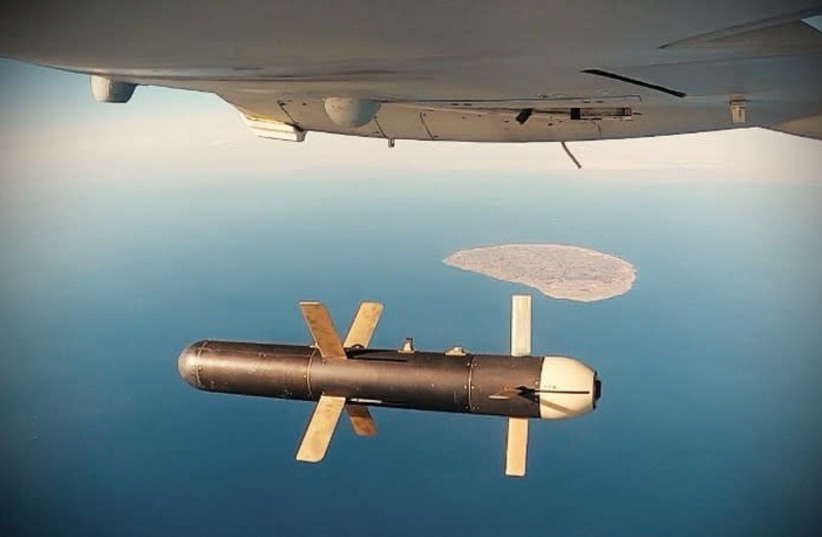
An Iranian Shahed 171 drone dropping a bomb as part of a military exercise in the Gulf, in Iran (photo credit: REUTERS)
An Iranian Shahed 171 drone dropping a bomb as part of a military exercise in the Gulf, in Iran
(photo credit: REUTERS)
Iran’s Tasnim news, one of several regime media outlets in Tehran that are avenues for the government to boast about its military technology, showed off its weekly drone and weapon threats. This has become a kind of tradition for Iran over the last years, always trying to portray itself as innovating some new weapon every month. Then the new weapon gets weekly coverage, as if Iran is a technological lab of genius that is like a silicone valley of drones and weapons.

The latest story involves an air base in Isfahan and the Iranian air force, sometimes called Nahaja as an abbreviation. “It was Nahaja’s third appearance after participating in the Zulfiqar 99 exercise,” Iran’s Tasnim said. That refers to a drill in September. Now more drills have taken place that involved dozens of fighter jets, bombers and refueling aircraft, electronic warfare and drones, Iran says. “As in previous years, the deployment phase, the unarmed exercises, and the demonstration took place using a variety of weapons in the exercise. A combination of experienced and other forces were present at the exercise to transfer operational experience in an environment close to the actual combat conditions.”

Iran says that in recent years it has improved its Ababil-3 drones, its Mohajer-4 and Karrar drones. The Ababil and Mohajer drones are the latest versions of those that date from the 1980s. Iran has long innovated drones, some of them based on studying US and Israeli designs. For instance it copied the US Predator and RQ-180 and also claimed to have copied Israel’s Hermes 450. Drones in Iran are divided for use between the IRGC Aerospace force and the regular air force. There is some internal competition to see who can build the best ones. Iran says that its Air Force has built a Kaman-12 reconnaisance and combet drone. “In this exercise, in addition to Karar and Kaman-12 drones, a suicide drone named Arash was also introduced,” the report says.

The story of the new drones is linked to claims that for the first time Iran used a drone to drop a bomb. This was a 225kg munition, supposedly, and it hit its target accurately. It was unguided. The air force also used its Karar drone and what it called the “Balaban” bomb that has a range of 25km. The air force supposedly also has “pods” now on the drones for electronic warfare. “Karar may have carried one of these pods.” The use of targeting pods or other types of pods put under aircraft is not new, the US, Israel and other countries use such pods. For instance Israel’s Rafael Advanced Defense Systems makes a targeting pod called Litening that is used by 27 air forces around the world, including aircraft like the F-16 and F-15. Iran’s attempt to use “pods” is part of its overall attempt to claim it has the capabilities of other air forces. It doesn’t. It has drones and has used them as a kind of instant air force. It wants to put add-ons onto the drones as a way of showing that it is a kind of 4th generation air force.

Towards this end Iran says that its “Kaman-12” drone is capable of carrying three rocket launchers and bombs, and that it was in the Zulfiqar-99 drill with the Kaman-12 UAV which helped with targeting and identifying targets. What’s interesting here is that Iran does appear to be using more drone combinations and using them with ballistic missiles. It did this o target Kurdish dissidents in Koya in 2018 and also against ISIS. It paired the drones with its ballistic missiles such as Zulfiqar, Qiam and Fateh 110 missiles.

Iran has also been watching closely how Azerbaijan is using drones. Azerbaijan has a large number of modern drones, including the Turkish Bayraktar TB2 as well as Israel’s SkyStriker, Harop, Harpy and Orbiter drones, according to reports. Iran says that “suicide drones are among the weapons whose remarkable performance in the recent Nagorno-Karabakh war once again demonstrated their high operational value. In Iran, two decades ago, various types of suicide drones were built.” The “suicide” drone is what is called a “loitering munition” or kamikaze drone. Israel has also worked on numerous types of these, such as Harop and Harpy. Iran appears to be studying Israel’s UAV strategy and trying to copy it and also the US drone experience. Iran may have gone further though, it used these types of kamikaze munitions against Saudi Arabia in September 2019 and also armed the Houthi rebels in Yemen with drones to fight Saudi Arabia. These drones have proven successful against Riyadh, despite Riyadh having the latest air defense. Iran has learned from this and is now being more open about its achievements.

Iran says that its new achievements show progress in electro-optical “lock” on target and that it is making progress with smart bombs, pods, and arming drones with munitions. This is a leap forward for Iran, if all this is accurate as depicted in their media. Iran showed off images of its Arash kamikaze drone diving on a target at 230km per hour. Iran says it has new advanced pairing drones with manned aircraft and using laser targeting designators as well as electronic warfare. Iran’s media points out that decades ago Iran didn’t have satellite images and relied on its F-4 aircraft, which the Shah’s regime acquired from the US, to complete missions. Iran launched a military satellite earlier this year. Iran says I has new Ghased and Yasin bombs for its aircraft.

Iran is also trying to copy western militaries with improving electronic warfare aircraft. It says it uses Boeing 707s and its Falcon 50 aircraft for this. It says it has a range of 5,000km. It also showed off F-14s and its F-5 aircraft. Iran still has dozens of these functioning aircraft that it got in the 1970s. It ability to keep these aircraft functioning and flying and improve them shows its technical skill. It is not entirely clear how much of these capabilities actually exist or are just shown off in drills and on paper.


‘Biden’s victory is a big win for Iran and the Ayatollahs’

Senior Middle East affairs expert warns that if Biden’s apparent victory is confirmed, it will provide a lifeline to the Iranian regime.

Arutz Sheva Staff , 06/11/20 12:54
Joe Biden

Joe Biden

REUTERS

With Joe Biden moving closer towards clinching the 270 electoral votes needed to win the White House, veteran Israeli journalist and Middle East expert Zvi Yehezkel warned Friday morning that a Biden administration would boost the Iranian regime at a critical juncture.

Speaking with Radio 103FM, Yehezkel, a Channel 13 commentator, said that a Biden victory would ensure the survival of Iran’s hard-line Islamist regime.

“The ayatollahs’ regime won’t survive under the current conditions if Trump would continue on,” said Yehezkel. “It is just a matter of time before the regime collapses.”

But, Yehezkel continued, “The ayatollahs’ regime will continue on with the help of Biden. Biden’s victory means the continuation of the ayatollahs’ rule.”

Turning to the Trump administration’s push to broker additional peace deals between Israel and Sunni Arab states, Yehezkel said that the possibility of a normalization deal with Saudi Arabia would at the very least be “delayed” as a result of Biden’s victory.

“The deal with the Saudis which was supposed to happen during the Trump administration will be delayed.”


New footage shows ready-to-launch ballistic missiles on a railway-type system within a cavernous subterranean complex.

Video and photos have emerged showing for the first time an underground Iranian ballistic missile facility in which groups of missiles ready to fire are moved around massive tunnels using an automated railway-type system. The vertically-stowed missile “magazine” appears to bring groups of missiles into position for rapid, consecutive launching from the cavernous subterranean bunker.

On its YouTube channel, the quasi-official Iran’s Military Achievements Media states that “Wagons carrying ballistic and long-range missiles can create continuous shooting conditions in this platform.” The same source adds that “the quantity and continuity of the missile fire will increase impressively in a safe atmosphere,” i.e. within the protected underground cavern.

The location of the facility seen in the latest imagery is unconfirmed, but Iran is known to have built underground caves to protect ballistic missiles operated by its Revolutionary Guards Corps in the past. Previously, imagery from within these caves showed long lines of ballistic missiles sitting on launchers, a process that now seems to have been refined, or at the very least augmented, using the automated railway system.

The thinking behind the system seems to be to allow launches of ballistic missiles in quick succession. Since the missiles on their individual platforms are ready to fire, there is no need to reload individual launchers using a crane or trans-loader. The magazine method would potentially allow many more missiles to be fired from a single bunker while increasing the chances of the outbound missile strike overwhelming anti-ballistic missile defenses.

The new method is also much more space-efficient. While previously, bulky conventional transporter-erector-launchers (TELs) would be parked and moved under the firing apertures in the cavern’s ceiling, using this new approach, Iran could potentially massively increase the number of missiles stowed in each underground complex. Some of the tunnels in which the rail-mounted missiles are being transported also look too narrow to accommodate conventional TELs or towed launchers.

The concept seems also to be broadly aligned with Iran’s recently announced “missile farms,” in which short-range ballistic missiles are hidden in buried launchers to help reduce their vulnerability to pre-emptive strikes. You can read more about recent developments in this area here.

In the case of the railway missile magazine, however, the weapons themselves have been identified by analysts as Emad liquid-fuel, medium-range ballistic missiles (MRBM), a derivative of the Shahab-3. The Emad is reported to have a range of around 1,000 miles and is considered to be capable of carrying a nuclear warhead if such a capability existed. The Emad missile was apparently developed around a new re-entry vehicle (RV) fitted with fins to give it increased maneuverability, accuracy, and additional stability.

IMA MEDIA SCREENCAP

A close-up view of an Emad IRBM as personnel prepare to move it from its transport cradle to the rig that will bring it into a vertical position.

The missiles on the magazine assembly also appear to be separated by dividers, which could include all the umbilicals and pre-launch test equipment required for them to be fired in an autonomous, or near-autonomous manner. Although it is not clear from the available imagery, it’s reported that each missile “clip” contains five rounds. In a wartime scenario, it might be expected that the fueled and ready-to-launch Emads would be fired first, with the aim of getting as many as possible into the air during a first strike, before their underground facility was destroyed.

While the imagery shows the missiles being raised into the vertical on their multi-round launch platforms and then moved around within underground tunnels, it is unclear how they would actually be fired. Normally, Iranian missile caves like this have ports in the roof through which the missiles are launched. However, the proximity of the missiles to one another as arranged within their magazines suggests that there might be another stage in the process, in which an individual missile is moved into a launch chamber, to avoid damaging the adjacent missiles when it blasts off. These facilities are thought to have a number of launch chambers arranged in rows, so each ‘clip’ with five missiles could be separated into five launch chambers for a coordinated launch.


IMA MEDIA SCREENCAP

Two Emad IRBMs await being lifted onto their rail-mounted platforms to join the magazine, with another two missiles already in a vertical position.

Intriguingly, Hinz also points out an interesting parallel to Nazi Germany’s rail-mounted V-2/A4 ballistic missile system and how those weapons were fueled. He highlights how the Iranian missile complex shares similarities with the La Coupole bunker that was constructed by the Germans in northern France as an underground V-2 launch facility during World War II, as well.

U.K. GOVERNMENT/PUBLIC DOMAIN

An Allied reconstruction of the 1944 conjectural reconstruction of the La Coupole bunker in France, including rocket preparation chamber and tunnels.

Other observers have pointed to the writing on the side of the missiles, which seems to read “UAE.” However, some of the lettering that follows this has been obscured with a placard and there’s no other evidence to suggest that it refers to potential targets in the United Arab Emirates. It is possible that the missiles are pre-programmed for their intended targets for expediency and launched in groups at those colocated targets in an attempt to overwhelm missile defense systems.

IMA MEDIA SCREENCAP

A crane lifts an Emad MRBM from its trolly. The “UAE” inscription is clearly visible on the missile body.

Above all else, this new missile launch system reveals that the country is clearly interested in expanding and improving its already extensive underground missile facilities that, in the case of a full-scale conflict, would likely be one of Tehran’s primary means of striking an early blow against its enemies.

https://www.thedrive.com/the-war-zone/37440/iran-now-has-automated-missile-launching-magazines-for-its-underground-bases?fbclid=IwAR2urMdbGQdi7wahQv08rsZcbeASuAZoMKWbN0i2hGXCUuzaOfBWO84XiWg
