
Europe slams Israel over Judea and Samaria building plans

UK, Germany, France, Italy, and Spain protest Israel’s decision to approve thousands of new housing units in Judea and Samaria ‘settlements’

David Rosenberg , 16/10/20 11:59
Boris Johnson, Angela Merkel and Emmanuel Macron

Boris Johnson, Angela Merkel and Emmanuel Macron

Reuters

Five European countries issued a joint statement Friday morning condemning Israel’s decision to approve the construction of thousands of new housing units in Israeli towns in Judea and Samaria.

Britain, France, Germany, Italy, and Spain criticized Israel for the move, expressing ‘deep concern’ and calling the new construction “counterproductive” and a ‘violation of international law’.

“We are deeply concerned by the decision taken by the Israeli authorities to advance more than 4,900 settlement building units in the occupied West Bank,” the five powers said in the joint statement.

“The expansion of settlements violates international law and further imperils the viability of a two-state solution to bring about a just and lasting peace to the Israeli-Palestinian conflict. It is also a counterproductive move in light of the positive developments of normalisation agreements reached between Israel, the United Arab Emirates and Bahrain.”

“As we have emphasised directly with the Government of Israel, this step also undermines efforts to rebuild trust between the parties with a view to resuming dialogue. We therefore call for an immediate halt to settlement construction, as well as to evictions and to demolitions of Palestinian structures in East-Jerusalem and the West Bank.”

“We call for the full implementation of UN Security Council resolution 2334 with all its provisions. We emphasise that we will not recognise any changes to the 4 June 1967 lines, including with regards to Jerusalem, unless agreed to between the parties. The suspension of plans to annex parts of Occupied Palestinian Territories must become permanent. We call on both sides to refrain from any unilateral action and resume a credible dialogue, as well as direct negotiations on all final-status issues.”

Israel’s Higher Planning Committee, part of the Defense Ministry’s Civil Administration which manages Area C of Judea and Samaria, granted approval Wednesday and Thursday to nearly 5,000 new housing units for Israeli towns in Judea and Samaria.

The decision to issue the permits ended an eight-month de facto freeze on approval for new housing units in Judea and Samaria.

On Thursday, the UN Special Coordinator for the Middle East Peace Process Nickolay Mladenov slammed the Higher Planning Committee’s decision.

“The new settlement activity will undermine the achievement of the two-state solution that would put an end to the ongoing conflict between the Palestinians and Israelis,” Mladenov said in a statement quoted by the Xinhua news agency.

“The construction of the settlements is illegal under international law, as well as it is one of the main obstacles to achieve peace in the region,” he added.

http://www.israelnationalnews.com/News/News.aspx/289216?utm_source=dlvr.it&utm_medium=twitter


Saudi FM: Normalization with Israel unlikely any time soon

Saudi Foreign Minister speaks at Washington think tank, says focus should be on resuming Israel-PA peace negotiations.

Elad Benari , 16/10/20 02:07


Riyadh, Saudi Arabia

Riyadh, Saudi Arabia

Saudi Foreign Minister Prince Faisal bin Farhan Al Saud hinted on Thursday that Israeli-Saudi normalization is unlikely any time soon.

“I believe that the focus now needs to be on getting the Palestinians and the Israelis back to the negotiating table. In the end, the only thing that can deliver lasting peace and lasting stability is an agreement between the Palestinians and the Israelis,” the Saudi minister said in a virtual appearance at the Washington Institute for Near East Policy think tank, according to the Reuters news agency.

The comments come amid speculation Saudi Arabia could follow in the footsteps of the United Arab Emirates and Bahrain, which on September 15 signed agreements to establish formal ties with Israel.

On Wednesday, US Secretary of State Mike Pompeo met the Saudi Foreign Minister and encouraged Saudi Arabia to recognize Israel.

Pompeo said the agreement with the UAE and Bahrain “contributed greatly to our shared goals for regional peace and security.”

“We hope Saudi Arabia will consider normalizing its relationships as well. We want to thank them for the assistance they’ve had in the success of the Abraham Accords so far,” he added.

While Saudi Arabia has not reached any normalization agreement with Israel, recent reports indicated that the Kingdom was working behind the scenes and urged the UAE and Bahrain to reach their respective deals with the Jewish state.

The speculation about Saudi Arabia possibly normalizing ties with Israel was further fueled last week, when Saudi Arabia’s former intelligence chief and ambassador to the United States offered sharp criticism of the Palestinian Authority.

Prince Bandar bin Sultan bin Abdulaziz said that the kingdom must focus on its own interests and security while supporting the Palestinian cause.

“We are at a stage in which rather than being concerned with how to face the Israeli challenges in order to serve the Palestinian cause, we have to pay attention to our national security and interests,” he said.

Prince Bandar slammed the leadership of the Palestinian Authority for criticizing the decision of some Gulf states to normalize ties with Israel.

“The Palestinian cause is a just cause but its advocates are failures, and the Israeli cause is unjust but its advocates have proven to be successful. That sums up the events of the last 70 or 75 years,” he was quoted as having said.

“There is something that successive Palestinian leadership historically share in common: they always bet on the losing side, and that comes at a price,” he added.

http://www.israelnationalnews.com/News/News.aspx/289188?utm_source=dlvr.it&utm_medium=twitter

Nearly 80% of Saudis in favor of normalization with Israel – poll

Despite the importance placed on resolving the conflict, a majority of Arab respondents thought that some Arab states were still likely to establish ties with Israel without the conflict ending.

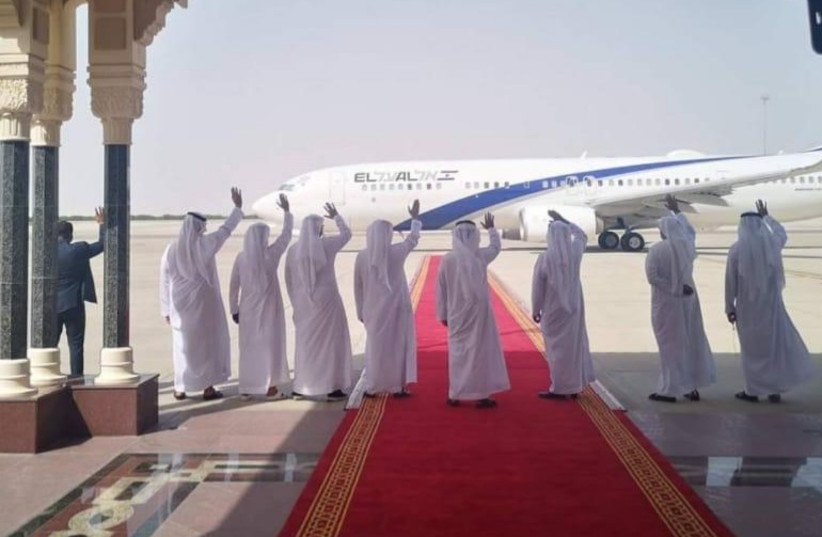
United Arab Emirates delegates wave to the departing El Al plane at the end of IsraelUAE normalization talks in Abu Dhabi on September 1 (photo credit: EL AL)
United Arab Emirates delegates wave to the departing El Al plane at the end of IsraelUAE normalization talks in Abu Dhabi on September 1
(photo credit: EL AL)
Nearly 80% of Saudis are in favor of working towards normalizing ties with Israel within the next five years, with 71% even thinking it likely that other Arab states will normalize ties without a peace deal between Israel and the Palestinians, according to a new poll from Zogby Research Services.

The study surveyed attitudes among Israelis and Arabs from five different countries (Egypt, Saudi Arabia, the United Arab Emirates, Palestine and Jordan) from the period spanning June 24 and July 5. This was over a month before the landmark peace deals between Israel, the UAE and Bahrain were announced, which had resulted in the annexation of 30% of the West Bank, in line with US President Donald Trump’s peace plan, being pulled off the table. As such, annexation remained a real possibility at the time.

What is notable, however, is that the survey still showed that many Arabs were being in favor of normalizing ties with Israel at the time, provided steps were taken to achieve peace with the Palestinians.

Bringing an end to the Israeli-Palestinian conflict was shown to be important for a large majority of both Arab and Israeli respondents (80%) though opinions were divided on how likely a resolution could be achieved within the next five years. As such, it is unsurprising to see that a majority of Arab respondents said normalizing ties with Israel, without there being peace with the Palestinians, was undesirable – with the exception of the UAE where 56% said it was still desirable.

And despite the importance placed on resolving the conflict, a majority of Arab respondents thought that some Arab states were still likely to establish ties with Israel without the conflict ending.

Overall, Arab respondents were more optimistic about how quickly the conflict could be resolved, with the lowest percentages being 53% from Jordan and 57% from “Palestine” and the highest being the UAE with 76%. By comparison, only 15% of Israelis felt the same.

With the exception of Palestinian respondents, 40% from other Arab countries said that Arabs should work to convince Israel of the benefits of resolving the conflict and establish normalized ties with other countries in the region. However, 70% of all Arab respondents did insist that despite the many benefits of normalizing relations with the Jewish state, annexation would mean the end of their support.

THESE STATISTICS were reflected by an opinion piece authored by the Emirati Ambassador to the US in the Israeli newspaper Yediot Aharonot, which warned of the damages of annexation to Israeli-Arab ties while also discussing some of the benefits that could come from warmer relations. The survey found that more Arabs than Israelis were familiar with the article (55% compared to 38%). In addition, while a majority of respondents from Arab states were in favor of the article, a majority of Palestinians were opposed, with Israelis being divided.

But what is arguably most interesting is how the article shifted opinion among some Israeli respondents, with 15% of respondents no longer supporting annexation after reading the article. However, the gap between secular and religious Israelis on the issue remains.

Regarding incentives to normalizing ties with Israel, Arabs were divided on which benefits were the most desirable. The top choice for Emiratis (55%), Saudis (40%) and Jordanians (36%)  is “furthering shared interests around climate change, water and food security, technology and advanced science.” The top choice for Egypt (37%) is “mutually beneficial increases in trade and investment in health care and education.”

Iran was also a notable factor, with “Working together to confront regional challenges from extremism to Iran” being desirable to between 21% and 36% of Arab respondents. About one in five say increasing tourism would be worthwhile to explore if Arab states proceed with normalization. Also notable is the Palestinian response, with the survey showing the same support (34%) for both shared climate, water, food and technology interests as well as seeing nothing of interest.

The findings of the survey contrast with a recent poll published by Mitvim – The Israeli Institute for Regional Foreign Policies. According to that study, the fields of tourism, trade and technology were the most important benefits in fostering ties with the UAE, according to nearly half (44%) of respondents. That was followed by security at 24%, political at 16% and civil at 5%.

Most Israelis (67%) also believe they should form similar deals with other Arab nations, most notably with Saudi Arabia. However, among Arab respondents, nearly half (48%) said Israelis should focus on resolving the conflict with the Palestinians, while only 29% were in favor of new ties with Arab states.

Despite the importance of resolving the Israeli-Palestinian conflict, 40% felt the deal with the UAE did not impact the prospects of achieving peace.

Lahav Harkov contributed to this report.

https://www.jpost.com/arab-israeli-conflict/nearly-80-percent-of-saudis-in-favor-of-normalization-with-israel-poll-645826?fbclid=IwAR2ebz5Smc5gPLfG6Wi-J_nr24mtXZ_4Zo97YSM4kihIM2TC8goDCuNLBCo
