US hits Iran’s entire financial sector with sanctions

Move introduces penalties for non-Iranian institutions that work with banks in the Islamic Republic, effectively cutting them off from the international financial system


Iranians use ATMs of Bank Melli Iran in downtown Tehran, Iran, April 4, 2015. (AP Photo/Vahid Salemi, File)

Iranians use ATMs of Bank Melli Iran in downtown Tehran, Iran, April 4, 2015. (AP Photo/Vahid Salemi, File)

WASHINGTON (AP) — The Trump administration has blacklisted virtually all of Iran’s financial sector, dealing another blow to an economy that is already reeling under US sanctions. The move will deepen tensions with European nations and others over Iran.

Thursday’s move hits 18 Iranian banks that had thus far escaped the bulk of re-imposed US sanctions and, more importantly, subjects foreign, non-Iranian financial institutions to penalties for doing business with them. Thus, it effectively cuts them off from the international financial system.

“Today’s action to identify the financial sector and sanction eighteen major Iranian banks reflects our commitment to stop illicit access to US dollars,” said Treasury Secretary Steven Mnuchin. “Our sanctions programs will continue until Iran stops its support of terrorist activities and ends its nuclear programs. Today’s actions will continue to allow for humanitarian transactions to support the Iranian people.”

The action targets 16 Iranian banks for their role in the country’s financial sector, one bank for being owned or controlled by a another sanctioned Iranian bank and one military-affiliated bank, Treasury said in a statement. Some of them had been covered by previous designations but Thursday’s move places them all under the same authority covering Iran’s entire financial sector.

US Treasury Secretary Steven Mnuchin walks from the office of Senate Majority Leader Mitch McConnell as he leaves the Capitol on September 30, 2020, in Washington. (AP Photo/Manuel Balce Ceneta)

The targeted banks are the Amin Investment Bank, Bank Keshavarzi Iran, Bank Maskan, Bank Refah Kargaran, Bank-e Shahr, Eghtesad Novin Bank, Gharzolhasaneh Resalat Bank, Hekmat Iranian Bank, Iran Zamin Bank, Karafarin Bank, Khavarmianeh Bank, Mehr Iran Credit Union Bank, Pasargad Bank, Saman Bank, Sarmayeh Bank, Tosee Taavon Bank, Tourism Bank and Islamic Regional Cooperation Bank.

Foreign companies that do business with those banks were given 45 days to wind down their operations before facing so-called “secondary sanctions.”

European nations have opposed the blanket financial services blacklisting because it will open up their biggest banks and and other companies to US penalties for conducting business with Iran that had previously been allowed.

Iranian Foreign Minister Mohammed Javad Zarif reacted angrily to the designations, calling them a “crime against humanity” at a time of global crisis. “Amid Covid19 pandemic, U.S. regime wants to blow up our remaining channels to pay for food & medicine,” he said in a tweet. “Iranians WILL survive this latest of cruelties. But conspiring to starve a population is a crime against humanity. Culprits & enablers — who block our money — WILL face justice.”

Iranian Foreign Minister Mohammad Javad Zarif speaks during a press conference with his Iraqi counterpart, Fouad Hussein during his visit to Baghdad, Iraq on July 19, 2020. (AP/Hadi Mizban)

The move comes as the US has stepped up efforts to kill the 2015 Iran nuclear deal that President Donald Trump withdrew from in 2018. Since then, Trump has steadily increased pressure on Iran by imposing sanctions on its oil sales, blacklisting top government officials and killing a top general in an airstrike.

Last month, the administration unilaterally announced that it had restored all international sanctions against Iran that had been eased or lifted under the nuclear deal. And, having been ridiculed by most members of the U.N. Security Council for claiming to have retained the right to restore international sanctions despite no longer being a member of the deal, the administration has continued to seek to boost its leverage with Iran.

While almost the entire rest of the world, which has an interest in preserving the deal, has vowed to ignore those sanctions, violating them will come with significant risk of losing access to the US financial system. Some believe that Thursday’s action could destroy any chance of salvaging the accord by making it impossible for Iranian banks to have any relationships with their foreign counterparts.

People wearing protective face masks to help prevent spread of the coronavirus walk on a sidewalk of a commercial street in Tehran, Iran, September 20, 2020. (AP Photo/Vahid Salemi)

Critics say the sanctions will further cut off Iran’s ability to import humanitarian goods that are especially needed during the coronavirus pandemic, although US officials insist there are carve-outs for legitimate items such as food and medicine. Relief organizations and others, however, say the exemptions still starve the Iranian people of essentials.

Thursday’s decision, which was first reported by The Washington Post, follows months of internal administration debate about the best way to proceed with Iran, particularly as Trump faces a difficult reelection challenge against former Vice President Joe Biden, who has said he wants to return to the nuclear deal.

Until Wednesday, the Treasury Department had opposed the step, arguing that it would adversely affect US relationships with Europe. However, Iran hawks in Congress and outside the government have long sought the cut-off.

https://www.timesofisrael.com/us-to-hit-all-of-irans-financial-sector-with-sanctions/


Statement dispels speculation Damascus is interested in talks with Jerusalem in order to lift US sanctions that shattered its economy


Syrian President Bashar Assad speaks at the presidential palace in Damascus, Syria, Sept. 21, 2016 (Syrian Presidency via AP)

Syrian President Bashar Assad speaks at the presidential palace in Damascus, Syria, Sept. 21, 2016 (Syrian Presidency via AP)

Syrian President Bashar Assad said in an interview with Russian state news Thursday that peace talks with Israel would only take place if the Israelis return the Golan Heights to Syrian control.

In the interview, Assad said that Syria would hold peace talks with Israel only when the Jewish state was ready “to return the occupied Syrian land.”

Israel captured the Golan Heights from Syria during the 1967 Six Day War and the two countries have been technically at war ever since.

Assad’s statements seemingly came in response to recent speculation that Syria is interested in negotiations with Israel in order to alleviate crushing economic sanctions imposed by the United States.

The report by Ibrahim Hamidi, a senior diplomatic editor at the Asharq al-Awsat newspaper and an expert in Syrian affairs, speculated that Syria’s silence on the recent normalization accords between Israel and the United Arab Emirates and Bahrain, along with a delivery of Humanitarian aid from the UAE, indicated Syria was interested in coming to the table in order to appease the Americans.

People stand on top of an old tank near the border with Syria in the Golan Heights on March 23, 2019, across from the Syrian city of Quneitra. (Jalaa Marey/AFP)

Asked about normalization with Israel, Assad said that normalization is possible “only when we can reclaim our land, it is very simple,” he said.

Assad also emphasized in the interview that Syria was not negotiating with Israel.

Israel and Syria have fought three major wars since the establishment of the Jewish state. After the Israeli capture of the Golan Heights in 1967, hypothetical peace agreements between the two nations have been characterized by the Syrian drive to regain control of the territory. Throughout the 1990s talks were held between the Israelis and former Syrian president Hafez Assad that eventually failed.

Since the start of the Syrian civil war in 2011 Israel has launched hundreds of strikes in Syria, targeting government troops, allied Iranian forces, and fighters from the Lebanese Shiite terror group Hezbollah.

Israel rarely confirms details of its operations in Syria, but says Iran’s presence in support of Assad and Hezbollah is a threat and that it will continue its strikes. The raids are coordinated with Russia to avoid a clash between its forces, and cooperation between Moscow and Jerusalem has widely been touted by its leaders as tight, despite Russia’s alliance with Iran, Israel’s enemy, and its occasional condemnations of the Israeli raids.

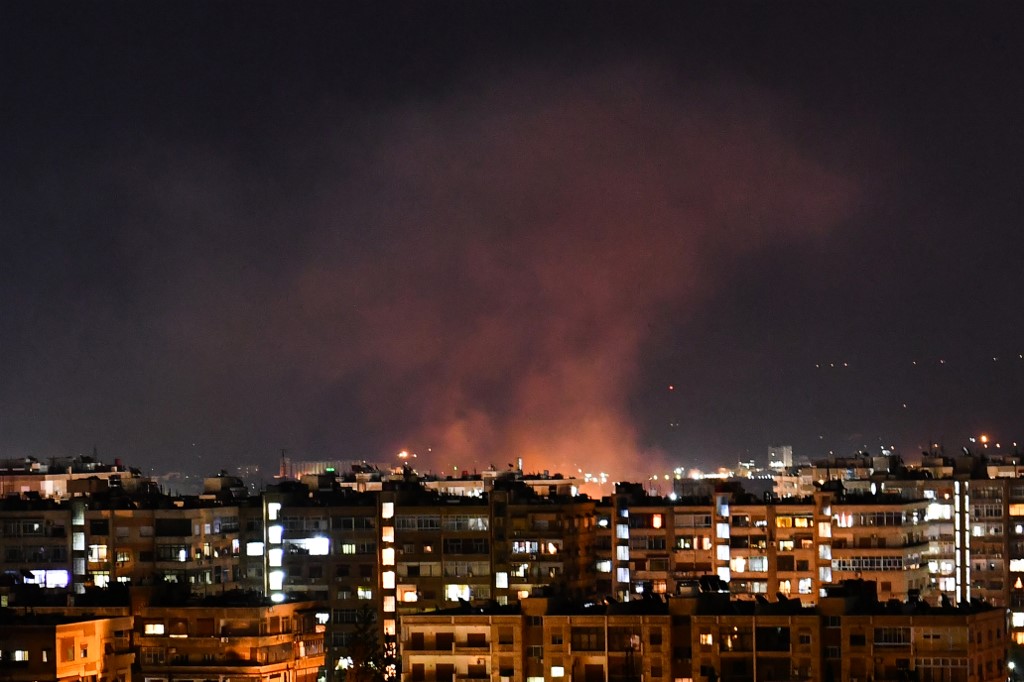
Smoke billows following an alleged Israeli airstrike south of Damascus, Syria, on July 20, 2020 (AFP)

In June, American legislation called the Caesar Syria Civilian Protection Act came into force and represented a vast financial pressure campaign on the Syrian government for its human rights abuses during the Syrian Civil War, in which at least 380,000 people have lost their lives, according to the Syrian opposition.

The first batch of sanctions targeted 39 people or entities, including Assad personally as well as his wife, Asma. It also penalized in the United States any company that did business with Assad.

Fears of action against foreign investors under the Caesar Act have wreaked further havoc on Syria’s shattered economy by dimming hopes for reconstruction.

Agencies contributed to this report. 

https://www.timesofisrael.com/assad-no-talks-with-israel-without-return-of-golan-heights-to-syria/


After UAE, Qatar also submits request for F-35 jets — report

Gulf state’s ties with Hamas could make bid a non-starter for Americans, who are committed to maintaining Israeli military edge in the region

By TOI STAFF
Today, 11:51 pm

US Air Force crew members beside an F-35 Lightning II at the Paris Air Show June 18, 2019. (AP/Michel Euler)

Qatar has reportedly asked the United States to buy advanced F-35 stealth fighters, in another test to America’s commitment to maintaining Israel’s military edge in the region in the face of wealthy Gulf states seeking advanced military hardware.

According to a Wednesday report by Reuters, which cited three people familiar with the matter, the Qataris submitted their request in recent weeks and no American response would be forthcoming until the details were handed over to Congress.
Under US law, Congress is tasked with vetting sales of arms to Middle Eastern countries and weighing them against America’s commitments to Israeli military superiority, with a determination usually made following consultations between the Pentagon and Israeli defense officials. While Israel cannot veto a sale, it can raise concerns that could make it more difficult to seal a deal.

Get The Times of Israel’s Daily Edition by email and never miss our top storiesFREE SIGN UP
The Qatari embassy in Washington did not immediately respond to a request for comment, according to the report.

The US and Qatar enjoy a close military relationship based on their shared animosity toward Iran. The gulf state hosts some 8,000 US military personnel at the Al-Udeid Air Base, the US’s largest in the region.

Despite that relationship, Qatar’s ties with the Palestinian Hamas terror group could mean any request of stealth fighters would be dead on arrival, the report assessed.

The Qatari request comes after reports in September that the US and the United Arab Emirates were likely to seal an arms deal for the sale of the aircraft following the Washington-brokered Abraham Accords between the UAE, Bahrain and Israel.

Since the announcement of the normalization accords, Abu Dhabi has been open about its desire to acquire F-35 warplanes and other advanced US-made weaponry, and senior Emirati officials have also said that ties with Israel should lift any remaining barriers to such a sale.

Prime Minister Benjamin Netanyahu initially said he opposed the sale of the planes to any other nation in the region, even an Arab country at peace with Israel. But since then, he has softened his line, signaling he will trust the US to honor its commitment to ensure Israel’s military edge in the Middle East.

An unsourced Hebrew-language media report last month said Israel hoped to convince the US to “downgrade” the weaponry provided to Abu Dhabi, as preventing a sale altogether was seen as unlikely.

The report further said that with more normalization deals on the horizon between Israel and Arab states following the Abraham Accords, Jerusalem believed the US administration could push for more American weapons deals with regional powers.

In September US President Donald Trump said he has “absolutely no problem” with selling advanced F-35 fighters to the United Arab Emirates and other Gulf states.

“They’re very wealthy countries for the most part. Some are extraordinarily [wealthy] like the UAE, and they would like to buy some fighter jets and I personally would have no problem with it,” Trump said.

Judah Ari Gross and AFP contributed to this report.