
Netanyahu personally okays entry of ‘technical team’; Israel said certain Hamas holding more slain captives, deliberately refusing to return them, expects return of two on Sunday
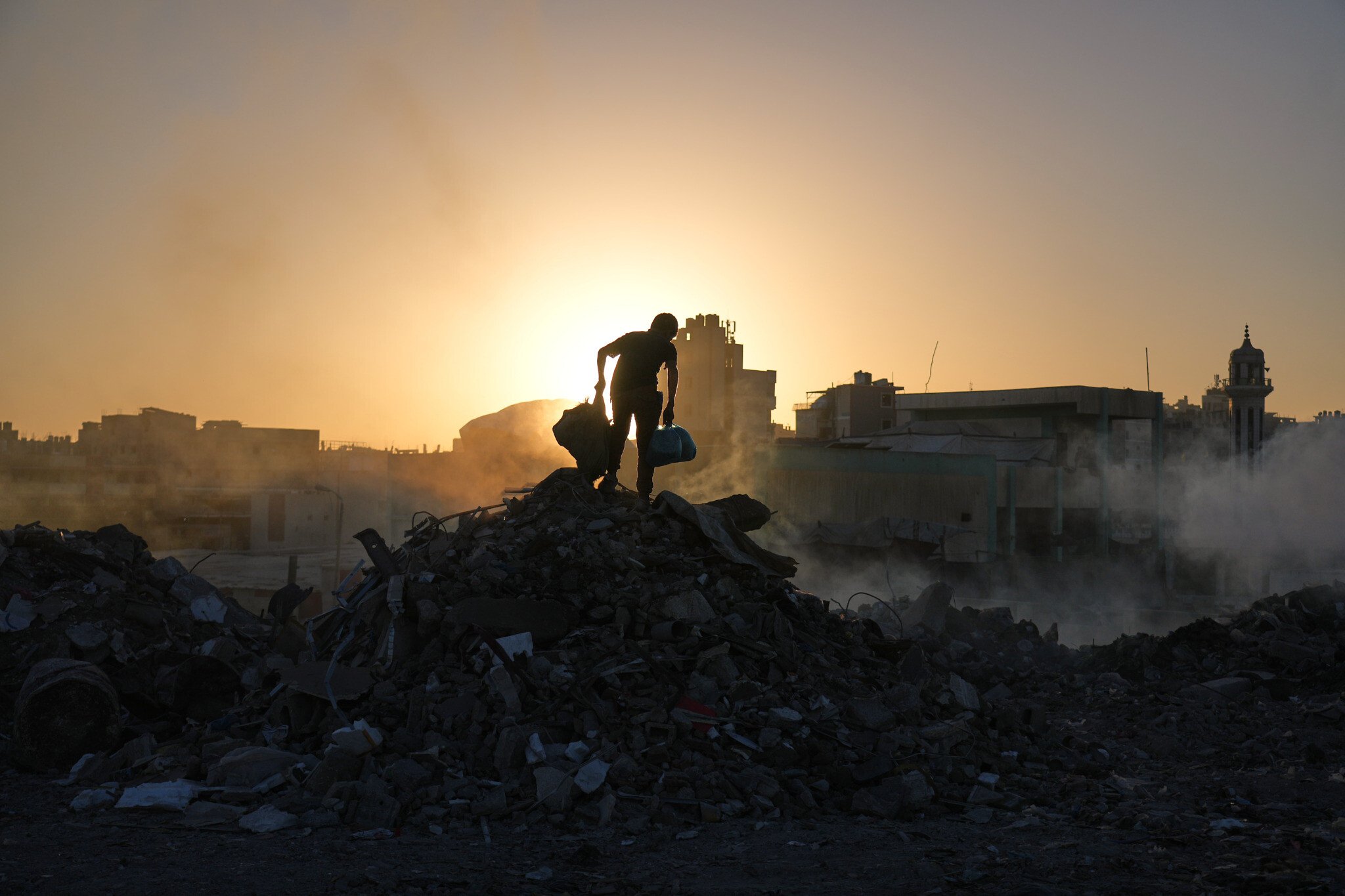
Palestinians search for goods at a landfill in Gaza City, October 25, 2025. (AP Photo/Abdel Kareem Hana)

Palestinians search for goods at a landfill in Gaza City, October 25, 2025. (AP Photo/Abdel Kareem Hana)

As part of the efforts to recover the remaining 13 slain hostages held in Gaza, an Egyptian team has entered the Strip with several engineering vehicles to assist with locating their bodies, an Israeli defense official said Saturday.

The move was personally approved by Prime Minister Benjamin Netanyahu, his office told The Times of Israel.

“It is a technical team,” the PMO said. “They are going in only to locate the slain hostages.”

Information from both Israel and Hamas on the location of dead hostages has been given to the Egyptian team to guide their search, Channel 12 reported.

Until now, Israel had not approved the entry of such teams, claiming that Hamas was capable of finding and returning the bodies itself.

According to Channel 12, Israel knows for certain that Hamas can hand over more bodies of slain hostages but is deliberately refusing to do so, and is also holding back information about their location, in direct breach of the October 9 Israel-Hamas hostage-ceasefire agreement.
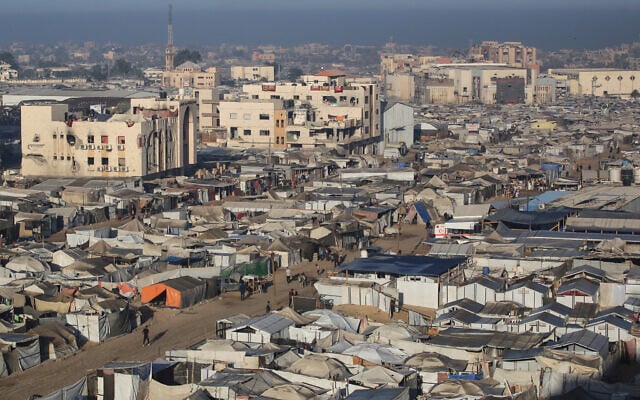
A photograph shows tents at a makeshift displacement camp in the al-Mawasi area of Khan Younis, in the southern Gaza Strip, on October 25, 2025. (BASHAR TALEB / AFP)

Security officials have told families of some slain hostages the general area where the bodies of their loved ones are being held, the TV report said.

Israeli sources told the outlet that they expect Hamas to return two more bodies on Sunday after pressure from mediators, who told the terror group that US President Donald Trump is close to declaring that Hamas is responsible for the collapse of the ceasefire agreement.

According to the network, Israel considered holding up the entry of fuel and food into Gaza in order to pressure Hamas, but senior Trump administration officials who were in Israel over the past week shot down the idea, arguing it could endanger the ceasefire. The Prime Minister’s Office denied this report.

The report on possible sanctions on Hamas came after the Kan public broadcaster reported that Israeli defense officials told US Vice President JD Vance during a meeting Thursday that Hamas could return the bodies of at least 10 of the 13 deceased hostages still held in Gaza.
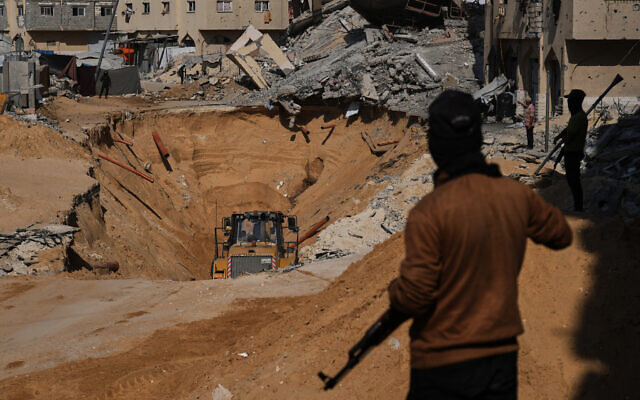
Members of the Hamas terrorist group search underground for the bodies of Israeli hostages amid destroyed buildings in Khan Younis, in the southern Gaza Strip, October 19, 2025. (AP Photo/Abdel Kareem Hana)

According to the Kan report, top Israeli officials presented Vance with the IDF’s intelligence assessment of Gaza and “stated unequivocally” that Hamas is capable of returning at least 10 of the bodies.

Before the ceasefire, Hamas was holding the bodies of 28 dead hostages. It has since returned 15 of them, along with releasing all 20 surviving hostages. The most recent transfer of the remains of two slain captives took place on Tuesday night.



Tehran moves to reassure depositors after Ayandeh Bank collapse, transferring assets to state-owned Bank Melli amid mounting economic pressure and renewed international sanctions.

An Iranian man walks past a branch of the state-owned Melli Bank, which absorbed the assets of the now-defunct Ayandeh Bank, in the capital Tehran on October 25, 2025.
(photo credit: Atta Kenare/AFP via Getty Images)
Iran has declared one of its largest private banks bankrupt and transferred its assets to a state-owned institution, Iranian state media reported on Saturday, in what appears to be a rare financial failure in the heavily sanctioned country.

According to the Turkish daily Türkiye Today, Ayandeh Bank collapsed under mounting debt. The bank, which was established in 2012, operated 270 branches nationwide, including 150 in Tehran. It reportedly accumulated losses of approximately $5.2 billion and had liabilities of some $2.9 billion, the ISNA news agency said.

Long lines formed outside Ayandeh branches in Tehran on Saturday as police were deployed to manage crowds, AFP reported.

 An Iranian woman walks past a branch of the state-owned Melli Bank, which absorbed the assets of the now-defunct Ayandeh Bank, with signage on its facade reading in Farsi ''This former Ayandeh Bank branch is now part of Melli Bank'', in the capital Tehran on October 25, 2025. (credit: Atta Kenare/AFP via Getty Images)
An Iranian woman walks past a branch of the state-owned Melli Bank, which absorbed the assets of the now-defunct Ayandeh Bank, with signage on its facade reading in Farsi ”This former Ayandeh Bank branch is now part of Melli Bank”, in the capital Tehran on October 25, 2025. (credit: Atta Kenare/AFP via Getty Images)

Ayandeh clients ‘have nothing to worry about’

“The transfer from Ayandeh Bank to Bank Melli has now been completed,” said bank director Abolfazl Najjarzadeh in an interview broadcast on Iranian state television. Economy Minister Ali Madanizadeh stated earlier in the week that Ayandeh clients “have nothing to worry about.”

Türkiye Today reported that the bankruptcy comes amid renewed international sanctions against Iran. In September, the United Nations reinstated a series of severe restrictions on Tehran after a prolonged diplomatic deadlock over reviving the 2015 nuclear deal.

The sanctions restored measures that had been suspended under the original 2015 agreement brokered by then-US president Barack Obama, which had offered Iran economic relief in exchange for limits on its nuclear program.

The United States had already reimposed wide-ranging sanctions after then-President Donald Trump withdrew from the deal during his first term, further isolating Iran economically and exacerbating its financial instability.


Trump leads signing of Thailand-Cambodia peace deal

President Trump oversees agreement ending months of border conflict as ASEAN leaders convene in Malaysia for regional and trade talks.

US President Donald Trump on Sunday presided over the signing of a peace agreement between Thailand and Cambodia, marking a key moment in the opening of the ASEAN Summit in Malaysia. The deal, which expands on a ceasefire first brokered by Trump earlier this year, officially ended months of deadly border clashes between the two neighboring countries.

The agreement was signed by Cambodian Prime Minister Hun Manet and Thai Prime Minister Anutin Charnvirakul. It includes provisions for Thailand to release 18 Cambodian soldiers held captive and for both sides to begin withdrawing heavy weapons from the border region. Trump described the occasion as a “momentous day,” saying the ceasefire had quickly stopped severe violence along the frontier.

The initial truce, reached after a five-day exchange of heavy artillery fire in July that left dozens dead and displaced hundreds of thousands, came following direct calls from Trump to the leaders of both nations. The expanded deal signed in Kuala Lumpur cements that ceasefire and lays out mechanisms for future conflict prevention.

Trump was welcomed to Malaysia by Prime Minister Anwar Ibrahim ahead of the summit, where leaders from across Asia and beyond are gathered for two days of high-level discussions. The US president is also scheduled to sign new economic agreements with Thailand and Cambodia, and a separate trade pact with Malaysia later in the day.

Trade issues have featured prominently at the summit, with US and Chinese officials holding talks on the sidelines to de-escalate tensions in their ongoing trade dispute. Trump is also expected to meet with Brazilian President Luiz Inácio Lula da Silva to discuss Washington’s 50% tariffs on Brazilian goods.

The summit also marked a milestone for East Timor, which was officially admitted as the 11th member of the Association of Southeast Asian Nations. Prime Minister Xanana Gusmao hailed the occasion as a “dream realized,” saying the country’s inclusion in the bloc represented a new beginning for the young nation.

Malaysian Prime Minister Anwar Ibrahim called East Timor’s entry the completion of the ASEAN family, affirming the bloc’s commitment to shared prosperity and regional u