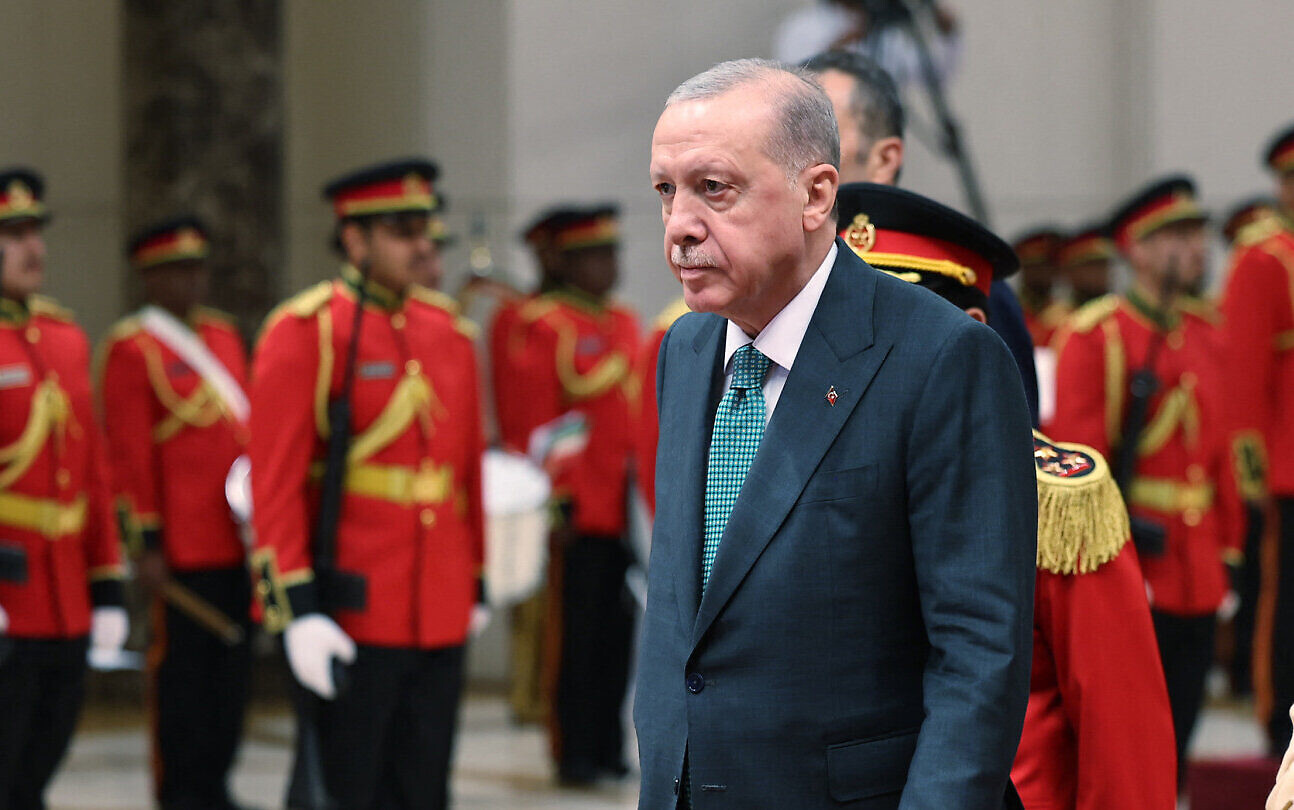
This handout photograph taken and released by Turkish Presidency Press Office on October 21, 2025, shows Turkey’s President Recep Tayyip Erdogan during a welcoming ceremony in Kuwait City (Handout / Turkish Presidency Press Office / AFP)
ANKARA — Turkish President Tayyip Erdogan said the United States and others must do more to push Israel to stop what he said were violations of the Gaza ceasefire agreement, including the possible use of sanctions or halting of arms sales.
NATO member Turkey, one of the most vocal critics of Israel’s campaign in Gaza, has joined the ceasefire negotiations as a mediator after largely indirect involvement. Its increased role followed a meeting last month between Erdogan and US President Donald Trump at the White House.
Israel has been very wary of the involvement of Turkey and its leader Erdogan, who has compared Israel throughout the war to Nazi Germany, repeatedly accused it of genocide and embraced the Hamas terror group as freedom fighters.
“As Turkey, we are doing our utmost for the ceasefire to be secured. The Hamas side is abiding by the ceasefire. In fact, it is openly stating its commitment to this. Israel, meanwhile, is continuing to violate the ceasefire,” Erdogan told reporters on his return flight from a regional Gulf tour.
“The international community, namely the United States, must do more to ensure Israel’s full compliance with the ceasefire and agreement,” he said, according to a transcript of his comments shared by his office on Friday.
“Israel must be forced to keep its promises via sanctions, halting of arms sales.”
Ankara has said that it would join a “task force” to oversee the implementation of the ceasefire, that its armed forces could serve in a military or civilian capacity as needed, and that it would play an active role in the reconstruction of the enclave.
Israel is strongly opposed to close Turkish involvement in Gaza, while Trump has pushed for Ankara’s inclusion.
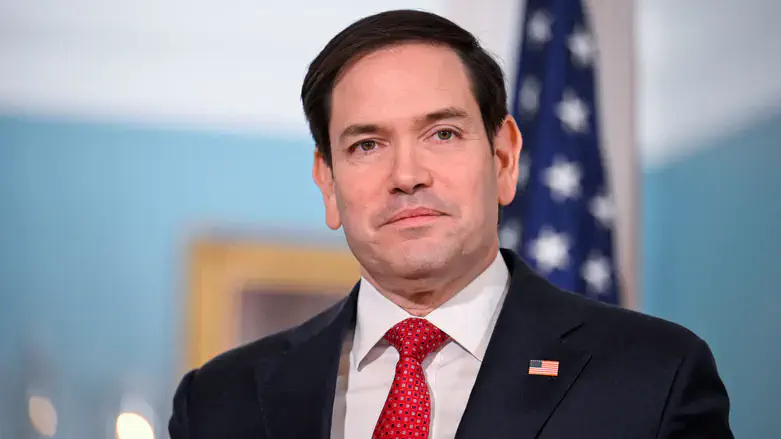
US Secretary of State Marco Rubio, on a visit to Israel aimed at shoring up the ceasefire, said on Friday that a planned international security force for Gaza would have to be made up of “countries that Israel’s comfortable with,” but declined to comment specifically on Turkey’s involvement.
Erdogan said talks on the issue were still underway.
“Talks are continuing on the task force that will work in Gaza. The modalities of this are not yet clear. As this is a multifaceted issue, there are comprehensive negotiations. We are ready to provide Gaza with any form of support on this issue,” he said.
He also reiterated a previous call for Gulf countries to take action now on financing efforts to rebuild Gaza, saying nobody could single-handedly complete this task.
Tehran has prided itself on ‘strategic patience’ in confronting enemies, but now that policy has slipped into paralysis as it reels from Israel war, resumption of sanctions
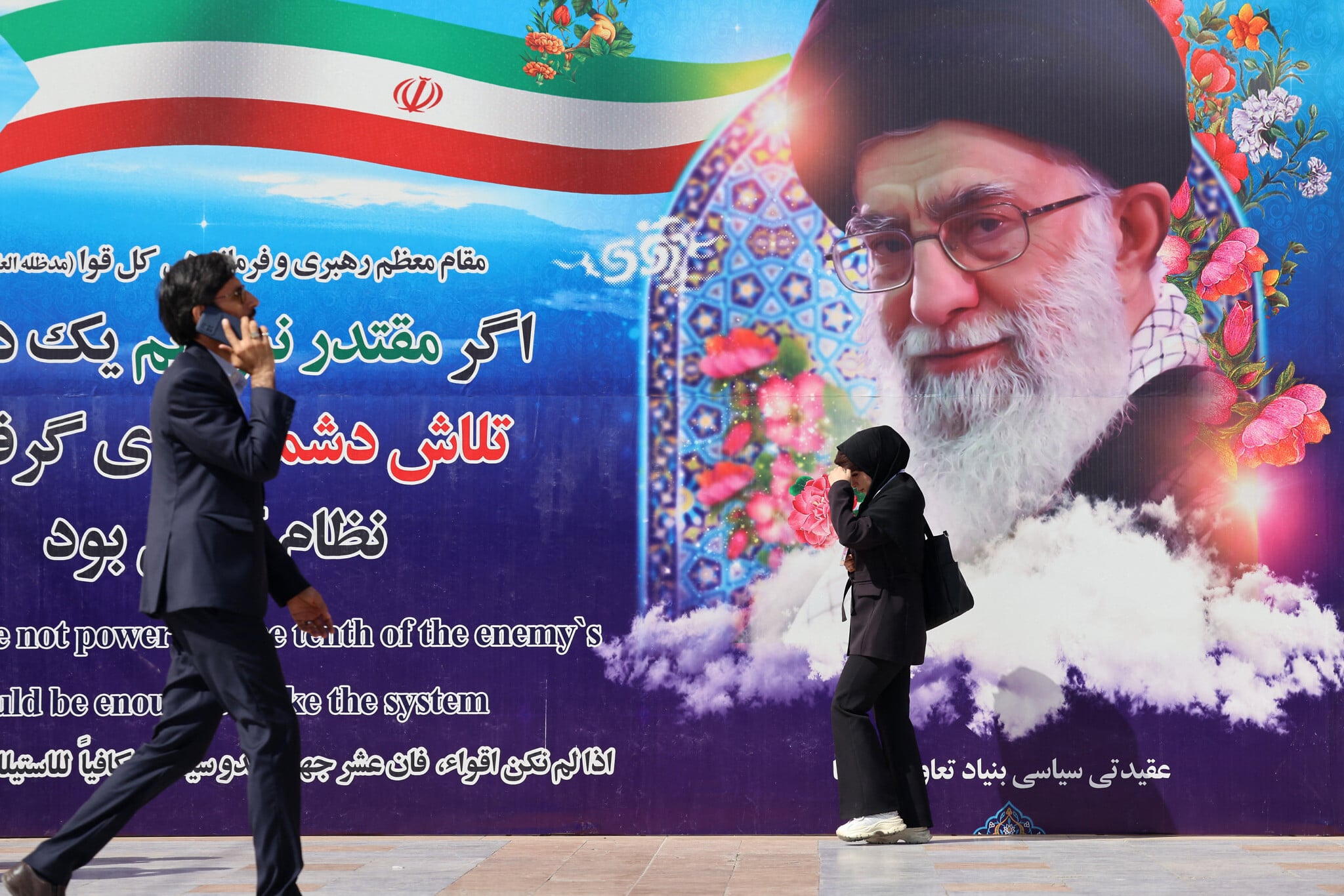
Iranians walk past a poster featuring Iran’s Supreme Leader Ayatollah Ali Khamenei outside the venue of the 22nd Police and Security Equipment Exhibition at Imam Khomeini Mosque in Tehran on October 15, 2025. (Photo by ATTA KENARE / AFP)
DUBAI, United Arab Emirates (AP) — Iran has been bombed and has seen United Nations sanctions reimposed and its economy collapse further into the red this year. But its theocracy so far hasn’t taken any major action to halt the slide, restart crucial nuclear negotiations with the West nor fully prepare for possible further hostilities with Israel and the United States.
In the past, Iran’s 86-year-old Supreme Leader Ayatollah Ali Khamenei heralded the benefit of Tehran’s “strategic patience” in confronting its enemies. Now, however, concern is growing that patience has slipped into paralysis as Iran’s partners in its self-described “Axis of Resistance” have been devastated and there’s no overt sign of materiel support from either China or Russia.
“One of the harms and dangers facing the country is precisely this state of neither war nor peace, which isn’t good,” Khamenei himself warned in September.
But there’s been no move to change that calculus, as Iranians themselves remain fearful of war resuming. Each fire or industrial accident becomes grist for new worry as they watch their life savings further dwindle as Iran’s rial currency falls to historic lows against the US dollar.
“Even if we accept that the possibility of a second war exists, the right approach to governing the country is not to keep public opinion in constant anxiety through recurring alerts every few days,” said Ali Abdullah Khani, an analyst with Iran’s Presidential Strategic Affairs Office, in an interview published in October by the website NourNews.
“Such a policy places the nation in a permanent state of crisis — a condition in which it always seems that war could break out at any moment, and as a result, all managerial and political capacities are consumed by confronting a presumed and hypothetical conflict.”
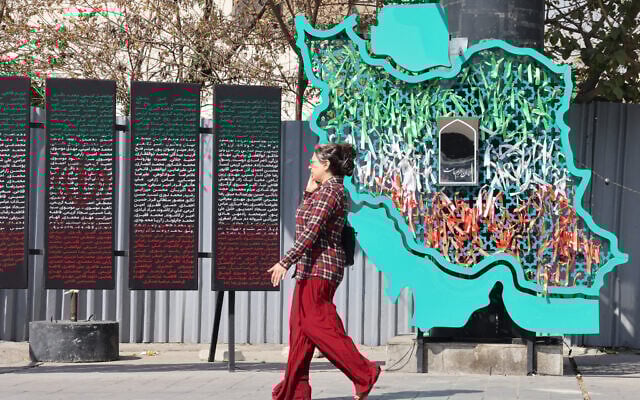
An Iranian woman walks past a map of Iran in Tehran on October 13, 2025. (ATTA KENARE / AFP)
Iran tries to talk sanctions away
The United Nations reimposed sanctions on Iran last month, but Tehran has sought to downplay their effect or even insist they don’t exist. The sanctions date from Tehran’s 2015 nuclear deal and were reimposed by a mechanism known to diplomats as “snapback.” China, Iran and Russia issued a tripartite statement over the weekend, decrying them as “legally and procedurally flawed.”
But while China and Russia have signaled they won’t enforce the sanctions, the US, European nations and others are doing so.
Some of the measures are pretty out of date — for instance, sanctions on Iranian Revolutionary Guard Gen. Qassem Soleimani, who was killed in a US drone strike in Baghdad during President Donald Trump’s first term in 2020.
But the main ones squeeze Iran’s Central Bank and its oil exports, one of the few sources of hard currency for the government. That could allow for the seizure of Iranian crude oil shipments on the seas, something that in the past has sparked confrontations with Tehran.
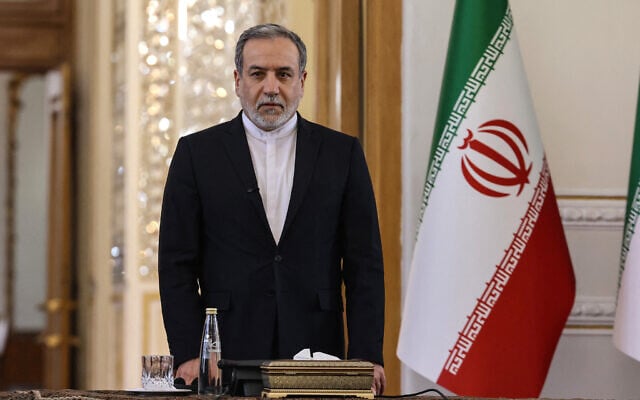
Iranian Foreign Minister Abbas Araghchi addresses foreign ambassadors to Iran, in Tehran on October 5, 2025. (ATTA KENARE / AFP)
Iranian government at odds
The June war saw Israel kill top leadership in Iran’s regular military and its paramilitary Revolutionary Guard, a force answerable only to Khamenei that controls its own arsenal of ballistic missiles. In the time since, Iran has held no major military parades and conducted only limited drills at sea — likely out of the concern of providing Israel with any tempting targets.
Criticism is slowly rising to the surface of Iran’s theocracy, which under Khamenei has grown into various competing camps and agencies often tasked with the same missions.
Ali Shamkhani, a top adviser to Khamenei who survived an Israeli attack targeting him during the war, said in an online video that Iran’s earlier attacks against Israel in 2024 “did not achieve the outcomes” sought by Tehran — a rare acknowledgment by a senior official of the low accuracy plaguing the theocracy’s vaunted missile arsenal.
He also even went as far as to openly muse about Iran pursuing a nuclear weapon — something Tehran long has insisted it doesn’t want to do despite the West and the International Atomic Energy Agency saying the Islamic Republic had an organized weapons program up until 2003.
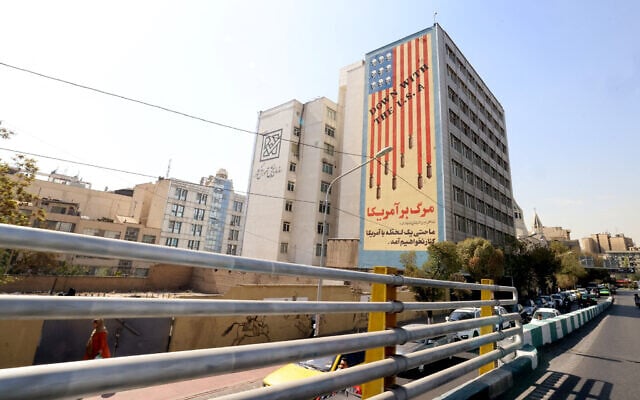
Commuteres drive past a building with an anti-US mural with the slogan “Down with the USA” and skulls replacing the stars on the flag, in Tehran on October 13, 2025. (ATTA KENARE / AFP)
“Now that it has become clear, Iran should have developed this capability for itself,” Shamkhani said.
After the interview, Shamkhani found himself targeted by the leak of a video from his daughter’s wedding, in which she was unveiled and wearing a wedding dress with a plunging neckline — something criticized by hardliners who have been calling for a new campaign targeting women over the mandatory hijab, or headscarf.
Former president Hassan Rouhani, who reached the 2015 nuclear deal, meanwhile has stepped up his criticism of hardliners and sought to organize his fellow Shiite clerics in Qom, the Iranian seminary city. Executions are also now at a decades-long high.
The theocracy, meanwhile, has largely been mute about the economic turmoil, sparked by exchange rate pressure, loose fiscal policies and sanctions, the International Monetary Fund said this week. The IMF estimates annual inflation in Iran to be 45 percent by the end of the year, further eating into people’s already-shriveled savings.
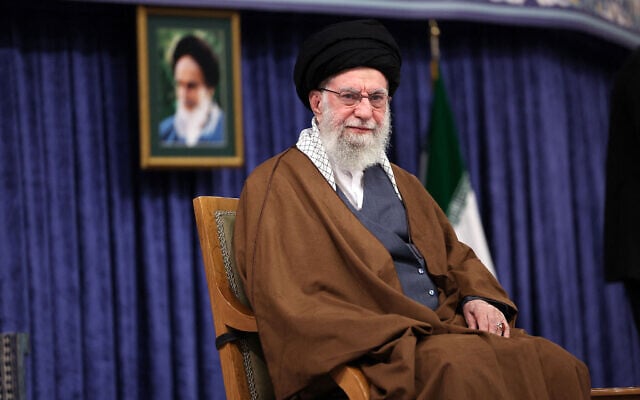
A handout picture provided by the office of Iran’s Supreme Leader Ayatollah Ali Khamenei shows him addressing a meeting with local champions and medalists of sports and world science awards in Tehran on October 20, 2025. (KHAMENEI.IR / AFP)
Supreme leader halts talks with West
Then there is Khamenei himself, with no clear front-runner to succeed him. His profile has dropped since the war, with more delays surrounding the release of his remarks — likely again a security measure against possibly being targeted by Israel.
Yet at a moment when talks with the US and the Europeans represent one path out of Iran’s issues, he’s been adamant that negotiations can’t be held. He gave a speech as both Iranian President Masoud Pezeshkian and Foreign Minister Abbas Araghchi went to New York for the UN General Assembly, which had the effect of stopping them from having direct negotiations.
“Once a decision is made, everyone must follow it — whether they support it or not,” Araghchi told the state-run IRNA news agency in August, before the summit.
Speaking to athletes on Monday, Khamenei kept up his criticism of the US president and insisted Iran “will not submit to coercion.”
Trump “prides himself on ‘bombing and destroying Iran’s nuclear industry,’” Khamenei said. “Fine — keep dreaming.”
But for now, it doesn’t appear time is on Iran’s side.
Ahead of Israel visit, Secretary of State warns that Israel’s sovereignty bill, approved in a preliminary reading by the Knesset, endangers Trump’s Gaza peace plan.
US Secretary of State Marco Rubio said on Wednesday night that the bill approved by the Knesset to apply sovereignty in Judea and Samaria would threaten President Donald Trump’s plan to end the war in Gaza.
The bill in question was approved in a preliminary reading by a majority of one vote.
25 Knesset members voted for the bill and 24 voted against. Knesset members from the Likud either abstained or were absent from the vote, and the only party member to vote yes, despite a directive from Prime Minister Benjamin Netanyahu, was MK Yuli Edelstein.
MKs Yitzchak Goldknopf, Yisrael Eichler, and Yaakov Tesler from United Torah Judaism also voted in favor of the bill. The Blue and White and Shas parties, like the Likud, were absent from the plenum during the vote.
In addition, a bill proposed by Yisrael Beytenu chairman MK Avigdor Liberman to apply sovereignty over the city of Maale Adumim passed 32-9.
Trump has previously declared his opposition to an Israeli move to apply sovereignty over Judea and Samaria, telling a reporter last month that he will “not allow” Israel to carry out such a move.
Rubio, who is set to arrive in Israel on Thursday, also said that nations beyond the Middle East are prepared to participate in an international force for Gaza, as stipulated in Trump’s peace plan.
The State Department, announcing Rubio’s trip earlier on Wednesday, said the Secretary of State will be in Israel until Saturday, before visiting Malaysia, Japan and South Korea.
The statement added that Rubio will be traveling to Israel “to support the successful implementation of President Trump’s Comprehensive Plan to End the Conflict in Gaza, which has garnered unprecedented international support.”
“During his visit, the secretary will reaffirm America’s unwavering commitment to Israel’s security and engage with partners to build on the historic momentum towards durable peace and integration in the Middle East,” it added.
Rubio’s arrival in Israel will follow the visit by US Vice President JD Vance, who arrived in Israel after Trump’s envoys Steve Witkoff and Jared Kushner also visited this week.
“If Hamas doesn’t cooperate, then as the President of the United States has said, Hamas is going to be obliterated,” Vance said, though he refused to set a timetable for Hamas to cooperate.